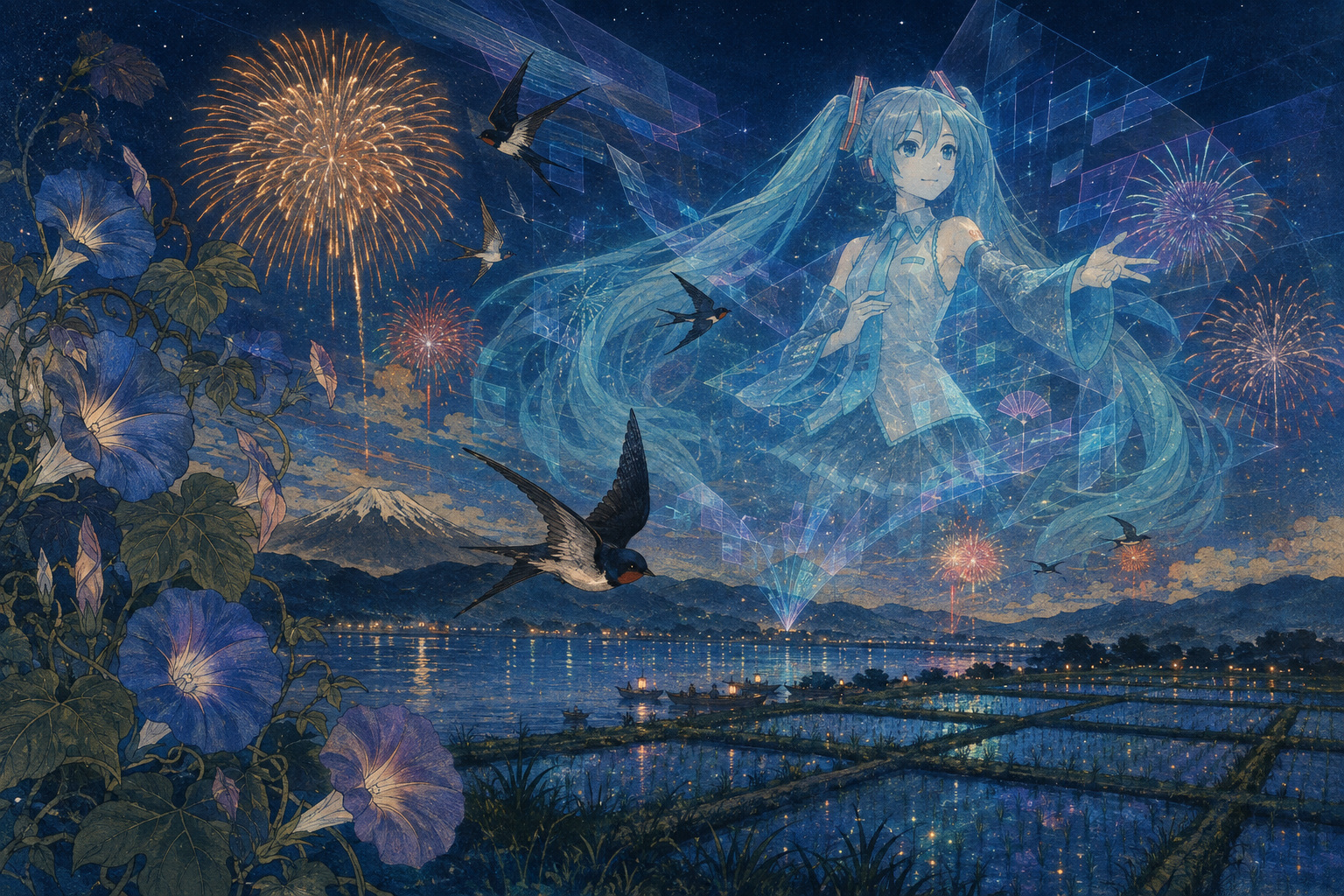
A firework is almost brutally public. Once the shell breaks, everyone beneath it receives the same white flash, the same expanding chrysanthemum and the same delayed concussion. Augmented reality changes that ancient bargain. The sky remains shared, but part of the show exists only for people looking through a particular pane of glass.
That is the experiment coming to Niigata on September 21. Physical fireworks will rise over the city while Hatsune Miku—turquoise twin-tails, impossible voice, no fixed human body—appears in transparent smart glasses, timed to music and the pyrotechnic sequence. Remove the glasses and Miku disappears; the fireworks do not.
Gugenka, the Niigata-based extended-reality company organizing the event with Niigata Nippo and cooperation from Crypton Future Media, calls the program a fusion of the “night sky” and a “festival.” It is both a performance and a useful question. Can a crowd still experience a common spectacle when software gives some spectators an additional, personalized layer?
What Will Actually Happen
The main base is Niigata Nippo Media Ship, a glass high-rise at 3-1-1 Bandai in Chūō Ward. The opening-night attraction is a special AR music-fireworks show built around “Bloom Out,” composed by emon(Tes.) and sung with Hatsune Miku. Tickets went on sale at noon on August 5.
For the limited on-site presentation, the first 200 participants are to wear XREAL One-series optical see-through glasses. The lenses allow the real night sky to remain visible while digital imagery is placed in the wearer’s field of view. Gugenka and XREAL say Miku’s dance will be fully synchronized with the music fireworks. That is a forward-looking production claim, not yet an independently observed result.
The distinction matters. This is not a giant Miku projected onto smoke, a drone figure visible across the city or a conventional stage image reflected on a transparent screen. Her AR body is rendered by the viewing device. The physical burst is common to the riverside; the virtual performer depends on a ticket, hardware, tracking and calibration.
A special livestream through ZAIKO is also on sale, with archive viewing planned from the following day. The viewing logic there is different again: the production can composite or frame digital and physical elements for a flat screen. A viewer at home, a glasses wearer at the site and a passerby watching unaided may therefore encounter three legitimate but non-identical versions of the same timed work.
| Layer | What the audience receives | What can vary |
|---|---|---|
| Physical fireworks | Light, smoke, color and sound in the real sky | Weather, sightline, distance and sound delay |
| Smart-glasses AR | Miku and digital effects overlaid on the sky | Fit, brightness, tracking, calibration and field of view |
| Online stream | A camera-directed combination on a conventional screen | Encoding delay, edit, connection and display quality |
| Venue MR | Spatial video, figures and an interactive fictional world | Device, software and the degree of interaction |
AR, MR—and a Vocabulary Still in Motion
Augmented reality usually means digital information laid over the user’s view of the physical world. Mixed reality is often used for a more spatially aware version: virtual objects seem anchored to a room, surface or location and may respond to the viewer. In commercial language the boundary is porous. The useful questions are less about labels than about what the device can see, where the image is anchored and how the visitor can act upon it.
On September 22 and 23, the event plans a “Spatial Disc / HoloModels experience powered by XREAL.” Visitors using XREAL’s xbx a01+ glasses and smartphones are to encounter spatial video and digital figures. Song and operating details were still to be announced at publication.
A separate VR/MR attraction, “Taishō 100-Year Imperial Capital Oukyo,” draws on the fictional world associated with the novel version of “Senbonzakura.” Alternate versions of Hatsune Miku and KAITO guide visitors through a story that crosses ordinary and imagined space. Calling all of these things “a hologram” would flatten meaningful technical differences: a phone screen, a head-worn see-through display and an enclosed virtual environment do not produce the same perception.
The City Continues Inside the Screen
The project does not end at the fireworks. A virtual Niigata world is due to open September 1. Its announced experiences include a boat date with Miku on the Shinano River, a brief performance of the theme song and, in a later update, an hourly live near Bandai Bridge.
A digital “Piapro Wall” is intended to connect drawings created online with a physical display at Media Ship. Paid support can unlock versions of Miku associated with earlier years. This makes the event less like a single concert and more like a circuit: river, building, smart glasses, phone, computer and fan art feed one another.
The route is geographically specific. Bandai Bridge is not decorative background but one of Niigata City’s defining structures, spanning Japan’s longest river near its mouth. Media Ship stands close to that waterfront. In the virtual world, familiar civic landmarks become a stage; at the venue, an imagined performer directs attention back to the real city.
How Miku Became a Place for Other People’s Songs
Hatsune Miku began not as a television heroine or a recording artist under contract, but as a software instrument. Crypton Future Media released the Japanese singing-voice library on August 31, 2007 for Yamaha’s VOCALOID2 engine. A user typed melody and lyrics; the software assembled a sung line from recordings of voice actor Saki Fujita. Illustrator KEI gave the package its now-famous turquoise-haired character.
The timing was decisive. Yamaha researcher Hideki Kenmochi has recalled a flood of VOCALOID videos appearing immediately after release and argued that a one-year shift in the rise of video-sharing culture might have changed the outcome. Nico Nico Douga gave composers a stage, illustrators supplied images, lyricists and animators answered, and listeners remixed, commented and circulated the results.
Miku therefore became famous through a reversal. In the conventional music industry, a singer’s identity gathers songs around one biography and one body. Miku offered a recognizable voice and image first, then allowed thousands of creators to fill that frame with incompatible feelings and genres. She can be naïve in one song, furious in another, a machine in a third and a historical fantasy in a fourth.
Crypton supported that participatory culture with Piapro and licensing rules. The company announced its Piapro Character License in 2009 and later made its original character illustrations available internationally under a noncommercial Creative Commons license. That does not make every Miku song, video or derivative image free to reuse—each creator retains rights in what they add—but it created a clearer channel for fan production.
Crypton’s official profile now describes more than 100,000 released songs, 170,000 YouTube uploads and one million artworks. Those are company counts rather than a complete census, but they explain why it is misleading to call Miku simply a singer. She is software, character, interface, license, archive and meeting point.
2003 Yamaha launches the first VOCALOID engine.
August 31, 2007 Crypton releases Hatsune Miku for VOCALOID2.
2009 Crypton announces the Piapro Character License.
2010 The “Miku no Hi Kanshasai 39’s Giving Day” concert helps establish her large-screen live format.
2013 The English voice library arrives; the first Niigata Yozora Program follows a decade later.
2026 Hatsune Miku V6 launches, while Niigata prepares the fourth Yozora Program.
Why Fireworks Are More Than a Backdrop
Japanese fireworks carry their own history of mediation between craft, mourning and mass entertainment. The recorded ancestry of Tokyo’s Sumida River festival reaches 1733, when the shogunate held a water-god observance and made offerings for victims of the Kyōhō famine and epidemic disease. Restaurants financed fireworks near Ryōgoku Bridge. Early displays were small and largely orange; later rivalry between the Kagiya and Tamaya houses became legend.
The familiar cry “Tamaya!” or “Kagiya!” was once a public judgment shouted toward competing makers. The star of the show was never only the chemical burst. It was also the named craftsperson behind a precisely timed transformation of powder, paper and air.
Modern Japanese shells developed formal geometries—chrysanthemum, peony, willow—whose stars must ignite evenly as the casing ruptures. The image lasts seconds, yet it is designed from the center outward. That combination of strict construction and disappearance made fireworks a natural emblem of summer, impermanence and collective memory.
Niigata has an especially powerful fireworks identity, but geography must be respected. Nagaoka’s memorial fireworks belong to Nagaoka City and a history of war remembrance; the Yozora Program is in Niigata City. Here, the relevant urban axis is the Shinano River and Bandai district. In 2023 the first Yozora event joined the Niigata Festival fireworks between the Shōwa and Yachiyo bridge area.
The 2023 Prototype
That first event, held August 4–6, 2023, supplied the proof of concept. Spectators could point smartphones loaded with Gugenka’s HoloModels app at the fireworks and watch Miku dance to “Senbonzakura.” The company estimated more than 10,000 AR participants; it cited Niigata City’s figure of 320,000 fireworks spectators overall. Those measures describe different populations and should not be combined.
The early version was deliberately accessible: a phone rather than specialized glasses. It also revealed the challenge. A hand-held screen turns a viewer into a camera operator. The person must frame the sky, keep the virtual figure in place and divide attention between direct sight and display.
In 2025, the program moved to Suntopia World in Agano City. Gugenka reported about 2,300 people at the physical venue and roughly 20,000 visits to a VRChat world over six days. The virtual extension included a ferris-wheel date and was prolonged after demand. The project was learning that “attendance” no longer describes one gate.
The 2026 smart-glasses plan attempts to return the eyes to the horizon. Hands can remain down and the real scene can fill peripheral vision. Yet the upgrade also narrows access: only the announced first 200 can use the glasses, while everyone else must use another channel or see the fireworks without that digital layer.
Synchronization Is the Hard Part
A good firework sequence is already a problem in choreography. Shells have different ascent times, burst diameters and persistence. Sound arrives later than light—roughly three seconds for every kilometer—so a spectator’s distance changes the felt relationship between the visible burst, the report and the soundtrack.
AR adds clocks. The pyrotechnic firing controller, music playback, animation timeline, glasses, tracking system and any networked cue must agree closely enough that a virtual gesture appears intentional. A few hundred milliseconds can turn a beat into a stumble. The organizers have not published a technical architecture or measured latency, so the promised synchronization should be judged after the performance.
Brightness presents another problem. Fireworks are intense points against darkness; optical see-through graphics must remain visible without blotting out the sky. Glasses fit differently over faces and prescription eyewear. Tracking may drift when the visual field lacks stable landmarks. Smoke and wind can alter contrast. These are not reasons the project cannot work. They are the material conditions of digital stagecraft outdoors.
- The final start time, viewing area, check-in rules and age or equipment restrictions.
- How the first-200 glasses allocation works and whether advance reservation guarantees a device.
- Weather, cancellation and refund terms for fireworks and the stream.
- Accessibility for prescription-glasses users, people sensitive to flashes or loud sound, and visitors with limited mobility.
- Phone, account, battery or app requirements for the virtual world and other experiences.
A Festival With Unequal Skies
There is an unavoidable politics to augmented public space. A conventional firework can be seen from a bridge, apartment window or distant embankment without a software account. A premium layer may be limited by price, device supply, eyesight, language, comfort or technical literacy. When the scarce layer carries the headline character, those without it can feel that the “real” event is happening elsewhere.
The project partly answers this through multiple entry points: unaided fireworks, livestream, smartphone content, venue installations and a virtual world. But multiplication is not the same as equivalence. Organizers should state clearly what each ticket includes and resist implying that every audience sees the same composition.
Privacy also belongs in the design. Head-worn devices can contain cameras and spatial sensors. Clear notice is needed about whether images or movement data are recorded, processed locally or retained. The releases name the hardware but do not provide a complete public data-flow explanation for this event.
The Meaning of a Virtual Performer Under a Real Sky
Miku is unusually suited to AR because she has never depended on one physical body. Her “presence” has always been assembled at the point of use: a producer tunes phonemes into a voice, an illustrator gives the voice a face, an animator gives the face movement, and an audience completes the performer by agreeing to perceive her.
Fireworks work in the opposite direction. Their physics is non-negotiable. Gravity, wind, combustion and distance determine what happens after ignition. The Niigata show places a mutable, copyable character beside an irreversible event. One can be replayed and reskinned; the other consumes itself in the act of appearing.
That contrast may be the program’s strongest artistic resource. The technology will date. Today’s glasses will eventually look as historical as early monochrome fireworks or 2010-era concert screens. The social invention may last longer: a festival can contain several overlapping publics, linked by timing and place even when their images differ.
On September 21, if weather and machinery cooperate, the Shinano River sky will hold two performances. One will be visible to anyone who looks up. The other will arrive through code, optics and the labor of many creators. Hatsune Miku has always lived in that second route. Niigata’s wager is that, for a few synchronized minutes, both skies can feel like one.
Reporting notes and principal sources
Future-event details are based on organizer and equipment-partner announcements published August 5, 2026. Capacity, synchronization and attendance figures are attributed because they have not been independently verified. Technical and accessibility details not yet announced are identified as open questions.
- Gugenka: full Hatsune Miku Yozora Program 2026 announcement
- XREAL Japan: smart-glasses and spatial-experience announcement
- Hatsune Miku Yozora Program: official event site
- Gugenka: 2026 dates and “Nijigate” preview announcement
- Gugenka: 2023 event results and participation estimates
- Gugenka: 2025 physical and VRChat attendance claims
- Crypton Future Media: official Hatsune Miku profile
- Piapro: character licensing and creator-use rules
- Yamaha: VOCALOID development and Miku’s role
- Yamaha: Hideki Kenmochi on the 2007 release and video-sharing culture
- Japan Search / National Diet Library: the 1733 Ryōgoku fireworks
- Niigata City: Shinano River and Niigata Festival fireworks