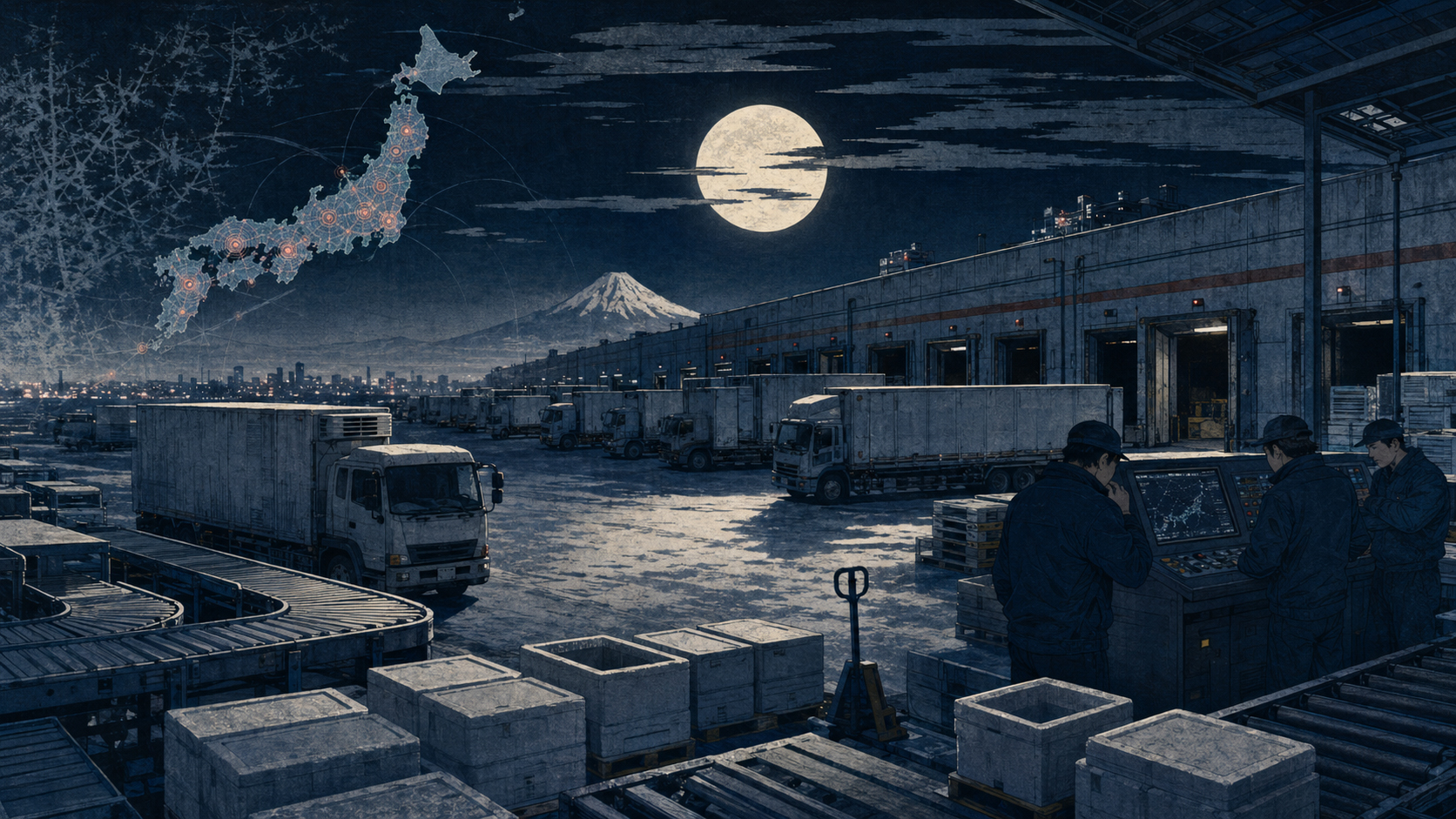
The food had not vanished. The freezers, Japan’s roads and restaurant fryers had not all broken. Yet in mid-July, digital ordering stopped across KFC Japan, some stores shortened their hours, and selected products disappeared from supermarket and Don Quijote shelves. The missing link was information: a trusted instruction identifying what to move, for whom, from which lot, at what temperature and to which destination.
Nichirei issued its first notice on July 13. Unauthorized access had caused system failures affecting inbound and outbound work at Nichirei Logistics Group refrigerated warehouses and frozen-food shipments by Nichirei Foods. The disclosed disruption was limited to Japan; the company said it had received no report of a corresponding overseas failure.
In a July 16 investor disclosure, Nichirei said its investigation had confirmed a cyberattack on company servers. It established an emergency response headquarters on the day the incident was discovered and isolated group systems, prioritizing protection of customer data and personal information. The interruption was therefore not merely a machine failing under attack. It also reflected a deliberate containment decision designed to prevent wider harm.
Nichirei said it would apply safeguards with an outside security specialist and begin restarting the affected warehouse and shipment operations sequentially from July 17. It did not give a date for complete normalization. Because some affected servers held personal information, the company submitted an initial report to Japan’s Personal Information Protection Commission describing a possible leak. It did not say a leak had been confirmed.
The attack type, entry path, attacker and any encryption or ransom demand remain undisclosed. Calling the incident ransomware would therefore be speculation. So would reporting that all systems were fully restored on July 17, that personal data had definitely escaped, or that every named retailer suffered the same loss.
July 13 to July 17: four days of expanding consequences
| Time | What was established |
|---|---|
| About 6:50 a.m., July 13 | TV Asahi reported that Nichirei’s systems team flagged the failure. Nichirei created an emergency response headquarters and isolated group systems. Refrigerated receiving, dispatch and frozen-food shipments were affected. |
| July 13 | Nichirei’s first notice described unauthorized access, a domestic operational impact and no restoration date. At that stage, it said no external release of customer or personal data had been confirmed. |
| July 14–15 | KFC said deliveries could not be made as ordered and that inventory could force shorter hours, menu suspensions or temporary closure at individual stores. Digital ordering and delivery functions stopped. Selected shortages and delays emerged in retail and restaurants. |
| July 16 | Nichirei confirmed a cyberattack, disclosed the possible-personal-data report and announced a safeguarded, sequential resumption beginning July 17. |
| 10:37 a.m., July 17 | JAPAN.co.jp cutoff. A staged restart was planned; complete normalization, attack mechanics, data loss and financial impact remained unresolved. |
KFC, supermarkets and Don Quijote: one failure, uneven effects
KFC Japan’s official notice identifies Nichirei Logistics Group as its contracted logistics provider and lists all KFC stores as potentially affected. That did not mean every store closed. It meant deliveries due from July 14 could not be made according to order and that the outcome at each store would depend on its remaining inventory. KFC warned of shorter hours, suspension of selected items or temporary closure. Coupons, mobile orders, KFC delivery and third-party delivery ordering were also temporarily stopped.
TV Asahi reported shortages of some products, including frozen goods, at Aeon. Aeon’s online supermarket warned that frozen food, ice cream, prepared dishes and sushi could be unavailable or suspended, though attribution of every affected category to the Nichirei incident was still being examined. York Benimaru reported some delayed distribution and shortages of selected frozen items.
ANN affiliate reporting said that Don Quijote used Nichirei Logistics for delivery to some stores and that certain goods were short at some locations. TableMark stopped shipments of household and commercial frozen foods in some regions for part of July 14–17. Kura Sushi reported delayed or stopped delivery of selected toppings. These effects were not uniform: they varied by warehouse, region, product, remaining stock and access to alternative routes.
| Company or channel | Reported effect by July 15–16 | What not to infer |
|---|---|---|
| KFC Japan | All stores in the potential impact scope; ordered deliveries difficult; store-level risk of shorter hours, item suspension or closure; digital orders and delivery temporarily stopped. | Not a statement that every KFC closed. |
| Aeon | Some shortages including frozen foods; potential online-supermarket suspensions across several food categories. | Not all stores, and not every online category was confirmed as caused by Nichirei. |
| York Benimaru | Some distribution delays and shortages of selected frozen products. | Scope was product- and store-specific. |
| Don Quijote | Some products short at some stores using Nichirei Logistics. | Not a nationwide shutdown or empty chain. |
| TableMark, Kura Sushi and others | Regional frozen-food shipment suspensions and delayed or stopped delivery of selected restaurant ingredients. | Temperature zone, customer and geography differed. |
Why paper and telephones cannot simply take over
A modern refrigerated warehouse uses a warehouse-management system to connect receiving, storage location, inventory ownership, picking, inspection and dispatch. A transport-management system assigns vehicles, loading order, delivery windows and routes. Customer orders arrive through electronic data interchange and contain far more than a product name and quantity: lot number, use-by or best-before date, owner, storage temperature, allergen controls, destination and recall status may all matter.
Those records are not merely an efficiency layer. They are a safety and custody system. Two identical cartons may belong to different customers; one lot may have to leave first; one may be blocked from shipment; a pallet may have experienced a temperature exception. Loading whatever can be found risks sending the wrong stock, shipping twice, reversing expiry order, mixing ownership and losing traceability.
Paper procedures remain essential for emergency continuity, but they do not reproduce national-scale throughput. A printed inventory becomes stale as soon as manual movements begin. Telephone orders create transcription risk. If delivery appointments fail, refrigerated loading docks and vehicle schedules congest. After systems return, every manual movement must be reconciled; accelerating blindly can create the next failure—food present in a building but missing from the record.
“Sequential resumption” is a beginning, not a finish
Recovery from a cyberattack is not a restart button. Responders must contain the intrusion, reset credentials, establish which endpoints and servers can be trusted, and, if necessary, restore into a clean environment. External connections, customer data, warehouse operations, routing and billing return in a controlled order. Monitoring remains heightened while a small operating area proves safe. That is why Nichirei paired “outside security specialists and safety measures” with “sequential” resumption.
A warehouse reopening also faces two streams at once: backlogged orders and new demand. Managers must decide whether to prioritize short-dated products, low-stock stores, institutional customers or major restaurant routes. Trucks that could not be loaded earlier compete for slots with fresh arrivals. An outbound restart date and a normal shelf date cannot be identical across a network that includes distribution-center processing, trunk transport, local delivery and receiving at each store.
True normalization includes record reconciliation, missed-delivery reports, confirmation of any temperature exceptions, disposal decisions and correction of invoices. “Operations begin sequentially on July 17” should not be rewritten as “fully recovered July 17.”
From a 1942 control company to twin pillars of food and logistics
Nichirei’s predecessor was Teikoku Marine Products Control Company, established in December 1942 to administer marine products under wartime controls. It entered ice making, refrigeration and freezing in 1943. After the war, the control function was removed and the business relaunched as Nippon Reizo in December 1945.
The company sold the fruit-juice ice candy Reika in 1946, then experimented with frozen fruits and developed prepared frozen foods in the 1950s, including tempura and chawanmushi. Food and logistics were never truly separate. Freezing creates little market value unless a product can be stored and carried at a stable temperature. Nichirei’s history records the 1959 development of Hayabusa, a three-ton long-distance refrigerated truck designed to hold minus 20 to minus 23 degrees Celsius on routes such as Tokyo to Kyushu.
Nippon Reizo adopted the name Nichirei in 1985. In 2005, a holding-company reorganization created specialist operating companies including Nichirei Foods and Nichirei Logistics Group. Today the group spans processed foods, temperature-controlled logistics and other businesses. For the year ended March 2026, Nichirei reports consolidated revenue of ¥716.144 billion and 17,763 employees.
Nichirei Logistics describes itself as Japan’s largest low-temperature logistics network. It advertises about 70 domestic distribution centers and about 30 customer-specific centers operating 24 hours a day, 365 days a year. That scale produces ordinary reliability. It also explains why one containment event can propagate through brands that consumers experience as unrelated.
A century of frozen food: fish, school lunch, the Olympics and the home freezer
The Japan Frozen Food Association dates the modern industry’s domestic beginning to 1920, when a large commercial facility in Mori, Hokkaido, gained the capacity to freeze 10 tonnes of marine products a day. The first challenge was seasonal fish: preserving a catch long enough to reach distant consumers. Postwar food scarcity and school lunches later familiarized children with products such as frozen mandarin oranges.
Two episodes became central to Nichirei’s account of the industry. In 1957, Nippon Reizo supplied Japan’s first Antarctic research expedition with 69 kinds of frozen food totaling about 20 tonnes. In 1964, frozen ingredients helped kitchens serve more than 5,000 athletes from over 90 countries and regions at the Tokyo Olympics. Feeding a temporary multinational city with consistent meals demonstrated that frozen food could support demanding commercial catering, not merely emergency storage.
By 1965, refrigerator ownership in Japan exceeded 50 percent of households, and separate freezer compartments spread soon afterward. Supermarkets, freezer cases, microwave ovens and restaurant chains grew together. Croquettes, hamburg steaks, shumai, gyoza and fried shrimp became five foundational prepared-frozen-food categories. The Japan Frozen Food Association was established in 1969, the same year domestic production passed 100,000 tonnes.
Expo ’70 in Osaka and the expansion of fast food in the early 1970s made frozen ingredients a standardization technology for chain restaurants. Temperature became standardized too. The association created voluntary handling rules in 1971 and later set distribution and retail control at minus 18 degrees Celsius or below. A frozen product had become the output of an unbroken chain, not a factory alone.
In 2025, Japanese frozen-food consumption passed three million tonnes for the first time, reaching 3,029,325 tonnes, or 24.6 kilograms per person. Domestic factory-shipment value reached a record ¥857.7 billion. A disruption now interrupts ordinary home meals, restaurant service, prepared-food counters and labor-saving kitchens—not a niche category.
| Year | Milestone | Why it matters now |
|---|---|---|
| 1920 | Japan’s first full-scale fish-freezing facility in Mori, Hokkaido | Connected a seasonal catch with distant demand. |
| 1942–45 | Teikoku Marine Products Control Company became Nippon Reizo | Combined ice, cold storage and food operations. |
| 1957 | 69 frozen-food types, about 20 tonnes, for the Antarctic expedition | Proved long-duration, remote, multi-item supply. |
| 1959 | Hayabusa long-distance refrigerated truck | Extended controlled temperature from warehouse to national routes. |
| 1964 | Large-scale frozen ingredient use at the Tokyo Olympics | Built trust in mass catering and food service. |
| 1969–71 | Industry association, 100,000 tonnes, handling standards | Created shared rules and a national retail base. |
| 1985–2005 | Nichirei name and holding-company structure | Specialized food and logistics operations. |
| 2025 | 3.029 million tonnes consumed in Japan | Frozen food became everyday infrastructure. |
| July 2026 | Cyberattack and system isolation stopped warehouse movements | Digital control emerged as a critical cold-chain dependency. |
The common point of failure behind competing brands
KFC, supermarkets, discount stores, food manufacturers and sushi chains appear to be separate companies. Behind their signs, however, they can share the same refrigerated building, line-haul service, regional delivery operation and system connection. Third-party logistics removes duplicated warehouses and half-empty trucks. It is one answer to Japan’s driver shortage, fuel cost and tightly timed urban deliveries.
The trade-off is hidden concentration. Brand A and Brand B may seem diversified while relying on the same warehouse-management system, identity service or distribution center. A single technical boundary can then stop competitors at the same time. The structure is not unique to Nichirei; cloud computing, payments, communications and pooled delivery networks create similar common dependencies.
The answer is not to reverse every efficiency and bring logistics entirely in-house. It is to identify essential products and regions, qualify alternative centers and carriers, segment identity and networks, and allow a warehouse to run safely in a limited local mode. Customers need to test more than whether a vendor possesses a business-continuity document. They need to know which supposedly separate services share a server, administrator, database or recovery environment.
An earthquake-resistant data center is not enough
Nichirei Logistics has described systems optimized for low-temperature work and a core environment housed in a seismically isolated data center to support continuity during disasters. Protection against earthquakes, power loss and communications failure remains essential. A cyberattack creates a different condition: the building may be intact while the operator has to distrust and disconnect its own systems. Physical redundancy and cyber segmentation are not substitutes for one another.
Resilience requires compartments that keep one compromise from spreading across warehouses; separation of administrative privilege; multifactor authentication; monitoring; immutable backups; and tested recovery into a clean environment. Operations teams must also rehearse the human layer: priority customers and products, emergency contacts, the small set of shipments that can be documented manually, temperature-and-lot recording, and reconciliation after systems return.
IPA’s 2026 list of major organizational security threats ranks ransomware attacks first and attacks on supply chains or contractors second. That ranking does not identify Nichirei’s attack type. It does show that a contractor’s interruption spreading across customers is a mainstream management risk. Japan’s Ministry of Economy, Trade and Industry has also published plans for a supply-chain security rating system targeted to begin around the end of fiscal 2026, intended to make control levels visible across trading relationships.
Do not make food recovery unsafe in the name of speed
Customers understandably want rapid restocking. Yet bypassing traceability can transform an availability incident into a food-safety event or a broad recall. Stable freezer temperature does not answer every question: goods may have waited at a dock, doors may have remained open, temporary staging may have changed, or vehicles may have been reassigned. The wrong product must not reach a location with different allergen or labeling requirements.
A sound recovery should therefore be measured in order: containment; a clean operating environment; physical inventory checked against records; limited release of essential and short-dated stock; graduated expansion of throughput; transparent updates to customers and regulators; and a completed cause-and-prevention review. Full shelves matter, but they are not the only test of a completed response.
Ten facts to watch next
| Open question | Why it matters |
|---|---|
| Date of complete normalization | Separates initial resumption from restoration of ordinary throughput. |
| Sites and processing capacity | Shows what percentage is running and where regional gaps remain. |
| Attack method and entry path | Necessary for prevention and warning peers; still undisclosed. |
| Data exfiltration | Moves the case from a possible-leak report to confirmation or exclusion. |
| Affected people and customers | Determines notification, protective action and contractual duties. |
| Temperature exceptions and disposal | Connects the stoppage to food safety, waste, insurance and cost. |
| Order and inventory reconciliation | Tests whether double shipments, shortages and incorrect invoices were avoided. |
| Customer-by-customer recovery | KFC, retailers and restaurants may return on different schedules. |
| Financial impact | Includes lost sales, response cost, disposal and potential compensation; Nichirei will disclose when known. |
| Prevention and alternatives | Shows how segmentation, recovery tests and customer redundancy change. |
Conclusion: the warm risk beneath frozen infrastructure
This outage revealed more than the size of Nichirei’s warehouses. It exposed the history that made frozen food infrastructure: commercial fish freezing in 1920, postwar school meals, Antarctic provisions, Olympic catering, household refrigerators, supermarkets and chain restaurants. The industry succeeded by joining two unbroken chains—a physical chain of low temperature and an informational chain of ownership, quality and destination.
On July 13, Nichirei broke the informational connection to protect the data within it. Isolation was a rational containment measure; the stopped flow of food was its heavy cost. Sequential reopening from July 17 was progress, not closure. Complete recovery, the mechanics of the attack, the existence of any leak and the financial loss were still unknown at this edition’s cutoff.
The next test should not be speed alone. Nichirei must return safely and explain cause and impact. Its customers must map hidden concentration in shared logistics and test alternatives. Policymakers must treat contractor security as measurable supply-chain quality. Consumers see the empty space on a shelf. What actually needs rebuilding is the digital trust that tells the right box to move to the right store.
Sources and further reading
- Nichirei: First report on the group system failure, July 13 — Unauthorized access, affected refrigerated operations and frozen-food shipment work, and the initially domestic scope.
- Nichirei: Investor disclosure on the system failure, July 16 — Confirmed cyberattack, isolation, possible personal-data report, sequential restart and undetermined financial impact.
- KFC Japan: Store impact from its logistics contractor’s failure — Potential all-store scope, delivery limits, operating contingencies and suspension of digital ordering.
- TV Asahi: Rolling summary of the Nichirei impact — Discovery time and reported effects at KFC, Aeon and York Benimaru.
- KAB/ANN: Don Quijote, TableMark and other effects — Store- and region-specific expansion of the disruption.
- Jiji Press/Nippon.com: Logistics failure disrupts restaurants and retailers — Selected restaurant-delivery effects including Kura Sushi.
- Nichirei: Corporate outline — Establishment, revenue, workforce and business lines.
- Nichirei: Corporate history — Company origins, Antarctic provisions, Olympic food supply and refrigerated transport.
- Nichirei Logistics Group: Business domains — National low-temperature network, about 70 distribution centers and about 30 dedicated centers.
- Nichirei Logistics Group: 20th anniversary as a separated business — Cold-logistics roots and international expansion.
- Japan Frozen Food Association: A century of frozen food — Industry history from 1920, refrigerators, Olympic and Expo catering, and temperature standards.
- Japan Frozen Food Association: Statistical graphs — Long-term domestic production, use and per-capita consumption.
- Food Industry Newspaper: 2025 frozen-food production and consumption — 3,029,325 tonnes, 24.6 kg per person and ¥857.7 billion in shipment value.
- IPA: Top 10 Information Security Threats 2026 — Organizational rankings for ransomware and supply-chain or contractor attacks.
- METI: Policy for a supply-chain security rating system — Visibility of controls across suppliers and the targeted fiscal-2026 launch.
Editor’s note: This report reflects company statements, government material, industry statistics and reporting available by 10:37 a.m. JST on July 17, 2026. Nichirei confirmed a cyberattack but did not identify the attack category, entry route or attacker. It reported a possibility of personal-data leakage; it did not confirm leakage. A sequential restart from July 17 is distinct from full recovery. Store effects varied with inventory, product and region and should not be generalized into closure or shortage across every location.