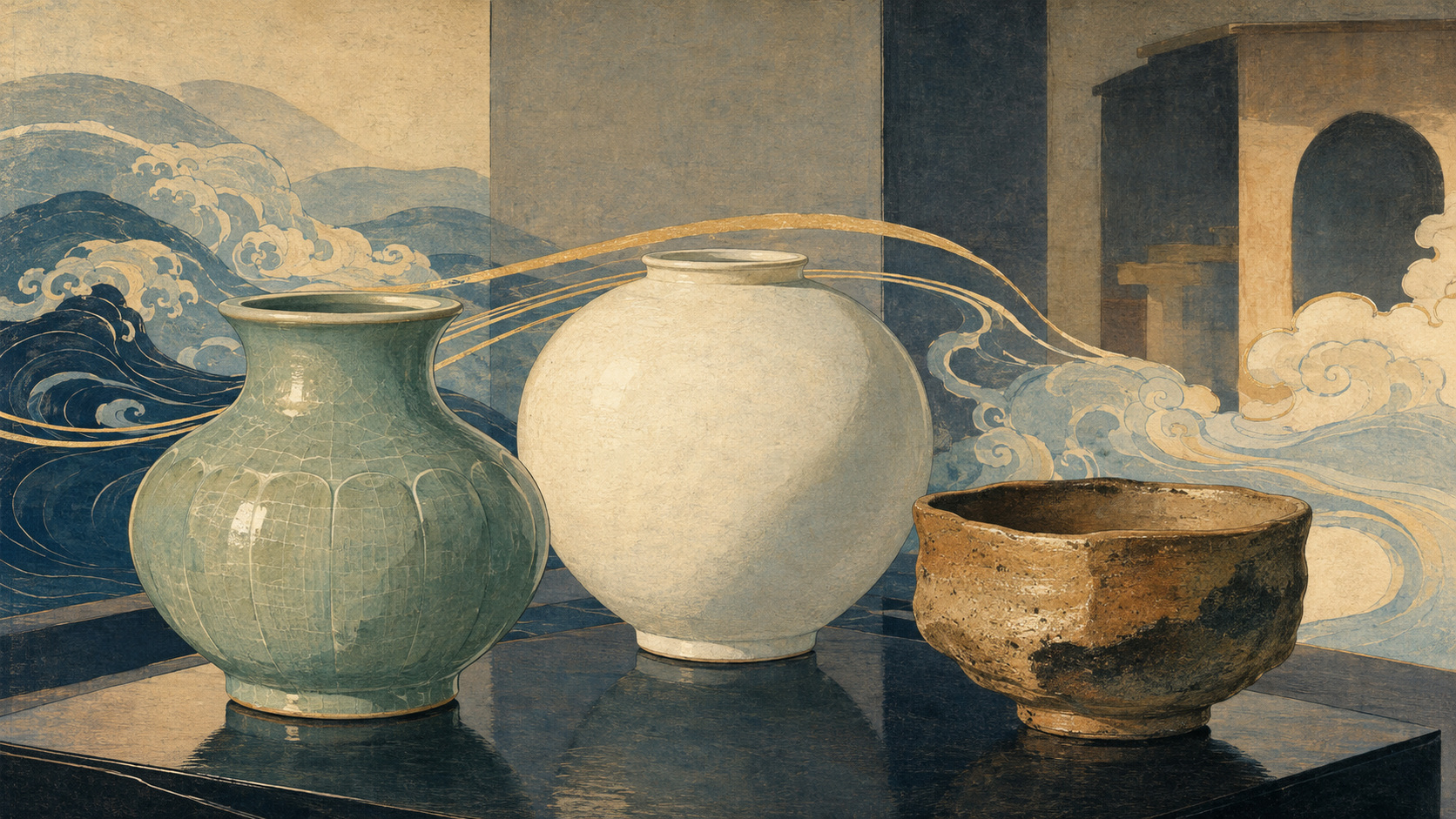
A ceramic vessel can carry a longer history than its walls appear able to hold.
Take the pale green ewer and basin near the beginning of the Nezu Museum’s new exhibition. Made in the Yue kiln world of 11th-century China, the pair is refined enough to seem still. Yet it once performed a practical trick: hot water in the basin kept wine warm inside the ewer. Its color depended on iron-bearing glaze, controlled oxygen and a kiln hot enough to turn clay into dense stoneware. Its survival depended on owners who gradually moved it from use into the category of art.
The exhibition calls itself a travelogue. Gallery 1 presents China, Gallery 2 Japan and Gallery 5 the Korean Peninsula, selecting from approximately 2,300 ceramic holdings. The official list contains 101 main catalog entries—some representing sets—plus 11 entries in the concurrent “Meibutsu: Distinguished Tea Ceramics” display. The route is lucid, generous and immediately pleasurable.
It is also only a first map. Ceramics did not develop inside three sealed national rooms. Materials, kiln designs, court demands, religious uses, merchants, war captives, tea practitioners and modern dealers carried techniques and meanings across the sea. To travel through these galleries responsibly is to notice both regional distinction and historical entanglement.
Three galleries make a precise route—and a deceptive map
The proportions reveal the exhibition’s argument. The Chinese section has 54 entries and stretches from painted Majiayao jars of roughly 3300–2000 BCE to porcelain from the Qing court’s Qianlong era. The 23 Japanese entries concentrate heavily on the 17th and 18th centuries. The 24 Korean entries move from Goryeo celadon of the 12th century through Joseon white porcelain of the 18th.
| Gallery | Range | Questions to carry |
|---|---|---|
| 1 · China | Prehistoric painted pottery to Qing porcelain | How did kiln control, court taste and long-distance trade turn local clays into international standards? |
| 2 · Japan | Early modern stoneware, Kyoto ware and Hizen porcelain | How did Korean expertise, Chinese models and Japanese tea or export markets converge? |
| 5 · Korean Peninsula | Goryeo celadon to Joseon buncheong and porcelain | How were imported technologies remade into distinctly Korean forms—and later reclassified abroad? |
Chronology therefore runs unevenly. China is granted deep time; Japan receives an early-modern flowering; Korea is framed through the Goryeo–Joseon transition. That is not a universal history of East Asian ceramics. It is the history this collection can tell. The distinction matters because every collection transforms survival, acquisition and donation into an apparently natural canon.
“China,” “Japan” and “Korean Peninsula” also help visitors orient themselves, but the labels can hide changing states, workshop systems and identities. Jingdezhen was not Yue; Kyoto was not Hizen; a Goryeo celadon workshop did not answer to the institutions of a Joseon official kiln. The best journey keeps the museum’s geographic labels while refusing to stop thinking at their borders.
China’s room compresses five millennia of controlled fire
The earliest painted jars in the list were made long before porcelain existed. Their makers selected clay, built walls without a modern wheel, painted sweeping dark designs and managed a firing that permanently converted earth into a vessel. The first technological leap in ceramics is easy to overlook because it is now ordinary: fire makes a brittle, water-sensitive material into a durable social object.
Across the millennia represented in Gallery 1, Chinese kilns increased control over temperature, atmosphere and raw materials. Earthenware remained relatively porous. High-fired stoneware became dense and resonant. Porcelain—made from carefully prepared pale bodies and fired to vitrification—produced a hard, translucent ideal that many regions tried to understand or imitate. These are useful technical families, not a ladder on which one culture simply replaces another.
The list samples green-glazed Han architectural models, Eastern Jin celadon, Tang white and three-color wares, and the immense diversity of Song production: Yue, Yaozhou, Ding, Cizhou, Longquan, Jizhou and Jun traditions, among others. Each name refers less to a lone studio than to a network of kilns, materials, workers and markets. The visible surface is the last stage of an industrial ecology.
c. 3300–2000 BCE · Majiayao painted pottery records sophisticated Neolithic forming and design.
960–1279 · Song kilns refine celadon, white ware, painted decoration and expressive glaze effects.
14th century · Jingdezhen blue-and-white porcelain expands under Yuan-era trade networks.
16th century · The Nezu’s gold-enriched red-and-green vase shows Ming private-kiln exuberance.
18th century · Qing court and commercial kilns command an enormous vocabulary of bodies, enamels and glazes.
Song ceramics made restraint a form of power
The Northern Song ewer and basin with peony design clarifies why “simple” is the wrong word for monochrome ware. Its green is not paint laid over a neutral body. It emerges from a glaze whose small iron content changes under a reducing atmosphere, when the kiln is starved of oxygen. Temperature, clay, glaze thickness, cooling and placement collaborate. A calm surface is the record of unstable forces successfully governed.
The pair also prevents an aesthetic misunderstanding. Modern viewers may isolate a celadon behind glass as sculpture, but the basin’s hot water once served wine. Shape followed a choreography of pouring, warming and hospitality. Peony ornament added cultural meaning to use. Utility and beauty were not successive stages; they occupied the same vessel.
Song connoisseurship did elevate exceptionally controlled ceramics, and later collectors in Korea and Japan made Chinese wares powerful points of reference. Yet no single “Song taste” can contain the era. Ding kilns made pale, thin-bodied vessels; Cizhou workshops used bold brushwork and contrasting slips; Jun glazes could erupt in purple-blue effects. Restraint was one achievement among many, not a timeless definition of Chinese refinement.
Jingdezhen turned porcelain into a global language
Jingdezhen’s importance lay in concentration: suitable materials, specialized labor, vast kiln capacity and systems able to serve court, domestic and overseas demand. Under the Yuan dynasty, cobalt-blue decoration on white porcelain flourished. Much of the cobalt and some of the visual vocabulary arrived through commercial networks connecting China with Iran and the wider Islamic world. The object later treated as quintessentially Chinese was international at the level of pigment.
By the Ming era, Jingdezhen had become the most influential porcelain-producing center in the world. Millions of vessels moved through palace systems and maritime trade. Shapes and motifs were adjusted for users in Southeast Asia, the Middle East, Japan and eventually Europe. Foreign workshops copied Chinese porcelain in local clay, then returned altered forms to the market. Influence moved in loops.
The Nezu’s 16th-century “Vase with Flower Design” comes from a private Jingdezhen kiln and refuses the cliché that Chinese excellence is always austere. Red and green overglaze enamels fill its surface; gold describes peonies; the lower body swells with theatrical weight. The official designation as an Important Cultural Property recognizes the object in Japan, but its fabrication belongs to a commercial Chinese kiln world whose products circulated far beyond any modern national boundary.
Goryeo potters received celadon—and made it Korean
Korean celadon technology developed through contact with Chinese Yue, Yaozhou and other kiln traditions. That statement describes transmission, not passive copying. Goryeo potters adjusted bodies, glaze color, forms and decoration to courtly and Buddhist settings on the peninsula. By the 12th century, their finest greenwares had a presence recognized as distinctive even by Chinese observers.
The most consequential innovation was sanggam inlay. A potter incised a design into leather-hard clay, filled the cuts with white or dark slip, scraped the surface level, then glazed and fired it. The image became part of the body beneath the translucent celadon surface: cranes, clouds, flowers and geometric borders could appear with astonishing clarity without behaving like paint.
Technique carried institutions with it. Kiln centers near Gangjin and Buan supplied elite demand; maritime routes carried finished ware to the capital. Shipwreck cargoes and kiln sites now let archaeologists reconstruct production beyond the prestige objects that survived in collections. A perfect celadon cup is not only a masterpiece. It is the visible point of a network of quarrying, fuel, transport, taxation and specialized hands.
Buncheong records a world between court order and potterly freedom
Early Joseon buncheong grew from the inlaid celadon tradition but changed its visual logic. Potters coated gray bodies with white slip, then stamped, incised, carved, brushed or dipped the surface. Some vessels carry repeated government marks and disciplined patterns; others preserve broad, fast brushwork that later viewers admired as spontaneous. The same family of ware can embody administration and improvisation.
Even the name is historical. The abbreviated term buncheong was coined in the 1930s by Korean art historian Go Yuseop. It does not tell us what a 15th-century maker called the vessel. Museum language can illuminate a category while also reminding us that categories are later constructions.
The exhibition’s rare 15th-century Buddhist cabinet with peony design gives buncheong an unexpected architecture. Its design was cut into the clay and filled with white slip, but the form was made to hold a sacred image or sutra rather than food. It joins domestic ceramic knowledge to ritual enclosure.
Buncheong production declined as Joseon official preference shifted toward white porcelain. The Japanese invasions of 1592–98 devastated kiln regions and displaced skilled potters, many forcibly taken to Japan. In Japanese tea culture, however, Korean buncheong and related surfaces were intensely valued and emulated. A tradition diminished on the peninsula acquired an influential afterlife across the sea—a history that should not be narrated without the violence that moved people.
Joseon white porcelain made restraint political
Joseon’s ruling elite associated undecorated white porcelain with clarity, discipline and the Neo-Confucian order, but actual production was never colorless in either sense. Official kilns at Bunwon in the Gwangju area served the court from the 15th century. White bodies and clear glazes demanded clean materials and close firing control; cobalt, iron and copper offered very different decorative risks and costs.
Cobalt was expensive and at times difficult to obtain. Iron pigment supplied a brown-black alternative. Copper red could be spectacular but was notoriously sensitive to the kiln atmosphere. The changing use of these pigments cannot be explained by taste alone: supply, regulation, technical success and court finance all entered the surface.
The Nezu exhibition’s 18th-century blue-and-white jar with grasses and flowers, made at a Gwangju official kiln, has the loose assurance of practiced brushwork. It was donated by Akiyama Jun’ichi. That credit line matters. It places the vessel in two histories at once: Joseon court production and the modern Japanese formation of a Korean ceramic collection.
Japan’s porcelain revolution was international—and violent
The Japanese gallery’s 17th-century concentration is not an accident. Japan had long traditions of high-fired stoneware at centers such as Bizen and Shigaraki, and tea practitioners valued ash, deformation and kiln accident. Porcelain production, however, arrived later. Korean potters displaced during Toyotomi Hideyoshi’s invasions of the peninsula brought crucial knowledge of climbing kilns, materials and firing to western Japan.
In Hizen, especially around Arita, those skills met porcelain stone and strong patronage. Early wares drew on Chinese forms and decoration. When political upheaval in China disrupted exports in the mid-17th century, Japanese kilns entered markets formerly supplied by Jingdezhen. The Dutch East India Company shipped large quantities of what Europe called “Imari,” named for the port through which Arita-area wares departed.
Nabeshima ware followed a different logic: tightly controlled production for elite presentation rather than an open export market. Both systems were Japanese achievements, but neither was purely endogenous. Korean labor and technology, Chinese models, domain power, Dutch shipping and foreign demand all helped make the porcelain.
Older accounts often softened this history by saying Korean potters were merely “brought” to Japan. Many were forcibly relocated in the context of invasion. Their descendants built communities and transformed Japanese ceramics, but later success does not erase the coercive beginning. Beauty is not evidence of a painless exchange.
Tea changed the names, uses and status of foreign bowls
Gallery 6 supplies the exhibition’s most revealing coda. A meibutsu, or distinguished tea object, is not defined only by kiln quality. Ownership, recorded use, poetic naming and transmission through celebrated collections accumulate around it. The object acquires a biography.
The Important Cultural Property tea bowl named Shibata is a 16th-century Joseon ao-ido bowl, its pale yellow glaze shifting toward blue in places. Bowls of this family were treasured in Japan, although many Korean vessels later classified as tea bowls were not originally conceived for the highly codified Japanese tea setting. Tea altered function by looking backward: a utilitarian foreign bowl became the bearer of pedigree, scarcity and aesthetic authority.
That recategorization could generate demand in the other direction. At kilns in Busan maintained for Japan between the 17th and early 18th centuries, Korean potters made gohon and other wares to Japanese specifications. Japan’s admiration of Korean ceramics helped create new Korean exports tailored to Japanese taste. What looked like preservation of an old Korean ideal was also a contemporary cross-border market.
Nezu Kaichirō, whose tea name was Seizan, collected within this connoisseurial world. His friend Takahashi Yoshio compiled the monumental Taishō Meikikan, recording 875 celebrated tea caddies and bowls. Such catalogs preserved provenance but also consolidated a hierarchy of taste. The tea room did not merely receive ceramics; it made and remade their historical identities.
Kenzan and Hizen turned borrowing into new design
Ogata Kenzan’s 18th-century set of dishes returns the visitor from global systems to the intimacy of a hand. The potter formed earthenware dishes manually, then used iron, cobalt and overglaze gold to render seasonal nature with the rhythmic compression associated with Rimpa. His elder brother Ogata Kōrin gave the school its later name, but Kenzan’s ceramics did not simply transfer painting onto plates. Form, absorbent ground, food and handling changed the image.
Hizen porcelain points elsewhere. The exhibition’s foliated dish with three auspicious fruits belongs to a production region made possible by Korean kiln expertise and enlarged through Chinese and international markets. Its symmetrical edge and enamel color convert a functional plate into a framed image. The work entered the Nezu through the gift of Yamamoto Masayuki, whose 1998 donation became a central strength of the museum’s Hizen holdings.
It is tempting to call these objects “Japanese syntheses,” and they are. But synthesis must name its ingredients and conditions. Kenzan worked within Kyoto intellectual and tea networks; Hizen depended on domain organization and international rupture. Originality did not mean freedom from influence. It meant making inherited or imported systems behave differently.
The Nezu collection is itself a modern historical document
Nezu Kaichirō Sr. (1860–1940) built his fortune and public influence as a businessman, politician, educator and president of Tōbu Railway. Tea practice intensified his collecting. The museum says he worried that important works would be dispersed abroad and wanted his collection shared rather than sealed as private treasure. His son established the foundation in 1940; the museum opened at the family’s Aoyama residence in 1941.
War immediately entered its history. Exhibitions were suspended and objects evacuated in 1944. The residence, galleries, garden and tea houses burned in the 1945 air raids, while the moved collection survived. Displays resumed in 1946. A new main building designed by Kengo Kuma opened in 2009, placing six technologically controlled galleries beside the restored garden.
The founding collection contained 4,642 works according to the museum’s English history; the institution now describes approximately 7,600, including seven National Treasures and 93 Important Cultural Properties. Ceramics number about 2,300. Those figures demonstrate that “the Nezu collection” is not a sealed founder’s cabinet.
Japan.co.jp’s count of the public exhibition list finds Akiyama Jun’ichi credited on 15 of the 24 Korean-section entries and Yamamoto Masayuki on 12 of the 23 Japanese entries. Donations can create scholarly depth that a founder never possessed. They also mean a visitor is seeing a history of 20th- and 21st-century Japanese collecting alongside the history of medieval and early-modern kilns.
That modern layer deserves continued provenance research. The international market for Korean art expanded during an era marked by Japanese colonial rule and unequal power. This does not establish a problematic history for any specific Nezu object, and the exhibition list itself provides no such finding. It does make acquisition history a legitimate curatorial question: when, where, from whom and under what conditions did each vessel enter a modern collection?
How to make the journey without flattening East Asia
Begin with the foot. A vessel’s base may preserve stacking scars, sand, glaze runs or a carefully trimmed ring—clues to how it met the kiln and table. Then look through the surface rather than only at it. Is the color in a translucent glaze, brushed beneath it, painted over it or inlaid into the body? Each answer describes a different sequence of labor and risk.
- What did the maker control, and what did flame or cooling decide?
- Was the object made for storage, ritual, court, export, food or later display?
- Which materials, technologies or motifs crossed a border before the vessel did?
- Did a later owner rename or repurpose it—as Japanese tea culture did with Korean bowls?
- How and when did it enter the Nezu collection?
Compare rather than rank. A Longquan celadon bowl, Joseon white jar and Kenzan dish solve different problems; they are not contestants in a civilizational race toward porcelain perfection. Look for transfer without assuming equivalence. Korean sanggam is indebted to a broader celadon world but is not a lesser Chinese product. Arita porcelain absorbed Chinese models and Korean skill but became neither Chinese nor Korean.
Finally, resist the romance of frictionless exchange. Some knowledge traveled with merchants and gifts; some with monks, envoys and tea practitioners; some through invasion and forced displacement. Later, colonial power and modern dealers shaped what could be collected and how it was named. The sea between the galleries was a route, a market and at times a battlefield.
When the journey works, the final impression is not that East Asia shared one ceramic tradition. It is that people repeatedly confronted the same volatile elements—earth, mineral, water, air and fire—under different political and aesthetic pressures, then watched one another’s solutions. Every vessel is local. None is historically alone.
Reporting notes and principal sources
Exhibition dates, fees, gallery assignments, titles and object descriptions follow the Nezu Museum. The 101-entry total and regional counts are Japan.co.jp’s count of the official list; an entry may contain more than one physical piece. Donation counts are also derived from its published credit lines. Broader historical interpretation relies on museum and scholarly sources below. Public information was checked through August 16, 2026 at 6:00 AM JST.
- Nezu Museum: A Ceramic Travelogue—overview, hours, fees and highlighted works
- 根津美術館:企画展「やきもの名品紀行」公式ページ
- Nezu Museum: complete 2026 exhibition list (PDF)
- Nezu Museum: founder, collection, wartime history and Kengo Kuma building
- Nezu Museum: Hizen porcelain and the Yamamoto Masayuki donation
- Nezu Museum: distinguished tea ceramics and the Taishō Meikikan
- Nezu Museum: the Shibata ao-Ido tea bowl
- Nezu Museum: Korean ceramics, Karatsu and debated “Okugōrai” classifications
- Metropolitan Museum: Chinese ceramics, Jingdezhen and global exchange
- Metropolitan Museum: Longquan celadon in China and Japan
- Metropolitan Museum: Goryeo celadon technology and sanggam inlay
- Metropolitan Museum: Joseon buncheong, terminology, methods and decline
- Metropolitan Museum: Joseon white porcelain and Bunwon official kilns
- Metropolitan Museum: Korean ceramic history and modern collecting
- Metropolitan Museum: Korean potters and Edo-period Japanese porcelain
- Metropolitan Museum: Karatsu ware, Korean kiln technology and tea
- Metropolitan Museum: Oribe ware and intentional deformation
- Kyoto National Museum: the Agata Ido tea bowl and 16th-century Japanese record
- Metropolitan Museum: a gohon bowl and the Korea–Japan feedback loop
- Metropolitan Museum: Busan kilns producing ceramics for Japan