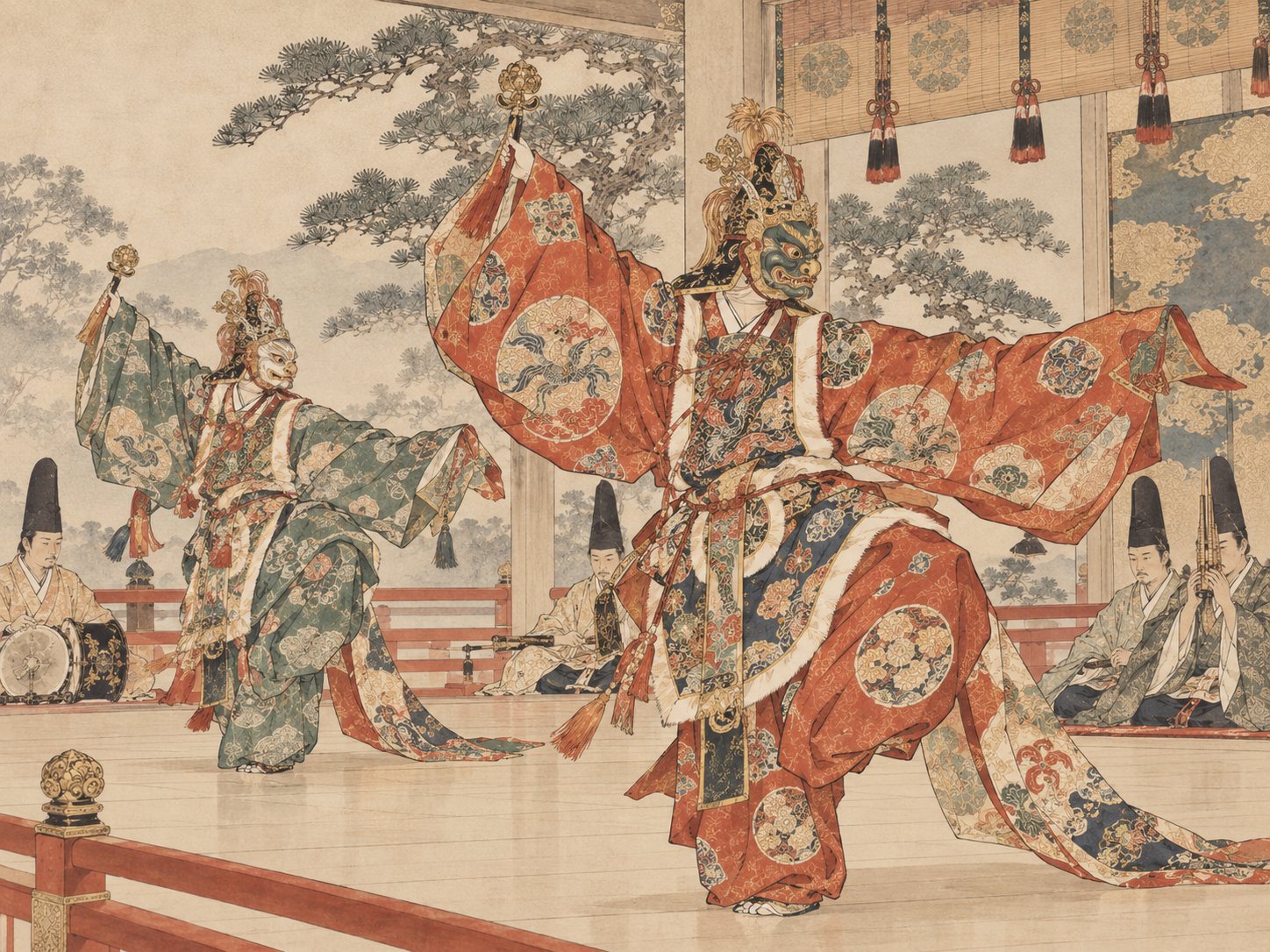
A stage costume loses something when it enters a museum case. Bugaku costume more than most. Its wide sleeves, layered hems, mask, crown, armor and color were designed to move with a body. The garment becomes fully itself only when someone dances in it.
From Oct. 24 to Nov. 23, Tokyo’s Nezu Museum will present “Bugaku Costumes: The Enduring Beauty of Textiles”, a special exhibition of roughly 50 objects, many of them National Treasures or Important Cultural Properties. Rather than treating court costume as decoration alone, the exhibition traces how music and dance imported from continental Asia were reorganized inside Japan’s court and temple culture and became one of the country’s oldest classical performing traditions.
How imported performance became Japanese classical culture
Gagaku is not simply an indigenous Japanese musical tradition. Tokyo University of the Arts notes that music and dance began arriving from the Asian continent and Korean Peninsula as early as around the fifth century, mixing with local song and dance. By the Nara period, the state had established a court music office, and in the Heian period gagaku expanded from official ritual into aristocratic court culture.
Gagaku is an umbrella term. It includes instrumental ensemble performance, vocal forms and indigenous song-and-dance traditions. Bugaku is the branch in which music is joined to choreographed dance—and therefore to costume.
The Nezu Museum explains that repertoire traditionally associated with Chinese continental origins was classified as sahō, or “left-side” dance, while material associated with the Korean Peninsula was classified as uhō, or “right-side” dance. Red became the principal costume color of the left and blue of the right. Imported performance was not preserved untouched; it was reorganized through Japanese court institutions, religion and textile practice until it became a distinctly Japanese classical form.
Why medieval costumes survived around Mount Koya
The first major group comes from Amanosha, the shrine now known as Niutsuhime Jinja and historically closely connected with the Koyasan Buddhist complex. The exhibition explains that musical and dance performance was at times restricted on Mount Koya itself because it was considered a distraction from religious study, while ceremonies incorporating bugaku were held at the shrine instead.
Costumes from ceremonies between the 13th and 15th centuries therefore became an archive not only of performance but of medieval Japanese textile technology. An Important Cultural Property, a pale-red suikan decorated with roses and arched bridges, can be dated to 1454 through an inscription associated with its costume set. Its embroidery includes techniques later familiar from Momoyama-period kosode.
A 1378 garment made with imported brocade
Another centerpiece is the Important Cultural Property Ryōtō, Dark Blue Ground with Double-Vine Peony Scroll Design, now in the Tokyo National Museum. An inscription inside dates its donation to Koyasan’s Niu shrine to 1378.
The sleeveless ryōtō hangs over the front and back of a dancer’s body. This surviving example uses imported gold brocade lavishly and preserves its overall form, making it an important chronological reference. In a single garment, foreign textile trade, religious patronage, status and Japanese performance practice meet.
A 1408 picture scroll tells us how the clothes were actually worn
The exhibition also brings together garments with images that show them in use. A 1408 Bugaku Dancers handscroll from the Asian Art Museum of San Francisco is one of the relatively rare medieval bugaku paintings with a clear date.
The Nezu Museum believes the work was copied by court musician Abe no Suehide from paintings once owned by the imperial prince-priest Toganoo-no-miya Gi’nin, who appears in the diary of court noble Yamashina Noritoki. The detailed color imagery makes the scroll especially valuable for reconstructing how garments, headgear and accessories were combined on a moving performer.
Raryōō: a foreign prince who became an icon of Japanese bugaku
The Nezu Museum’s own fifteenth-century painting of Raryōō, attributed to Tosa Yukihide, is another key work. Raryōō—also called Ranryōō—is one of bugaku’s famous fast dances, associated with the legendary Prince of Lanling of China’s Northern Qi dynasty.
On Nov. 8, instructors and graduates from the gagaku program at Tokyo University of the Arts are scheduled to demonstrate how the Raryōō costume is dressed and then perform the music and dance. The event makes explicit what a textile exhibition can otherwise only imply: these objects were engineered for choreography.
The Ōnin War nearly broke the tradition
The exhibition does not present bugaku as a tradition that passed through a thousand years unchanged. The Nezu Museum describes a major rupture during the Ōnin War of 1467–77 and the warfare that followed. Court musicians dispersed and instruments and costumes were lost.
From the late 16th century, emperors and powerful patrons, including the Toyotomi family, supported revival. After political power moved to Edo in the 17th century, major religious institutions in eastern Japan also developed bases for bugaku performance. Over time, costume design became more standardized across the court and leading temples and shrines.
Shitennōji: destroyed, rebuilt, and still dancing
Osaka’s Shitennōji preserves one of Japan’s most important living bugaku traditions. Every April 22, its Shōryō-e memorial for Prince Shōtoku combines Buddhist chanting with bugaku by the Tennōji Gakuso. The bugaku of the Shitennōji Shōryō-e is designated an Important Intangible Folk Cultural Property.
The tradition survived catastrophe. Shitennōji burned during warfare in 1576, and its bugaku equipment was lost. Toyotomi patronage helped restore the performance culture, and the surviving costumes have been repaired and preserved across generations.
The exhibition includes garments from Taihēraku, an essential dance marking the end of the ritual section of Shōryō-e. A full Taihēraku costume includes more than ten components, among them armor and weapons; the exhibition presents 11 pieces from the set.
More than 800 pieces at Rinnōji
A second monumental group comes from Rinnōji in Nikkō. Tokugawa Iemitsu commissioned the costumes in 1636 for the great rebuilding of Nikkō Tōshōgū and ceremonies marking the 21st anniversary of Tokugawa Ieyasu’s death.
The collection exceeds 800 objects and is large enough to furnish costumes for the full bugaku repertoire. It was designated collectively as Important Cultural Property in 1983. The Nezu Museum says the Rinnōji holdings are being shown again after 45 years.
Among their unusual features are costumes for the child dance Karyōbin. As a left-side dance it would normally use a red hō, yet Rinnōji preserves both red and green versions. The exception is a reminder that tradition does not always mean a single immutable rule.
| Focus | Why it matters |
|---|---|
| Amanosha / Niutsuhime tradition | 13th–15th century costumes tied to Koyasan ritual |
| 1378 ryōtō | Important Cultural Property using imported gold brocade |
| 1408 Bugaku Dancers scroll | Rare dated medieval evidence for how costumes were worn |
| Shitennōji | 16th–17th century costumes rebuilt through Toyotomi patronage |
| Rinnōji | 800+ Tokugawa-period costume pieces; major display after 45 years |
| Dates | Oct. 24–Nov. 23, 2026, Nezu Museum Galleries 1–2 |
Red on the left, blue on the right: color remembers geography
One of bugaku costume’s most elegant features is that color carries an old map. The Nezu Museum describes red as the base color of the left-side repertoire associated with continental China, and blue as the base color of the right-side repertoire associated with the Korean Peninsula.
Those categories should not be translated too literally into modern national identities. Bugaku gathered material from multiple historical cultures and transmission routes, then reorganized it over many centuries in Japan. “Chinese” or “Korean” in this context refers to inherited historical classification, not a simple one-to-one mapping onto modern states.
A costume was both cultural property and consumable equipment
Stage clothing was made to be used. Sweat enters the fabric. Sleeves rub. threads weaken. Decorations fall. At temples and shrines, costumes were repeatedly repaired because ritual performance mattered more than preserving an untouched museum object.
That history makes conservation unusually complex. A curator has to distinguish original material from later repair, understand how components belonged together and preserve documentation about which dance used which garment. Shitennōji and Rinnōji matter not simply because the textiles are beautiful but because their use, repair and institutional history remain connected.
- The red/blue visual logic of left- and right-side dances
- How imported gold brocade was absorbed into medieval Japanese costume
- Embroidery techniques that anticipate later kosode decoration
- The difference between a costume laid flat and the same costume shown in a painting on a dancer
- How postwar revival after the Ōnin conflict encouraged standardization
- The evidence of repair and continued use at Shitennōji and Rinnōji
Japanese tradition is also a history of transforming imports
Bugaku quietly complicates the idea of a culturally “pure” Japan. The music and dance arrived from elsewhere in Asia. They were then reshaped by court ceremony, temples, shrines, warrior patrons and Japanese textile makers until they became among the most recognizably classical forms of Japanese culture.
By focusing on clothing, the Nezu Museum makes that transformation visible: imported brocade, Japanese embroidery, temple-specific ritual, wartime destruction, Toyotomi and Tokugawa restoration, and centuries of repair all survive in cloth.
A bugaku costume becomes complete when someone wears it and dances. Across a millennium, however, there is another kind of movement to see—the movement of culture itself across borders, institutions and generations. That may be the exhibition’s most compelling story.
Sources & Reference Material
- Nezu Museum, “Bugaku Costumes: The Enduring Beauty of Textiles,” exhibition overview and selected works.
- Nezu Museum, Japanese press release for “Bugaku Costumes,” Oct. 6, 2026.
- Tokyo University of the Arts University Art Museum, history and structure of gagaku (Japanese).
- Koizumi Fumio Memorial Archives, Tokyo University of the Arts, introduction to gagaku and bugaku.
- Koizumi Fumio Memorial Archives, Raryōō costume and performance.
- Shitennōji, Shōryō-e and Tennōji Gakuso bugaku tradition.
- Shitennōji, temple history and continuation of Shōryō-e bugaku.
- Nezu Museum, 2026 exhibition schedule.
Reporting cutoff: Oct. 6, 2026, 1:21 PM JST. Because the exhibition opens Oct. 24, the final gallery layout, any rotations during the run, the complete list behind the roughly 50 objects, and conservation-related substitutions are not established beyond the materials released so far.