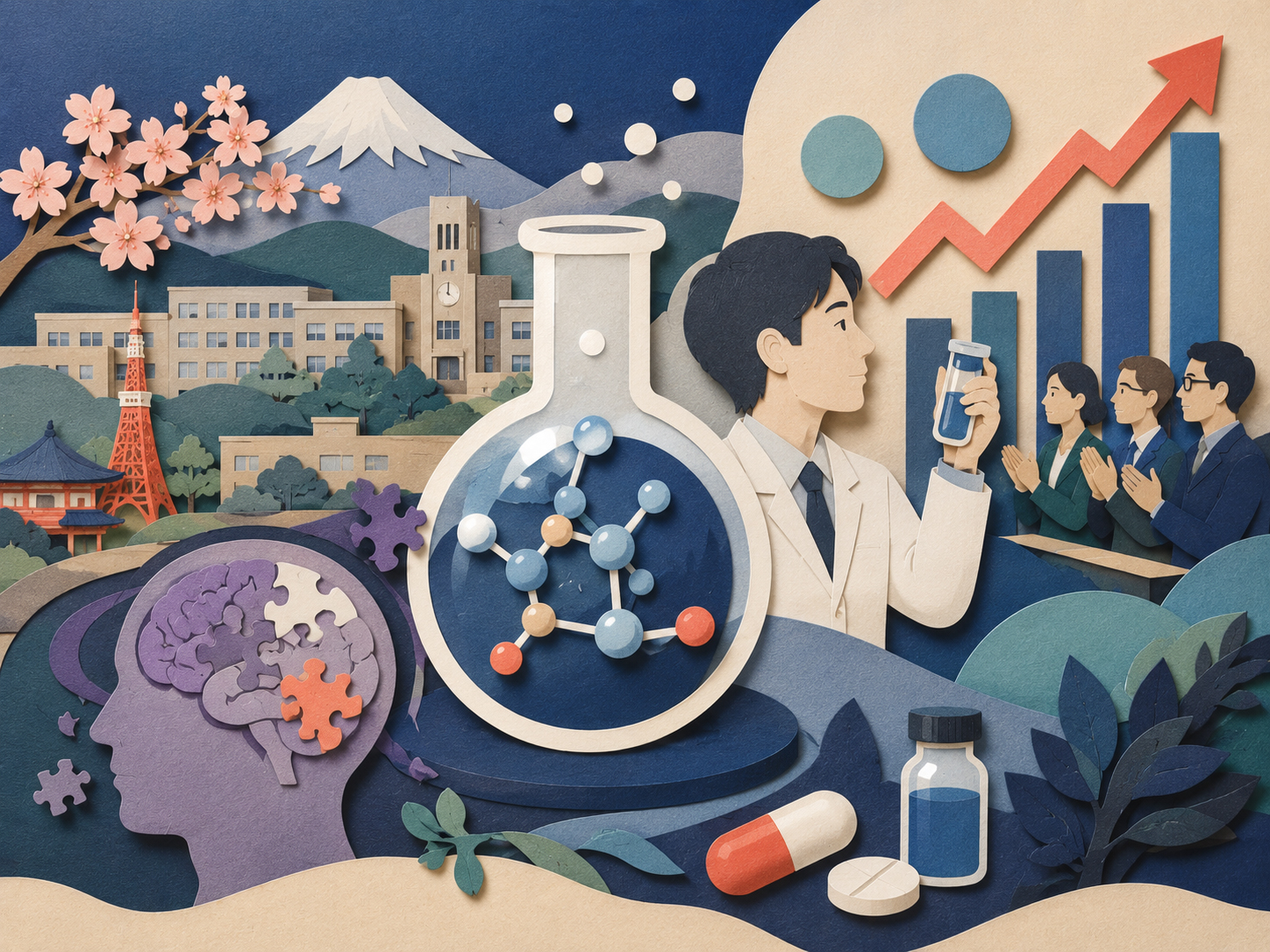
The biggest Japanese startup funding story of June was not a generative-AI SaaS company, a space venture or a translation platform. It was a Tohoku University drug-discovery startup trying to move an Alzheimer’s disease candidate from early human safety work toward a patient trial in the United States. Neusignal Therapeutics raised ¥5.32 billion in a Series B round, enough to place it at the top of Japan’s June startup funding ranking and to make a quiet biotech company one of the month’s most important innovation stories.
The number matters. But the deeper story is bigger than the number. Japan is the country where aging became a national operating condition before it became a global cliché. Dementia is not an abstract medical category here. It is a family issue, a municipal issue, a labor-force issue, a long-term-care issue, a fiscal issue and a question of dignity. For Japan, every serious attempt to change the treatment landscape for Alzheimer’s disease carries social meaning.
Neusignal is developing NTX-083, a small-molecule Alzheimer’s disease treatment candidate based on drug-discovery seeds from Tohoku University. In 2025, the company began an investigator-initiated single-dose trial in healthy adults at the University of Tokyo Hospital, then completed observation of all subjects in September. A company-sponsored repeat-dose trial in healthy adults began in November 2025, and observation of all subjects was completed in March 2026. According to the company, both studies showed no notable safety issues, high safety and tolerability, and favorable pharmacokinetic profiles.
That is not the same as proving efficacy in Alzheimer’s patients. Drug development is a long road. Many candidates fail between early human safety and approved medicine. But the June financing is still important. It means a Japanese university-origin drug candidate has gathered enough scientific, financial and policy support to move toward a U.S. Phase 1b trial in patients. In Japanese biotech, that is a meaningful threshold.
A No. 1 ranking with a different message
STARTUP DB’s June 2026 domestic startup funding ranking put Neusignal at No. 1 with ¥5.32 billion. Trifa, the overseas eSIM app company, followed with ¥3.3 billion. KOWRO, which offers an AI translation-management environment for games and entertainment, and MW, a home-service robot startup, were tied at ¥3.0 billion. In other words, June’s leaderboard included themes investors usually understand quickly: travel, AI localization and domestic robotics. At the top sat a clinical-stage drug company.
That matters because biotech does not behave like ordinary software. It does not scale immediately after a product launch. It consumes capital through research, toxicology, chemistry and manufacturing controls, regulatory strategy, clinical trials, contracting, hiring and business-development work. The risk is high. The time horizon is long. The social value, if the program succeeds, is also enormous.
Neusignal’s top ranking therefore says something about the maturity of Japanese startup finance. Capital is beginning to flow not only to fast-growing digital businesses but also to longer-cycle medical bets. The disease target makes that especially important. Alzheimer’s disease is not just one therapeutic category among many. In Japan, it is a mirror of the country’s demographic future.
Who is Neusignal?
Neusignal Therapeutics was founded in April 2022 as a Tohoku University-origin drug-discovery startup. The company is based in Nihonbashi Honcho, Tokyo, a district that has become one of Japan’s modern life-science clusters. Its business is the research and development of treatments for dementia and psychiatric disorders, as well as the exploration of new drug-discovery seeds for brain diseases.
The company’s lead program, NTX-083, has been described as a small-molecule Alzheimer’s disease candidate with KATP-channel inhibitory activity. It has been supported by AMED’s Strengthening Program for Pharmaceutical Startup Ecosystem. In February 2025, Neusignal supplied NTX-083 for an investigator-initiated healthy-adult clinical trial at the University of Tokyo Hospital, marking the candidate’s first administration in humans.
The Series B round brought together a notably Japanese mix of specialist and institutional capital. Angel Bridge and DCI Partners served as co-lead investors. New investors included Nissay Capital, Red Capital and Gogin Capital. Existing investors included Fast Track Initiative, Keio Innovation Initiative, Mitsubishi UFJ Capital, SMBC Venture Capital, FFG Venture Business Partners and Nippon Venture Capital. That list tells the real story: university science, government-backed development support, specialist venture capital, financial-group venture capital and regional finance are all being braided into one drug-development pathway.
Alzheimer’s treatment has changed, but the problem is not solved
For decades, Alzheimer’s drug development was a field of heartbreak. Symptomatic treatments existed, but drugs that could meaningfully alter disease progression remained elusive. Then anti-amyloid antibody drugs changed the landscape. Japan approved Eisai and Biogen’s Leqembi, and later approved Eli Lilly’s donanemab, sold as Kisunla. For researchers, clinicians and families, those approvals marked the beginning of a new era.
But a new era is not the same as an easy answer. Antibody therapies require careful patient selection, biomarker confirmation, infusion infrastructure, imaging and safety monitoring. They are expensive and can involve serious risks such as brain swelling and bleeding. They are meaningful breakthroughs, but they are not simple, universal medicines that every patient can take at home.
That is why a small-molecule approach remains compelling. A small molecule can, in principle, open different treatment designs and different access pathways than an antibody therapy. Whether NTX-083 ultimately becomes oral, broadly usable, clinically effective or commercially practical will depend on data that do not yet exist. Still, investors are clearly responding to the possibility of a differentiated mechanism that could complement or challenge the current antibody-centered wave.
From Tohoku University to Nihonbashi
The intellectual roots of the story are in Tohoku University. The university has long been one of Japan’s major research institutions, with deep strength in medicine, pharmacy, materials, disaster science and brain-related research. Turning that kind of science into a venture-backed clinical company is never automatic. A strong academic mechanism is only the beginning.
University drug discovery must pass through a translation machine. The science has to become intellectual property, a development candidate, a toxicology package, a manufacturing plan, a clinical protocol, a regulatory strategy and, eventually, a product that a pharmaceutical company or global market can understand. That is a very different discipline from discovery research.
Neusignal’s geography is therefore symbolic. The seed begins in Tohoku University. The company sits in Nihonbashi, a Tokyo life-science and pharmaceutical-business corridor. The next clinical stage points toward the United States. That route — regional university science to Tokyo venture company to global clinical development — is exactly the route Japan has been trying to strengthen.
The AMED bridge
One of Japan’s historical weaknesses in drug discovery has been the funding valley between academic research and global clinical development. The country has world-class science, but compared with the United States and Europe it has often lacked enough risk capital and specialized commercialization support for early clinical biotech.
AMED’s Strengthening Program for Pharmaceutical Startup Ecosystem was built to address that gap. The program recognizes that recent drug innovation often comes from startups, but also that drug development requires far more capital than ordinary startup categories. The scheme registers venture capital firms with drug-discovery expertise and supports pharmaceutical startups in nonclinical, Phase 1, Phase 2 and exploratory clinical stages, tied to investment by registered VCs.
Neusignal’s financing history shows that policy design in action. Its 2025 Series A combined ¥1.15 billion in equity financing with an ¥1.1 billion AMED subsidy, bringing the round total to ¥2.25 billion. The new Series B again combines third-party allotment financing with AMED support to reach ¥5.32 billion. The message is clear: Japan does not want university drug seeds to stop at papers, patents or small grants. It wants them to become development companies capable of reaching global patients.
Dementia is a social question before it is a market
The Alzheimer’s story carries special weight in Japan because dementia is already part of everyday national life. Government-related projections discussed in Science Japan point to 5.84 million dementia patients aged 65 or older in 2040, with another 6.32 million people living with mild cognitive impairment. Combined, that would mean 12.77 million people with dementia or MCI — roughly one in 2.8 older adults.
No hospital system can absorb that alone. Dementia touches household finances, caregiving, local-government services, transport, housing, consumer protection, employment continuity, adult guardianship, neighborhood safety and social isolation. Japan’s dementia policy has therefore moved beyond a narrow medical frame. Its basic plan emphasizes dignity, self-determination, community life, social participation and the use of new knowledge and technology.
Medicine still matters profoundly. Social inclusion and drug development are not rivals. If a therapy slows decline, preserves function or reduces caregiver burden, it can help people remain in their communities longer and with more dignity. Japan needs both: better social design and better treatment options.
Why the United States trial matters
The next planned step for Neusignal is a Phase 1b trial in Alzheimer’s disease patients in the United States. That is not just a matter of choosing a foreign trial site. In global drug development, the U.S. pathway is central because of FDA expectations, clinical-development infrastructure, investor attention and the business-development logic of large pharmaceutical companies.
For a Japanese university-origin startup, showing early safety domestically and then moving into a U.S. patient study is a way of entering the global drug-development conversation. Phase 1b is still early. It will not answer every question. But it can begin to establish patient-stage safety, tolerability, pharmacokinetics, pharmacodynamics and exploratory clinical signals that shape the next development plan.
That is why investor comments repeatedly point toward future partnerships with global pharmaceutical companies. Modern pharma rarely invents everything inside its own laboratories. Promising university and startup programs move through early evidence, then enter partnerships, licenses, co-development deals or acquisitions. Neusignal’s Series B is fuel for that crossing.
Promise, risk and the right level of skepticism
The promise around NTX-083 is that it could offer a mechanism different from the newly approved antibody drugs, and investors have described its potential in terms of both symptom improvement and disease-progression suppression. If that promise were confirmed clinically, it could change the Alzheimer’s treatment map.
But Alzheimer’s drug history demands caution. The field is full of programs that looked promising in theory and failed in patients. Amyloid, tau, inflammation, synapses, vascular factors, metabolism and neurotransmission are all relevant, but translating a mechanism into measurable clinical benefit is brutally difficult. Disease stage, biomarkers, dosing duration, endpoint choice and patient heterogeneity can all determine the outcome.
So the right conclusion is neither hype nor dismissal. Neusignal is not yet a success story in the sense of having an approved medicine. It is, however, an important story: a Japanese university-origin Alzheimer’s program has raised major capital, advanced through early human safety work and is preparing to test its candidate in U.S. patients. That is worth watching closely.
Reader guide
| Item | Meaning |
|---|---|
| What happened | Tohoku University-origin drug startup Neusignal Therapeutics raised ¥5.32 billion in Series B financing and ranked No. 1 in Japan’s June 2026 startup funding ranking. |
| Lead candidate | NTX-083, a small-molecule Alzheimer’s disease treatment candidate supported by AMED’s pharmaceutical startup ecosystem program. |
| Clinical progress | Healthy-adult single-dose and repeat-dose studies have completed observation. The company reported strong safety, tolerability and pharmacokinetic profiles. |
| Next milestone | A Phase 1b trial in Alzheimer’s disease patients in the United States is planned for 2026. |
| Why it matters | The story links Japan’s university science, biotech venture finance, AMED policy, Alzheimer’s drug history and the country’s aging-society challenge. |
Sources and reference materials
This article draws on Neusignal Therapeutics’ June 30, 2026 Series B announcement, STARTUP DB’s June 2026 funding ranking, Neusignal’s NTX-083 clinical-trial disclosures, AMED’s pharmaceutical startup ecosystem program materials, Tohoku University Alzheimer’s drug-discovery background, AP and Reuters coverage of Alzheimer’s drug approvals in Japan, and Science Japan’s reporting on Japan’s dementia policy and projections.
- Neusignal Therapeutics: Series B financing announcement.
- STARTUP DB: Japan’s June 2026 startup funding ranking.
- Neusignal Therapeutics: NTX-083 healthy-adult clinical trial.
- AMED: Strengthening Program for Pharmaceutical Startup Ecosystem.
- Tohoku University: Alzheimer’s disease drug-discovery background.
- AP News: Japan approval of Leqembi.
- Reuters: Japan approval of Kisunla.
- Science Japan / JST: Japan’s dementia basic plan and projections.