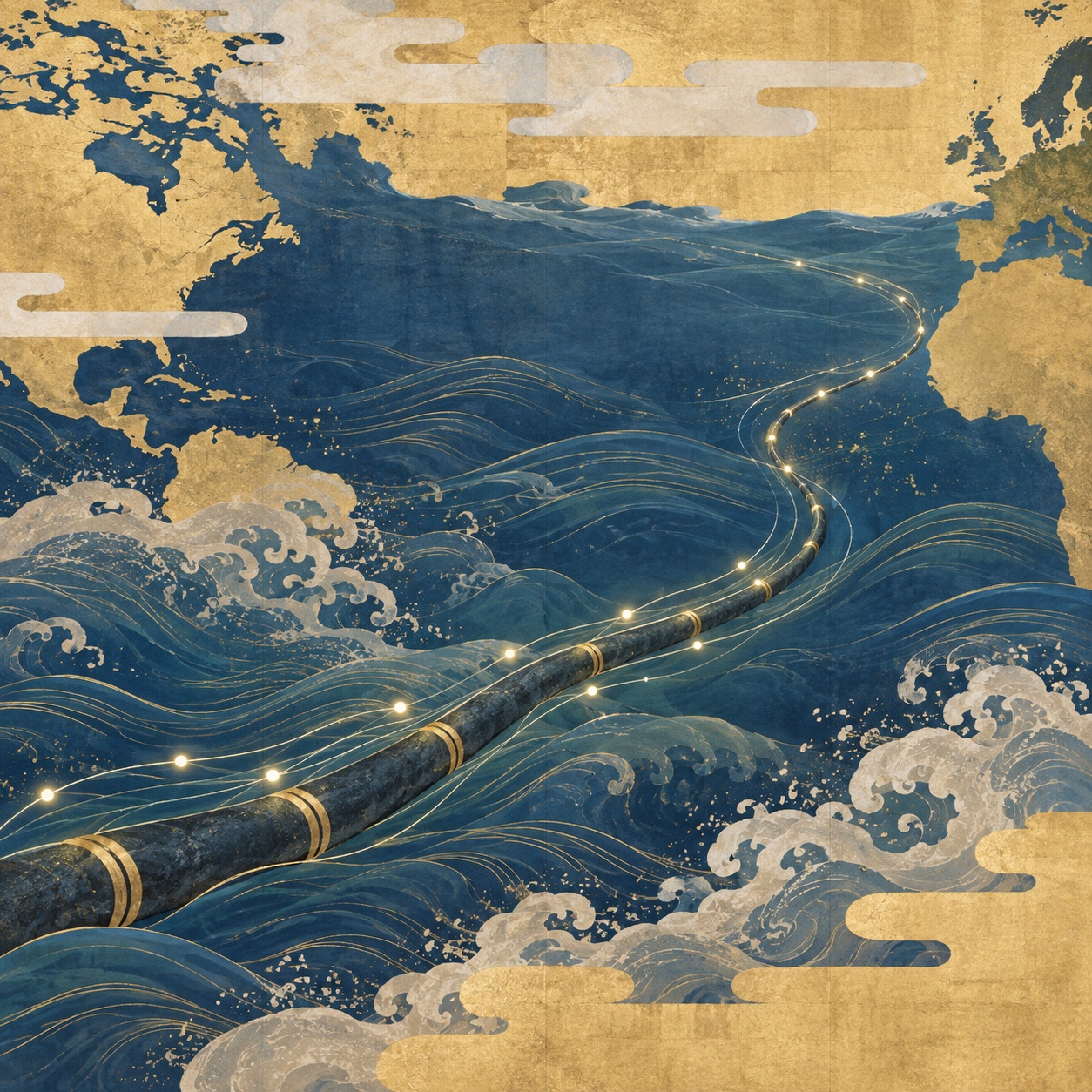
A cable planned for the floor of the Atlantic is attempting something more consequential than setting another bandwidth record. Petal, a new subsea system backed by Meta Platforms, is designed to connect the United States and France across roughly 7,000 kilometers and deliver 1 petabit per second of capacity. NEC Corporation will be responsible for the overall system design and construction, while Sumitomo Electric Industries will supply the two-core optical fiber. Service is planned for 2029.[1]
The distinction between a plan and an operating system matters. Petal is not yet a live 1-Pbps cable. NEC and Sumitomo Electric describe the project as aiming to become the world's first commercial petabit-class optical submarine cable system, while Meta says the finished system will deliver 1 Pbps. Those claims ultimately depend on manufacturing, installation, commissioning and real-world operation.[1][2]
How 24 fiber pairs become the equivalent of 48
The central innovation is not simply to make the cable larger and pack in twice as many conventional fibers. Petal will use multi-core fiber containing two separate light-guiding cores inside a single strand. The system is designed with 24 fiber pairs, or 48 physical fibers. Because every fiber carries two cores, the architecture creates 48 core-pairs of spatial channels—the transmission-path equivalent of a much larger conventional single-core system.[1]
Sumitomo Electric will provide its 2C Z-PLUS Fiber® ULL, an ultra-low-loss two-core submarine fiber. The company says it achieved the world's first mass production of this class of fiber in 2023. Two optical paths can occupy a glass fiber whose outer diameter remains roughly 125 micrometers, allowing more spatial channels without doubling the number of separate fibers.[3]
Across an ocean, the system must keep attenuation low, prevent the two cores from interfering with one another, survive manufacturing and splicing, and work with repeaters expected to operate reliably for decades. Meta says Petal uses ultra-pure synthetic silica, carefully controlled refractive indices and counter-propagating optical signals to push crosstalk between the cores to extremely low levels.[2]
About a hundred repeaters beneath the Atlantic
Light fades as it travels through fiber. A transoceanic cable therefore needs repeaters distributed along the route. Meta says a 7,000-kilometer cable would typically require about 100 repeaters. Petal's design uses a Fan-In/Fan-Out interface to separate each two-core fiber into single-core paths inside the repeater, amplify them, then return the signals to two-core fiber. Meta describes a single-body repeater amplifying 96 fiber cores; the Japanese announcement describes the same high-density approach as 48 amplifier pairs.[1][2]
Power is another constraint. Submarine repeaters are fed electrically from landing stations thousands of kilometers away. Meta says Petal is intended to remain within existing power-feeding equipment rated up to 18 kV while doubling spatial capacity. NEC says its lower-power repeater and dense amplifier design also supports single-end powering, adding resilience.[1][2]
From Anjana to Petal: changing the unit of scale
Petal is the next step in a broader move toward spatial division multiplexing, or SDM. Meta's transatlantic investments show the progression: Marea used eight fiber pairs, Amitié 16, and Anjana 24. Meta describes Anjana as roughly a 0.5-Pbps system. Petal keeps 24 physical fiber pairs but doubles the cores, effectively creating 48 core-pairs and targeting twice Anjana's capacity.[2]
Designers could instead try a conventional 48-fiber-pair system. Meta says it chose the two-core approach because it can double spatial capacity without a proportional increase in cable materials and power. It also argues that one 1-Pbps system should use fewer resources than constructing two separate 0.5-Pbps systems. That is the project sponsor's engineering assessment, not yet a full independent lifecycle comparison; actual environmental performance will depend on manufacturing, installation, utilization and operating conditions.[2]
NEC's role reaches back to the first U.S.–Japan Pacific cable
For NEC, Petal sits at the end of more than six decades of submarine-network work. The company traces its first involvement to 1964, when it supplied land-side terminal equipment associated with TPC-1, the first submarine cable connecting Japan and the United States. As the industry moved from coaxial systems to optical fiber, NEC expanded into repeaters, terminal equipment, cable manufacture, route engineering, marine installation and end-to-end integration.[4]
NEC says it has laid more than 450,000 kilometers of submarine cable since 1964—enough to circle the Earth about 11 times. Petal is strategically notable because NEC is not merely supplying a component; it is responsible for the overall design and construction of the two-core system. Sumitomo Electric provides the second major Japanese contribution by supplying the transmission medium itself.[5][3]
From the 1858 telegraph to a petabit in 2029
The Atlantic has repeatedly been a proving ground for communications technology. The first transatlantic telegraph cable sent messages in 1858 but failed within weeks; a durable connection followed in 1866. More than a century later, TAT-8 entered service in December 1988 as the first transatlantic fiber-optic cable, carrying 280 megabits per second and capacity equivalent to about 40,000 telephone circuits.[6][7]
Petal's stated design capacity of 1 Pbps equals one million gigabits per second. A simple numerical comparison with TAT-8 is not a clean engineering benchmark because architectures, coding, redundancy and the difference between design and usable capacity are fundamentally different. It is still useful history: in less than four decades of transatlantic fiber, the unit of ambition has moved from hundreds of megabits to a petabit.
The invisible infrastructure behind the AI buildout
Meta, NEC and Sumitomo Electric frame Petal against rising traffic from AI, cloud computing and data centers. But calling it an “AI cable” would overstate the case. Subsea networks carry the broad fabric of international digital life: cloud traffic, enterprise data, video, messaging and consumer services. Meta cites the widely used estimate that roughly 99% of intercontinental data traffic travels through subsea cables.[2]
AI nevertheless changes the economics of the network. Massive training and inference systems consume extraordinary computing capacity, but compute is useful only when datasets, models and services can move reliably between regions. Meta will fund and operate Petal. NEC will design and construct it. Sumitomo Electric will supply the two-core fiber. Orange is working with Meta on the planned French Atlantic-coast landing and terrestrial connection into Europe.[1][2]
- Meta: Owner, funder and operator of the cable system
- NEC: Overall design and construction of the two-core submarine system
- Sumitomo Electric: Supplier of the two-core submarine optical fiber
- Orange: Partner on the planned French Atlantic landing and terrestrial connection
The questions that matter after the headline number
The 1-Pbps figure is the obvious headline, but the more revealing measures will come later. Can the partners manufacture and splice two-core fiber at transoceanic scale with acceptable yield? Can roughly a hundred repeaters and thousands of kilometers of cable meet reliability targets? Can the system enter service on schedule in 2029? And once operating, how much usable capacity, energy efficiency and cost improvement will the architecture deliver compared with conventional alternatives?
Important commercial details remain outside the public record. The announcements reviewed by Japan.co.jp do not disclose the contract value or total construction cost. They do not identify a specific U.S. landing point, and Meta describes the French landing only as being on the Atlantic coast with Orange support. Without those figures and locations, it would be premature to calculate Petal's economics or infer a precise route from public maps.
What is already clear is the scale of Japan's role. NEC is responsible for making the system work as a whole, and Sumitomo Electric is providing the new transmission medium at its center. Submarine cables are almost invisible to users, yet they are the physical foundation beneath the global cloud economy. If Petal enters service in 2029 at petabit-class capacity, it will be more than a Meta network expansion. It will also test whether Japanese submarine-network engineering can help define the architecture of the next generation of intercontinental connectivity.
Sources
- NEC: Meta, NEC, and Sumitomo Electric to Collaborate on “Petal” (Sept. 22, 2026)
- Engineering at Meta: Inside Petal: Building the World’s First Petabit-Class Transoceanic Subsea Cable (Sept. 21, 2026)
- Sumitomo Electric: Petal collaboration announcement (Sept. 22, 2026)
- NEC corporate history: early submarine cable work and TPC-1
- NEC Submarine Cable Systems: capabilities and deployment record
- Smithsonian Institution Libraries: the 1858 transatlantic telegraph cable
- IEEE Communications Society: First Optical Transatlantic Cable TAT-8
