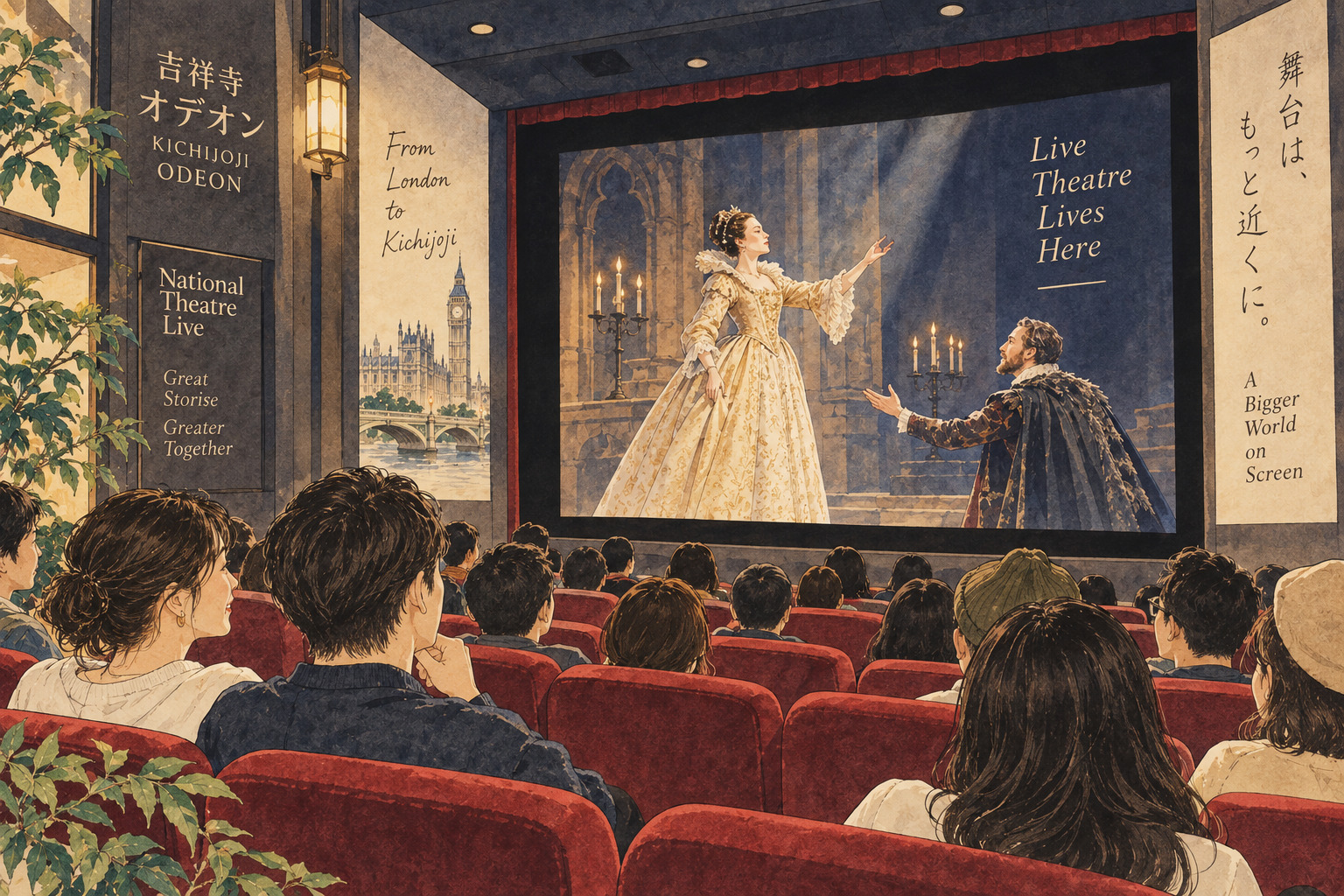
You do not have to be sitting in London to share a stage actor's breath, pause, timing and the audience's laughter. That proposition has driven National Theatre Live since 2009. The project does not literally transport a theatre; it records a performance in front of a live audience and builds a second auditorium around the world. From autumn 2026 into winter 2027, one of those auditoriums will be Kichijoji Odeon in western Tokyo. [1][7]
The cinema will screen three recent National Theatre Live titles for one week each: Arthur Miller's All My Sons from October 2; J. M. Synge's The Playboy of the Western World from October 30; and Christopher Hampton's Les Liaisons Dangereuses from January 8, 2027. Each was filmed in front of a theatre audience and will be shown in Japan with Japanese subtitles. [1][2]
The worlds could hardly be more different: postwar American family responsibility, an Irish village intoxicated by a story of patricide, and aristocratic sexual warfare in pre-Revolutionary France. Yet all three turn on a related question: how long can people live inside the stories they construct about themselves and others?
“Live” does not mean these Kichijoji screenings are live satellite broadcasts
The brand name can be misleading. National Theatre Live films stage performances in front of actual theatre audiences. Some first screenings in Britain have historically been transmitted live, but many international presentations—including these Japanese runs—are recorded presentations shown later. Kichijoji audiences will not be watching actors perform in London in real time. [1][6]
That does not make the result a conventional film adaptation. Actors are not repeating individual scenes for cinema takes. They perform the continuous stage production for the theatre audience while cameras capture it.
The cinema viewer gains possibilities that a fixed theatre seat does not offer: close-ups, changes between full-stage composition and small gestures, and clearer visual access to details. The trade-off is equally real. The cinema viewer cannot decide independently where to look; the broadcast director and camera edit shape the gaze.
October 2: All My Sons enters the house of a father who profited from war
The first title is Arthur Miller's All My Sons, directed by Ivo van Hove. The Japanese cinema version runs 2 hours 25 minutes without an interval. Bryan Cranston plays Joe Keller, Marianne Jean-Baptiste is Kate Keller and Paapa Essiedu plays their son Chris, alongside Hayley Squires and Tom Glynn-Carney. [1][3]
Miller's drama places wartime industrial responsibility inside the American family. Joe has built prosperity through manufacturing, but defective military parts, a convicted business partner and a missing son refuse to remain in the past. His belief that he acted for his family collides with responsibility to people outside it.
This production ran at Wyndham's Theatre in London's West End from late 2025 until March 7, 2026. It was not a production staged in the National Theatre building itself, which is worth noting: National Theatre Live now distributes productions created with partner commercial and independent producers as well as National Theatre productions. [10][11]
At the 2026 Olivier Awards, the production won Best Revival and Essiedu won Best Actor in a Supporting Role. Cranston, Jean-Baptiste and van Hove were among the production's other nominees. [3]
Cranston and van Hove: a screen-famous actor who still has to fill stage space
Cranston is globally identified with Walter White in Breaking Bad, but his stage career includes Tony-winning performances in All the Way and Network. All My Sons reunites him with van Hove after their collaboration on Network. [3][10]
The attraction of NT Live is not merely that a cinema camera can move close to a television star's face. It can also show the spatial behavior of stage acting: where Joe stands in relation to his family, when he avoids another character's gaze, how long a silence occupies the stage.
Miller wrote the play in the 1940s, but its structure does not remain comfortably historical. Manufacturing responsibility, corporate harm, family loyalty and the stories successful people tell to justify their choices remain contemporary problems.
October 30: The Playboy of the Western World, the comedy that caused riots in 1907
The second title is John Millington Synge's The Playboy of the Western World, directed by Caitríona McLaughlin. The Japanese screening runs 2 hours 31 minutes with an interval. Nicola Coughlan plays Pegeen, Éanna Hardwicke plays Christy Mahon and Siobhán McSweeney plays Widow Quin. [1][4]
A nervous young man enters a pub in rural western Ireland and says he has killed his father. Instead of expelling him, the villagers transform the confession into a glamorous story of courage. Christy becomes a local celebrity—until the supposedly dead father arrives.
Synge's 1907 Abbey Theatre premiere provoked audience disturbances later known as the Playboy Riots. NT Live Japan's contextual material explains how the play's sexual language, women characters and representation of Irish rural life collided with nationalist and moral expectations. [4]
The 2025-26 National Theatre production was directed by McLaughlin, artistic director of the Abbey Theatre, and ran in the Lyttelton Theatre from December 4, 2025 through February 28, 2026. An Irish national-theatre director and Irish cast revisiting a central work of the Irish Literary Revival inside Britain's National Theatre gives the revival a cultural history more complicated than a generic “British classic.” [4][8]
Nicola Coughlan is the marketing hook; language is another star
Japanese publicity understandably foregrounds Coughlan, familiar to a large audience from Bridgerton. Her screen fame may bring viewers into a filmed stage production they would not otherwise encounter.
But Synge's language is one of the production's central attractions. His Hiberno-English carries Irish syntax, rhythm and imagery into English dialogue. The NT Live Japan materials explicitly highlight the musical, poetic quality of the language and the revival's rebalancing of its women characters. [4]
Japanese subtitles expand comprehension but cannot reproduce every sound pattern. Cinema audiences therefore experience the play through two simultaneous channels: translated meaning on screen and the original vocal rhythm in the room.
January 8, 2027: Les Liaisons Dangereuses turns desire into information warfare
The third title is Les Liaisons Dangereuses, Christopher Hampton's stage adaptation of Pierre Choderlos de Laclos' epistolary novel, directed here by Marianne Elliott. Lesley Manville plays the Marquise de Merteuil, Aidan Turner the Vicomte de Valmont, and Monica Barbaro Madame de Tourvel. The Kichijoji cinema version runs 2 hours 53 minutes with an interval. [1][5]
Merteuil and Valmont manipulate reputation, sex and information as weapons. Letters, rumors and intimate access become tools for controlling other people's social reality. Although the story is rooted in pre-Revolutionary French aristocracy, the underlying mechanism is recognizably modern: power belongs partly to the person who can control the narrative others receive.
The 2026 National Theatre production ran in the Lyttelton from March 21 through June 6 and marked the first staging of Hampton's version at the National Theatre, using a refreshed script. Marianne Elliott's stage history includes War Horse, The Curious Incident of the Dog in the Night-Time and Angels in America. [5][9]
The September 21 Japanese announcement abbreviates the Kichijoji date as “1/8 (Fri.)”. Because the announcement was issued in September 2026, January 8, 2026 was already past—and was a Thursday. January 8, 2027 is a Friday. Japan.co.jp therefore states the absolute date as January 8, 2027. [1]
Lesley Manville is returning to the same play from the other end of its power structure
Manville has a particularly long relationship with Les Liaisons Dangereuses. NT Live Japan notes that she appeared decades earlier as the young Cécile de Volanges in the Royal Shakespeare Company's celebrated production of Hampton's adaptation. In 2026, she returns to the play as Merteuil, the strategist at the center of its power structure. [5]
That kind of return is one of theatre's special forms of time. An actor can re-enter the same text decades later and discover that age has moved her to a completely different position inside it.
National Theatre Live began in 2009 with Phèdre
National Theatre Live launched in June 2009 with Helen Mirren in Racine's Phèdre. By its 100th cinema production in 2024, the National Theatre said the initiative had reached more than 11 million people and was regularly screening in more than 2,000 venues across 65 countries. The September 2026 Japanese distributor release now cites a cumulative global audience of more than 13 million. [1][7]
The innovation was geographical as much as technological. A theatre performance that once required a trip to London and a seat during a limited run could be encountered in a local cinema, collectively, after the original performance had ended.
Access is not absolute. Which cities receive a title, for how long, with which subtitles and at what price still depends on distribution and exhibitors. In Kichijoji, each title is limited to one week and tickets are scheduled to go on sale through the cinema website two days before the screening date. [1]
Japan's NT Live story began in 2014 with Frankenstein
The first National Theatre Live theatrical release in Japan arrived on March 28, 2014 with Danny Boyle's Frankenstein, starring Benedict Cumberbatch and Jonny Lee Miller alternating the roles of Victor Frankenstein and the Creature. [12][13]
Over the following decade, Japan developed a pattern of new releases and encore screenings. The Kichijoji series belongs to that second-life model. All My Sons already screened in Japan earlier in 2026, The Playboy of the Western World opened in August, and Les Liaisons Dangereuses is scheduled for its main Japanese release at TOHO Cinemas Hibiya and other venues from October 16 before reaching Kichijoji in January. [1][2]
Recorded theatre can therefore have a longer distribution life than the stage run that created it. The London production closes; a cinema can reopen access months later.
Kichijoji Odeon brings its own history of shared viewing
Kichijoji Odeon sits about a minute from the east exit of JR Kichijoji Station. Its current official site lists three screens and 719 total seats. The original Kichijoji Odeon opened in 1954, making the site part of the neighborhood's cinema culture for more than 70 years. [14][15]
The complex was rebuilt as Kichijoji Toa Kaikan in 1978, with several cinemas operating inside, and the names were later consolidated under Kichijoji Odeon in 2012. [15]
Bringing recorded theatre into a long-running neighborhood cinema subtly expands what the building can be. It is not only a place to see films produced for cinema; for three weeks it becomes a local auditorium for completed London stage runs.
Does cinema dilute the “real” theatre?
There is no need to pretend the experiences are identical. Live theatre shares physical air. Performers can feel an audience's response. Viewers decide where to look. The performance exists only once in exactly that form.
Cinema offers different strengths. A camera can expose a small facial response invisible from the back of a theatre, move between scale and detail, and allow the same performance to be discussed by audiences in different countries. Subtitles can also remove a major language barrier.
The useful distinction is therefore not “authentic theatre” versus “fake theatre.” They are different formats. For some people, NT Live becomes a path toward seeing theatre in London. For others, the cinema may be the only realistic seat available.
They are called British theatre screenings, but the cultural map is wider
The three productions demonstrate how international contemporary British theatre actually is. All My Sons is an American play directed in London by Belgian-born van Hove. The Playboy of the Western World is an Irish play directed by the head of Ireland's national theatre at Britain's National Theatre. Les Liaisons Dangereuses adapts a French novel through a British playwright and British production system. [3][4][5][8][9]
“British theatre” here is less a claim that all the stories are British than a description of the production and distribution infrastructure. London becomes a cultural relay point that remakes American, Irish and French texts and sends the resulting performances through cinemas worldwide.
Put the three plays together and another theme appears
In All My Sons, a father protects a story about what he did for his family. In Playboy, a village turns a confession of patricide into a heroic legend. In Les Liaisons Dangereuses, aristocrats construct other people's reputations through letters, rumor and sexual strategy.
All three are about narrative power. Facts matter, but what communities choose to call those facts becomes equally dangerous. The communities differ—family, village, salon—but each eventually collides with reality it has tried to narrate away.
Seen as a three-title mini-season rather than isolated screenings, Kichijoji's programme develops an unexpected through-line: people trapped by stories they themselves helped create.
These are long screenings because they still breathe like theatre
All My Sons runs 2 hours 25 minutes without an interval; The Playboy of the Western World 2 hours 31 minutes with an interval; Les Liaisons Dangereuses 2 hours 53 minutes with an interval. [1]
They are not recut into conventional feature-film pacing. Pauses, stage transitions, audience reaction and long dramatic accumulations remain. For viewers accustomed to tightly edited cinema, that rhythm may feel different. It is also part of what preserves the performance as theatre.
Access is also a question of which cinemas choose to participate
National Theatre Live defines itself through widening access, but Japanese availability remains uneven. In 2026, separate screenings are appearing in places such as Suita, Kagoshima and Saitama, while many titles still concentrate heavily in major metropolitan areas. [1][2]
Three extra Kichijoji runs materially improve choice for Tokyo-area viewers because a person who missed Hibiya receives another date and another neighborhood. They do not, by themselves, solve the broader geography of theatrical access across Japan.
What remains unresolved
As of September 22, Kichijoji Odeon has not publicly posted the daily number of screenings, specific showtimes, ticket price, auditorium assignment, subtitle technical format or detailed accessibility provision for each of the three titles. The distributor says seats will be purchasable through the cinema website two days before each screening date. [1]
The September 21 distributor release also contains an apparent link error in its “upcoming NT Live releases” section, where a Les Liaisons Dangereuses line points to another title's URL. The title and October 16 Hibiya date are consistent with the current NT Live Japan lineup, so Japan.co.jp cross-checked the production against multiple official pages rather than reproducing the bad link. [1][2][5]
For Kichijoji Odeon's 1954 opening history, the current cinema site verifies location and present facilities, while the historical opening date is supported here by a regional historical feature rather than a detailed first-party corporate archive. This article therefore keeps the cinema-history claim limited to the well-established opening year and later consolidation. [14][15]
A London night begins again in Kichijoji
Theatre disappears when the performance ends. That ephemerality is part of its power. The 2025-26 Playboy run is over. Les Liaisons Dangereuses has closed in London. The actors will not be standing behind the Kichijoji screen.
Yet recorded theatre gives the ended performance another audience. Someone who first saw Frankenstein in Japan in 2014 may still follow NT Live now. Someone who missed a 2026 Hibiya run can catch the performance months later in Kichijoji.
In the dark, a Tokyo audience can laugh a fraction of a year after a London audience laughed at the same pause. The performance is no longer live, but the act of watching remains communal.
Kichijoji Odeon's three one-week runs are not attempts to turn theatre into cinema. They are three new audiences assembled around performances that were supposed to have ended.
Sources & documents
- Cultureville: Three 2026 National Theatre Live titles confirmed for Kichijoji Odeon (Sept. 21, 2026; Japanese primary release)
- National Theatre Live Japan: 2026 lineup and Kichijoji Odeon encore screenings
- National Theatre Live Japan: All My Sons (2026)
- National Theatre Live Japan: The Playboy of the Western World
- National Theatre Live Japan: Les Liaisons Dangereuses
- National Theatre: May 2026 What's On Guide—NT Live cinema lineup
- National Theatre: NT Live 100th-production announcement and history from 2009
- National Theatre: Full cast and dates for The Playboy of the Western World
- National Theatre: Full cast for Les Liaisons Dangereuses
- Wyndham's Theatre: All My Sons production information
- Official London Theatre: All My Sons production listing
- British Culture in Japan: Ten years of NT Live in Japan, beginning with Frankenstein in 2014
- Eiga.com: Frankenstein as the first NT Live theatrical release in Japan, March 28, 2014
- Kichijoji Odeon: Official cinema information
- Imatama: Kichijoji Odeon—opened in 1954