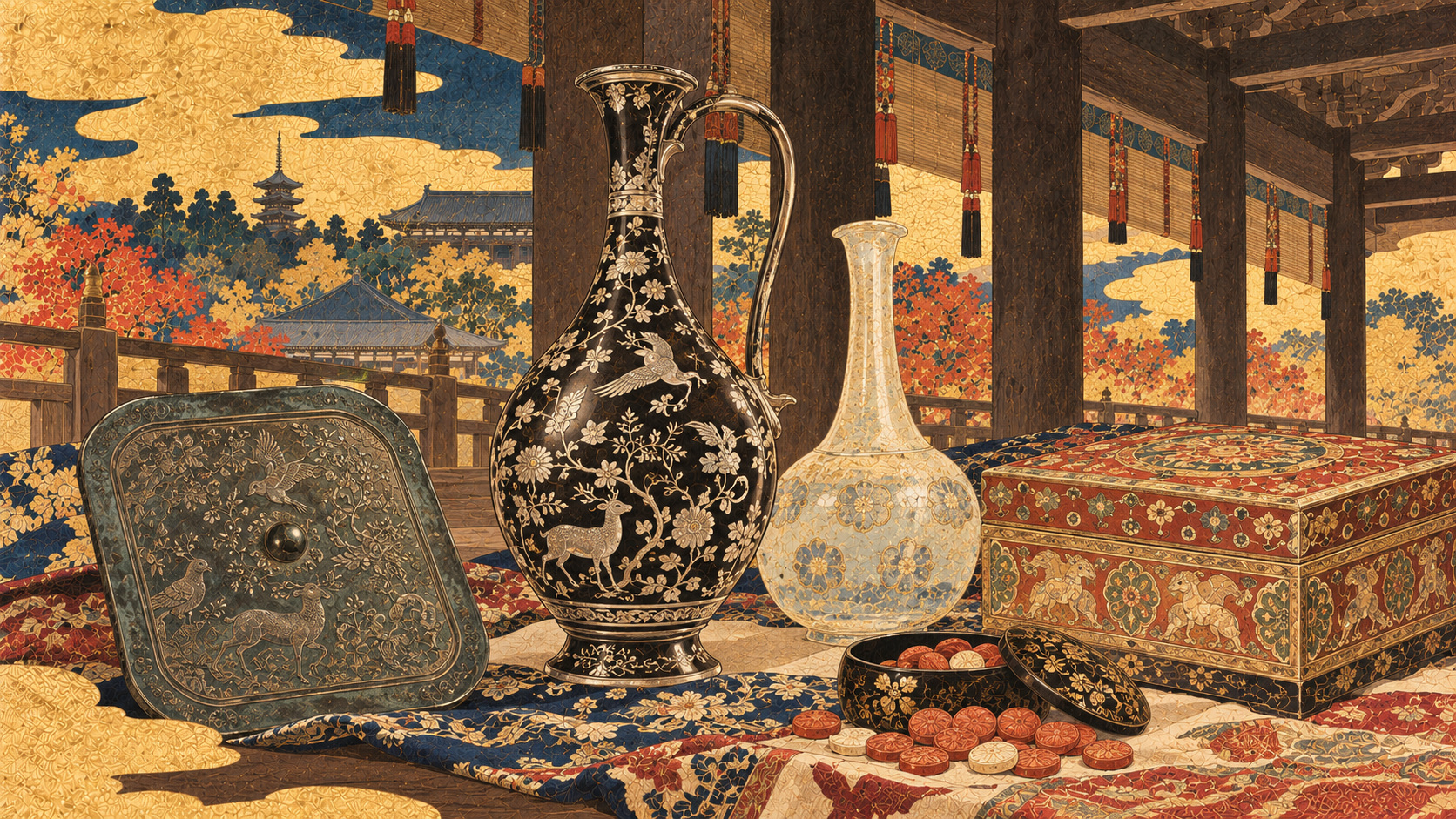
A lacquer ewer, a game piece, a tax register and a preserved animal: together they tell a far larger story than imperial luxury alone.
A Persian-shaped vessel, made for an interconnected world
The black lacquer vessel is only 41.3 centimeters tall, yet it contains a sweeping history of exchange. The Persian Style Lacquered Ewer, known in Japanese as the shikkohei, has a silhouette associated with western Asian handled pitchers. Its surface carries silver-cut images of deer, birds, flowers and mountains, employing ornament associated with Tang China. The Nara National Museum says importation from Tang China is likely; it does not establish that the object itself was made in Persia. That distinction matters. An object’s shape, its decoration and its physical journey may each tell a different geographical story.
The 78th Annual Exhibition of Shōsō-in Treasures opened at the Nara National Museum on October 24 and runs through November 9, 2026. The museum currently lists 60 exhibits, 11 never previously displayed. Rather than treating its cases as a parade of exotic luxuries, this year offers a chance to ask how eighth-century Japan fitted into networks of skills, religious ideas, commerce and record-keeping extending far beyond the archipelago.
A collection born from remembrance and administration
The Shōsō-in collection has its roots in several streams of history. One defining moment came in 756, when Empress Kōmyō made offerings associated with her late husband, Emperor Shōmu, to the Great Buddha at Tōdaiji. The inventory known as the Kokka chinpōchō records precious possessions among those offerings. Shōmu had championed Buddhist institutions in the Nara period, and the collection preserves evidence of the imperial household’s devotional and material world.
But the roughly 9,000 treasures are not simply an emperor’s private estate. Ritual utensils, documents generated by Tōdaiji’s administration and scriptorium, and objects from other settings entered the holdings by different routes. Their continued care was supported in part by the imperial-seal management system, or chokufū, which regulated access. The collection was also inventoried, investigated and conserved over generations. It did not survive merely because a storehouse door stayed shut for 1,300 years.
The ewer: how historians read one object
The lacquered ewer, North Section 43 and exhibition item seven, combines a West Asian-derived form with an East Asian production method. According to the museum, X-ray examination shows that its body was built from thin wood sections and lacquered. Carefully cut silver foil embellishes its dark surface. Because this ornamental technique circulated in Tang China, the museum considers it highly likely the vessel arrived from there.
That does not amount to a verified itinerary from a specific maker to a specific purchaser in Nara. “Silk Road” is a useful shorthand for long-distance exchange, but no single route explains every item: objects, techniques, patterns and ideas could move separately across land and sea. The evidence is richest when we resist turning a complex transmission into a straight line on a map.
Game pieces made for an imperial world
Among the smallest featured objects are the Red Ivory Go Game Pieces with Engraved Bachiru Design of Birds and Flowers, or kōge bachiru no kishi. The pieces are roughly 1.5–1.7 centimeters in diameter. Craftspeople dyed ivory red, engraved away parts of the surface to expose the paler material beneath, and added touches of other colors. The bird motif is described by the museum as probably representing a hoopoe. Blue counterparts also appear in the exhibition.
Their intricacy is a reminder that elite recreation could demand as much artistic effort as ceremonial equipment. These were objects designed to be handled, not merely admired behind glass. Yet the existence of exquisitely decorated playing pieces does not tell us who won a match, how regularly the court played, or precisely which rituals surrounded particular games.
Glass, mirrors and a world beyond the Japanese islands
A glass ewer known as the Hakururi no hei is presented by the organizers as having been made in the region of present-day Iran. A square bronze mirror, the Chōjū kahai no hōkyō, features grapevine ornament whose origins trace westward. Both are evidence that the visual and technical vocabulary of Nara’s elite world was far more varied than an isolated national narrative would suggest.
Cultural borrowing is not a simple matter of copying. Materials may have been imported while designs were locally adapted; some objects could be made abroad while others used foreign-looking motifs in East Asian workshops. The right question is not “which civilization owned this pattern?” but what historians can substantiate about its movement and transformation.
An ancient performance survives in a mask
The Gigaku Mask of Suiko-ō, the Drunken King, is among this year’s displayed treasures. Gigaku was a masked performance tradition introduced to Japan from the Asian mainland and associated with Buddhist ceremonies. The mask speaks to an international theatrical culture and to the pleasure, movement and spectacle that once filled ceremonial spaces.
What survives is the physical object, not a video of the performance. Scholars use masks and texts to reconstruct possible characters and contexts, but a reliable account does not invent the gestures, music or expressions of an individual eighth-century show.
When the paper records outshine the silver
The exhibition’s Brahma’s Net Sutra, Bonmōkyō, evokes the Buddhist ethical and devotional world; the decorated offering box known as the Mitsuda-saie no hako carries a striking painted design. A very different kind of source lies in the Shōsō-in archives: the Ukyō keichō, connected to a 733 administrative register for the western half of the old capital. Such documents help researchers investigate population, taxation and the machinery of government.
A lacquer object can reveal aesthetic choices. A handwritten document may illuminate the people who maintained a city. The survival of both makes the collection exceptionally valuable to historians seeking a picture broader than the court’s finest possessions.
The “Rainbow Dragon” turns out to be a marten
One of the most unexpected items is the so-called Rainbow Dragon, Kōryū, South Section 174. Scientific examination has identified this preserved mammalian specimen as a Japanese marten. It is easy to turn the name into a story about ancient people mistaking an animal for a dragon, but the available documentation does not justify that neat conclusion.
The more interesting story is how naming, preservation and modern analysis coexist. A long-maintained object receives a new biological identification without erasing the older cultural questions. It is a reminder that museum interpretation changes as scientific tools improve.
Rush mats and the ingenuity of ordinary materials
Items related to ancient rush mats, imushiro, reflect recent materials and technique research by the Office of the Shōsō-in at the Imperial Household Agency. Rush fibers, weaving and the inner construction of footwear may seem less spectacular than lacquer and precious metal. But they preserve a record of material selection, practical design and labor.
When visitors look at a mat or a footwear lining, they are seeing decisions made by people who knew how to process raw plants and turn them into everyday objects. Craft history is not only the history of elite splendor. It is also the accumulated intelligence of ordinary making.
An exhibition that began amid postwar rebuilding
The first Shōsō-in exhibition was held in 1946, so 2026 marks eighty years since the event began. The exhibition number is 78, and three previous editions were held in Tokyo rather than Nara. A recurring autumn exhibition has become a way for the public to encounter a tiny selection of a collection whose significance goes far beyond decorative art.
The survival and interpretation of the treasures depend on institutional continuity: the Imperial Household Agency’s Office of the Shōsō-in, the Nara National Museum, specialist conservators and researchers, and decades of cataloguing. The public visits a museum exhibition of selected objects. The ancient repository itself is not being opened for general exhibition admission.
An official discrepancy worth acknowledging
The museum’s current exhibition page and the official exhibition website state that 60 treasures are on display, including 11 first-time exhibits. A July Imperial Household Agency announcement, however, describes 67 objects and 12 first-time displays. The reason for this discrepancy was not established through the publicly accessible material reviewed for this article. We use the museum’s current exhibition count while identifying the differing official notice.
This is not a disagreement about whether the exhibition opened. It is a reminder that a small factual point can have more than one official formulation. Preserving the date and provenance of a figure matters as much in cultural journalism as it does in a financial report.
How to visit—and what to look for
The exhibition runs daily through November 9 in the Nara National Museum’s East and West New Wings. Regular hours are 8 a.m. to 6 p.m., extended to 8 p.m. on Fridays, Saturdays, Sundays and holidays. Last entry is an hour before closing. The museum says there is no rotation of works during the exhibition, and timed-entry tickets are in use; visitors should confirm current ticket availability and conditions.
One way to see this exhibition is to search only for its most beautiful object. Another is to follow the human choices that link its contents: the maker decorating a game piece, a monk receiving an offering, an administrator recording households, a craftsperson weaving a mat. Together they describe not a vanished fantasy but a society that worked, worshipped, played and exchanged ideas across borders.
Sources and verification
Based on official Nara National Museum, Imperial Household Agency and exhibition materials. Official object counts differ between sources; the reason was not independently established. No onsite reporting or original interviews were conducted.