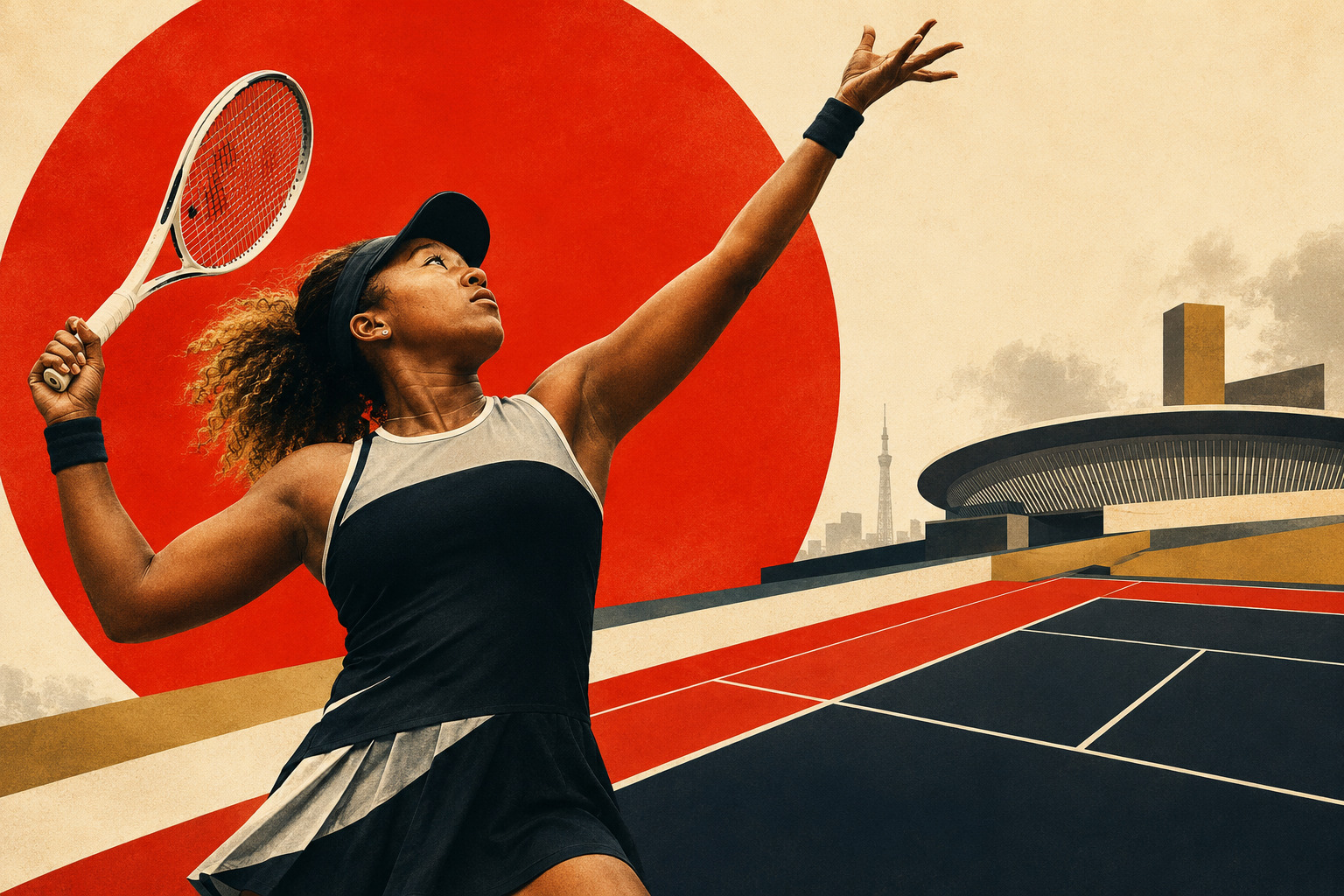
There was no clean celebration. Naomi Osaka held serve for 3–1 in the second set, walked toward her chair and learned that Ashlyn Krueger could not continue. The American had injured her right ankle, received treatment during the first set and tried to play on. Fifty-four minutes after the match began, the score stopped at 6–3, 3–1.
Osaka looked concerned before she looked pleased. That is the difficult etiquette of advancing through another player’s pain. A tournament draw records a victory; the athlete understands that the ending was incomplete. Yet the result still carried a real consequence. Osaka, the No. 3 seed and world No. 13, had reached the Washington quarterfinals for the first time.
Her own performance was compact and controlled. The serve did not land with its usual consistency, but Krueger never reached a break point. Osaka finished with 11 winners against five unforced errors and repeatedly punished the American’s second serve. She did not need to manufacture drama. She needed to keep the court orderly until her opponent’s body made continuation impossible.
On the same date in Japan, the Toray Pan Pacific Open announced that Osaka would return in October for her first appearance at the event in four years. Washington created a new line in her tournament record. Tokyo opened an older book—the event where Japan first watched her become a finalist, then a major champion coming home, then a champion in the city where she was born.
A quarterfinal reached through restraint
Osaka entered the draw with a first-round bye, so the Krueger match was her Washington debut for 2026. The American had survived Katie Boulter in three sets; Osaka had spent the opening round waiting. That difference can make a first match awkward. One player has already solved the court speed and heat. The other begins with a cleaner body but no competitive rhythm.
The first set turned less on spectacular serving than on Osaka’s control of the first strike after the serve. She protected every service game, kept her error count low and moved Krueger before the American could settle behind the baseline. When the ankle became the match’s central fact, Osaka did not force the pace into recklessness. She made Krueger play one more ball, then another.
It would be wrong to mine an opponent’s injury for proof that Osaka had returned to championship form. It would be equally wrong to erase how efficiently she managed the match in front of her. Tennis careers contain retirements, walkovers and days when the scoreboard cannot capture the quality of a win. The honest reading is smaller: Osaka did what was required, remained unbroken and earned the right to play again.
Washington, in three visits: before, during and after the transformation
Osaka made her Washington debut in 2018 as the third seed and Indian Wells champion. She beat Bernarda Pera 6–2, 7–6(4), then lost to Magda Linette 6–2, 3–6, 6–3. Five weeks later, she defeated Serena Williams in the U.S. Open final. Washington caught her in the narrow interval when the power was already visible but global fame had not yet arrived.
She returned in 2025 in a different phase of life. Osaka beat Yulia Putintseva 6–2, 7–5 before Emma Raducanu stopped her 6–4, 6–2 in the round of 16. She was then ranked outside the Top 40 and still constructing a full season after maternity leave. The loss looked ordinary at the time. Within weeks she reached the Montreal final, then the U.S. Open semifinals, climbing back into the Top 20 for the first time since January 2022.
The 2026 visit completed the sequence. Now ranked No. 13, Osaka received a bye, advanced past Krueger and reached a quarterfinal that had eluded her in the two earlier appearances. The milestone is modest beside four Grand Slam titles, but that is precisely why it matters. A second career is assembled from new firsts at tournaments an athlete once passed through quickly.
- 2018: beat Bernarda Pera; lost to Magda Linette in the round of 16.
- 2025: beat Yulia Putintseva; lost to Emma Raducanu in the round of 16.
- 2026: first-round bye; advanced over Ashlyn Krueger to reach her first quarterfinal.
“What am I coming back to?”
Before the tournament, Osaka resisted the language that follows every famous athlete after an absence. Calling this a comeback, she suggested, imposes the old self as the destination. “What am I coming back to?” she asked. The better idea was a new chapter—a different person with an altered relationship to tennis, expectation and time.
The 2026 results support that distinction. Osaka reached the fourth round at Roland Garros for the first time. At Bad Homburg, she advanced to her first grass-court final. At Wimbledon, she beat world No. 1 Aryna Sabalenka and reached her first quarterfinal at the All England Club before Karolina Muchova stopped her. Washington became the third consecutive tournament in which she reached at least the last eight.
All seven of Osaka’s tour-level titles came on hard courts. Her four major trophies were won in New York and Melbourne. For years, clay and grass appeared to be pauses between the surfaces that truly fit her. The 2026 season has begun to make that biography less tidy. Reaching new landmarks in Paris and London does not mean her game has abandoned its foundation. It means the foundation now supports more rooms.
Osaka said she had learned more about her serve and become more comfortable at the net. Those sound like technical details, but together they change the geometry of her tennis. A player once defined by the violence of the first two shots can now end a point forward, use a slice to alter pace or survive when the first serve is not providing easy control—as it did not against Krueger.
The hard-court architecture of four major titles
The original Osaka game was built for fast courts: a heavy first serve, compact backhand, explosive forehand and the nerve to redirect pace down the line. She won her first tour title at Indian Wells in March 2018. Six months later, at age 20, she defeated Williams 6–2, 6–4 to become Japan’s first Grand Slam singles champion.
The final’s arguments and penalties threatened to swallow the achievement. Osaka’s tennis should not disappear inside that controversy. She broke Williams in the opening game, defended her second serve under pressure and closed against both an idol and a stadium struggling to accept the ending it received. The trophy ceremony was painful; the performance was decisive.
At the 2019 Australian Open, Osaka beat Petra Kvitova in three sets to win consecutive majors and rise to world No. 1. She became the first Asian player—woman or man—to hold the top singles ranking. She added the 2020 U.S. Open after coming from a set down against Victoria Azarenka, then won the 2021 Australian Open over Jennifer Brady. Four major finals produced four titles.
That perfect record generated a distorted expectation: if Osaka entered a major quarterfinal, the public began to imagine the trophy. In the first part of her career, she often made that fantasy rational. In the second, the work is different. A quarterfinal can be evidence of progress without becoming a contract to win the tournament.
| Year | Milestone | Historical meaning |
|---|---|---|
| 2016 | First WTA final at Toray PPO | Breakthrough at home; WTA Newcomer of the Year |
| 2018 | Indian Wells and U.S. Open champion | First Japanese Grand Slam singles champion |
| 2019 | Australian Open champion; world No. 1 | First Asian player to lead a singles ranking |
| 2020 | Second U.S. Open title | Won while using her platform to name victims of racial violence |
| 2021 | Second Australian Open title | Fourth major in four final appearances |
| 2023 | Birth of daughter Shai | A season away and a changed reason to compete |
| 2025 | Montreal final; U.S. Open semifinal | Returned to the Top 20 after maternity leave |
| 2026 | New bests in Paris, Wimbledon and Washington | The second career expands beyond her old hard-court identity |
When the public role became bigger than tennis
Osaka’s first rise was so fast that the person and the symbol fused. She was Japanese and Haitian, raised primarily in the United States, shy in public and devastating on a hard court. Sponsors, broadcasters and national audiences found a different version of her to claim. By 2019, she was not simply a champion; she was a global argument about identity, race, language and belonging.
At the 2020 U.S. Open, staged without ordinary crowds during the pandemic, Osaka walked on court wearing seven masks bearing the names of Black victims of racial violence. In 2021, she disclosed that she had experienced periods of depression and anxiety and withdrew from Roland Garros after a dispute over press conferences. Her decision helped force elite sport to discuss mental health, media obligations and the cost of treating access to an athlete as unlimited.
Weeks later, she lit the cauldron at the Tokyo Olympic opening ceremony. The image was powerful precisely because it did not resolve every contradiction. Japan chose a biracial, internationally raised woman as the last torchbearer. Osaka carried the country’s highest sporting symbol while still negotiating how much of herself public life was entitled to take.
It is tempting to turn those events into a simple arc of courage and recovery. Osaka’s own language is less convenient. Mental health is not a hurdle cleared once. Public confidence and private ease are not the same. A player can wear theatrical fashion onto Centre Court, speak softly in a press room and still want the ball on break point. Complexity is not inconsistency; it is the condition of being watched at scale.
Motherhood and a ranking rebuilt point by point
Osaka played the 2022 Toray PPO, then stepped away from the tour. She gave birth to her daughter, Shai, in July 2023 and returned in Brisbane at the beginning of 2024 after roughly 15 months without tournament tennis. The first season back was uneven: quarterfinals in Doha and ’s-Hertogenbosch, flashes against leading players, then injuries that ended her Asian swing.
The breakthrough came in stages during 2025. Osaka reached the Auckland final, won the WTA 125 event in Saint-Malo for her first title of any level since 2021, made the Montreal final and reached the U.S. Open semifinals. Her ranking had remained between No. 42 and No. 60 for much of the year. Montreal and New York lifted her to No. 14, her first Top 20 position in more than three and a half years.
Motherhood did not make travel or training simpler. It changed the stakes. Osaka has said that seeing children in the stands carries more responsibility since Shai’s birth. That can sound like additional pressure, but it also redirects attention. The loss is no longer the whole day. The ranking is not the only identity waiting outside the court.
The player in Washington was therefore not the 2019 No. 1 restored from storage. She was 28, ranked 13th, accompanied by a daughter and equipped with more ways to solve a point. The forehand could still end a rally abruptly. The difference was that her sense of purpose no longer depended on proving she had never changed.
Toray PPO is a timeline disguised as a tournament
Osaka first played the Toray Pan Pacific Open at 17 in 2015. One year later, she beat Misaki Doi, Dominika Cibulkova, Aliaksandra Sasnovich and Elina Svitolina to reach her first WTA final. Caroline Wozniacki won 7–5, 6–3, but the tournament had introduced Japan to a player capable of moving from promise to the Top 50 in a single season.
She returned to the final in 2018 immediately after winning the U.S. Open. Karolina Pliskova ended Osaka’s 10-match winning streak 6–4, 6–4. The result revealed the burden of a homecoming that no longer belonged only to tennis. Every movement carried the new title “Grand Slam champion.” Osaka was 20 and already being asked to explain what her victory meant to a country.
In 2019, the tournament moved temporarily from Tokyo to Osaka, her city of birth. She beat Anastasia Pavlyuchenkova 6–2, 6–3 in the final to win the trophy after two runner-up finishes. It was her first title since the Australian Open and the start of a 10-match winning streak that continued through Beijing. The symmetry was almost too neat: Naomi Osaka, champion in Osaka.
The 2022 appearance produced the opposite kind of memory. Daria Saville injured her knee in the opening game and retired; Osaka then withdrew before the second round with abdominal pain. She had barely played in front of the home crowd. It became her last tournament before the 15-month absence that included pregnancy and Shai’s birth.
| Toray PPO year | Osaka’s result | The career phase it captured |
|---|---|---|
| 2015 | First round | A 17-year-old learning the main tour |
| 2016 | Runner-up to Caroline Wozniacki | First WTA final and national breakthrough |
| 2018 | Runner-up to Karolina Pliskova | First event after becoming U.S. Open champion |
| 2019 | Champion over Anastasia Pavlyuchenkova | A hometown title in Osaka |
| 2022 | Withdrew before round two | Final event before her maternity absence |
| 2026 | Committed to return | First appearance as a mother and a rebuilt Top 20 player |
A home tournament with more history than one star
The event began in 1973 as Japan’s first women’s professional tennis circuit tournament. In 1984 it was remade as the Toray Pan Pacific event, described by organizers as Asia’s first major official international women’s tournament. Its champions have included Billie Jean King, Martina Navratilova, Steffi Graf, Martina Hingis, Lindsay Davenport, Maria Sharapova and Petra Kvitova. Osaka entered a lineage rather than creating the stage from nothing.
The 2026 main draw will run from October 26 through November 1 at Ariake Coliseum and the Ariake Tennis Forest Park courts. It remains a WTA 500 event, with 28 singles players and a total financial commitment listed by the WTA at just over $1.2 million. Defending champion Belinda Bencic and Elena Rybakina were among the other early commitments announced before Osaka.
For Osaka, “home” has never been a simple geographic label. She was born in Osaka to a Japanese mother and Haitian father, moved to the United States at age three and represents Japan in international tennis. Her Japanese has been publicly examined; her Americanness has been emphasized or ignored depending on the speaker; her Blackness changed how she understood her platform. None of those identities cancels another.
That is why playing in Japan carries weight without needing to prove where she belongs. Ariake will not settle Osaka’s identity. It will offer something more useful: a court, an opponent and a crowd that has watched her at 17, 18, 20, 21 and now 28. The relationship can be expressed through tennis rather than interrogation.
First Cocciaretto, then the road home
At the reporting cutoff, Osaka’s next task was Elisabetta Cocciaretto. The Italian had beaten eighth seed Emma Navarro 6–3, 4–6, 6–3. Osaka won their only previous meeting in straight sets in Miami in 2024, but a prior result supplies information, not entitlement. Cocciaretto had already played two full matches in Washington; Osaka had completed only 13 games.
That imbalance creates a subtle quarterfinal problem. Osaka was physically fresh but still short of match rhythm. Cocciaretto carried more fatigue but had solved the conditions repeatedly. The match would test whether Osaka could move from a controlled, abbreviated contest into the longer negotiations required late in a WTA 500 draw.
Beyond Washington, the North American hard-court season points toward the U.S. Open, where Osaka’s connection to Nishikori adds another thread. Their names appeared together on the initial mixed-doubles entry list, though entry did not guarantee a main-draw place. Then comes the Asian swing and the confirmed Toray PPO return at Ariake.
The temptation is to make Tokyo the emotional conclusion of the season before the draw exists. Osaka’s history advises against writing that script. In 2016 and 2018, the home final ended in defeat. In 2019, it ended with a trophy. In 2022, the body would not let her begin the second round. Homecoming is not a result; it is the decision to enter again.
Washington’s first quarterfinal fits the same logic. It is not proof that Osaka is back because “back” points to a finished version of her. It is evidence that the new player—the mother, the public figure, the former No. 1, the student of grass and clay, the still-dangerous hard-court striker—has reached another place she had never reached before.
Reporting Notes and Sources
Information was checked through July 31, 2026, at 2:05 p.m. Japan Standard Time. The Washington quarterfinal had not begun. Rankings and tournament results use WTA and tournament records available at that cutoff. A public commitment to enter Toray PPO is distinguished from the later final draw, which remains subject to WTA entry rules, health and withdrawal.
- WTA: Krueger result, match statistics and Cocciaretto quarterfinal
- WTA: Official 2026 Washington singles draw
- WTA: Washington match notes and Osaka career data
- Mubadala DC Open: Osaka on a “new chapter,” her game and motherhood
- WTA: Osaka’s 2018 Washington debut victory
- Reuters via Euronews: Osaka’s 2018 Washington loss to Linette
- WTA: Osaka–Putintseva official 2025 score
- Reuters: Osaka’s 2025 Washington loss to Raducanu
- Toray PPO: Official 2026 Osaka participation announcement
- Toray PPO: 2026 dates, venue and tournament outline
- Toray PPO: Tournament origins and the first Pan Pacific edition
- WTA: Osaka’s 2019 Toray PPO title in her birth city
- WTA: Osaka’s 2018 Toray PPO final
- WTA: Osaka’s 2022 Toray PPO withdrawal
- Reuters: Abdominal pain behind Osaka’s 2022 Tokyo withdrawal
- WTA: Official Osaka profile, titles and career milestones
- WTA: Osaka’s 2025 return to the Top 20
- WTA: Osaka becoming the first Asian singles No. 1
- Olympics.com: Osaka lighting the Tokyo 2020 cauldron
- WTA: Maternity return and daughter Shai
- WTA: Osaka’s 2021 break and mental-health context
- U.S. Open: Osaka’s 2020 mask tributes
- WTA: Toray PPO history and notable past champions
- Toray PPO: 2026 announced players