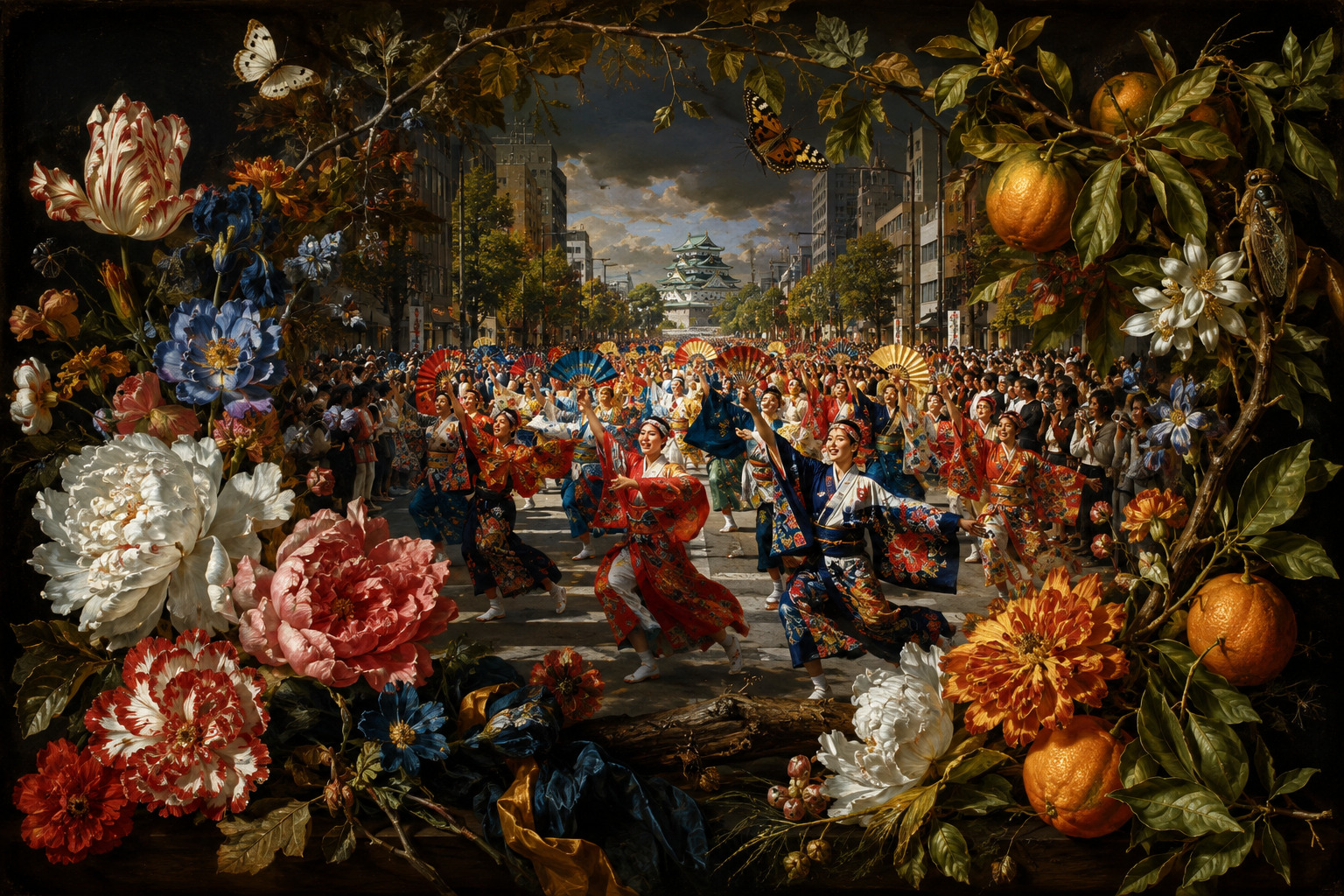
For three days, Nagoya was less a single festival site than a map of moving stages. Dance teams appeared in Hisaya-odori Park, beneath the television tower, around Oasis 21, near Nagoya Station and at neighborhood parade routes. The 28th Nippon Domannaka Festival, widely shortened to Domatsuri, ran from August 28 through 30.
Aichi Prefecture’s official tourism guide described the field as about 200 teams from Japan and overseas. The number should be read as a rounded official estimate, not a final audited count. The organizer’s participant directory contains more than 200 entries across competition, youth, corporate, guest and other categories, but it had not published a single reconciled participation total by the morning of August 31.
The weekend ended with a local winner. Yayoi, written 夜宵 and based in Nagoya’s Naka Ward, received the Domatsuri Grand Prize and its associated Prime Minister’s Award. The foundation’s official profile gives the reading as Yayoi, identifies 2026 as the team’s 27th appearance and says its membership spans high-school students through working adults.
The One Rule That Makes the Festival Local
Domatsuri does not prescribe one dance style. Its defining rule is musical: every team must place part of a folk song from its home region in the performance track. Beyond that requirement, the music is open. The foundation says teams may arrange familiar local phrases through hip-hop, jazz or other contemporary forms.
Costume, makeup, choreography and narrative then carry the same regional argument in visual form. Parade teams may also decorate the jikatasha, the vehicle that leads the dancers and carries their sound equipment. The result is not a survey of untouched folk traditions. It is a festival of deliberate reinterpretation.
That distinction matters because Domatsuri is not an ancient Nagoya rite. It began in 1999 through the initiative of students and residents. Its organizing foundation describes “revitalizing people and regions” and “inheriting and creating culture” as twin goals. The festival uses tradition, but it is itself a contemporary civic institution.
A Festival Distributed Across the City
The published 2026 program named 16 venues, from the main stage in Hisaya-odori Park and the television-tower parade route to Nagoya Castle, Osu Kannon, Oasis 21 and several station and neighborhood locations. That distribution gives small and large groups different ways to participate: stage presentation, forward-moving parade, junior competition, the under-40-member division and the main judged program.
There is an important correction to the advertised venue count. On July 31, the organizer cancelled the indoor Atsuta Hiroba venue at Aeon Mall Atsuta and said affected performances would be reassigned. The separate outdoor Aeon Mall Atsuta venue in the east parking area continued as planned. Sixteen is therefore the originally announced network, not evidence that all 16 locations ultimately operated.
How Domatsuri Builds Participation
- Every team incorporates a folk song from its home region
- Stage and parade formats reward different kinds of presentation
- Junior and U-40 divisions create routes for younger and smaller teams
- Mass dances invite spectators to become participants
A Competition That Ends by Dissolving the Boundary
Domatsuri contains serious competition, culminating in a final contest and a grand prize. Yet the foundation’s larger slogan is 観客動員ゼロ=全員参加型—literally, “zero spectators equals participation by everyone.” It is not a claim that nobody watches. It is an invitation to reject a permanent division between performer and audience.
The most visible expression is the so-odori, or mass dance, in which teams and visitors can join the same accessible choreography. The foundation says a 2010 performance involving 9,481 people received Guinness World Records recognition. Competition sharpens the individual productions; the shared dance then loosens the borders between the teams.
Heat management is part of running that participatory model in late August. Before the festival, the foundation warned that exertional heat illness at Domatsuri has historically risen sharply once the wet-bulb globe temperature exceeds 28 degrees Celsius. It advised sleep, breakfast, water with salt, cooling breaks and immediate withdrawal when symptoms appear. No official 2026 total for first-aid cases was available by the reporting cutoff.
The 28th Edition Continues in November
The closing of the Nagoya street program did not end the edition. Tele-Domatsuri is scheduled to stream recorded performances on November 25 and 26, followed by its semifinal and final on November 27. An in-person Autumn Domatsuri is scheduled at Expo 2005 Aichi Commemorative Park, commonly called Moricoro Park, on November 28 and 29.
| Official Japanese name | 第28回にっぽんど真ん中祭り |
|---|---|
| Nagoya dates | Friday, August 28–Sunday, August 30, 2026 |
| Main area | Hisaya-odori Park and locations across Nagoya |
| Published scale | About 200 teams from Japan and overseas |
| Grand-prize winner | Yayoi, Nagoya’s Naka Ward |
| November program | Online November 25–27; Moricoro Park November 28–29 |
The scale is impressive, but the festival’s more consequential achievement is translation between places. A community arrives with one inherited phrase, decides what it means now and sends it through speakers and moving bodies into another city. For one weekend, Nagoya becomes the shared surface on which those local identities can meet.
- Nippon Domannaka Festival Cultural Foundation: 2026 overview (Japanese; August and November dates and organizer)
- Aichi Now official prefectural tourism guide: 28th Nippon Domannaka Festival (Japanese; about 200 teams, 16 advertised venues and schedule)
- Festival foundation: complete 2026 judging results (Japanese PDF published August 31)
- Festival foundation: Yayoi team profile (Japanese; official reading, base, appearance count, membership and purpose)
- Festival foundation: defining features and rules (Japanese; folk-song rule, music, costume, choreography and jikatasha)
- Festival foundation: principles and history (Japanese; 1999 origin, civic model and cultural aims)
- Festival foundation: mass dance (Japanese; participation concept and 2010 record)
- Festival foundation: official notices (Japanese; cancellation of the indoor Aeon Mall Atsuta venue and performance reassignment)
- Festival foundation: heat-illness guidance (Japanese; exertional heat illness, WBGT threshold and prevention)
This report is based primarily on Japanese-language material published by the organizing foundation and Aichi Prefecture and available by the morning of August 31, 2026 JST. “About 200 teams,” “one of Japan’s largest” and “participation by everyone” remain attributed institutional descriptions. A final attendance figure, number of first-aid cases, reconciled team total and definitive count of operating venues had not been published. The accompanying image is an editorial illustration, not documentary evidence of any performance or location.