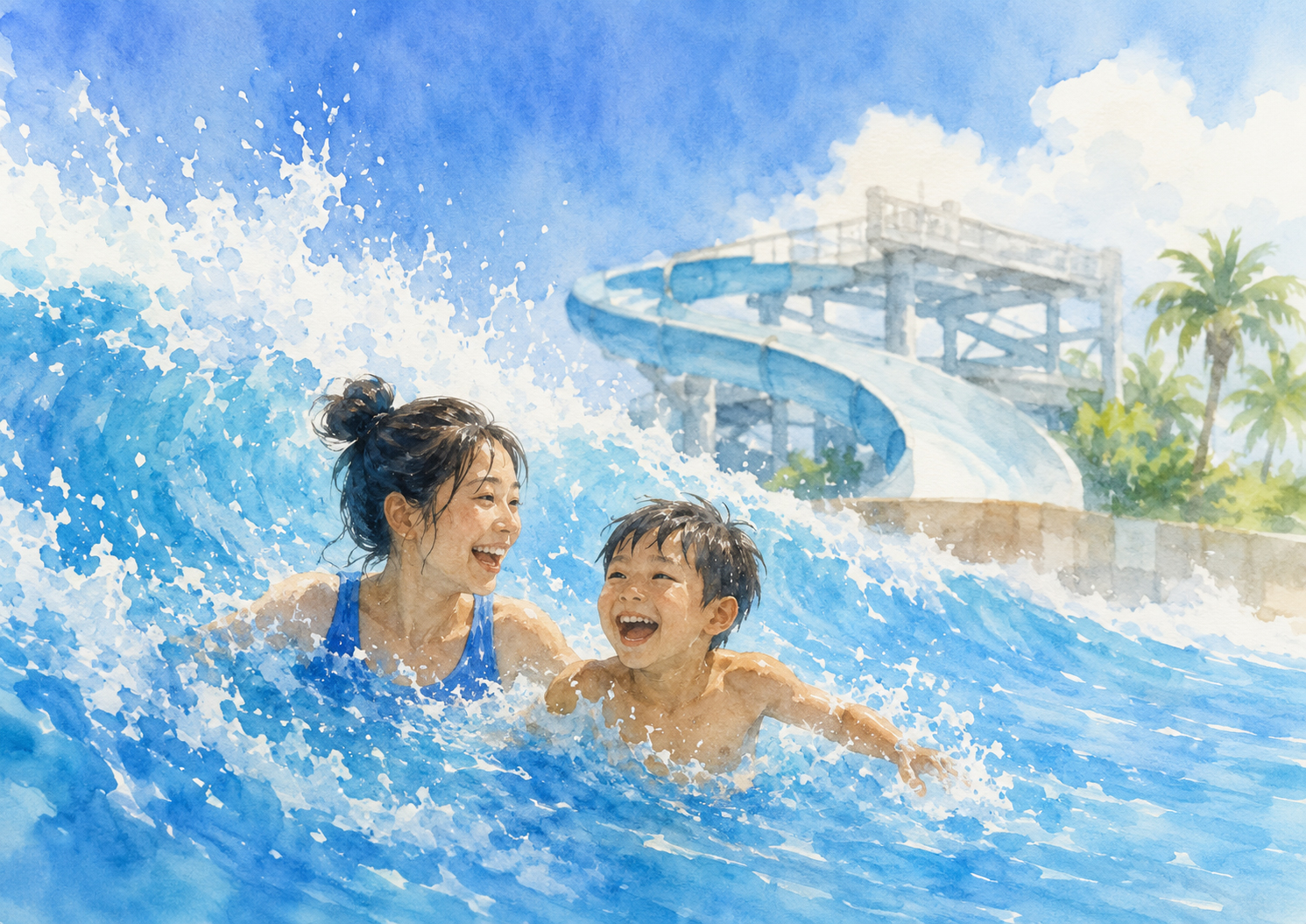
Summer in Japan has a sound: cicadas in the trees, station melodies under a hot roof, fireworks rolling somewhere beyond the river, and then the sudden roar of people hitting water. At Nagashima Spa Land in Kuwana, Mie Prefecture, that roar becomes almost architectural. The Jumbo Ocean Water Pool, scheduled for the 2026 season from July 11 to September 28, is not simply a pool. It is a daylong city of summer.
Nagashima Resort’s official site lists the 2026 opening of the Jumbo Seawater Pool for July 11 and promotes it as a world-class water park. The location matters. This is not an isolated swimming complex. It sits inside the wider Nagashima Resort, near Ise Bay, tied to an amusement park, hot springs, official hotels, outlet shopping, Nabana no Sato and family attractions. A visitor can build a day around water, then stretch it into coasters, shopping, onsen and a hotel night.
Nagashima as a water resort
That is the secret of Nagashima. The pool is huge, but size alone does not make a summer memory. What makes it work is the way the resort holds different kinds of visitors at once: families with toddlers, teenagers chasing thrill rides, couples looking for a summer date, grandparents managing shade and timing, coaster fans adding a water day to a roller-coaster trip, and travelers from Nagoya who want a full resort without flying anywhere.
Nagashima Spa Land opened in 1966, when Japan’s postwar economy was transforming leisure. Cars, family trips, hot-spring holidays and large-scale amusement parks were becoming part of the new middle-class imagination. Nagashima did not remain a single park. Over time, it grew into a resort cluster: amusement park, water park, onsen, hotels, outlet mall and flower park. That accumulation is why it still feels powerful in 2026. It is not one attraction trying to be everything. It is a small leisure kingdom.
Water was always part of the identity. The name Nagashima Onsen points back to the hot-spring roots of the place. Japanese hot springs traditionally mean recovery, bathing, eating, resting and staying overnight. Nagashima added speed, scale and family spectacle to that vocabulary. In the morning, a child can run toward the pool. In the afternoon, a teenager can chase slides. In the evening, parents can think about a hot bath. Excitement and recovery live on the same map.
From hot-spring retreat to leisure kingdom
The 2026 opening also arrives in a Japan where summer heat has become a serious editorial subject. Outdoor leisure now has to answer a harder question: how do people still go outside when the heat is punishing? A water park offers more than entertainment. It offers a kind of managed refuge. Families can move through wet zones, shaded areas, rest breaks and resort services while still feeling that they are having a holiday, not merely escaping the weather.
There is also a technology story underneath the splash. WhiteWater, the water-park design and manufacturing company, describes Nagashima’s Jumbo Ocean Water Pool as one of Japan’s largest outdoor water parks and notes major attractions including the world’s first Walhalla by WhiteWater, the giant Abyss funnel slide and Extreme Rivers. These are not ordinary slides bolted onto a municipal pool. They are engineered attractions involving capacity, flow, speed, turns, family raft dynamics and visual drama.
Mega Abyss captures the Nagashima personality particularly well. It is a water ride, but visually it belongs to the same family as the park’s steel monsters. A tower, a funnel, a drop, a scream, a moment of weightlessness, then relief. Nagashima’s amusement park and water park are often discussed separately, yet they share the same instinct: build big, make it visible, and let the structure itself become part of the visitor’s anticipation.
Why pools matter more in the age of extreme summer
On the dry side of the resort, that instinct produced coasters such as Steel Dragon 2000 and Hakugei. JNTO introduces Nagashima Resort as a place with about 60 attractions, summer water-park cooling, white-knuckle rides, outlet shopping and the gardens and illuminations of Nabana no Sato. In other words, the water park is not a side dish. It is one seasonally powerful part of a multi-part destination.
Access helps explain the resort’s strength. JNTO notes that Nagashima Resort can be reached by bus or car from the Nagoya metropolitan area and Mie, with buses from Nagoya Station and Kintetsu Kuwana Station. The Nagoya Station bus takes roughly 35 to 50 minutes depending on the destination in the resort, and a non-stop shuttle from Chubu Centrair International Airport is also listed. For international visitors, that matters. Nagashima may not have the overseas name recognition of Disney or Universal, but from central Japan it is very practical.
Its geography gives it a distinctive identity. Nagashima is not Tokyo and not Osaka. It belongs to the Tokai region, the Ise Bay corridor and Nagoya’s wide orbit. It suits cars, buses, family groups and overnight plans. Large regional resorts need more than a single headline attraction to compete with the glamour of the big metropolitan parks. Nagashima’s answer has been scale plus variety.
The water slide as roller coaster
The history of Japanese pools also runs through this story. In the Showa era, pools often meant schools, local facilities and simple summer recreation. By the Heisei period, wave pools, lazy rivers and big slides had become family-leisure anchors. In the Reiwa era, pools carry even more expectations: photo moments, safety, cooling strategies, toddler areas, multi-generation comfort, foreign visitors, special tickets and weather flexibility. Nagashima’s Jumbo Ocean Water Pool is a large-scale expression of that evolution.
The family dimension is especially important. A great summer pool cannot be only terrifying. It must have zones. It must let older siblings go after speed while smaller children stay in safer places. It must provide enough space for adults to rest, enough movement to keep teenagers interested, and enough clarity that a parent can plan the day. Nagashima’s combination of large slides, pools and kids’ areas makes the resort more than a thrill destination.
The resort model also changes the economics of a summer outing. A family can choose a day trip, but the surrounding hotels and onsen make overnight travel easy. Outlet shopping gives non-swimmers something to do. Nabana no Sato and seasonal events extend the appeal beyond the pool gate. That is why Nagashima can be a summer story and a travel story at the same time.
There are practical cautions. Big water parks require planning: crowd timing, sun protection, hydration, sandals for hot surfaces, locker strategy, children’s supervision, slide restrictions, weather updates and official operating calendars. The bigger the park, the more important it is not to treat the day like a checklist. Families with small children will usually have a better time by choosing a few zones carefully rather than attempting to conquer every attraction.
A practical resort from Nagoya
Why does Japan.co.jp like this story? Because Nagashima is a true Japanese summer machine. It does not rely only on characters or a single intellectual-property universe. Its appeal is more physical and social: the drive, the bags, the sunscreen, the wave pool, the slide tower, the bath afterward, the sleeping child in the hotel room. It is a giant infrastructure for making family memories under extreme heat.
Water does not erase summer’s difficulties. It does not remove crowds, humidity or long days. But it changes the emotional texture of heat. A hot day becomes a pool day. A tiring trip becomes a story. A child’s splash becomes the picture everyone remembers. That is the power of Nagashima’s Jumbo Ocean Water Pool in 2026.
This summer, the Ise Bay resort will fill again with water noise. Beyond the phrase “world-class water park” is something simpler and more durable: people trying to turn heat into happiness. Nagashima Spa Land has spent decades learning how to do that at scale. The 2026 Jumbo Ocean Water Pool season is another reminder that Japan’s summer is not only something to survive. Sometimes, with enough water, shade and courage, it is still something to play inside.
| Highlight | How to read it |
|---|---|
| Jumbo Ocean Water Pool | The summer-only water anchor of Nagashima Resort. |
| Mega Abyss and big slides | Nagashima’s coaster-like instinct translated into water. |
| Kids’ zones | Essential for making the park work for families with small children. |
| Nagashima Onsen | The recovery side of the resort: bath after splash. |
| Access from Nagoya | A central-Japan summer destination that is practical, not just spectacular. |
Sources and references
This article draws on public information from Nagashima Resort, JNTO, WhiteWater and Japan Guide. Operating dates, prices, restrictions, slide rules and weather-related changes may change; travelers should check the official site before visiting.
- Nagashima Resort official site: 2026 Jumbo Seawater Pool season notice, facility information, access and resort updates.
- Japan National Tourism Organization: Nagashima Resort travel overview, access, attractions, onsen and outlet context.
- WhiteWater: Nagashima Spaland water-park project, Walhalla, Abyss, Extreme Rivers and slide-technology background.
- Japan Guide: Nagashima Resort visitor overview and seasonal water-park context.