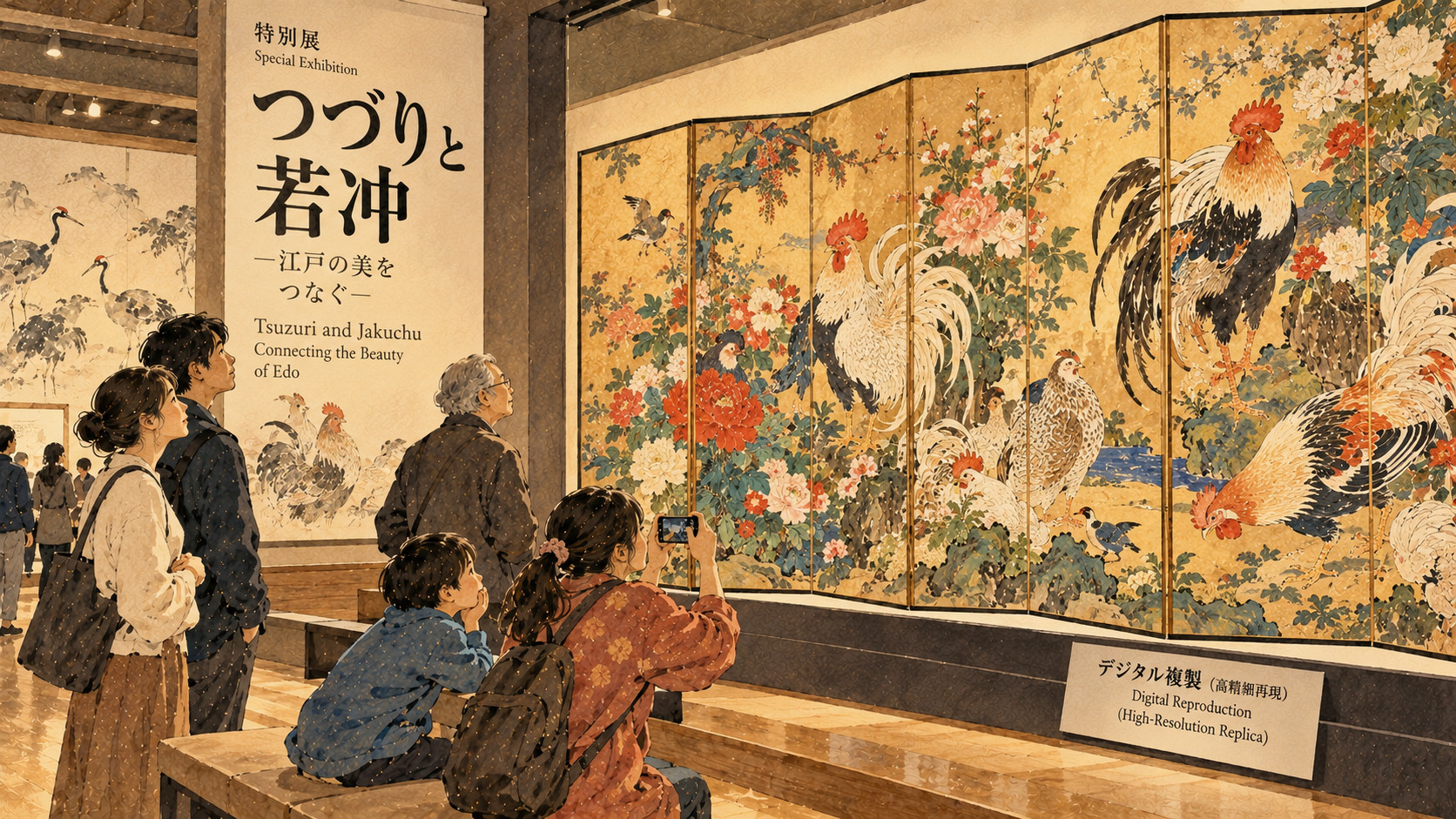
A facsimile is not the original. That is precisely why it can open a different door to fragile art.
The masterpiece is here. The original is not.
Visitors entering the Nagasaki Museum of History and Culture encounter extraordinary Japanese paintings. Yet the exhibition is unusually candid about a central fact: these are high-resolution facsimiles, not the originals. The distinction is the premise, not the small print. The show, devoted to the Tsuzuri cultural-heritage project, runs October 3 through November 8, with a new display period beginning October 20. Among the new arrivals is a reproduction of Ito Jakuchu’s astonishing Birds and Animals in the Flower Garden. The museum invites a larger question: can technology and craftsmanship bring people closer to art precisely by leaving fragile originals where they can be protected?
A change of screens on October 20
During the exhibition’s first period, October 3–18, visitors could see facsimiles of 15 of the 30 hanging scrolls in Jakuchu’s celebrated Colorful Realm of Living Beings (Doshoku Sai-e). From October 20 through November 8, a reproduction of Birds and Animals in the Flower Garden replaces that presentation. Those two Jakuchu displays should not be described as appearing together. The full exhibition brings together facsimiles representing 23 works by Japanese masters, but visitors should check the museum’s display schedule rather than assume each work is on view throughout. This changeover gives the October 21 edition a concrete reason to look anew at the exhibition.
An animal paradise assembled from tiny squares
The Shizuoka Prefectural Museum of Art owns the original Birds and Animals in the Flower Garden, a pair of six-panel folding screens. Elephants, lions, deer, monkeys, mythical beasts and brilliant birds crowd a fantastic setting. Its most peculiar feature is the method known as masume-gaki: the painter divided the surface into a grid of squares roughly one centimeter across, then built up color within them. From a distance it reads as an exuberant landscape; close up, it resembles a mosaic. Comparisons with pixels are tempting, but inaccurate if taken literally. This is painstaking pigment on paper, not an eighteenth-century digital image.
The painting is not entirely flat
In April 2026 Shizuoka's museum published high-resolution and three-dimensional imaging related to measurement work carried out in 2025. The analysis revealed variations in the thickness of pigment applied within Jakuchu’s grid, sometimes raised to produce subtle relief. These minute variations affect how the surface catches light. A photograph and print, however exact their color calibration, do not automatically recreate every feature of that physical topography. The finding makes this an especially revealing artwork with which to consider what a faithful copy can—and cannot—mean.
How a modern facsimile is made
Canon and the Kyoto Culture Association launched the Tsuzuri Project in 2007. Technicians photograph sections of an original work at very high resolution, adjust the colors against the source and print at full scale. Kyoto craftspeople then use traditional materials and mounting methods, potentially including gold leaf, gold paint and mica, to recreate qualities that a conventional print would miss. Canon describes a process bringing digital capture, color matching, printing and traditional finishing together. That is not the same as claiming an exact duplicate of every fiber, brushstroke or repair. It is an attempt to deliver meaningful access while reducing the handling and travel required of vulnerable works.
Why Nagasaki is more than a venue
A particularly resonant example is a Nanban folding screen whose original is at the Cleveland Museum of Art. A high-resolution facsimile was donated to Nagasaki Prefecture in fiscal 2024. The screen belongs to a tradition of depicting foreign merchants and ships arriving in Japan in the era of early modern overseas trade. In Nagasaki, where maritime exchange profoundly shaped the city, the subject is not simply exotic spectacle: it is local history. The exhibition also presents reproductions based on other important Nanban and ship paintings. A facsimile does not reverse the movement of an original into an overseas collection; it can, nevertheless, reopen access to a shared cultural memory.
Conservation is an argument for copies
Light-sensitive paintings on paper and silk cannot spend unlimited time under gallery lighting. Transport exposes fragile objects to environmental changes and physical risk, while conservation policies can restrict loans and exhibition periods. A sophisticated facsimile can help curators show an image to a regional audience without taking the same risks with the original. It may also enable teaching, close looking and photography under conditions that would be difficult for certain original works. Yet the physical object remains essential for research into materials, condition, authenticity, revisions and repair. A reproduction should expand the museum's vocabulary, not replace the original with a convenient fiction.
From wind gods to painted animals
The exhibition’s roster includes works associated with Tawaraya Sotatsu, Kano Eitoku, Hasegawa Tohaku, Hishikawa Moronobu, Ogata Korin, Soga Shohaku and Katsushika Hokusai. The breadth matters. Jakuchu’s busy mosaics and Sotatsu’s boldly arranged Wind and Thunder Gods do not embody one single timeless Japanese style. They record different eras, patrons, materials and artistic arguments. The museum’s own catalog identifies such works as facsimiles, allowing viewers to connect them with the originals in their different collections. The better the reproductions become, the more important accurate curatorial labels and provenance become as well.
The economics and ethics of access
The Tsuzuri partners report producing more than 60 high-resolution facsimiles and placing them with museums, municipalities, religious institutions and other organizations. Their public purpose is clear, but it leaves serious policy questions. Who grants imaging rights? Who pays to make, repair or replace a replica? How are the master image files governed? Does a donated facsimile lead to sustained access for schools and smaller communities? And when a work is held overseas, how can institutions describe an emotional “return” without suggesting that legal ownership or provenance has changed? These questions are part of the cultural value, not distractions from it.
What visitors should know
The exhibition is in the museum’s third-floor special exhibition gallery at 1-1-1 Tateyama, Nagasaki. It runs 9 a.m. to 6 p.m., with last admission at 5:30 p.m. Adult admission is ¥1,000; visitors of high-school age and younger enter free, with other exemptions and discounts under the museum's rules. The gallery was closed for the October 19 changeover, while the second display period runs October 20 to November 8; November 2 is also listed as a closure day. The organizers have scheduled an October 25 discussion with representatives of Canon and the Kyoto Culture Association. Verify the most recent visitor details directly with the museum.
Not a substitute, but an invitation
The most productive way to see Nagasaki's facsimiles may be to accept their imperfections along with their extraordinary precision. The reproductions cannot travel backward through time, carry every microscopic detail of the originals or resolve debates about ownership. They can make rare art visible to students, local communities and travelers who would otherwise never stand before it. Jakuchu’s improbable animals offer a particularly fitting invitation. Look closely enough and the image becomes a record of patient human labor—not only the painter’s, but the conservators', photographers', printers' and craftspeople's work required to share it today.
Sources and further reading
Based on museum and project primary materials. No original on-site reporting or interviews were conducted.