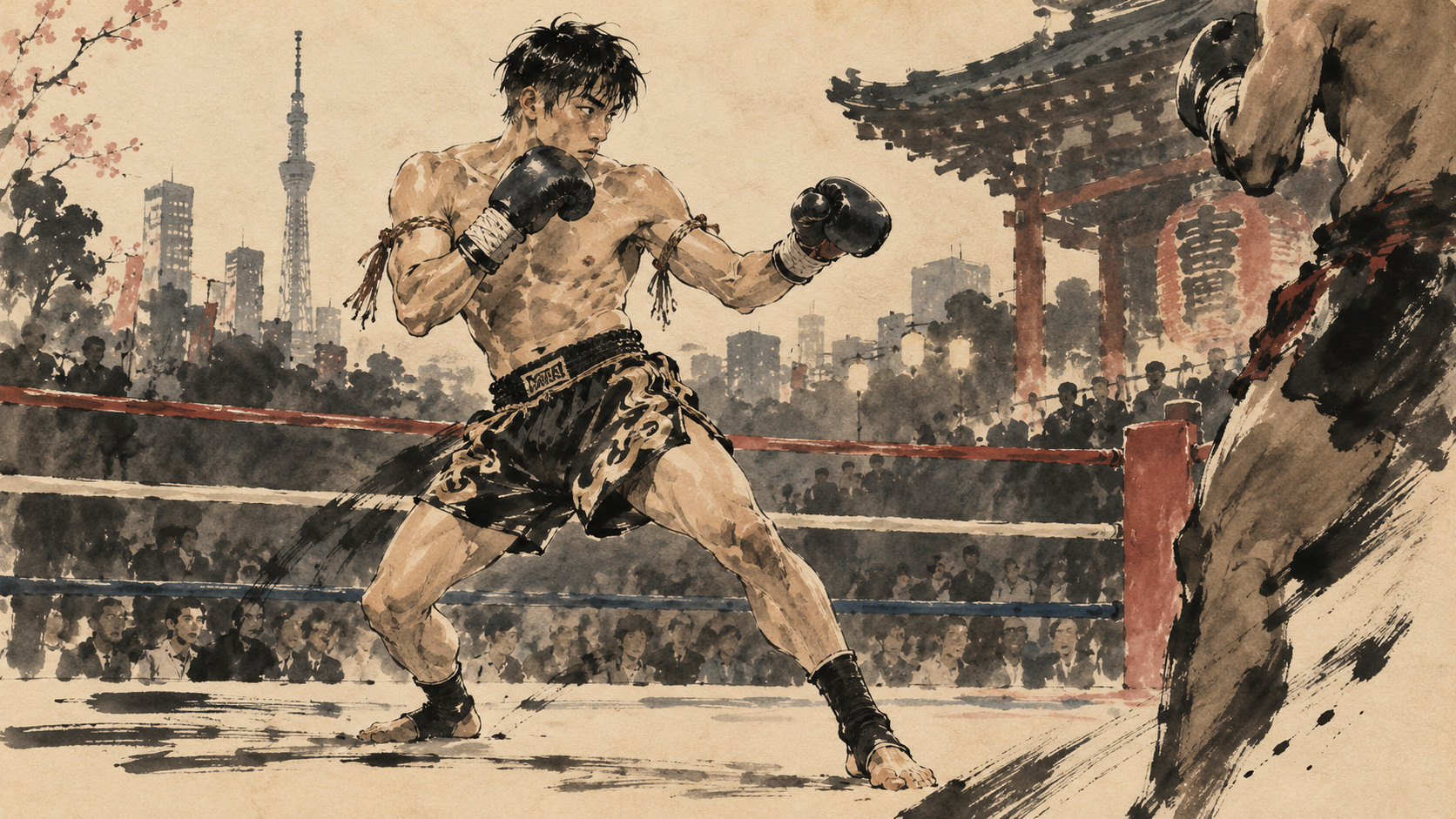
A winning streak means more when we understand which fights and which rules it includes.
A finish measured in 58 seconds
The decisive moment in Tokyo came after one round of precision and less than a minute of the second. On October 17 at Ariake Arena, Japan’s Nadaka Yoshinari stopped Malaysia’s Rifdean “Magic Boy” Masdor with a high kick and follow-up referee intervention at 0:58 of round two. ONE Championship recorded a technical knockout; Japanese ringside reporting described the decisive left high kick. The result extended a winning streak that ONE and multiple Japanese outlets put at 43 bouts, and marked Yoshinari’s second successful defense of the promotion’s atomweight Muay Thai championship. The number makes a headline. The more revealing story is the way this 25-year-old Japanese fighter has learned to win in a sport whose traditional centers of power lie in Thailand.
An important qualification: the challenger missed weight
The contest did not take place under entirely ordinary title-fight conditions. ONE announced on October 16 that Masdor had failed to make the atomweight limit during the official window. He later passed a hydration test and weighed 118.6 pounds, but was ruled ineligible to win the championship. The five-round contest nevertheless remained on the card. Yoshinari’s belt therefore could not have changed hands to Masdor under those conditions, although Yoshinari still faced a live opponent in a sanctioned bout. Reporting this detail is essential: a decisive victory does not erase what the pre-fight rules meant for the title stakes. Nor should the episode be simplified into a claim that Masdor failed hydration altogether: ONE says he subsequently passed.
How the finish was made
Japanese reporting describes an early knockdown from Yoshinari’s compact left straight in the first round. In the second, Masdor turned into a spinning attack; Yoshinari evaded the movement and connected with a left high kick as the challenger came around. The referee stopped the fight. The strike drew attention not merely for power but for timing—the ability to recognize an exposed angle in the narrow interval after an opponent commits. This description is based on the promoter’s result and contemporary ringside accounts; it is not an independent frame-by-frame technical analysis. Yoshinari emerged from the fight with a reported ¥15 million performance bonus, announced by ONE chairman and chief executive Chatri Sityodtong.
Forty-three wins: one streak, different rule sets
The 43 consecutive wins are not 43 fights inside ONE Championship, and the claim must not be confused with a career-long undefeated record. ONE described Yoshinari as carrying a 42-fight run into October 17, including his September kickboxing victory at ONE SAMURAI 3. The streak encompasses contests staged by different organizations and under more than one striking ruleset. ONE’s biographical record separately lists losses earlier in his professional career. A fully independent, fight-by-fight audit of the entire 43-bout sequence was not available for this report. The article therefore attributes the streak to the promotion and the contemporaneous Japanese sports record, rather than treating every underlying bout as newly verified by Japan.co.jp.
From Yokosuka to Bangkok’s stadiums
Born in Kanagawa Prefecture and associated with Eiwa Sports Gym, Yoshinari was competing professionally in Thailand while still a teenager. ONE’s career history places his professional debut at Bangkok’s Lumpinee Stadium at age 14. Early defeats mattered. His training path also required balancing school with an increasingly demanding fight schedule; in a 2026 interview carried by ONE, he described initially struggling to establish the morning-and-evening practice routine he wanted. That history challenges the easy portrait of an athlete who simply discovered an effortless gift. What appears instantaneous under bright arena lights rests on years of carefully rehearsed movements, bouts, setbacks and travel.
What it means to win in Thailand
Muay Thai is rooted in Thailand and has distinctive scoring traditions, rituals and competition institutions. Rajadamnern and Lumpinee are not just picturesque stadium names: they are central stages on which generations of elite fighters have sought recognition. Yoshinari won titles associated with both stadiums and collected championships in multiple weight classes. ONE credits him with three Rajadamnern championships and a Lumpinee title. Those honors make him unusual among non-Thai fighters, but claims such as “the greatest” or comparisons across eras demand far more than a promotional biography. The lasting achievement is that a Japanese specialist earned recognition in the sport’s home market before rising on a globally distributed platform.
The ascent through ONE
Yoshinari entered ONE in 2025 and, in November that year, defeated Numsurin Chor Ketwina at ONE 173 to become its inaugural atomweight Muay Thai champion. His first defense came in April 2026 against Songchainoi Kiatsongrit at ONE SAMURAI 1. A September 2026 victory under kickboxing rules offered a different test, before his return to Muay Thai in October. This arc underscores the point: Muay Thai and kickboxing share strikes and athletic skills, but differ in allowable techniques, clinch opportunities, scoring conventions and tactical rhythms. The transition between them is neither automatic nor trivial.
A sports business reaching beyond Thailand
ONE has built an international platform across Muay Thai, kickboxing and mixed martial arts, giving Japanese fighters a stage visible to viewers beyond traditional domestic arenas. Tokyo’s ONE SAMURAI series also offers a way to test the local appetite for international-format fight cards, subscriptions and sponsorship. But ONE’s commercial claims and audience metrics require independent evaluation. A victory bonus is not itself evidence that the sport has achieved lasting mass-market penetration in Japan. Questions remain over fighters’ contractual economics, the costs of maintaining a career, and who benefits from expanding distribution.
Why humility mattered after the knockout
There was a human counterpoint to the spectacle. Japanese post-fight reporting described Yoshinari asking the Tokyo audience to applaud Masdor, acknowledging the difficulty of preparing away from home and the weight-limit complication without dismissing the challenger’s effort. His reported remarks also stressed that he had improvements to make despite the win. Those comments, attributed to the ringside reports rather than an original Japan.co.jp interview, complicate the familiar picture of the invincible champion. The fighter who delivered the startling high kick still saw things that had gone wrong.
The real measure of a remarkable run
What comes after victory number 43? The answer is not an inevitable 44th. Opponents study film; divisions change; the demands of travel, training and repeated weight cuts accumulate. The story of Nadaka Yoshinari is more substantial than an extraordinary numeral. It concerns the export and exchange of combat-sport expertise between Japan and Thailand, the different tests imposed by changing rules, and how a fighter’s skill survives scrutiny over time. On October 17, the contest ended at 58 seconds of the second round. The longer argument about his place in the sport is still unfolding.
Sources and reporting notes
Verified against official event and weigh-in records, contemporary independent Japanese reporting, and career background. No original interviews or bout-by-bout verification of the complete 43-fight streak.
- ONE Championship: event and official result
- ONE Championship: weigh-in and hydration update
- ONE Championship: Japanese event report, October 19
- Nikkansports: October 17 fight report
- Daily Sports: opponent’s weight and post-fight remarks
- ONE: Yoshinari athlete biography
- ONE: seven-year unbeaten run and personal history
- ONE: Thai stadium titles and career development
- ONE Japan: 2026 first title defense