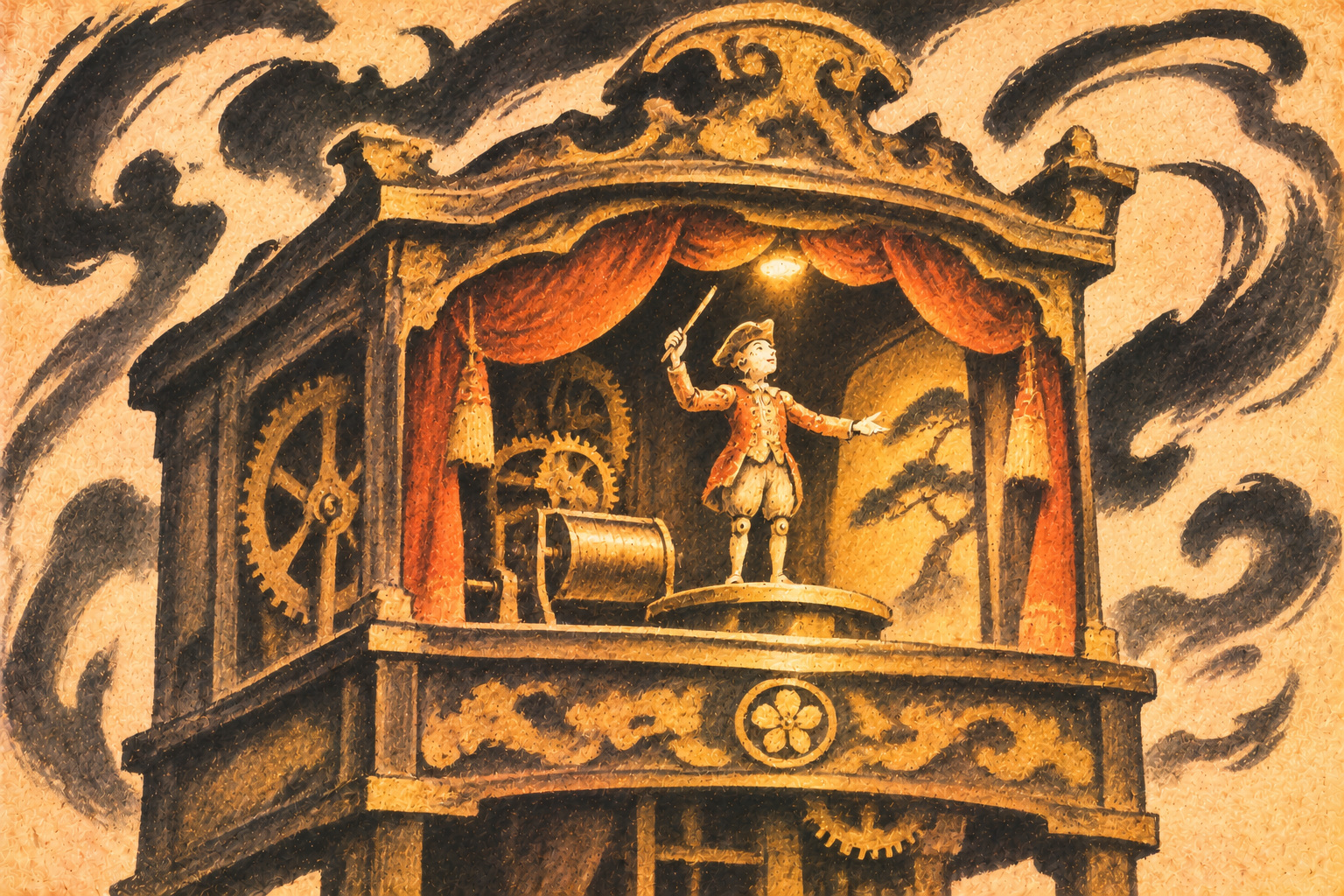
- A theater small enough to fit inside a cabinet
- A debut titled Robert and John’s Night Paradise
- Who is MUTTONI?
- The machinery is part of the drama
- The art of making a gesture mean something
- From Edo automata to twentieth-century theater
- Why Hachioji has become a recurring stage
- When the artist becomes the narrator
- How to visit and what to expect
- The human imagination inside a machine
A theater small enough to fit inside a cabinet
Imagine an audience gathered around a cabinet. The stage is scarcely larger than a display case, yet light rises, an articulated figure begins to move, music suggests a setting and suddenly the viewer supplies an entire world beyond the box. The performance lasts minutes; its afterimage may last far longer.
On November 14, Hachioji Yume Art Museum opens World of MUTTONI – Automaton Theater VI, running through January 11, 2027. Its sixth exhibition in this series promises more than 20 mechanical theaters, including a previously unseen work. This November 13 report is an advance feature drawn from the museum's published materials, not an eyewitness review of an exhibition that has yet to open.
A debut titled Robert and John’s Night Paradise
Among the chief attractions is Robert and John's Night Paradise, identified by the museum as a 2024–2026 work receiving its first public showing. That description matters: a title is not a plot synopsis, and promotional images cannot establish how the automaton behaves over the course of its performance.
The announced selection includes Jungle Paradise, Hell Paradise, Satellite Cabaret and Cantate Domino, alongside 2026 pieces and works making their Hachioji debut. The program is described as specially assembled by the artist, with the final lineup subject to change. A credible exhibition preview should not pretend to know the unreleased piece's narrative or internal engineering.
Who is MUTTONI?
MUTTONI is the professional name of Masahiko Mutō (武藤政彦), born in Yokohama in 1956. In his own account, childhood play centered on telling stories and fashioning scenes from modeling clay. He later played trumpet and painted in oils, disciplines that already suggest the combination of narrative, rhythm and visual staging that would come to distinguish his mature work.
He completed the research course at Sokei Art School in 1979. After traveling in Europe in the mid-1980s, he gradually turned from painting toward three-dimensional work. In 1987 he presented his first motor-driven automaton, Heaven and Hell. Around 1990, he developed a box-theater format uniting articulated characters, sound, changes of scene, lighting and his own spoken narration. The dates come from the artist's official biography, not retrospective guesswork.
The machinery is part of the drama
A conventional sculpture is usually encountered as an object in space. A mechanical theater also makes a claim on time. It must arrange an entrance, a pause, a gesture, a shift in light and an ending. In that sense, a cabinet can function like a proscenium stage, with an unseen backstage reserved for the mechanisms that make the apparent magic possible.
The museum says MUTTONI personally designs, assembles and wires the mechanisms as well as creating the figures and their decorated settings. This is a remarkable kind of integrated authorship. It does not, however, establish which motors, controllers or fabrication methods each exhibit uses. Descriptions of electronic precision or complex gearing should remain informed interpretation unless a technical specification is published.
The art of making a gesture mean something
The difference between an automated motion and a theatrical gesture is not merely speed. A head turning after a long silence can suggest apprehension; a hand rising as the lights change can become a revelation. Lighting and sound redirect the spectator's attention, while mechanical timing can make the smallest action feel consequential.
That helps explain why the finished box does not simply demonstrate engineering. A spectator watches an elaborate physical system and nevertheless experiences uncertainty, anticipation or humor. How individual visitors interpret those feelings is open; the artist's documented schedule does not license an invented account of what the unshown characters do.
From Edo automata to twentieth-century theater
Japan's older karakuri traditions provide a useful historical backdrop. Edo-period automata, including figures designed to serve tea, turned hidden mechanisms into moments of public astonishment. Mechanical dolls, clocks and ingenious small machines sit within a larger history of Japanese craft, mathematics and performance.
But resemblance is not proof of a direct technological lineage. MUTTONI's practice also invites comparison with dioramas, miniature stages, musical boxes, cinematic scene changes and modern installation art. His distinctive contribution is not the mere fact that something moves. It is the arrangement of movement into self-contained dramatic time, informed by painting, sound and storytelling.
Why Hachioji has become a recurring stage
This is the sixth World of MUTTONI / Automaton Theater exhibition at Hachioji Yume Art Museum. The museum also holds six works on deposit, according to its exhibition release. The 2026 lineup is expected to bring together larger showpieces, first-time presentations and deposited works such as Another Wings and Flowers, Origin, and Love.
More than 20 machines sounds like a catalog of objects, but motion complicates museum-going: the visitor encounters works unfolding at different moments. A room of automata is an exhibition of durations as much as an exhibition of sculptures. What may look static in a photograph might need patient attention in person.
When the artist becomes the narrator
There will be special live presentations in which MUTTONI introduces the works and tells their stories. The museum schedules them at 1 p.m. and 4 p.m. on Saturdays, Sundays and public holidays during the exhibition, around 45 minutes each. It currently lists 18 days and 36 sessions; admission to the exhibition is required, but no separate performance fee or advance booking is specified.
The contrast is fascinating: the automata move by mechanical means, yet a human voice can change the experience of the story. Rather than replacing a performer, the device collaborates with one. The museum cautions that crowded conditions may cause sessions to change or be suspended, so schedules should be checked near the visit.
How to visit and what to expect
The museum occupies the second floor of View Tower Hachioji, 8-1 Yōkamachi, Hachioji, Tokyo. Exhibition dates are November 14, 2026–January 11, 2027; hours are 10 a.m.–7 p.m., with last admission at 6:30 p.m. Regular closures are Mondays, with holiday exceptions, and December 28–January 4. Admission is ¥1,000 for adults, ¥500 for students of high-school age and above and visitors aged 65 or older, and free for children of junior-high-school age or younger.
The museum gives approximate walks of 15 minutes from JR Hachioji Station and 18 minutes from Keio Hachioji Station. Because light and darkness are essential to the presentation, visitors should expect a dimly lit gallery. Check the current museum notice for performance sequencing and photography restrictions rather than assuming standard gallery rules.
The human imagination inside a machine
We live amid increasingly ambitious claims that software and robots can generate culture, perform labor and imitate intelligence. MUTTONI offers a more intimate encounter with automation. The apparatus is emphatically made, adjusted and composed by a person, and its purpose is not productive efficiency but attention and feeling.
The exhibition may be an unusually good place to ask what a machine actually contributes to art. Motors can repeat a motion; they cannot determine how an audience will interpret the silence after it stops. That gap—between a programmed sequence and an imagined story—is where MUTTONI's miniature theaters find their scale-defying power.
Primary sources and reporting limits
Source note: This is a pre-opening report. The announced number of works and presentation schedule may change.