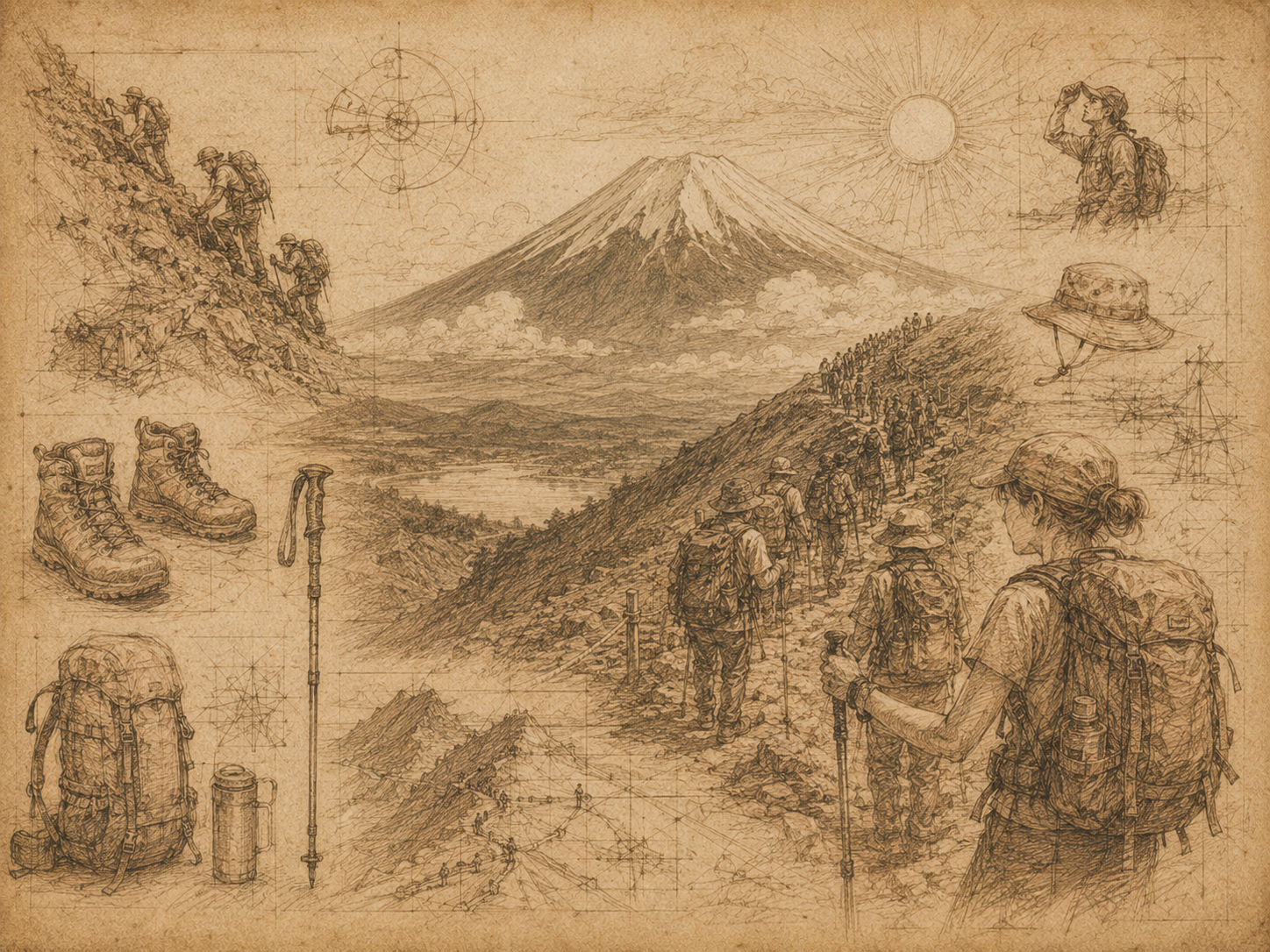
Mount Fuji looks easy from far away. A perfect cone, a blue sky, a cloud line, a memory from ukiyo-e prints. But once a climber stands on the summer trail, the mountain changes. Volcanic gravel slips underfoot. Shade disappears. The air thins. Hut reservations, hiking fees, gates, gear checks, crowds, heatstroke, hypothermia and altitude sickness all become part of the climb. In 2026, Fuji is no longer just “the mountain everyone wants to climb.” It is the mountain that asks whether you prepared.
For the 2026 season, the official climbing site lists the Yoshida and Subashiri trails as opening on July 1, with the Fujinomiya Trail, Gotemba Trail and crater-rim walk scheduled for July 10. A ¥4,000 hiking fee applies to all four main routes. From 2 p.m. to 3 a.m., entry is restricted unless the climber has a mountain hut reservation. The Yoshida Trail maintains a daily cap of 4,000 climbers.
The purpose is not to close Fuji. It is to keep it open safely. Mount Fuji is a World Cultural Heritage site, a sacred mountain, an artistic icon, a national park destination and a modern global tourist magnet. The question in summer 2026 is no longer how many people can be attracted to Fuji. It is how many can climb responsibly.
What changed for Fuji climbing in 2026
The most important 2026 shift is that Fuji now expects preparation. The official site emphasizes online reservation or registration, payment of the hiking fee, entry-control hours and proper equipment. On the Yoshida Trail, the 4,000-person daily cap remains in place, and reservations close once the cap is reached. Shizuoka-side trails also have opening-period controls tied to the season.
This did not begin in 2026. In 2024, Yamanashi introduced a paid gate and cap on the Yoshida Trail to confront crowding, litter, unsafe “bullet climbing” and poorly equipped hikers. Reuters reported the broader context: a weak yen, surging inbound tourism, crowded photo spots, trail pressure and environmental strain. Mount Fuji became one of the most visible front lines of Japan’s overtourism debate.
The 2026 rules continue that shift. They are not designed to make Fuji exclusive. They are designed to make responsible climbing normal. Reserve, register, pay, prepare, rest, and do not rush through the night without a hut. Safety and preservation are becoming part of the ticket.
From sacred mountain to global tourism icon
Fuji’s story is much older than the modern climbing boom. UNESCO inscribed Fujisan as a World Cultural Heritage property because it is both a sacred place and a source of artistic inspiration. The listing covers not only the summit, but 25 component sites including shrines, routes, lakes, springs and coastal views. Fuji was recognized not simply as a natural wonder, but as a mountain shaped by centuries of faith, poetry, pilgrimage and art.
In the medieval period, Fuji became a place of ascetic practice blending Buddhist and Shinto elements. In the Edo period, Fuji-ko pilgrimage associations spread, especially among ordinary people in and around Edo. Pilgrims climbed in white clothing, and miniature Fuji mounds were built in cities for those who could not make the journey. Fuji was a destination, but also an idea people carried into everyday life.
Hokusai and Hiroshige made Fuji global before airplanes did. Their prints fixed the mountain in the world’s visual imagination: behind waves, streets, fields, travelers and weather. Today’s visitors photograph Fuji with phones instead of woodblocks, but they are part of the same long culture of looking at the mountain.
Why Fuji is dangerous
Mount Fuji is not a technical alpine wall. Climbers do not need ropes or glacier gear in the summer season. That is exactly why it can be underestimated. At 3,776 meters, the summit is high enough for altitude sickness. Headache, nausea, dizziness and impaired judgment can happen regardless of age or fitness.
The weather can also turn quickly. A climb that begins in heat can end in strong wind and cold near the summit. If rain soaks a climber and wind rises, hypothermia is possible even in summer. At the same time, the lower trails have little tree shade, and long stretches expose hikers to direct sunlight. The official site warns that Fuji climbers must consider heatstroke as well as altitude sickness and hypothermia.
Fuji can be hot and cold on the same day. Sweat at the fifth station, breathlessness at the eighth, numb fingers near sunrise. That is why T-shirts, sandals, shorts and city sneakers are not enough. Sunshine does not cancel the need for rain gear. Summer heat does not cancel the need for insulation.
Gear is not fashion. It is safety.
The first piece of gear to take seriously is footwear. Fuji’s volcanic gravel is slippery, especially on descent. Hikers need proper boots or sturdy trekking shoes with grip and ankle support. The next essential is rain gear: a jacket and pants, not an umbrella. Strong wind makes umbrellas dangerous and impractical.
Cold-weather layers are also mandatory. A fleece, light down layer, gloves, hat or beanie, neck warmer and quick-drying base layers can be the difference between discomfort and danger. A headlamp, spare batteries, water, salty snacks, food, sunscreen, sunglasses, hat, cash, portable charger and basic first aid kit should be part of the plan.
The official climbing site identifies hiking boots, rain gear and cold-weather clothing as essential, and notes that equipment may be checked before entry to mountain areas. This is not bureaucracy for its own sake. It is rescue prevention. Fuji is a mountain you climb, not a view you are carried to.
The magnet of sunrise, and the problem of crowds
Fuji’s crowding is not only about how many people climb. It is about how many people want the same moment. The summit sunrise, or goraikō, pulls climbers toward one narrow time window. People walk at night, converge near the top, stop, photograph, shiver and wait. Fatigue, darkness, cold and crowds combine.
The most criticized pattern is bullet climbing: attempting to climb through the night without resting at a hut in order to see sunrise and descend quickly. It saves money and time, but increases the risk of altitude sickness, fatigue, falls and poor judgment. The Fujisan World Cultural Heritage Council’s safety rules specifically urge climbers to plan with enough time and to rest at a hut.
The 2026 entry restriction is a direct response. From 2 p.m. to 3 a.m., climbers without hut reservations cannot enter. The rule does not simply ban night climbing. It pushes climbers away from reckless overnight itineraries and toward safer, staged climbs.
The four routes, four personalities
Fuji’s four main routes each have a distinct character. The Yoshida Trail, on the Yamanashi side, is the most popular and has the most huts and services. It is often the easiest route for first-timers to understand, but it is also the most crowded. The Fujinomiya Trail is shorter but steeper and has more shared ascent/descent sections. The Subashiri Trail begins with more forest and then merges with Yoshida higher up. The Gotemba Trail is long, less crowded, and physically demanding because of the greater elevation gain.
Route choice should not be based only on fame or crowd avoidance. Climbers should consider fitness, experience, hut availability, transportation, opening dates, descent route and weather. In 2026, Subashiri aligns with Yoshida on a July 1 opening, while Fujinomiya and Gotemba are scheduled for July 10. Early-season climbers must check which route is actually open.
For beginners, the important thing is not “choose Yoshida because it is famous” or “choose Gotemba because it is quieter.” The important thing is to choose the route that matches your body, your schedule, your equipment and your exit plan. Many climbers discover that descending Fuji is harder than climbing it.
Fuji and overtourism
Fuji’s climbing rules belong to a larger Japanese story. Kyoto, Himeji Castle, Shirakawa-go, Nara, Kamakura and Niseko all face the same tension: Japan succeeded in attracting the world, and the world concentrated in a few iconic places.
On Fuji, the consequences are sharper than in a city. Litter, unprepared hikers, dangerous night climbing, crowded trails, toilets, rescue work, buses and road access are not only management issues. In bad weather or high altitude, they can become life-and-death issues. That makes fees and access controls more urgent here than at many ordinary attractions.
The ¥4,000 hiking fee should not be understood as a simple admission ticket. It is a contribution to preservation, safety support, guidance, facilities and the shared cost of keeping the mountain open. Paying it does not buy the right to behave carelessly. It confirms an obligation to climb responsibly.
Fuji is a volcano
Mount Fuji’s beauty can obscure its geology. JNTO notes that volcanic activity forming Fuji began roughly 100,000 years ago. The last major eruption, the Hōei eruption of 1707, sent ash as far as Edo. The mountain’s stillness today is not a guarantee of eternal silence. Its slopes, gravel, crater, lava, lakes and springs are all part of its volcanic story.
Climbers feel that geology underfoot. The trail is black, red and gray. The ground is loose. Above the treeline, the landscape becomes austere. The elegant cone seen from Tokyo contains a harsh volcanic interior.
That duality is Fuji’s power. From far away, it is an image. Up close, it is a mountain of ash, wind and rock. It is sacred site, tourist destination, active stratovolcano, national park, World Heritage landscape and physical challenge all at once.
Japan.co.jp’s climbing advice: choose the slower Fuji
For 2026, Japan.co.jp’s clearest advice is simple: slow down. Use a mountain hut if possible. Start early. Do not plan around beating the gate. Turn back if weather deteriorates. Do not treat the summit as the only valid experience. Sunrise from the eighth station can be unforgettable too.
Heat planning matters as much as cold planning. Bring a hat, sunglasses, sunscreen, water, salt, and real rest breaks. Fuji is not a place to escape summer heat. It is a place where direct sunlight, altitude, wind and cold can all appear in one itinerary. Good gear must handle both ends of that range.
For foreign visitors, Fuji may be Japan’s most legible dream. But dreams are not enough. Reservation, fee, gear, fitness, timing, weather and manners all matter. Prepare well, and Fuji can still give what pilgrims, painters and travelers have sought for centuries: a view that feels larger than ordinary life.
Reader guide
| Topic | What to know |
|---|---|
| 2026 opening | Yoshida and Subashiri opened July 1; Fujinomiya, Gotemba and the crater-rim walk are scheduled for July 10. |
| Fee | All main routes require a ¥4,000 hiking fee. |
| Entry hours | From 2 p.m. to 3 a.m., entry is restricted unless you have a mountain hut reservation. |
| Crowd control | The Yoshida Trail maintains a 4,000-climber daily cap; reservations and registration should be checked in advance. |
| Gear | Boots, rain jacket and pants, warm layers, headlamp, water, food, sun protection and cash are basic necessities. |
| Japan.co.jp view | Fuji is a tourism icon, but first it is a high mountain and a sacred cultural landscape. Climb with safety and respect. |
Sources and references
This article draws on the Official Website for Mt. Fuji Climbing, 2026 Yamanashi and Shizuoka route regulations, JNTO, UNESCO, the Fujisan World Cultural Heritage Council, and Reuters reporting on Mt. Fuji access controls.
- Official Website for Mt. Fuji Climbing: 2026 opening schedule and route information.
- Official Website for Mt. Fuji Climbing: common rules, ¥4,000 hiking fee, registration, equipment checklist.
- Official Website for Mt. Fuji Climbing: Yoshida Trail 2026 restrictions, 4,000 climber daily cap, gate hours.
- Official Website for Mt. Fuji Climbing: Shizuoka-side opening schedule for Subashiri, Fujinomiya and Gotemba trails.
- Official Website for Mt. Fuji Climbing: altitude sickness, hypothermia and heatstroke precautions.
- UNESCO World Heritage Centre: Fujisan as sacred place and source of artistic inspiration.
- Japan National Tourism Organization: Mt. Fuji’s height, volcanic history and cultural profile.
- Reuters: Mt. Fuji access controls, crowding, litter and bullet-climbing context.