- The woman who helped give Tokyo a night-time identity
- Tokyo Tower was not always the night-time icon we know
- Light is an engineering material—and an artistic one
- An unusual path from art school to a new profession
- The bridges that made infrastructure part of the skyline
- Castles and villages: the challenge of lighting history
- When a Japanese idea of light traveled abroad
- From 180 lamps to 268 LEDs: a changing technology
- Recognition accumulated over decades
- A city’s nightscape has many authors
- A problem for cultural conservation: light is temporary
- What should the next generation of city lighting accomplish?
The woman who helped give Tokyo a night-time identity
On November 3, 2026, lighting designer Motoko Ishii received Japan’s Order of Culture at the Imperial Palace. The government lists her discipline with unusual specificity: “Design (Lighting).” The award recognizes work that is constantly visible, yet seldom credited to an artist. Millions have looked at illuminated bridges, towers and historical buildings without necessarily knowing who planned the light. Ishii helped make that planning a recognizable profession.
At 88, she was one of eight people named for the 2026 honor. Seven attended the ceremony; Ishii was among them and spoke on behalf of the recipients. Her recognition offers a way to examine a question that belongs as much to city planning as to art: who decides what a city should look like after sunset?
Tokyo Tower was not always the night-time icon we know
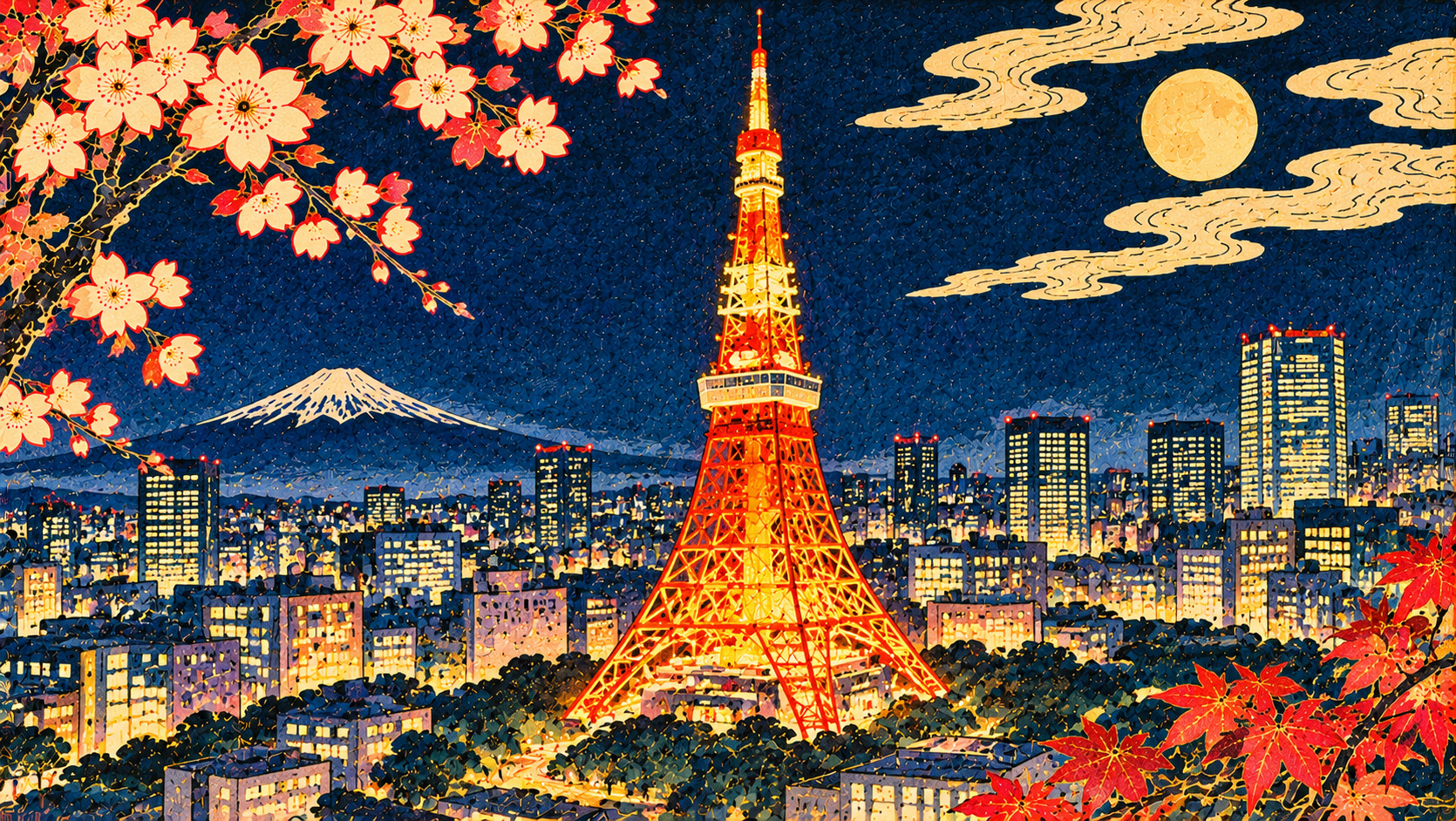
The present lineage of Tokyo Tower’s landmark illumination dates to January 1, 1989. According to the tower’s official history, the “Landmark Light” system uses 180 lamps, historically switching between warm orange high-pressure sodium lamps for most of the year and cooler metal-halide lamps in summer. Ishii’s name is closely associated with the transformation.
Its purpose was not simply to make Japan’s famous steel lattice brighter. Directional light emphasizes the structure, allowing the tower’s own geometry to tell the story. The result is a distinctive silhouette that can be recognized across the city. Illumination here becomes an act of selecting and editing the urban landscape.
Light is an engineering material—and an artistic one
Lighting design occupies the boundary between vision and measurement. Illuminance describes how much light reaches a surface; luminance concerns how bright that surface appears. Beam distribution, glare, contrast, color temperature, maintenance access and energy use alter the visual result. Every beautiful photograph has a technical system outside its frame.
A lighting designer must decide what remains dark as carefully as what becomes visible. A bridge can be read as a line across water; a castle can be made to appear almost theatrical; a public square can become legible without being flooded with light. These choices affect people who never asked to become spectators. That is why the design of public illumination is never just decoration.
An unusual path from art school to a new profession
Ishii was born in Tokyo in 1938, studied at Tokyo University of the Arts and entered design work in 1962, according to Tokyo Metropolitan Government’s official profile. She then trained in Finland and Germany beginning in 1965 before establishing her own lighting-design practice in 1968. The firm’s own biography confirms the broad trajectory.
The timing matters. Japan was remaking its infrastructure and public architecture during decades of rapid growth. For a specialist, there was an opportunity to argue that illumination ought to be considered while a building or bridge was being designed—not added as an afterthought once construction was finished.
The bridges that made infrastructure part of the skyline
The practice’s recorded projects range from Rainbow Bridge and Yokohama Bay Bridge to Akashi Kaikyo Bridge and Tokyo Gate Bridge. Its award history credits the Rainbow Bridge work with a 1994 North American lighting award. These are enormous pieces of infrastructure, but they are also objects seen by residents and visitors from a distance, sometimes every evening.
The illumination does not negate the contributions of architects, engineers, public authorities, electrical contractors and maintenance crews. Indeed, the achievement is collaborative. Ishii’s role illustrates why a city-scale lighting concept requires many disciplines to work toward a shared visual outcome.
Castles and villages: the challenge of lighting history
Ishii’s portfolio includes Himeji Castle, Shirakawa-go’s traditional gassho-style village and the reconstructed Daigokuden at the Heijo Palace site, alongside the Kabukiza theater. These projects bring the designer face to face with a delicate dilemma: illumination can reveal historical form, but it can also flatten texture and reshape the setting in ways that daytime conservation never intended.
The issue extends beyond aesthetics. Protected sites require thoughtful decisions about visitor safety, disturbance, visual authenticity and the effect on neighboring residents. The architect of an evening scene does not own the history it illuminates. Good design should help people see a place without making its historical fabric disappear under spectacle.
When a Japanese idea of light traveled abroad
The firm lists work in Europe, Asia and the Middle East. A particularly telling example was the special illumination of the Eiffel Tower in connection with Japonismes 2018, a program of cultural exchange between Japan and France. An internationally recognized landmark became a canvas for a temporary visual message about cultural connection.
Such projects show lighting’s potential to communicate without translating a sentence. The change in appearance can draw attention to history and friendship, but there is no need to exaggerate its effect. Without verified surveys or project accounts, claims about visitor increases, tourism revenue or diplomatic outcomes would be speculation.
From 180 lamps to 268 LEDs: a changing technology
The Tokyo Tower website records a second major phase: the “Infinity Diamond Veil,” operating from October 2019 with 268 LED lighting units. Programmable technology allows far more combinations of color and sequence than the original Landmark Light. The two systems belong to different chapters of the tower’s identity, and neither should be confused with the original 1989 lighting project.
LED technology can lower energy use per unit of light, but efficiency alone does not guarantee responsible lighting. Bright, poorly directed illumination can increase glare, spill into homes and disturb nocturnal ecology or views of the stars. Japan’s infrastructure guidance increasingly treats energy performance and controlled distribution as design requirements, not optional extras.
Recognition accumulated over decades
Ishii received the Medal with Purple Ribbon in 2000 and was named a Person of Cultural Merit in 2019, then an honorary Tokyo citizen in 2020. The Order of Culture is therefore not a sudden discovery of her work. It is the culmination of a long public record of artistic and technical achievement, including professional awards in Japan and abroad.
After the 2026 ceremony, Japanese television quoted Ishii expressing gratitude that the spotlight had finally reached lighting, a field she characterized as relatively marginal. The remark is almost too apt: the person who helps others see buildings and cities has spent much of her career in a profession the public rarely sees.
A city’s nightscape has many authors
The tower, bridge or temple in a finished image may look like a single design statement. In reality, the scene depends on power systems, lamp replacement, access to structures, urban policy and daily operation. Weather, viewing position and the evolving city skyline change the effect from night to night.
Awards often focus the narrative on one individual. The more revealing story is of a designer who made space for a specialized discipline within much larger teams. Ishii’s career challenges the familiar assumption that the architect makes the building and everyone else merely installs equipment.
A problem for cultural conservation: light is temporary
Painting, stone and documents can be conserved as objects. Lighting installations are harder to preserve because the lamps, control software, power systems and building surfaces eventually change. Even if a tower remains in place, its night-time appearance may become unrecognizable after a retrofit. Drawings, photographs, operating programs and measured lighting data thus become part of the historical record.
The Tokyo Tower of 1989 and the programmable tower of 2026 are related but not identical cultural experiences. Preserving the story of that evolution may matter as much as preserving a single favorite color or nightscape photograph.
What should the next generation of city lighting accomplish?
A cultural honor is a recognition, not an exemption from hard questions. How should cities balance safety, beauty, energy use, residents’ sleep and wildlife? How long should monuments remain illuminated? Should a powerful new lighting system always be used to its maximum capability? Those questions have technical answers, political dimensions and no universally correct visual solution.
Ishii’s legacy is an invitation to look at the familiar city with more attention. Tokyo Tower’s glow is not a naturally occurring property of steel. It is a carefully constructed experience. By honoring its designer, Japan has recognized something larger: the art of shaping the hours after sunset.
Sources and reporting method
Dates, projects, titles and honors are checked against primary documentation; ceremony statements are attributed to news coverage. Interpretation of artistic significance is editorial analysis.
- MEXT: 2026 Order of Culture recipients and official discipline
- MEXT: 2026 honors announcement
- Tokyo Metropolitan Government: official Ishii biography
- Motoko Ishii Lighting Design: official biography and projects
- Motoko Ishii Lighting Design: landmark portfolio
- Motoko Ishii Lighting Design: English works list
- Tokyo Tower: official history of illumination
- Kyodo News: November 3 palace ceremony
- Nippon TV News: Ishii’s post-ceremony comments
- MLIT: revised roadway-lighting standards
- Japan Tourism Agency: sustainable-tourism guidance on light pollution
- Motoko Ishii Lighting Design: publication history