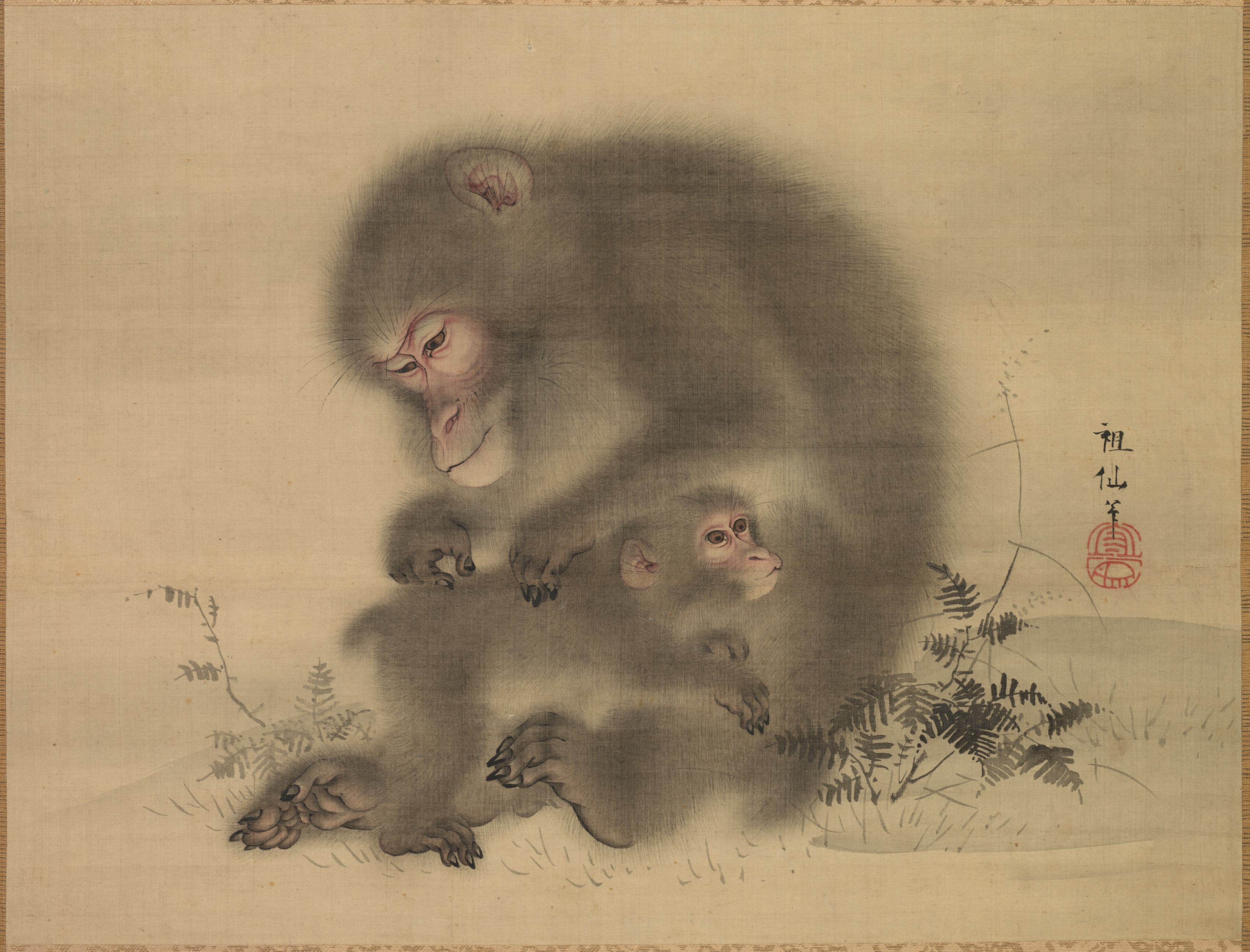
Its emotional force lies not in spectacle but in the distance between two living bodies.
A small scene with enormous emotional reach
The larger monkey looks down. The smaller animal nestles against its chest. Their fur, drawn in fine overlapping strokes, seems to hold weight and warmth. The surrounding silk is mostly quiet, with a few modest plants and a great deal of room for the viewer's attention to settle. Nothing dramatic needs to happen. The intimacy is the event.
This is *Monkeys*, an early nineteenth-century hanging scroll attributed to Mori Sosen (1747–1821), in the Cleveland Museum of Art. The museum describes the work as ink and light color on silk and catalogues it as accession number 1990.129. The image itself is only 34.2 by 45.2 centimeters: an unusually concentrated stage for such a memorable encounter.
The name that became a vocation
Sosen worked principally in Osaka, a prosperous center of trade and culture in Edo-period Japan. His exact place of birth is disputed. A Japanese museum record gives his name as Mori Sosen, 森狙仙, read *Mori Sosen*, and notes that he originally used the name 祖仙 before changing its first character to 狙, with its animal radical. The Osaka Museum of History links that change to his prominence as a painter of animals.
The graphic alteration is a wonderfully economical artistic statement. A small shift in a written character acknowledged a painter's identity. The Osaka museum's 2019 exhibition, devoted to the Sosen brothers and their animal paintings, provides especially useful evidence that his monkey specialty belonged to a larger artistic milieu, not merely a modern marketing label.
An Osaka artistic world, not an isolated eccentric
Osaka in the late eighteenth century was not simply a commercial powerhouse. Merchants, scholars, book publishers, collectors and artists created a market for images that could be lively, learned and technically ambitious. Painters encountered established Kano-school conventions alongside growing interest in observation from life and the naturalistic legacy of Kyoto artist Maruyama Ōkyo.
Japan's Museum of the Imperial Collections describes Sosen's distinctive contribution as naturalistic animal painting shaped by Ōkyo's influence, with exceptionally refined rendering of fur. These institutional descriptions support an art-historical connection; they do not prove that a particular monkey sat for a particular picture. Observational realism and studio composition can coexist.
What those fine brushstrokes really do
The remarkable feature of the Cleveland scroll is not only the accuracy of the fur. Sosen varies density, direction and softness, while leaving the silk around the subjects remarkably uncluttered. The viewer senses the contours of two bodies before registering every individual mark.
Empty space is essential to this effect. In another Sosen work, *Enkō-zu* (*Monkeys*), the Museum of the Imperial Collections notes that pale ink mist and broad open space place unusual emphasis on the animals themselves. The same compositional principle helps explain why the Cleveland pair can command attention without theatrical scenery.
Love, kinship—and a necessary note of caution
It is tempting to describe the Cleveland subjects as a mother and child. That may be how many viewers experience the image. Yet the museum's identification establishes an adult holding a smaller monkey, not the two animals' sex or family relationship. An art historian's responsibility is to distinguish a persuasive reading from a documented biological or historical fact.
Japanese museums provide valuable context for interpreting the closeness. The Osaka Museum of History observes that another Sosen painting of two monkeys may signify flourishing descendants if the pair is read as parent and child. Such auspicious associations were part of the visual culture in which he worked. They are a possible interpretive lens, not evidence that the Cleveland scroll had an identical intended meaning.
Monkeys were never a one-picture obsession
Compare the Cleveland painting with *Monkeys at Play*, a diptych in New York's Metropolitan Museum of Art dated to the late eighteenth century or before 1807. Its livelier poses show Sosen finding fresh narrative possibilities in repeated observation of the same creatures. One work asks us to notice care; another foregrounds agility and play.
The Met also owns a monkey painting by Mori Yūsen, whom it identifies as Sosen's son and pupil. That object points to the continuation of monkey painting beyond a single master's lifetime. Other Japanese institutions trace the broader Mori school through family and adopted successors, including Mori Tetsuzan. Those records are a reminder that Edo-period artistic identity often developed through workshops and lineages.
Before cameras, but not before close looking
Calling Sosen a wildlife photographer before photography risks both anachronism and a missed opportunity. His art operated in a different world, where an image could be an observation, a poetic statement, a seasonal gift or an auspicious symbol at once. He did not need a shutter or a scientific specimen label to find character in another living creature.
Photography would later offer unprecedented precision in capturing a single moment. Sosen achieved something different with his brush: he selected, simplified and lingered. The result is less a claim to mechanical accuracy than an invitation to attend to another animal's bodily presence.
From an Edo hanging scroll to an open digital collection
The Cleveland painting entered the museum as a bequest of Charlotte van der Veer. Its catalogue says that it is not presently on display. Through the museum's Open Access initiative, however, its image may be copied, modified and distributed without requesting permission. Japan.co.jp uses the institution's public-domain artwork identification rather than presenting a newly generated imitation as Sosen's painting.
Digital access cannot reproduce every effect of ink on silk, nor the proportions and presence of a mounted scroll in a room. But it changes who can look closely. A reader thousands of miles from Cleveland or Osaka may still stop at the quiet relationship between these two animals.
The secret is attention
The phrase 'secret lives' need not imply that Sosen discovered something hidden from biology. The secret is what hurried looking overlooks: the bend of a neck, the angle of a gaze, the disposition of a little body held close to a larger one. Sosen lets those seemingly modest facts become the whole subject.
He has made two animals recognizably themselves while leaving room for viewers to feel affection. It is a rare achievement. More than two centuries later, the most arresting thing about the picture may be that it asks so little of us except to look—and to keep looking.
Artwork at a glance
Mori Sosen, Monkeys; early 1800s; hanging scroll, ink and light color on silk; painted area 34.2 × 45.2 cm; Cleveland Museum of Art, Bequest of Charlotte van der Veer, accession 1990.129. The museum makes the image available through Open Access.