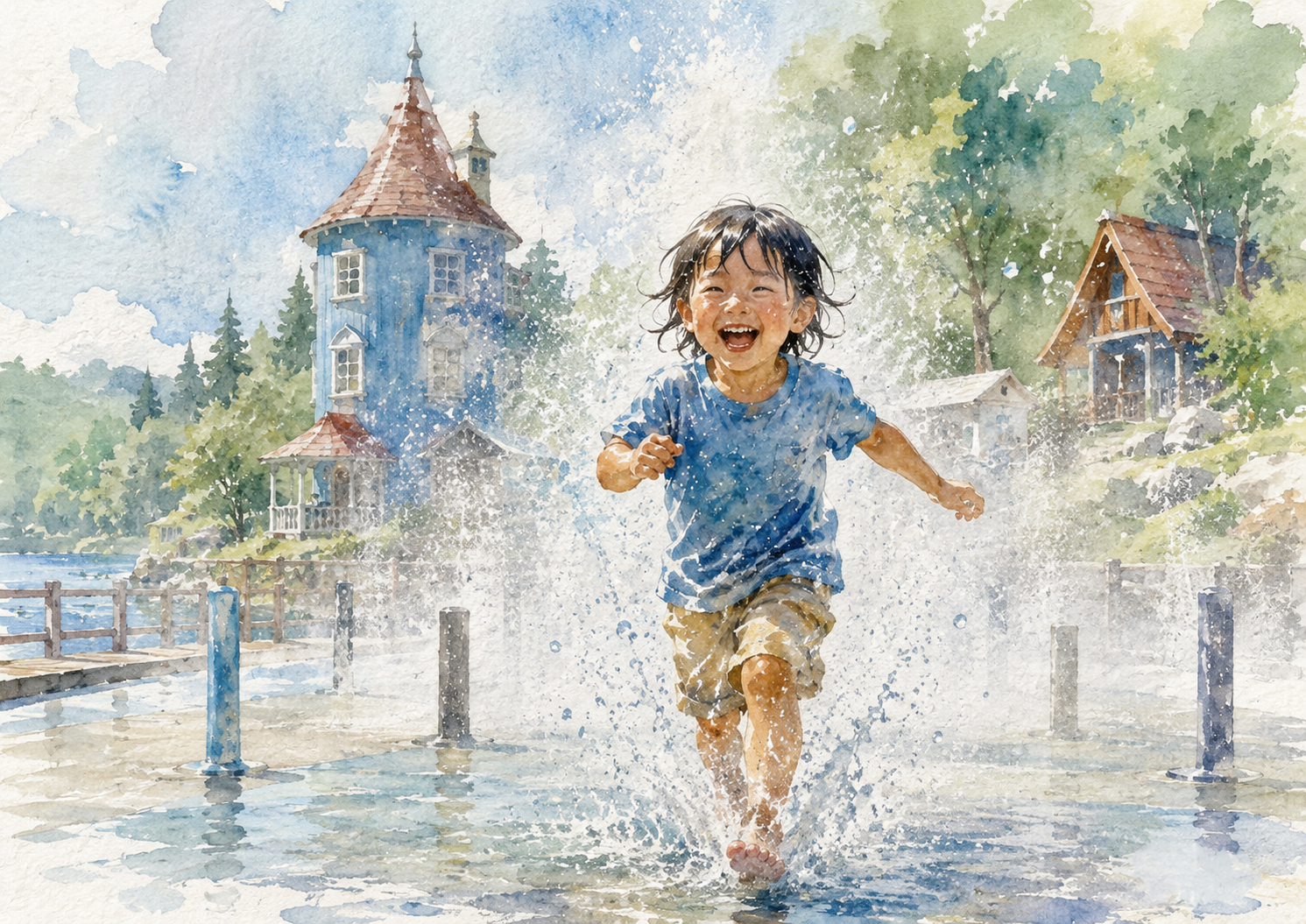
Japanese summer is becoming a design problem. Families do not only ask where to go. They ask where children can play without being defeated by heat, where parents can rest, where a day trip can still feel like a holiday, and where water is more than a hose pointed at a crowd. That is why Moominvalley Park’s 2026 summer announcement is more interesting than it first appears. It is a water-play event, yes. But it is also a small lesson in how a theme park can turn heat into story.
From July 3 to September 6, 2026, Moominvalley Park in Hanno, Saitama, will hold “Water Play at Moominvalley 2026.” The official theme is “Smiles bursting beyond the splashes of water!” The program combines children’s water-play areas, summer shows, mist effects and lakeside experiences. Next door, metsä Village will run “Elf Forest - metsä’s Sea of Clouds 2026 -” from July 3 to September 23, surrounding visitors with cool, fantastical mist at the entrance to the Nordic-themed lakeside resort.
A summer of splashes, snow and mist
The strongest part of the 2026 program is not any single machine. It is the vocabulary. The official event page lists “Summer Moran and Snow & Splash,” where the ice monster Moran brings water and snow into the hot season; “Hattifattener’s Downpour,” a sudden rain experience on the lakeside Terrace on the Lake; “Sun Sun Sunny Playtime!” at Emma’s Theatre; and “Moomin Valley’s Sea of Clouds,” in which the park is wrapped in mist.
That vocabulary matters. A normal water attraction says: here is a fountain, here is a spray zone, here is a place to get wet. Moominvalley Park says something else: the ice monster has arrived, the Hattifatteners have summoned a squall, the valley has disappeared into a cloud, the theater has become a beach. Water is still water. But inside this park, water is also a narrative device.
Why Moomin works in Japan
The Moomins were created by Finnish writer and artist Tove Jansson in the 1940s. Their world is often described as cute, but cuteness alone does not explain its durability. The Moomin stories carry loneliness, freedom, family, storms, floods, wandering, hospitality, private space and the need to return home. They wear the face of children’s literature while quietly keeping adults company.
Japan’s affection for Moomin is therefore not just another example of character culture. It also reflects a deeper fit. Japanese audiences understand seasonal feeling, small houses, strange neighbors, mountains, rivers, rain, summer holidays and the emotional power of landscape. Moominvalley may be Nordic, but its atmosphere can meet Japanese memories of lakes, forests and family trips. Placing Moominvalley Park beside Lake Miyazawa in Saitama was not simply importing a Finnish brand. It was placing a Nordic story into a Japanese landscape that could answer it.
The Hanno setting
Moominvalley Park opened on March 16, 2019, on the shores of Lake Miyazawa in Hanno City, Saitama Prefecture. The official park guide describes a place where visitors encounter Moomin characters and experience the stories through the Moominhouse, lighthouse, theater, bathing hut and Kokemus exhibition facility. This is not a dense urban thrill park. Its strongest materials are water, trees, walking paths, light, seasonal air and storybook architecture.
Hanno is part of the attraction. It is close enough to Tokyo for a day trip, but green enough to feel like an escape. For city families, that makes it a rare kind of destination: nature without the logistical burden of a faraway resort; foreignness without the airport; a storybook world that still fits inside a weekend. The 2026 water program uses that setting well. The lake becomes an adventure surface. The trees become an entrance to the Elf Forest. The mist becomes a threshold between everyday life and the valley.
Water play becomes family memory
Theme parks are usually planned by adults but remembered by children. Parents remember tickets, routes, food, timing and weather. Children remember being soaked, laughing in shoes that were not supposed to get wet, running through mist, getting surprised by a sudden downpour, seeing a show, and eating something cold before going home. Moominvalley Park’s summer event is built for that second kind of memory.
The official event page tells visitors to bring a change of clothes and notes that changing rooms are available near the cove terrace. That may sound like a small service detail, but for families it is central. A water-play event becomes much easier when parents know where children can change, when getting soaked is expected, and when the experience is designed rather than accidental. The best family attractions reduce parental anxiety while increasing child freedom.
Emma’s Theatre and the water in Moomin stories
Water is not incidental in the Moomin universe. Floods, journeys, islands, bathing huts, boats, lighthouses and weather all shape the stories. Emma’s Theatre itself points back to a world where a theater can float into life after a flood, where disaster and imagination are never far apart. In that context, a summer show is not only a seasonal entertainment product. It is a way to make the valley feel alive under summer conditions.
“Sun Sun Sunny Playtime!” brings characters into a beach-like summer mood. For children, it is a show. For adults who know the books, it is something more: the feeling that Moominvalley changes with the weather, that its residents have seasons, and that the park is not only a set but a living seasonal world.
The Elf Forest next door
The metsä Village side of the program adds a quieter, cooler counterpoint. “Elf Forest - metsä’s Sea of Clouds 2026 -” links mist to Nordic folklore. The official page describes elves as beings connected to the boundary between humans and the forest, with magnificent trees bringing good fortune and guardian spirits awakening along the tree-lined entrance.
That is smart summer design. Across Japan, parks are learning that hot-season leisure needs shade, mist, evening programs and atmosphere. Mist by itself cools the skin. Mist given a story cools the imagination. Arriving through the Elf Forest is a psychological transition: visitors leave the parking lot, buses and ordinary heat behind, and enter a different temperature of mind.
The strength of a quiet theme park
Moominvalley Park is not trying to out-shout the major coaster parks. Its power lies in pace. Visitors walk, read, eat, watch, look across the lake, enter little buildings, see exhibitions, photograph views, and let children play. The addition of water and mist makes that slow rhythm more durable in summer. It gives families a reason to stay longer and move through the park in waves: play, dry, eat, watch, walk, mist, play again.
That matters for 2026 tourism. International visitors are looking beyond the most famous urban attractions. Japanese families are looking for nearby destinations that can handle hotter weather. Moominvalley Park sits in a useful middle space: near Tokyo, outside Tokyo, recognizably Nordic, quietly Japanese, commercial but nature-based, gentle but not empty.
| Feature | Why it matters |
|---|---|
| Water Play at Moominvalley 2026 | Runs July 3–September 6 with water play, summer shows and cooling effects. |
| Summer Moran and Snow & Splash | A new program using water and snow to make summer heat feel playful. |
| Hattifattener’s Downpour | A lakeside water-play zone that turns sudden rain into an attraction. |
| Moomin Valley’s Sea of Clouds | Mist wraps the valley, adding both cooling and fantasy. |
| Elf Forest | metsä Village extends the experience with Nordic folklore and mist through September 23. |
Japan.co.jp’s view
The reason this story belongs in a summer amusement-park edition is not that it is loud. It is that it understands summer. Moominvalley Park is not simply adding water to a hot day. It is editing water into the world of the park. Snow belongs to Moran. Rain belongs to the Hattifatteners. Mist belongs to the valley and the forest. A family does not merely cool off; it enters a story about cooling off.
That is the future of many Japanese leisure destinations. Heat-countermeasures will be necessary, but the best parks will not make them feel like emergency equipment. They will make them feel like part of the experience. Water, shade, night hours, mist, indoor shows and lake breezes can all become narrative tools when a park knows what kind of world it is trying to build.
Moomin stories have always left room for weather, uncertainty and tenderness. A summer visit to Hanno may do the same. Children get wet. Parents take too many photos. Mist drifts across the trees. The lake holds the evening light. Clothes are a little damp on the way home. That is not a flaw in the day. That is the day becoming a memory.
Sources and references
This article uses public information from Moominvalley Park / metsä, the official event page and Japan travel references. Event schedules, operation hours, prices and attractions may change because of weather or operating conditions. Check the official site before visiting.
- Moominvalley Park / metsä: Water Play at Moominvalley and Elf Forest announcement.
- Moominvalley Park / metsä: Water Play at Moominvalley 2026 event details.
- Moominvalley Park / metsä: official park guide, facilities, activities, access and tickets.
- Japan Guide: Moominvalley Park overview and travel context.