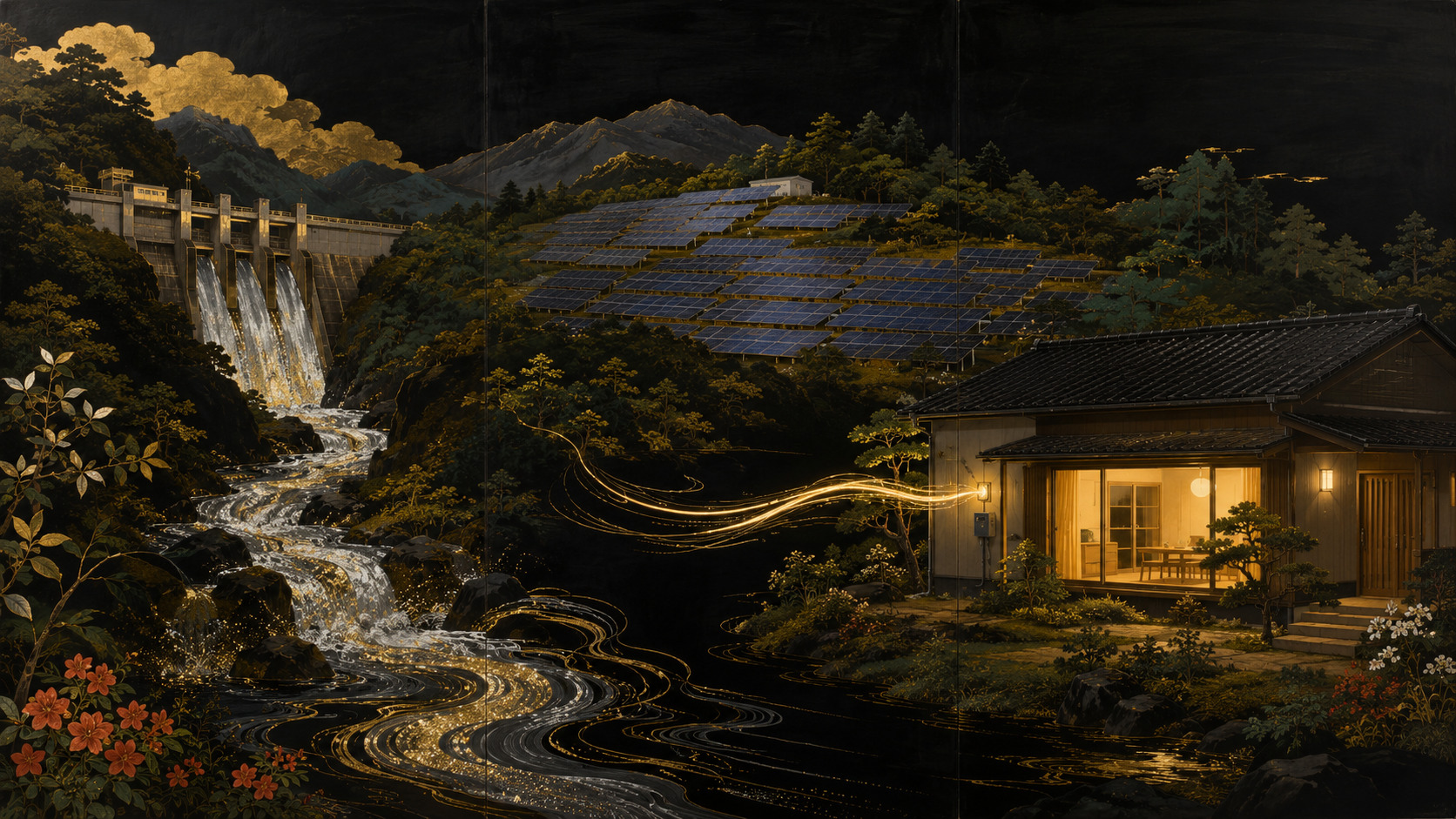
Most hometown-tax gifts are meant to arrive at the door. A box of beef. A case of fruit. A piece of local craft. Miyazaki Prefecture’s newest return arrives as an email code, then disappears into the arithmetic of a monthly electricity bill.
The prefecture and Tokyo-based energy company UPDATER launched the program on August 31. A donor selects “Miyazaki renewable electricity” on one of 19 participating hometown-tax portals. Once payment is confirmed, UPDATER sends a dedicated credit number. Entered in the Minna Denryoku customer account, it offsets future electricity charges by an amount equal to 30% of the donation.
The smallest listed option pairs a ¥10,000 donation with a ¥3,000 bill credit. The largest pairs ¥1 million with ¥300,000. Between them are ¥30,000, ¥50,000, ¥100,000, ¥150,000, ¥200,000, ¥300,000 and ¥500,000 tiers, all at the same 30% return ratio.
Miyazaki calls the arrangement a national first. That needs its entire qualifier: the prefecture says it is the first electricity return offered by a prefecture with power supplied by a publicly operated electricity enterprise. Municipal electricity gifts already exist. This is not Japan’s first hometown-tax electricity return in the broad sense.
The product is a bill credit, not a parcel of electrons
The customer journey has four distinct transactions. The resident donates to Miyazaki Prefecture through a portal. UPDATER sends a credit number by email, normally within a month after payment is confirmed. The donor registers that number—not the portal’s receipt number—in a Minna Denryoku account. The balance then begins reducing monthly charges, normally on the next bill, or the bill after that if registration comes after charges have been finalized.
The six-month clock begins when the number is registered, not when the donation is made. Any balance left at the deadline expires without a refund. Ending the electricity contract also erases the remaining credit, except when a move is followed by a new contract under the company’s rules. Family members may apply a donor’s code to a Minna Denryoku contract, according to the product listing.
That makes consumption an important part of the decision. A household choosing the ¥300,000 credit attached to a ¥1 million donation would need sufficiently large eligible bills to exhaust the balance within six months. The value is not cash, cannot be refunded and does not pause the expiration date.
| Donation | Bill credit | Return ratio | Practical constraint |
|---|---|---|---|
| ¥10,000 | ¥3,000 | 30% | One-time ¥500 registration charge on first use |
| ¥50,000 | ¥15,000 | 30% | Balance expires six months after registration |
| ¥200,000 | ¥60,000 | 30% | Applied progressively to monthly charges |
| ¥1,000,000 | ¥300,000 | 30% | Customer needs enough eligible charges before expiry |
Nor does a household receive a dedicated physical stream from a Miyazaki dam. Electricity from many generators enters the interconnected grid. The verified consumer benefit is the credit, while the origin claim depends on contractual procurement, power-source disclosure and environmental attributes. UPDATER describes Minna Denryoku as 100% renewable and effectively zero-carbon by combining renewable-source electricity with renewable-designated non-fossil certificates. That is the company’s accounting and retail claim; it does not identify the physical generator of each electron at a customer’s outlet.
Six named generators—and a much larger public utility behind them
Five sources belong to the Miyazaki Prefectural Public Enterprise Bureau. The hydro stations are Dogawa, rated at 12,344 kilowatts; Sakatani, 520 kilowatts; and Hori No. 2, 35 kilowatts. The two solar installations are at Aya No. 2 Power Station, 49.5 kilowatts, and the industrial-water purification facility, 20 kilowatts.
JNC Corporation’s 12,800-kilowatt Takachiho hydro station is the sixth. Together, the named facilities have 25,768.5 kilowatts of maximum capacity. The prefectural share is 12,968.5 kilowatts; JNC contributes almost exactly half of the combined total.
The distinction between those six sources and Miyazaki’s entire public power system is important. The bureau operates 14 hydro stations with 159,399 kilowatts of combined capacity. Its published annual supply of roughly 500 million kilowatt-hours—described by the prefecture as equivalent to about 30% of household consumption within Miyazaki—refers to the broader hydro portfolio, not output reserved for the return gift.
The supply chain at a glance
- Public hydro: Dogawa, Sakatani and Hori No. 2; 12,899 kW combined.
- Public solar: Aya No. 2 and the industrial-water purification facility; 69.5 kW combined.
- Private hydro: JNC’s Takachiho station; 12,800 kW.
- Retailer and credit administrator: UPDATER’s Minna Denryoku service.
That chain separates several things that everyday language compresses into “power from Miyazaki”: generation, grid delivery, retail billing and the environmental value attached to non-fossil generation. The prefecture owns the five public facilities. UPDATER holds the customer relationship and applies the credit. The existing transmission and distribution network continues delivering electricity.
What Miyazaki’s “first in Japan” does—and does not—mean
The exact Japanese release says this is the country’s first provision of an electricity return “by a publicly operated electricity business, in a prefectural hometown-tax program.” Three boundaries do the work: public electricity operator, prefectural government and electricity return.
Remove them and the claim collapses. Japanese municipalities have already listed electricity generated from local hydro, solar, wind and biomass sources as hometown-tax returns. Some products supply a number of kilowatt-hours; others discount a bill. UPDATER itself says it had built experience with municipal programs before expanding the model to a prefecture.
Japan.co.jp found no comprehensive government registry covering every active, expired and experimental electricity return offered by all municipalities and public utilities. We therefore treat the first as Miyazaki’s attributed claim within its own defined category, not as an independently proven origin point for the product class.
A public-power history older than the grid choice behind the gift
Miyazaki’s electricity bureau traces its mandate to a prefectural assembly proposal in December 1918. Public generation formally began in 1938 as part of the Komarugawa river-control project. After the war, integrated development extended across five river systems—Komarugawa, Ayagawa, Sanzai, Oyodogawa and Horikawa—through six multipurpose projects.
The dams were never only power assets. Flood control and agricultural water were designed alongside generation. Electricity revenue has helped cover the management of nine multipurpose dams, municipal payments and wider regional programs. The bureau describes its 159,399-kilowatt hydro fleet as the third largest among Japan’s publicly operated electricity businesses.
The gift required a second history: the gradual opening of Japan’s electricity market. Full retail liberalization reached households in April 2016, allowing all consumers to choose a retailer and tariff. A public generator that does not run a national household sales operation can now work through a registered retailer, while grid delivery remains with the established transmission and distribution system.
The tax mechanism is newer still. Hometown tax was created through the fiscal 2008 local-tax reform as an enhanced deduction for donations to local governments. Current rules generally let eligible taxpayers deduct the portion above ¥2,000, within income-dependent limits. Return gifts are constrained to a procurement value of no more than 30% of the donation—the ratio Miyazaki uses here.
1918 Miyazaki’s assembly considers public hydroelectric development.
1938 Prefectural electricity operations begin with the Komarugawa river-control project.
2008 Japan creates the hometown-tax donation framework.
2016 Electricity retail choice expands to every household.
2026 Miyazaki places public generation into a prefectural electricity return.
The tax benefit and the electricity contract require separate arithmetic
“Hometown tax” is a nickname. Legally, the payment is a donation to a local government. The frequently quoted ¥2,000 personal cost is not automatic: the deductible amount depends on income, household circumstances and other deductions. A donor who exceeds the limit bears more of the contribution. Receiving the deduction also requires a tax return or, for eligible taxpayers donating to no more than five local governments, the one-stop filing procedure.
There is another tax edge at the high end. Japan’s National Tax Agency says a return received from a local authority may be treated as temporary income. The Miyazaki product page cautions that a filing may be required when total temporary income for the year exceeds the ¥500,000 special deduction. Other prizes, insurance proceeds or similar income can matter to that calculation.
The retail contract deserves its own comparison. A 30% credit does not establish that Minna Denryoku will be the cheapest annual option for a particular household. Base charges, consumption, procurement adjustments, the current tariff and what happens after the credit runs out all affect total cost. The gift balance may last months; the electricity contract continues until the customer changes or cancels it.
Five checks before donating
- Estimate the household’s hometown-tax deduction ceiling.
- Confirm that the address and building arrangement can use Minna Denryoku.
- Compare annual electricity costs, not just the temporary credit.
- Choose a credit small enough to use within six months of registration.
- Plan for the email code, account registration and required tax filing.
The test is what remains in Miyazaki after the credit is spent
The program changes the public face of a business that has mostly operated upstream. For decades, Miyazaki’s bureau sold bulk electricity and returned earnings through dam finance and regional programs. The new product gives the household a list of plants, a retail brand and a recurring reminder on the bill.
That can deepen a donor’s connection with the prefecture, as Miyazaki and UPDATER argue. It can also turn public generation into a more recognizable regional asset. But those are intended outcomes, not measured results. The partners have not yet reported donation volume, new retail contracts, net revenue left after portal and administrative costs, or how many credits expire unused.
The same restraint applies to climate claims. Reassigning the output or certificates of an existing plant does not necessarily increase renewable generation in the short term. A stronger evaluation would show whether the program finances new capacity, prolongs hydro assets, improves local resilience or redirects buyers from fossil-intensive contracts. The launch materials do not quantify additional avoided emissions attributable to the gift.
Its durable significance may be administrative rather than promotional. Miyazaki has converted rainfall, river infrastructure and a public utility balance sheet into a household-facing service without pretending to run a private wire to the donor’s home. If the accounts remain transparent, the model gives voters and customers something concrete to audit: what they donated, what was credited, which sources were named and how much money returned to public power.
The “national first” label will fade quickly if other prefectures copy it. The better measures will come later—credits actually used, net funds retained, generation assets renewed and environmental value not counted twice. That is where a clever return gift becomes energy policy.
Sources and documents
- Miyazaki Prefectural Public Enterprise Bureau: “Japan’s first—electricity hometown tax by a public electricity operator begins August 31”, August 31, 2026 (Japanese; launch, precise first-in-Japan formulation, named facilities and capacity)
- Furusato Choice: Miyazaki renewable electricity, ¥60,000 bill-support return (Japanese; donation and credit amounts, six-month validity, contract, region, fee, cancellation and tax conditions)
- Miyazaki Prefectural Public Enterprise Bureau: Overview of the electricity business (Japanese; 1918 proposal, 1938 opening, river development, 14 stations, capacity and annual supply)
- National Tax Agency: No. 1155, hometown-tax donation deduction (Japanese; ¥2,000 threshold, income and resident-tax deductions, limits, filing and one-stop procedure)
- Agency for Natural Resources and Energy: Promotion of electricity-system reform (Japanese; full retail liberalization in April 2016 and household choice)
- Fukui Prefecture: The path to creation of hometown tax (Japanese; the 2007 study group and the fiscal 2008 local-tax reform)
Reporting was checked against material available by 10:30 PM JST on September 1, 2026. Japanese organization and facility names, readings, capacities and legal or market terminology were verified in primary Japanese government sources. “First in Japan” is attributed to Miyazaki within the prefecture’s stated category and is not presented as the first electricity return of any kind. The 100% renewable, effectively zero-carbon, regional-contribution and decarbonization descriptions are identified as claims by UPDATER or the prefecture. The article excludes any suggestion of a dedicated physical power route or a measured emissions reduction caused by the return.
Image rights: © 2026 Japan.co.jp. This AI-assisted editorial illustration may not be republished or reused without prior written permission. For licensing, use the contact page.