- The exhibition begins with a question, not an answer
- What can a private collection teach a public audience?
- Kusama, Nara and Murakami: three ways to hold an audience’s attention
- Warhol, Gursky and the changing scale of the image
- A museum that grew alongside Miyagi’s modern cultural life
- The 2026 reopening makes access a timely issue
- From looking to learning: the public programs
- Why Sendai matters in the geography of contemporary art
- Planning a visit—and taking the questions home
The exhibition begins with a question, not an answer
A visitor can stand in front of a contemporary artwork and feel uncertain about where to begin. Is the color important? The subject? The material? Or an unexpected memory stirred by the image? At the Miyagi Museum of Art in Sendai, a new exhibition suggests that such uncertainty is not a failure of appreciation. It can be the starting point.
“An Encounter with Contemporary Art,” which opened November 14, 2026, gathers approximately 70 works from the collection of a single person who originally began acquiring art in an effort to understand what made contemporary work interesting. The exhibition includes major Japanese and international names—Yayoi Kusama, Yoshitomo Nara, Takashi Murakami, Andy Warhol and Banksy—but does not organize itself principally around their fame.
Instead, the museum presents a sequence of approachable ideas: color, shape, light, figures, lines, scenery and memory. The proposition is deceptively simple. Rather than demanding that newcomers first master a chronology of postwar art, the exhibition asks them to look closely and discover what the experience does to their perception. The exhibition runs until January 24, 2027.
What can a private collection teach a public audience?
The collection has a striking origin story. According to the museum, one collector began purchasing contemporary art because of a desire to understand its appeal. That impulse differs from the familiar image of an art collector acting solely on reputation, scarcity or investment prospects. Curiosity, at least in the museum’s account of the collection, came first.
A collection made by one person is inevitably selective. It cannot represent every movement, medium or artist in contemporary art. That limitation is also its strength: it offers a particular path through an otherwise intimidating field. Public exhibition turns that personal journey into something other visitors can question, reject, extend or make their own.
The museum has not established a documented market valuation for the collection in its exhibition overview, and this article does not invent one. The more significant public question is whether a privately assembled body of works can help a regional museum make art accessible without reducing it to celebrity names.
Kusama, Nara and Murakami: three ways to hold an audience’s attention
The official exhibition brochure identifies Yayoi Kusama’s “A. PUMPKIN (Y)” (2004), Yoshitomo Nara’s “Ash Night” (2000) and Takashi Murakami’s “お花の笑顔。” (2011) among highlighted works. They are not interchangeable examples of a Japanese “contemporary style.” They propose different kinds of encounters.
Kusama’s repeated motifs invite the eye to navigate pattern, accumulation and the sensation of space. Nara’s figure demands a different act of reading: viewers bring their own emotional assumptions to the face before them. Murakami’s flowers raise questions about cheerful visual language, reproducible imagery and the porous border between fine art and mass culture. These are interpretive possibilities, not claims to speak on behalf of the artists.
The differences matter. An exhibition that puts these images into conversation can be more revealing than a presentation that merely asks visitors to recognize a famous signature. The question changes from “Do I know this artist?” to “Why does this work affect me differently from the next one?”
Warhol, Gursky and the changing scale of the image
The museum brochure also highlights Andy Warhol’s “DIAMOND DUST SHOES” (1980) and Andreas Gursky’s large-format photograph “Dubai World III” (2008). Their presence broadens the exhibition beyond painting as an isolated act of expression.
Postwar Pop Art challenged the inherited hierarchy separating advertisements, consumer imagery and museum art. Warhol made the visual language of commerce part of what art could investigate. Later large-format photographic practices, including Gursky’s, made scale, composition and the organization of modern spaces crucial to the viewing experience.
In this context, a work’s date does not by itself determine whether it belongs to “contemporary art.” What matters is the kind of dialogue it sustains with present-day life. Here, an image made in 1980 can sit productively beside a work from 2011 because the viewer brings the present into the encounter.
A museum that grew alongside Miyagi’s modern cultural life
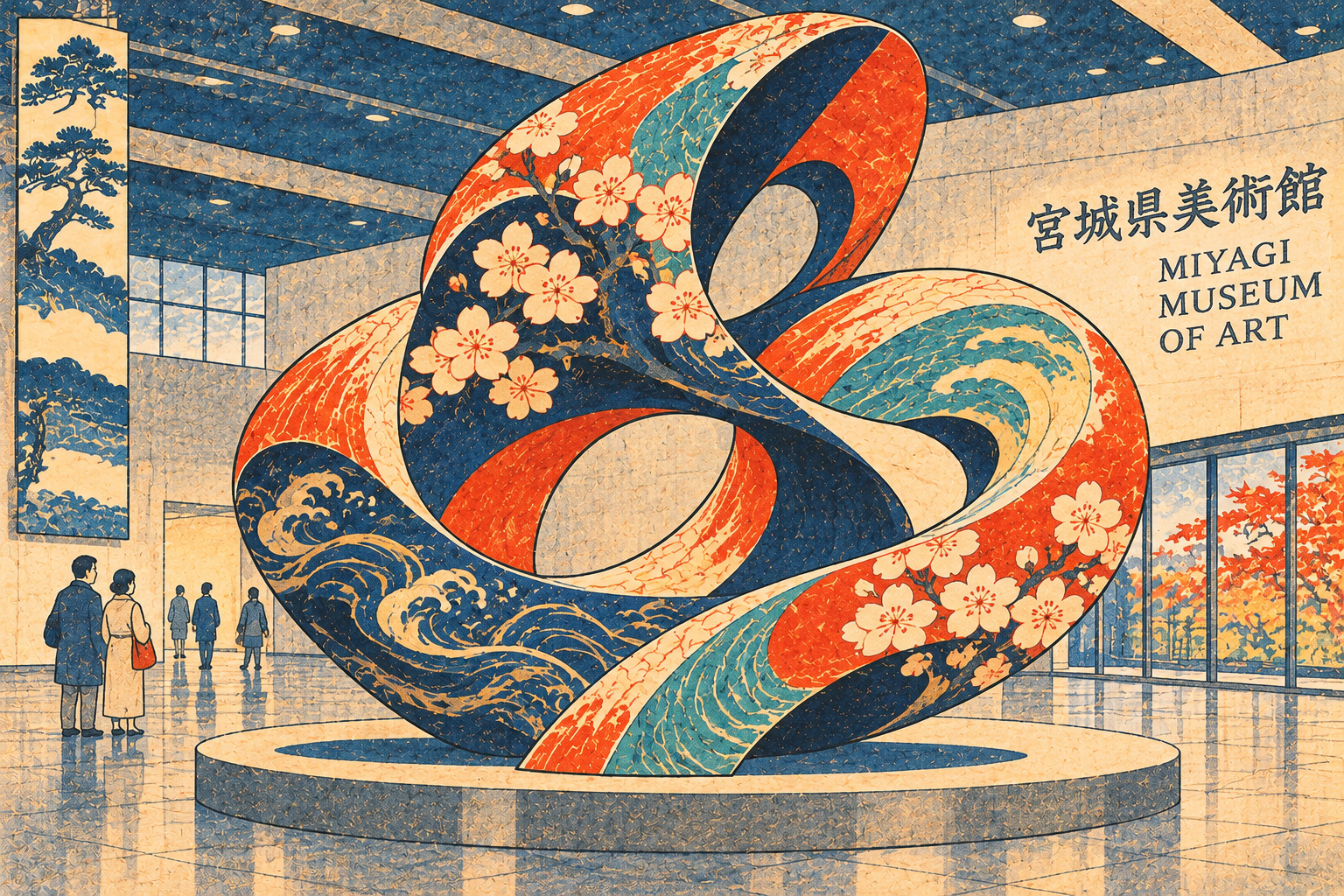
The location gives this exhibition an additional dimension. The Miyagi Museum of Art opened in November 1981, establishing a public institution dedicated to modern art, works associated with Miyagi and the wider Tohoku region, international artists such as Paul Klee and Wassily Kandinsky, and Japanese picture-book illustration.
Its main building was designed by the office of Kunio Maekawa, a leading figure in Japanese modernist architecture. The museum added a memorial facility for sculptor Churyo Sato in June 1990. These details matter because an art museum’s history is not just its succession of exhibitions; it is also a history of what a community has chosen to preserve, interpret and make available.
The building itself asks visitors to move among galleries, courtyards and spaces that respond to the surrounding environment. Architecture makes the encounter with art physical. It changes how a work is approached and how a visitor leaves it behind.
The 2026 reopening makes access a timely issue
After decades of use, the museum underwent extensive renovation beginning in 2023 and reopened on June 20, 2026. Alongside updated exhibition spaces, elevators and other facilities, the work brought a Kids Studio, visible storage, and new spaces intended to make visits easier for different audiences.
The contemporary-art exhibition follows less than five months after reopening. The museum has not claimed that the show is the definitive test of the renovation, but the timing makes a revealing juxtaposition: a building newly equipped to welcome people is offering an exhibition explicitly organized around the experience of encountering art.
Visible storage provides another way to think about access. Museums do more than display individual masterpieces. They steward large bodies of work, make curatorial decisions and invite the public to understand why particular objects are kept. The question of who feels welcome inside the institution is as important as the number of famous names on the exhibition poster.
From looking to learning: the public programs
The museum has announced guided interpretation and educational programs related to the exhibition. An opening gallery talk was scheduled for November 14 with exhibition adviser Fumio Nanjo and curator Mari Yasuoka of the Hamamatsu Municipal Museum of Art. A November 28 lecture by Yasuoka is titled, in Japanese, “From Looking to Encountering: Opening the Door to Contemporary Art.”
Curator-led exhibition explanations are scheduled for November 21, December 5, December 19 and January 9. Children’s programs explore forms, moving light and lines. Details and registration requirements vary by event, and some programs require advance application.
These activities are more than accessories to an exhibition. They acknowledge that close viewing is a skill that can be practiced, and that visitors do not need to already possess specialist vocabulary to participate in cultural life. A museum can teach people how to ask questions without prescribing the answers.
Why Sendai matters in the geography of contemporary art
Japan’s biggest art-market institutions and international exhibitions are often associated with Tokyo. The ability to encounter prominent international and Japanese works in Sendai instead matters for students, families and visitors throughout the Tohoku region. It reduces the assumption that serious cultural experiences require a trip to the capital.
It also brings international art into dialogue with a museum’s own regional responsibilities. The museum ticket covers access to the collection displays and the Churyo Sato Memorial Museum as well as the special exhibition. A visitor might move from contemporary images into works tied to Miyagi and the history of Japanese sculpture in one visit.
No verified attendance forecasts or economic-impact results were available from the museum materials reviewed for this report. It would be premature to assert that the exhibition will deliver a particular tourism dividend. Its immediate, documented value is the opportunity it offers audiences to look, compare and return.
Planning a visit—and taking the questions home
“An Encounter with Contemporary Art” is scheduled from November 14, 2026, through January 24, 2027, in the museum’s second-floor galleries. Opening hours are 9:30 a.m. to 5 p.m., with ticket sales ending at 4:30 p.m. Standard admission is ¥1,500 for adults, ¥1,300 for students and ¥750 for school-age visitors. Reduced group prices are available, and the museum lists exceptions to its usual Monday closure.
The museum is located at 34-1 Kawauchi-Motohasekura, Aoba Ward, Sendai. The organizers are the Miyagi Museum of Art, Kahoku Shimpo and Sendai Television. Visiting hours and programming should be confirmed on the museum’s official website before travel, particularly around year-end closures.
Ultimately, the exhibition leaves visitors with a surprisingly democratic proposition. A response to art does not have to be instant, correct or elegant. It may begin with fascination, discomfort or confusion. The important thing is to stay long enough to look again—and to discover that the experience of art belongs to the person standing in front of it.
Sources and reporting notes
Reporting scope: This article relies on official museum materials, its exhibition brochure, history and visitor guidance. It does not claim an on-site review, a first-hand inspection of every work, or interviews with artists or the collector. Interpretive passages are editorial analysis.
- 宮城県美術館:展覧会概要・会期・料金 / Museum exhibition overview
- The Miyagi Museum of Art: official English exhibition description
- 宮城県美術館:開会式の報道発表(2026年11月11日)
- 展覧会公式チラシ・出品作家と掲載作品 / Official exhibition brochure
- 宮城県美術館:特色・沿革 / Museum history
- 宮城県美術館:建築について / Architecture
- 宮城県美術館:リニューアルについて / Renovation
- 宮城県美術館:特別展関連プログラム / Related programs
- 宮城県美術館:利用案内 / Visiting information