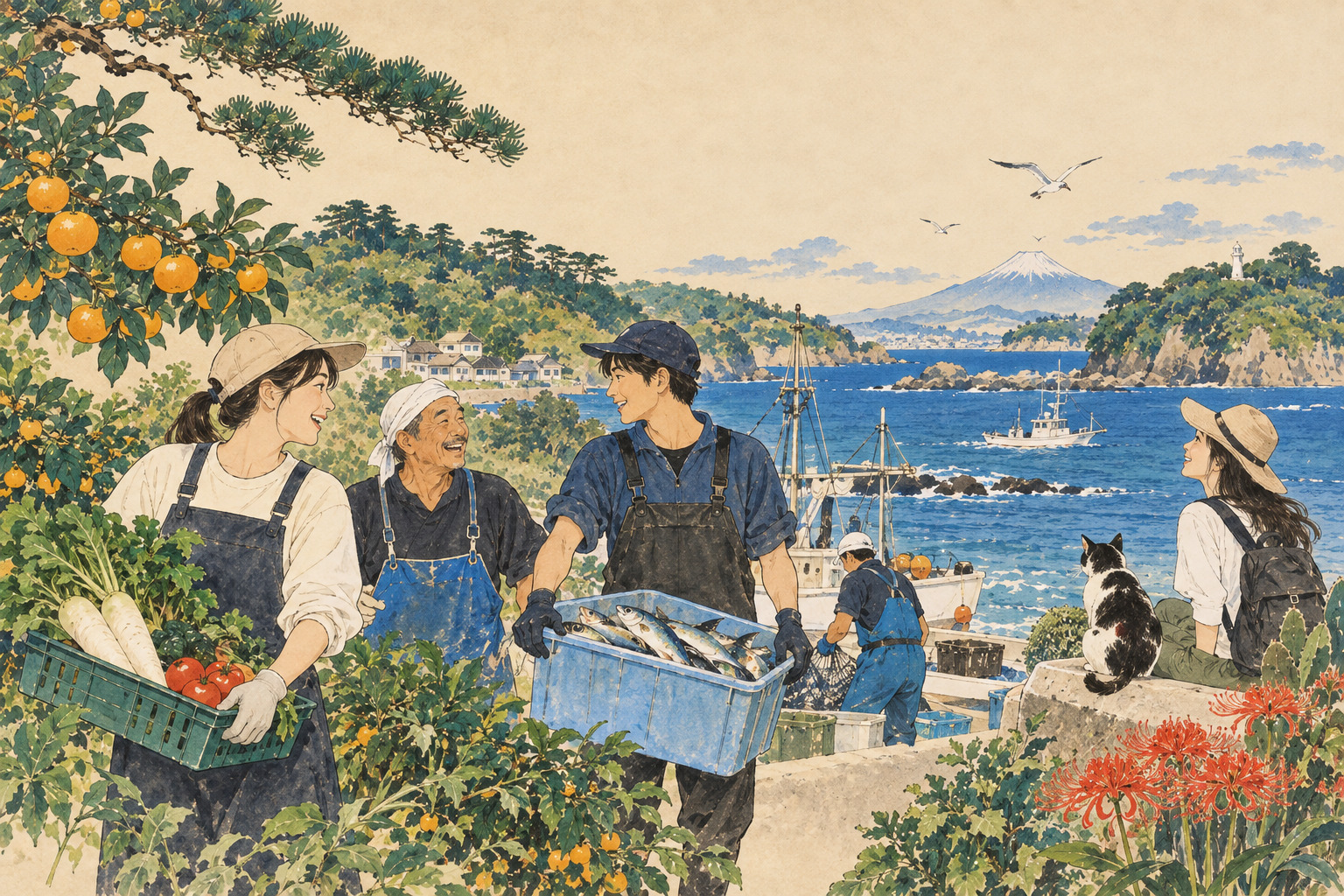
There is a large gap between liking a place and returning because somebody there is expecting you. Kanagawa Prefecture's Miura Peninsula Furusato Working Holiday is designed to work inside that gap. Participants live in the peninsula for two weeks, take paid jobs with local businesses, share a house, meet residents and reflect on the experience. They do not have to promise to migrate. The more immediate objective is to turn a pleasant visit into a relationship specific enough to produce a next action. [1][3]
The fourth summer term began September 17 with five students and working adults from outside Kanagawa. They are staying for 13 nights and 14 days at a participant share house called Yanbee in Miura City. Cloud JAPAN, the certified nonprofit operating the program for Kanagawa Prefecture, lists Iso Ryori Kanea, Shitekobe and Miura Brewery among the principal work hosts. Paid work is combined with local walks, one-on-one conversations, reflection workshops and communal living. [3][4]
The program covers the five Miura Peninsula jurisdictions used by Kanagawa Prefecture: Yokosuka, Kamakura, Zushi and Miura cities, plus Hayama Town. Four summer terms were scheduled for 2026, with 19 participants expected or completed across the four. [1][3][4]
Nine out of nine is striking—but it is still a nine-person interim survey
Cloud JAPAN's September 21 interim report says all nine people who completed the first two August terms were considering returning to the Miura Peninsula. Seven said they had a concrete plan or expected to return within six months. Before the program, only one of the nine selected “an atmosphere where you can interact with residents” as an image of Miura; afterward, all nine did. Four described a specific form of engagement beyond tourism, including returning to work, helping locally, connecting a university project with Miura or planning something with a host. [3]
One first-term participant has already returned with parents and a sister to introduce them to the people and places encountered during the stay. Two second-term participants were asked by their workplaces to come back and help regularly, and return dates were being arranged. [3]
Those are meaningful examples, but the evidence needs to stay in proportion. This is a self-reported interim sample of nine people, with no comparison group. Cloud JAPAN explicitly labels it an early aggregation based on final forms and reflection notes, not the program's final annual evaluation. “All nine are considering returning” is supported. “The program caused everyone to become a repeat visitor” is not yet established. [3]
Japan's policy category between tourism and migration
Japan calls this middle ground kankei jinkō, often translated as “relationship population.” The Ministry of Internal Affairs and Communications defines it as people who are neither resident population nor ordinary visitor population, but who engage with a place and its people in diverse, continuing ways. The category can include recurring visits, local work, volunteering, participation in community projects and other relationships that do not require moving one's residence. [6][8]
The national Furusato Working Holiday program began in fiscal 2016 as one route into that relationship. Ministry materials say 5,979 people participated from fiscal 2016 through fiscal 2024, including 858 participants across 66 implementing bodies in fiscal 2024. In an illustrated survey based on 123 respondents, 84% were “very satisfied” and 15% “satisfied,” while 72% said they “very strongly” intended to keep visiting and 25% said they did. [5]
Those percentages should not be mistaken for a longitudinal return rate among all 5,979 participants. They come from 123 survey respondents. The same distinction applies to Miura: intention is useful evidence, but actual repeated involvement must be measured later.
This “working holiday” is not the international visa scheme
The name can confuse overseas readers. Japan's Furusato Working Holiday is not the bilateral working-holiday visa system. It is a domestic regional-policy program promoted by the Ministry of Internal Affairs and Communications. Participants spend roughly two weeks to a month in a locality, enter employment arrangements with local businesses, earn income and experience community life through work, learning and interaction. [5]
For Miura's 2026 summer terms, Kanagawa targeted students and working adults roughly aged 18 through their 30s who lived outside Kanagawa, had an interest in the peninsula's nature or food and could stay for two weeks. Participants pay ¥5,000 toward communal-living costs and separately cover transport to the area and food. The program portal says around five days of the 14-day stay are expected to be work days, with placements matched after interviews. [1][4]
Work exposes the ordinary day that tourism does not
One 2026 host, Shitekobe, operates agricultural and fishing experiences. The national portal says the company manages more than 10 fields, including about 3,000 square meters at Soleil Hill dedicated to harvesting experiences, growing more than 70 varieties of vegetables across the year. Working-holiday participants are expected not only to do farm work but also to guide harvesting experiences for visiting families. [4]
A tourist can visit a field for an hour. A temporary worker sees the business around the experience: soil preparation, weather, timing, customer handling, explaining food to children and the relationships between farmers, fishers and visitors.
The same principle applies to restaurants and a local craft brewery. Participants are not only consuming a regional attraction; for a few days, they stand on the side that produces it. That change of position is central to the program's theory of relationship-building.
Communal living designs the hours that are not on the work schedule
Participants live together at Yanbee, a dedicated share house in Miura City with separate dormitory arrangements, bathing facilities and a shared kitchen. The program page even notes that local neighbors can be invited for home parties. [4]
That arrangement is more than cheap accommodation. After work, participants have a place to compare what they saw, talk about the people they met and make sense of whether the local life they observed fits anything they want for themselves. Cloud JAPAN describes its program design as moving back and forth between self-exploration and contribution to the community. [3][9]
Communal living does not guarantee connection. Personalities, group chemistry and program facilitation matter. But it creates more opportunity for an experience to be interpreted socially than isolated hotel stays would.
Miura's program began in 2025 as a much longer stay
Kanagawa's Miura Peninsula Furusato Working Holiday began in fiscal 2025. The first summer round ran from August 6 to September 9, roughly five weeks, with six participants across three host organizations: Misaki Megumi Suisan's FISHSTAND, Shiki no Shizensha's Maholova Minds Miura and kaneyo art studio's Kaneyo Shokudo. Their projects included marketing tuna and the region, creating plans to increase repeat visitors around a resort hotel, and developing ideas for the experimental use of a closed elementary school. [2]
The second round, from February 12 to March 18, 2026, involved 14 participants and seven hosts. Projects ranged across education, a century-old bakery, Yokosuka naval curry product planning, a local map for Zushi, social-media marketing for a charter-bus company, tourism retail and community education for children. [2][10]
Summer 2026 changed the design substantially: four separate two-week terms rather than one five-week period. That lowers the barrier for university students and employed adults. The trade-off is depth. A shorter stay is easier to enter, but it gives participants less time to understand a workplace. Whether 14 days is enough to create a durable relationship is precisely what the follow-up data will need to test.
Summer 2025 — First round: six participants, three hosts, about five weeks.
Spring 2026 — Second round: 14 participants, seven hosts, about five weeks.
Aug.–Sept. 2026 — Four summer terms, each 13 nights / 14 days; 19 expected or completed.
Nov.–Dec. 2026 — The national portal lists fifth and sixth autumn terms.
Jan.–Mar. 2027 — Additional spring term planned.
Based on Kanagawa and national-program pages. [2][4]
Twenty summer places drew 27 applications
Cloud JAPAN says the four summer terms received 27 applications for 20 planned places as of September 8. Among the 19 people then expected or completed, 14 were university students and five were workers or others; 12 were women and seven men. Applicants were interviewed online about their motivation, preferred work and ability to stay for two weeks before host matching. [3]
This matters when interpreting the early return-intention results. The sample is not random. Participants had already chosen to apply to a two-week regional-work program and were selected partly for fit. A high willingness to return may reflect the program, the selection process, or both.
But if the policy goal is not mass tourism and instead finding people likely to develop recurring ties, selection is not necessarily a flaw. It changes the correct metric. The key question becomes not “How many people entered?” but “How many relationships remained active afterward?”
Miura's advantage may be that it is close enough to come back casually
Regional revitalization is often discussed as if “regional” means remote. Miura is different. Parts of the peninsula sit roughly an hour to 90 minutes from central Tokyo by rail, depending on origin and destination. Its closeness can look like a disadvantage if the goal is a dramatic rural escape.
For a relationship-population strategy, proximity can be an advantage. Returning to Hokkaido or Tohoku may require flights or long journeys. Miura makes a smaller commitment possible: help at the shop next month, bring family back to meet someone, join a local event, connect a university project, or spend another weekend working. Cloud JAPAN explicitly argues that this accessibility makes it easier to convert a 14-day encounter into a repeat action. [3][4]
Kanagawa has been trying to sell more than tourism since 2016
Kanagawa created its Miura Peninsula Appeal Maximization Project in March 2016 and revised it in 2020 and again in March 2025. The latest revision says population decline is already continuing across the region and that net out-migration remains a problem. [7]
The project has two major pillars: increasing the appeal of tourism and increasing the appeal of “living on the peninsula.” Under the second are work, industrial vitality and making peninsula life more attractive to younger and working-age people. In 2026, Kanagawa is also operating a separate side-job / dual-employment matching program that pairs urban professionals with Miura businesses on local problem-solving projects, explicitly aiming to create continuing relationship population. [7][11]
The working holiday is therefore an entry-level piece of a broader strategy. It does not ask a 20-year-old to decide on migration after two weeks. It creates an experience of working and living locally that can later lead to repeat work, side jobs, dual residence or migration.
Cloud JAPAN has been tracking “people who come back” in Kesennuma
Cloud JAPAN traces its work to student-volunteer relationships formed after the 2011 Great East Japan Earthquake. It incorporated in 2016 and became a certified NPO in 2021. The organization has also operated Furusato Working Holiday programs with Kesennuma, Miyagi Prefecture. [3][9]
Cloud JAPAN says its Kesennuma program accepted 496 participants from July 2021 through March 2026, of whom 263 returned and 31 migrated. Those are organization-reported operating figures; Japan.co.jp has not independently audited each return or migration. They do, however, show that the organization measures repeat engagement rather than stopping at initial participation. [3]
Cloud JAPAN vice representative Kei Kawashima makes the philosophy explicit: migration is not the only goal. Returning to work, helping at a shop, linking university study to the community and other manageable relationships can all be meaningful outcomes. [3]
A low migration count does not automatically mean the program failed
Cloud JAPAN's September release, citing ministry materials, says roughly 169 participants nationally had gone on to migration or settlement among the 5,979 participants through fiscal 2024. The ministry's own overview emphasizes both migration examples and recurring engagement after participation. [3][5]
Dividing 169 by 5,979 would produce about 2.8%, but that would not be an official “migration rate”: follow-up periods and data collection are not necessarily standardized across every locality and cohort. More fundamentally, the relationship-population model does not define success only as changing one's registered residence.
A Tokyo worker who helps a Miura shop several times a year, a student who conducts a university project with the city, or a repeat visitor who becomes a regular customer can count as a meaningful relationship even without migration. If policy is evaluated only through resident counts, those ties disappear statistically.
Paid work must not become cheap short-term labor
The national Furusato Working Holiday framework openly recognizes a labor-market benefit: local farms and businesses may gain help while also interacting with young people from outside the region. [5]
That creates a design risk. If participants are used only as temporary labor, the relationship-population objective weakens. Miura's current format schedules roughly five work days within a 14-day stay and sets aside the rest for local interaction, conversations, excursions, reflection and communal living. [3][4]
The opposite failure is also possible. Too little real work and the program becomes an extended tourism experience. The challenge is to create work that genuinely contributes to a local business while still giving the participant enough context and reflection to understand the region rather than simply filling a shift.
The 2026 program now wants more than 40 participants
Cloud JAPAN says the project will continue beyond the summer, aiming for more than 40 participants across fiscal 2026. The national portal now lists an autumn fifth term for November 16–29 and a sixth for December 2–15, with another spring term planned between January and March 2027. [3][4]
Scaling from 19 summer participants to 40 or more changes the challenge. Organizers need enough high-quality workplaces, enough interview and matching capacity, enough support for communal living and a system for following participants after they leave. The program's most attractive feature—face-to-face, specific relationships—can become harder to sustain as volume grows.
What is still unknown
As of September 21, public materials do not establish the final number of participants across all four summer terms, wage levels and working hours at each host, the actual return rate for the full cohort, six- and 12-month continuation rates, host-company satisfaction, local spending generated, the public contract cost, public cost per participant, or long-term conversion into dual residence or migration.
The nine-person interim survey was conducted immediately after participation among motivated applicants. Its finding is encouraging, but the decisive evidence will be behavioral: who actually comes back after the novelty fades?
Regional revitalization is no longer only a competition for new residents
Miura Peninsula does not fit the stereotype of an isolated rural region. Kamakura is one of Japan's best-known tourist destinations; Yokosuka has major urban and port functions; Zushi and Hayama are part of the wider Tokyo residential sphere. Yet Kanagawa still identifies population decline and continuing net out-migration as regional policy problems. [7]
That makes Miura's experiment unusually revealing. It is not a policy based on convincing young people to abandon Tokyo. Its proposition is closer to: keep your life elsewhere if you want, but acquire a reason to come back here.
Among the first nine summer participants, at least one has already returned with family and two have concrete work-related return plans. Those are small numbers. Regional revitalization, however, may ultimately be built from exactly such small, repeated acts.
The real scorecard will not be how many people say Miura was beautiful after 14 days. It will be how many board the train again because a farmer, brewer, restaurant owner, neighbor or project partner on the peninsula has become part of their ordinary life.
Sources & documents
- Kanagawa Prefecture: Recruitment for the 2026 summer Miura Peninsula Furusato Working Holiday (June 8, 2026)
- Kanagawa Prefecture: Miura Peninsula Furusato Working Holiday—2025 summer and 2026 spring results
- Cloud JAPAN: All nine early participants considering return visits; fourth term underway (Sept. 21, 2026)
- Ministry of Internal Affairs and Communications Furusato Working Holiday portal: Miura Peninsula program page
- Ministry of Internal Affairs and Communications: Furusato Working Holiday overview and results (July 2025 PDF, Japanese)
- Ministry of Internal Affairs and Communications: Definition of 'relationship population' (kankei jinkō)
- Kanagawa Prefecture: Miura Peninsula Appeal Maximization Project, revised March 2025
- Kanagawa Prefecture: Relationship population as a response to shortages of local community actors
- Certified NPO Cloud JAPAN: Organization profile and working-holiday operating history
- Kanagawa Prefecture: Recruitment for the second Miura Peninsula working-holiday round (Nov. 27, 2025)
- Kanagawa Prefecture: 2026 Miura Peninsula side-job / dual-employment matching program