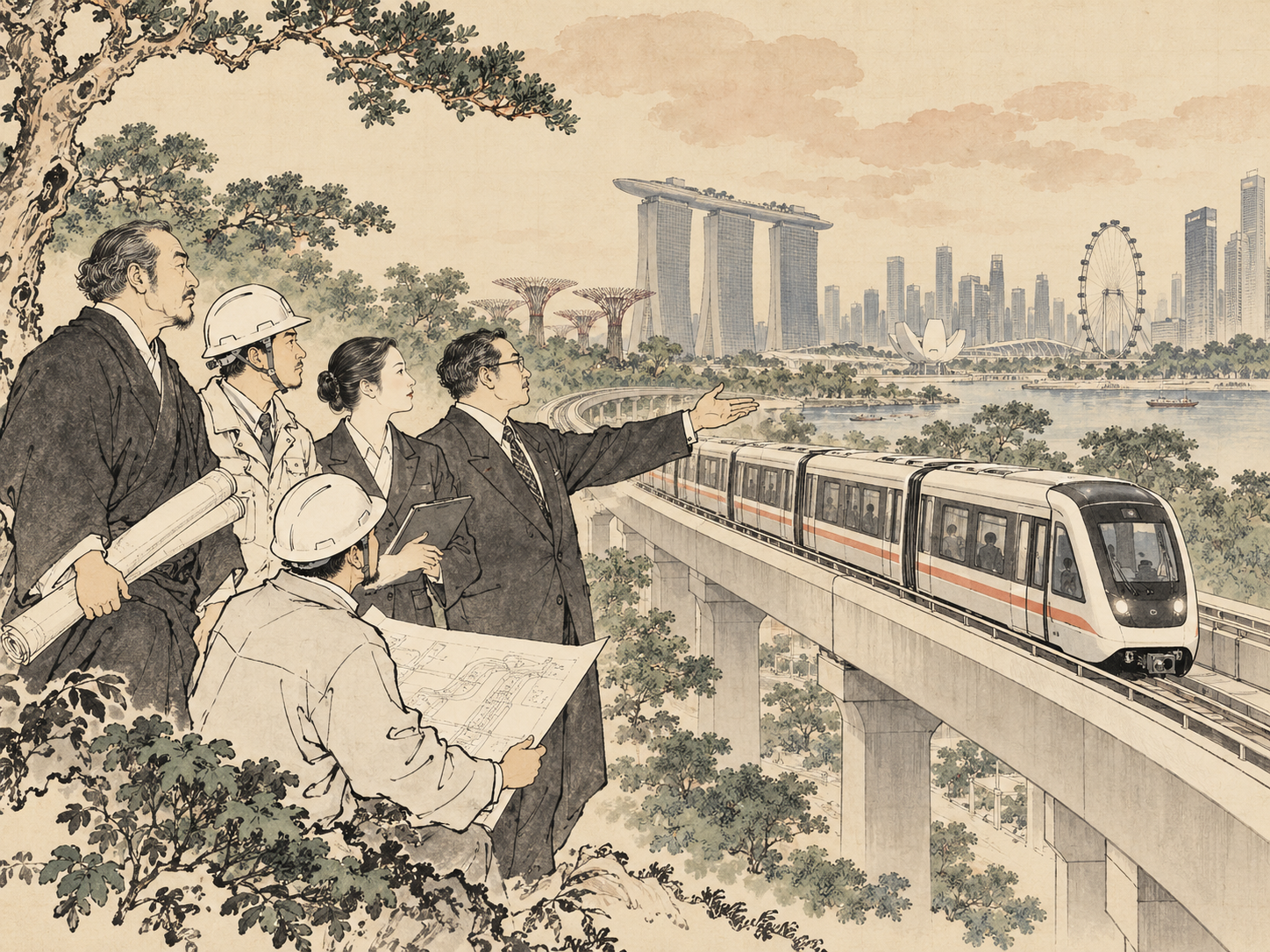
Mitsubishi Heavy Industries’ latest Singapore order is easy to underestimate. On Oct. 5, the company said it and regional subsidiary Mitsubishi Heavy Industries Asia Pacific had received an order from Singapore’s Land Transport Authority for eight additional two-car trains—16 cars—for the Sengkang-Punggol Light Rapid Transit network.[1]
The order is not a breakthrough into a new market. It is something more revealing about infrastructure exports: a repeat purchase from a customer that has been using Mitsubishi Heavy’s system for more than two decades. MHI supplied the original rolling stock and system for the network’s opening in 2003 and has since returned for capacity expansion, two-car operations, depot work, signalling, guideway upgrades, maintenance equipment and long-term after-sales service.
A system that grew with two new towns
The Sengkang-Punggol LRT is a fully automated feeder network in northeastern Singapore. Sengkang’s system opened in 2003 and Punggol’s in 2005. Both connect residential districts to stations on the North East MRT Line and to bus interchanges, making the LRT the local distribution layer of a much larger public-transport network.[8]
Mitsubishi Heavy’s technology is an Automated Guideway Transit, or AGT, system that runs on rubber tires and electric power. MHI began developing this class of transport in the 1970s and says it has delivered more than 500 AGT vehicles in Japan and overseas. Sengkang-Punggol was the first overseas urban-transport application of MHI’s Crystal Mover technology, which is also used in airport people-mover systems.[7][10]
From one-car operations to a larger two-car network
Sengkang and Punggol were still developing residential districts when the system was built. They have continued to grow, and transport demand has risen with them. MHI’s October announcement points to continued housing construction as well as new commercial facilities, universities and corporate activity in the northeast. LTA describes both as among Singapore’s fastest-growing residential estates.[1][8]
The railway has therefore been expanded in stages. In 2013, Mitsubishi Heavy and Mitsubishi Corporation won a capacity-expansion contract worth about ¥12 billion that included new vehicles, conversion work for two-car operations and upgrades to signalling and power systems. By 2016, the LRT had moved from a network limited to single-car trains toward regular two-car operation.[7]
The next major step came in 2022, when MHI Group won a project covering 17 new two-car trainsets and significant depot-related works, including signalling, guideway and vehicle-maintenance equipment. Eight more trainsets were ordered in 2023. The first two of that third-generation fleet entered passenger service in July 2025.[6][5][3]
The important improvements are mostly invisible to riders
The exterior design of the newest trains deliberately remains familiar. Much of the engineering change is inside. MHI says it optimized onboard equipment for paired two-car operation, added a touch-panel interface for equipment settings, and designed the vehicles to continuously collect operating data so maintenance teams can diagnose faults and troubleshoot faster.[3]
LTA lists rider-facing improvements too: ergonomic seating, brighter and more efficient LED lighting, clearer passenger-information displays, more visible door-closing indicators and improved air conditioning. But it also highlights the maintenance architecture—a touchscreen diagnostic panel, easier access to onboard equipment and inter-car doors that can support quicker evacuation in an emergency.[2]
The latest trains are tied to a much larger depot project
The eight-train order cannot be separated from the civil and systems work under way around it. Singapore temporarily closed part of the Sengkang West Inner Loop from April 2026 so that the SPLRT depot could be expanded to roughly three times its previous size. The works include major track changes, new reception tracks connecting the enlarged depot to the mainline, and installation and testing of signalling equipment. LTA says the depot expansion remains on track for completion in 2027.[2]
Progress was fast enough that LTA and operator SBS Transit restored full service on the affected loop on Oct. 4—two weeks earlier than originally planned. MHI announced the eight-train follow-on order the next day. The proximity of the announcements underlines the point: rolling-stock capacity and depot capacity are being expanded as one system.
Under LTA’s current plan, the 33 third-generation two-car LRVs will progressively replace a first-generation fleet consisting of 25 one-car and eight two-car LRVs. Eight second-generation two-car LRVs will remain. That is how the network reaches 41 two-car trainsets by 2030.[2]
Local service became part of the export model
MHI has not tried to support Singapore entirely from Japan. In 2021, it established a Technical Service Center in Singapore for operation, maintenance and after-sales work on transportation systems. The center supports not only Sengkang-Punggol but other regional transport assets, including airport people movers.[9]
That matters in infrastructure procurement because an overseas supplier creates a practical question for the operator: who answers when something fails? Where are the technicians? How quickly can parts, software expertise or engineering decisions reach the line? A local technical base reduces that distance and gives MHI an asset that a one-time equipment exporter does not have.
| Year | Milestone |
|---|---|
| 1998 | Original system contract awarded to MHI and Mitsubishi Corporation |
| 2003 | Sengkang LRT opened with MHI rolling stock and system |
| 2005 | Punggol LRT opened |
| 2013–16 | Capacity expansion, new cars, system upgrades and two-car operation |
| 2021 | MHI transport Technical Service Center established in Singapore |
| 2022 | 17 new two-car trainsets plus major depot and system work ordered |
| 2023 | Eight more two-car trainsets ordered |
| 2025 | First two third-generation trainsets entered passenger service |
| 2026 | Another eight trainsets ordered, taking planned third-generation deliveries to 33 |
| 2030 | LTA plans a total fleet of 41 two-car trainsets including eight retained second-generation sets |
This is more than a Japanese rolling-stock export
Japanese rail exports are often discussed in terms of how many trains a manufacturer sells. But MHI’s Singapore relationship includes rolling stock, signalling, guideway, power-related systems, depot expansion, maintenance equipment, data, retrofit work and local technical support. As urban systems become more software-intensive and maintenance-driven, lifecycle capability can matter as much as the initial vehicle price.
AGT also occupies a particular transport niche. Rubber-tired systems can handle tighter alignments and steep grades, support automated operation and work well where cities need medium-capacity transport rather than a full heavy-rail metro. That makes them relevant for airports, planned districts and dense feeder networks.
MHI’s global AGT/APM record includes systems in Singapore, Macau, Japan and major U.S. and Asian airports. Sengkang-Punggol stands out because the relationship has survived multiple generations of rolling stock and repeated expansion cycles.[10]
The contract value is not public
Neither MHI’s Oct. 5 announcement nor LTA’s Oct. 2 release states the price of the additional eight trainsets. A 2013 capacity-expansion contract involving vehicles and substantial electrical and system works was disclosed at approximately ¥12 billion, but the scope, specifications and cost environment are different. Using that older contract to estimate the current order would therefore be misleading.[7]
MHI also says the operating record, train quality and its responsiveness to operator requests were highly valued by LTA and led to the award. That is MHI’s description of the procurement outcome. The public LTA material reviewed by Japan.co.jp does not provide the tender score, rival bids or a detailed comparative assessment, so those elements remain unverified.
- The contract value and detailed delivery schedule for the eight new trainsets
- When all 33 third-generation trains enter passenger service
- How much peak capacity rises under the planned 41-trainset fleet
- Whether onboard diagnostic data measurably reduces downtime and maintenance cost
- How far MHI can use its Singapore service base to win lifecycle work elsewhere in Asia
The value of being chosen again
Infrastructure changes after it is built. Cities expand. ridership rises. equipment ages. A system designed for one generation of demand must eventually carry the next one.
What Mitsubishi Heavy has built in Sengkang and Punggol is therefore not just a fleet. It is a long-term position inside the evolution of the network: from single cars to two-car trains, from first-generation rolling stock to third generation, from a smaller depot to one roughly three times the size, and from conventional maintenance toward continuous vehicle-data use.
Eight additional trainsets will not, by themselves, transform MHI’s global earnings. But in long-lived infrastructure, a customer placing another order after more than 20 years can be a stronger competitive signal than a spectacular first contract. For Japan’s transport exporters, that may be the most important lesson in Singapore.
Sources & Reference Material
- Mitsubishi Heavy Industries, follow-up order for eight two-car Sengkang-Punggol LRT trains, Oct. 5, 2026.
- Singapore Land Transport Authority, SPLRT service resumption and eight additional LRVs, Oct. 2, 2026.
- Mitsubishi Heavy Industries, start of commercial operation for new SPLRT trains, July 16, 2025.
- Singapore Land Transport Authority, first two new two-car LRVs enter passenger service, July 15, 2025.
- Mitsubishi Heavy Industries, 2023 follow-up order for eight two-car trains.
- Mitsubishi Heavy Industries Engineering, 2022 SPLRT capacity-enhancement project.
- Mitsubishi Heavy Industries and Mitsubishi Corporation, 2013 SPLRT capacity expansion.
- Singapore Land Transport Authority, Sengkang-Punggol LRT network overview.
- Mitsubishi Heavy Industries Engineering, Singapore Technical Service Center, April 5, 2021.
- Mitsubishi Heavy Industries, AGT/LRT product history and global delivery record.
Reporting cutoff: Oct. 6, 2026, 1:21 PM JST. Public materials reviewed by Japan.co.jp did not establish the contract value for the eight-train order, a detailed delivery schedule, LTA tender scoring or rival bids, or the date on which all 33 third-generation trainsets will be in passenger service.