- The invisible factory problem inside an ordinary box
- Two announcement dates, one engineering development
- Why paper warps in the first place
- What the AI unit actually does
- The hidden economics of shorter production runs
- From hat linings to industrial infrastructure
- Mitsubishi’s 1956 machine and the long road to AI
- Can software preserve the judgment of experienced operators?
- What the manufacturer has not quantified
- Packaging and the environmental accounting question
- The future arrives as an uneventful sheet of board
The invisible factory problem inside an ordinary box
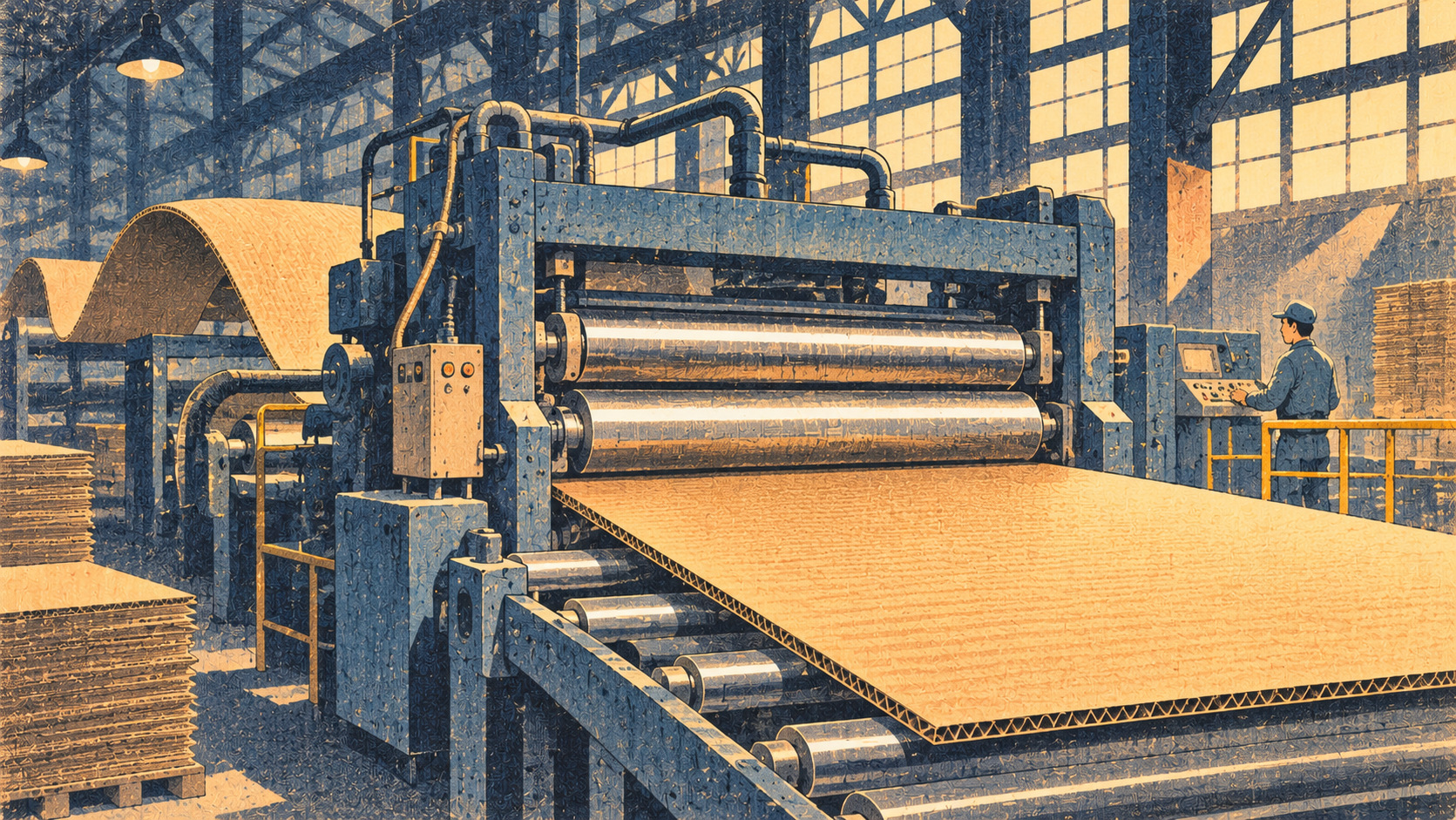
The cardboard box arrives, gets opened and is forgotten. Yet long before a parcel reaches a doorstep, that unremarkable object passes through a tightly controlled industrial process. Three layers of paper have to be joined, heated and dried while retaining the shape needed for printing, cutting, folding and filling. A small curl in the board can interrupt that journey. The defect is mundane; its consequences for a production line can be anything but.
That is the problem Mitsubishi Heavy Industries Machinery Systems, or MHI-MS, says it has addressed with artificial intelligence. Its new predictive control unit monitors the conditions under which corrugated board warps and recommends adjustments for different paper grades. The company has announced commercialization and plans a full-scale domestic and overseas sales effort.
There is no humanoid robot and no grand claim that AI has reinvented packaging. The intriguing development is more specific: a long-established equipment manufacturer is trying to capture a fragment of the judgment exercised by experienced machine operators, transforming it into measurements, predictions and repeatable settings.
Two announcement dates, one engineering development
The chronology deserves precision. MHI published its Japanese announcement on October 29, 2026; the English release bears a November 5 date. This November 11 article is an analytical examination of that already announced system, not a report that Japan first learned of it on November 5.
MHI-MS describes its system as a world first. That is a manufacturer claim, not an independently verified survey of every competing corrugating-machine control system. Commercialization and a planned global rollout likewise should not be confused with published proof of widespread customer adoption or independently audited savings.
The announcement nevertheless matters because it identifies a clear production bottleneck, describes a specific control architecture and comes from a supplier with decades of machinery experience.
Sources: MHI Japanese announcement · MHI English release
Why paper warps in the first place
Corrugated board typically begins with two flat sheets, known as liners, and a fluted paper medium between them. The fluted center supplies much of the structure that lets the finished material be light yet relatively strong. Adhesive, heat, pressure and drying help bring those three elements together. They also introduce changing thermal and moisture conditions.
As the inner and outer liners absorb and release moisture at different rates, they can shrink differently. The finished sheet may bow or curl. Depending on the direction and severity of deformation, downstream equipment may struggle to feed it accurately. MHI specifically identifies jams in box-making machines, quality problems and lost productivity as potential consequences.
Not every visibly warped sheet is necessarily discarded. Severity, orientation, downstream specifications and the factory’s tolerance limits all matter. That distinction is important when evaluating financial claims: a reduction in a measured warp defect is not automatically equal to a particular reduction in waste or line stoppages.
What the AI unit actually does
According to the company, the product is an electrical control unit for its corrugating machines. It combines sensors measuring board deformation, temperature and moisture content with an AI-capable computer and machine control hardware. Data are collected for different paper grades, and the prediction model learns the settings associated with satisfactory production.
The result, the manufacturer says, is the ability to predict settings that avoid warping from the beginning of each production lot. That last phrase is important. If production switches frequently among paper grades and customer requirements, a control system that reaches an acceptable condition quickly can be more valuable than a system that performs well only after extensive manual adjustment.
The public release does not disclose model architecture, sensor types, controller response times or the full set of manipulated variables. It therefore supports an explanation of the predictive control concept, but not detailed performance claims about algorithmic accuracy, safe operating envelopes or universal compatibility.
The hidden economics of shorter production runs
Factories that produce a long run of one specification can refine a set of machine settings and keep using it. Shorter runs and more product variations impose a different burden. A new grade or format can demand another adjustment, and the first sheets after a changeover may be more vulnerable to defects.
MHI-MS explicitly connects the development with Japan’s demand for varied box types and small-lot manufacturing. Packaging is shaped by food, beverages, appliances, clothing, household goods and countless shipping requirements. The commercial opportunity is not simply a faster machine; it is a machine that changes tasks without paying such a high penalty in adjustment time and inconsistent quality.
Whether that opportunity becomes a compelling customer investment remains unproven in the release. Customer interviews, controlled before-and-after measurements, machine-specific installation costs and maintenance requirements would be needed to determine the return.
From hat linings to industrial infrastructure
The roots of corrugated material run through 19th-century invention. Historical accounts compiled by Japan’s National Federation of Corrugated Board Industry Associations trace early corrugated paper to hat linings and protective cushioning. The idea developed through single-face board, double-face structures and machines capable of making packaging at industrial scale.
Japan’s distinctive chapter began in 1909, when Teijirō Inoue used hand-operated iron corrugating rolls to make the material domestically and gave it the Japanese name danbōru. He established an enterprise that became part of the history of Rengo, one of Japan’s major packaging companies. The origin story matters because it reminds us how much clever mechanical engineering lies behind a product that now seems ordinary.
The challenge in Inoue’s day was producing consistent waves in paper. The challenge in 2026 is controlling the thermal, moisture and mechanical behavior of multiple layers as they move through an automated high-speed line. One century of technological change has not removed the material’s sensitivity to the physical world.
Sources: Japanese corrugated-board federation: technology timeline · Rengo historical timeline
Mitsubishi’s 1956 machine and the long road to AI
MHI-MS says its first corrugating machine was delivered in 1956 and that more than 300 have since been sold in Japan and abroad. MHI’s machinery pages describe corrugating and box-making equipment marketed in more than 30 countries. Its published product specifications include a model capable of up to 450 meters of board per minute and a separate box-making machine rated at up to 400 boxes per minute. Those are catalogue ratings for product lines, not measured output from the new AI module.
For decades industrial machinery suppliers have competed on throughput, reliability and serviceability. The competitive question is widening. What happens when a machine must handle more kinds of orders, with fewer experienced staff and less tolerance for waste? Predictive controls offer a potential response, especially when they are developed alongside the machinery they operate rather than attached as an isolated software experiment.
The blend here is particularly revealing: MHI’s research organization contributed AI capabilities while MHI-MS supplied practical warp-control knowledge. It is the sort of cross-disciplinary work that often goes unnoticed because its best result is a factory that simply runs more consistently.
Sources: MHI corrugating and converting machines
Can software preserve the judgment of experienced operators?
A veteran machine operator does not necessarily consult a formula before changing heat, moisture or operating settings. Some judgments emerge from years of watching paper respond to changes in grade, weather and speed. That expertise can be difficult to document, particularly as experienced workers retire and manufacturing companies struggle to train replacements.
Japan’s Information-technology Promotion Agency has separately supported research on capturing tacit manufacturing knowledge through AI. That work is not presented here as a partner in the MHI-MS system; it illustrates a wider problem: many valuable shop-floor decisions have never been reduced to a clean dataset.
The new controller does not establish that factories can dispense with expert personnel. People still have to supervise quality, address mechanical faults, evaluate unsafe or unusual conditions and understand why a model occasionally fails. In a successful implementation, skilled workers may move from making constant corrections toward validating and improving the control process.
Sources: IPA tacit-knowledge research
What the manufacturer has not quantified
Industrial buyers need answers that press releases rarely provide: how much does an installation cost? What existing lines are compatible? How many minutes of setup time disappear? How many sheets stop being rejected? Does it work on recycled grades with variable properties? How often must its predictive model be retrained, and what happens when sensors drift?
The announcement provides no independently verified percentage reduction in defects or scrap, no customer deployment count, no price, no quantified payback period and no externally audited energy or carbon benefit. A claim of world-first innovation, although newsworthy, is not a substitute for those benchmarks.
There are also ordinary industrial-control considerations: cybersecurity, access to operating data, manual override, alarm behavior and accountability when machine settings fail. These are evaluation questions, not evidence that the new unit suffers from any particular defect.
Packaging and the environmental accounting question
Corrugated board is deeply integrated into paper recovery and recycling systems. MHI’s machinery materials describe Japan’s substantial recovery and recycled-fiber use, but those are different measures whose definitions and reporting periods need to be kept separate.
Better process control could in principle reduce startup waste, rework or wasted energy. It could also help a plant maintain quality while switching specifications. Yet the environmental benefit cannot responsibly be assigned a numerical value without actual baseline waste data and an appropriate lifecycle analysis. The same caution applies to any prediction that the new technology will immediately lower customer costs.
An appealing story about AI becomes more useful when readers know precisely which effects are demonstrated, which are plausible and which remain untested in public evidence.
Sources: Corrugated-board federation statistics
The future arrives as an uneventful sheet of board
If this technology succeeds commercially, its most significant achievement may be that nobody outside the factory notices. A production order changes, the new grade moves smoothly through the machine, the board stays flat and the boxes arrive on time. The control unit has prevented a problem rather than performed a spectacle.
That understated outcome captures an important dimension of industrial AI in Japan. The most consequential applications will not always look futuristic. Sometimes the future of automation is a century-old material emerging from a machine in exactly the shape it was supposed to have.
Sources and verification limits
“World first” remains the manufacturer’s attribution. Public documentation does not substantiate pricing, installed-customer count, independent improvement percentages, energy savings or audited return on investment. Japanese and English announcement dates differ.
- MHI Japanese press release, October 29, 2026
- MHI|AI warp control (English, November 5, 2026)
- MHI paper converting machinery and product specifications
- MHI corrugating machine process
- Federation: corrugated-board technical chronology
- Federation: production and consumption statistics
- Rengo company history and Teijirō Inoue
- IPA: tacit expertise in manufacturing
- METI/IPA: AI-ready manufacturing data
- JAPAN.co.jp: related MHI earnings report