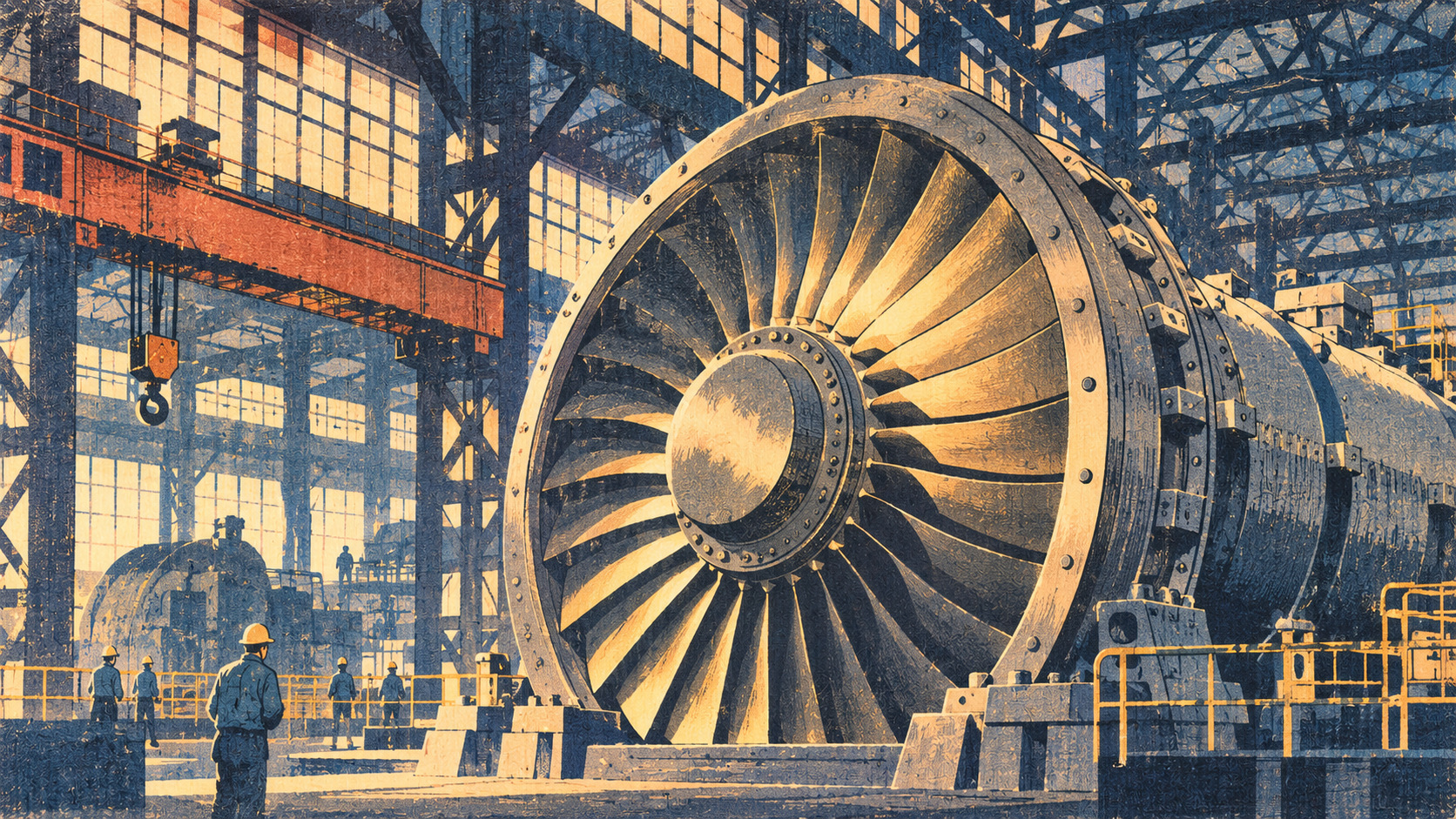
- An old industrial company meets a new wave of demand
- What the 45% profit gain measures
- Gas turbines: the geography of a global power shortage
- Nuclear power: an industrial business with long timelines
- Defense and aerospace: fewer new orders, more work delivered
- The less spectacular businesses still matter
- The ¥67.5 billion problem hiding in the power portfolio
- What a ¥14 trillion backlog can—and cannot—promise
- From a Nagasaki shipyard to a modern engineering conglomerate
- The revised forecast—and what could go wrong
- Industrial revival depends on the work after the order
An old industrial company meets a new wave of demand
The most revealing number in Mitsubishi Heavy Industries' latest accounts may not be profit. It may be the ¥14.23 trillion order backlog: a long queue of turbines, power equipment, infrastructure and aerospace work whose delivery will stretch well beyond a single reporting period.
On November 6, Mitsubishi Heavy Industries (MHI) reported first-half FY2026 revenue of ¥2.523 trillion, up 19.4% from a year earlier, and business profit of ¥249.3 billion, up 45.3%. Orders totaled ¥3.613 trillion. Those results, covering April through September 2026, illustrate how energy security, industrial investment and defense production are reshaping demand for Japanese engineering.
But the announcement also contained a less celebratory disclosure: MHI booked a ¥67.5 billion warranty provision for two coal-gasification power plants delivered in 2021. The combination of rising profitability and costly long-tail obligations makes this a more instructive story than a simple earnings beat.
What the 45% profit gain measures
MHI's business-profit margin increased from 8.1% to 9.9%, a 1.8-percentage-point improvement. The company attributed the gain chiefly to higher revenue and improved profitability, offset in part by wage pressures, currency effects and project-related charges. The metric is an MHI-defined measure of business profit; it should not automatically be equated with every company's operating-income measure.
Profit attributable to owners of the parent increased 76.9% to ¥203.2 billion. The larger rise in bottom-line earnings was partly helped by foreign-exchange gains and finance income. It would therefore be misleading to interpret the 76.9% figure as an improvement purely in industrial operations.
Operating cash flow reached ¥394.5 billion and reported free cash flow ¥468.3 billion. Cash generation is encouraging, though analysts should examine the influence of asset transactions and changes in working capital rather than extrapolate one half-year into an enduring run rate.
Primary documentation: enbrief · enpres
Gas turbines: the geography of a global power shortage
The Energy Systems segment led the company. Its first-half orders rose to ¥2.304 trillion, revenue to ¥1.123 trillion and business profit to ¥145.1 billion, an approximately 80% increase in the segment's profit from a year earlier.
MHI says demand for gas-turbine combined-cycle (GTCC) systems was particularly strong in North America and Asia. A combined-cycle plant uses exhaust heat from a gas turbine to produce steam and drive a second turbine. That makes more use of the heat in the fuel than a simple-cycle configuration. It does not, however, make electricity produced from fossil gas carbon-free.
Rising electricity demand, the need for dispatchable generation and investment in power reliability have renewed commercial interest in advanced turbines. For customers, the decisive questions extend beyond procurement price: fuel cost, efficiency, maintenance intervals, emissions, permitting and how the plant fits a changing power grid.
Primary documentation: enpres
Nuclear power: an industrial business with long timelines
Nuclear-related orders and revenue also strengthened, according to MHI's briefing. The business extends across equipment, services and nuclear fuel-cycle work, areas where project timelines and regulatory requirements can span years.
Growing nuclear revenue does not by itself establish that any particular reactor is safer or that a specific restart has been approved. Those are separate regulatory decisions. For Japan, the industrial question is whether engineering capacity, skilled workers and rigorous quality assurance can be sustained while energy policy remains contested.
That distinction matters outside Japan, too. International customers are watching Japanese suppliers for specialized components and long-term support, but assessing actual commercial opportunity requires looking at confirmed contracts rather than broad claims about a nuclear renaissance.
Defense and aerospace: fewer new orders, more work delivered
MHI's Aircraft, Defense & Space division illustrates an important feature of long-cycle manufacturing. First-half orders fell from ¥545.0 billion to ¥296.8 billion because the year-earlier period included major awards. Yet revenue increased from ¥538.8 billion to ¥633.4 billion and business profit climbed from ¥60.3 billion to ¥76.3 billion.
That apparent contradiction is normal for businesses that build against multiyear backlogs. A contract signed one year may generate production revenue in another. MHI credited progress in defense and space work and increased shipments of commercial aircraft-related products for the revenue growth.
Defense spending can support domestic industrial capabilities, but governments and taxpayers must still scrutinize delivery performance, cost escalation, procurement transparency and competitive capacity. Strong demand is not proof that complex projects will be delivered on budget.
Primary documentation: enpres
The less spectacular businesses still matter
Plants & Infrastructure orders rose substantially to ¥689.5 billion, helped by engineering and metals machinery. Yet segment business profit declined from ¥44.6 billion to ¥41.4 billion. MHI cited the absence of unusually profitable work in the comparison period. Rising orders, therefore, cannot be treated as an automatic signal of a rising margin.
Industrial Solutions, a collection that includes engines, turbochargers and thermal systems, generated revenue of ¥352.6 billion and profit of ¥14.7 billion, more than twice the previous year's ¥6.7 billion profit. Currency movements and higher engine revenue contributed.
Comparisons require care. On April 1, 2026, MHI renamed its Logistics, Thermal & Drive Systems segment Industrial Solutions and transferred its Data Center & Energy Management unit into it. The company has restated relevant prior-year segment figures. Mitsubishi Logisnext-related operations were also treated as discontinued for applicable comparative figures.
Primary documentation: loss · lossPDF
The ¥67.5 billion problem hiding in the power portfolio
In a separate November 6 notice, MHI disclosed a ¥67.5 billion provision for future product-warranty expenses related to the Nakoso and Hirono integrated coal gasification combined-cycle (IGCC) power plants delivered in 2021. The company concluded, following discussions with stakeholders and technical review, that selected components would need periodic replacement to support stable operation.
A provision is an accounting recognition of expected future costs, not evidence that the entire sum was paid in cash that day. MHI said the charge was included in its revised annual outlook. The presentation also discusses a roughly ¥70 billion FY2026 IGCC-related extraordinary charge; these disclosures overlap and should not simply be added together.
The case exposes a defining risk in heavy engineering: the manufacturer may be accountable long after a plant starts operating. A huge backlog of new projects matters, but so do contract terms, component longevity, maintenance obligations and warranty exposure.
What a ¥14 trillion backlog can—and cannot—promise
Orders outstanding at September 30 totaled ¥14.2256 trillion, ¥988 billion above the previous fiscal year-end. That is a formidable indicator of future workload, though it is not a guaranteed profit stream.
Long-cycle industrial contracts face changing steel and materials prices, labor constraints, subcontractor availability, design modifications and delivery milestones. Backlog converts into revenue only under the contract and applicable accounting rules, while the margin earned can shift as the project progresses.
The same pressures that lift demand can squeeze delivery. If power-system customers all want turbines sooner, capacity, skilled labor and suppliers become critical. The key measure over time is not just how fast MHI adds orders, but whether those orders translate into reliable delivery and cash earnings.
Primary documentation: enhist
From a Nagasaki shipyard to a modern engineering conglomerate
The company traces its founding to 1884, when Mitsubishi founder Yataro Iwasaki leased the government-owned Nagasaki shipyard and expanded shipbuilding operations. By 1934 the enterprise had spread into machinery, aircraft and rolling stock and adopted the Mitsubishi Heavy Industries name.
Japan's postwar industrial settlement remade the business. MHI was divided into three companies in 1950 amid the breakup of prewar industrial concentration; the three were reunited in 1964. Its history charts changing national priorities: ships and industrial machinery, postwar reconstruction, power stations, transport networks, commercial aviation and modern energy and defense systems.
The Nagasaki yard's company chronology records its first Japanese-made power-generation turbine, rated at 500 kilowatts, in 1908. The technologies are vastly more sophisticated today, but the continuity matters. Complex capital goods demand accumulated knowledge of metals, heat, precision and long operating lifetimes.
Primary documentation: enpres · buyback
The revised forecast—and what could go wrong
MHI raised its FY2026 revenue forecast from ¥5.4 trillion to ¥6.0 trillion, its business-profit forecast from ¥540 billion to ¥600 billion and its order forecast from ¥7.0 trillion to ¥8.0 trillion. The expected business-profit margin is 10%. These are management projections as of November 6, not completed FY2026 results.
The forecasts assume ¥150 to the US dollar and ¥180 to the euro for relevant unhedged exposures. Actual results could differ with currency movements, execution costs and industrial demand. The presentation explicitly says it has not included the impact of Middle East developments in its outlook.
The company also authorized a share-buyback program of up to ¥300 billion or 120 million shares, with an acquisition window from November 9, 2026 through November 8, 2027. Authorization is not the same as completed repurchases. The decision raises a wider capital-allocation question: how much should be returned to shareholders versus invested in plant capacity, product quality and skilled engineering staff?
Industrial revival depends on the work after the order
The financial picture challenges the idea that heavy manufacturing is merely an old-economy sector. Turbines, nuclear systems and defense equipment depend on advanced materials, digital controls, service networks and specialized supply chains. They are simultaneously old technologies in historical terms and modern strategic capabilities.
The decisive tests over the next reporting periods will be GTCC margins, the IGCC warranty response, execution of defense orders, recovery in Plants & Infrastructure profitability and durable cash conversion. Analysts should also weigh power-generation emissions and the public responsibilities attached to nuclear and defense work.
From the Nagasaki yard to a backlog extending years into the future, MHI's story is ultimately about the obligations embedded in engineering. Winning an order matters; delivering a machine that works reliably for decades matters more.
Sources and verification notes
Sources are corporate primary documents. Prior-year figures reflect treatment of discontinued operations and segment changes; projections are not actual results.