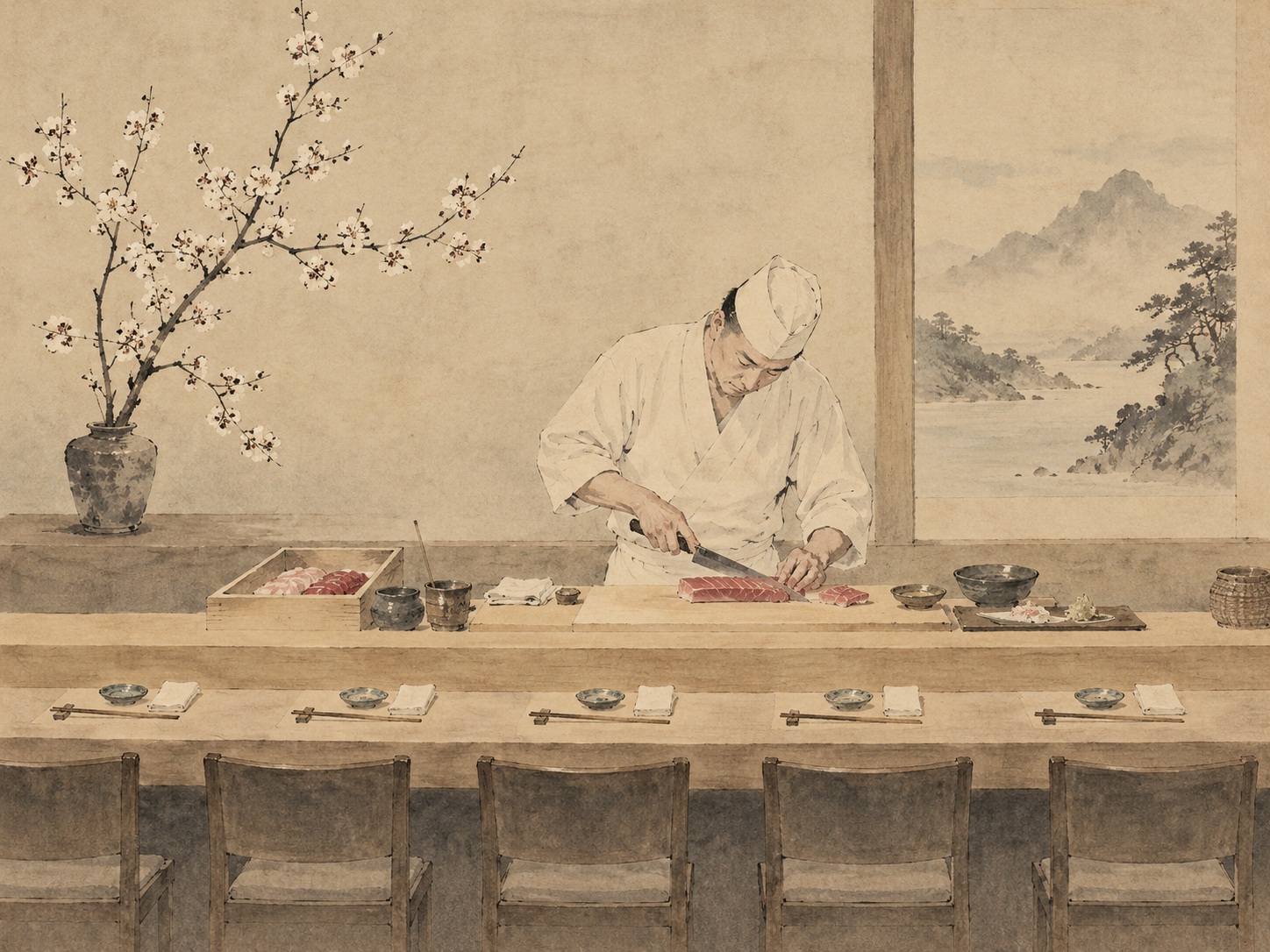
In Tokyo’s Yotsuya district, one of Japan’s most discussed sushi counters has only six seats. New reservations are said to be booked years ahead. Chef Yasuhiko Mitani built his reputation not only on sushi but on what he calls “Mariage”: pairing individual pieces with wine and sake in combinations that treat the drink as part of the dish rather than an accessory.
For the first time, that private world has become the subject of a feature documentary. MITANI – The Mariage of Sushi, co-directed by Japan’s Keita Ideno and Australia’s Ivan Kovac, screened September 23 in Culinary Zinema at the 74th San Sebastián International Film Festival. The 71-minute Japanese production was produced by TOMODE BASE with UPP as co-producer and features Mitani himself.[1]
A film about more than knife skill
San Sebastián’s official synopsis describes Mitani’s restaurant as a six-seat Tokyo “sushi sanctuary” with a four-year waitlist. The film follows his pairing philosophy, his sense of gratitude after surviving a serious heart condition and a major challenge: taking his culinary work to the Lotte New York Palace.[1]
In the festival daily, Ideno and Kovac said this was the first time Mitani’s life had been documented in a film. They stressed that his relative privacy did not come from hostility to cameras; he preferred to spend his limited time teaching apprentices and transmitting his craft. Allowing a feature production into that schedule was itself an exception.[2]
Who is Yasuhiko Mitani?
Japanese profile reporting says Mitani began training as a sushi chef at 15, later managed Sushi Rozan’s Shinjuku branch and opened Mitani in Yotsuya in 2006. He expanded with Kioicho Mitani in 2016 and Kioicho Mitani Bettei in 2021. GOETHE described the Yotsuya restaurant in 2022 as facing a four-year wait for new reservations and called Mitani a pioneer of sushi-and-wine pairing.[3]
That biography matters because Mitani sits inside the lineage of traditional sushi craftsmanship while designing the entire experience—beverage sequence, reservation model, room size, pacing and international presentation—as one authored work.
Edomae sushi began as fast food
The modern image of elite Tokyo sushi—a silent counter, advance reservation, personal interaction with the chef and a costly omakase—can obscure the form’s origins. Nigiri developed in Edo as popular street food.
Japan’s Ministry of Agriculture, Forestry and Fisheries describes Edo-mae cuisine as emerging from the city’s street-stall culture, where sushi, tempura and soba were sold using fish and shellfish from Edo Bay. Nigiri became a convenient food for ordinary urban residents, and figures such as Hanaya Yohei are traditionally credited with helping popularize the style.[4][5]
The “work” applied to Edo-mae toppings was partly preservation technology: kohada and mackerel cured in vinegar, tuna marinated in soy, anago simmered, shrimp cooked. Before refrigeration, flavor and preservation were inseparable.
Luxury did not erase the tradition; it changed the product
As sushi moved indoors and refrigeration, logistics and wholesale fish markets improved, the range of ingredients and service styles expanded. “Edomae” increasingly came to describe not simply fish from Tokyo Bay but a method: curing, simmering, steaming, marinating, kombu curing and other preparation designed to shape flavor before the piece reaches the customer. MAFF still identifies those techniques as defining characteristics of Edo-mae sushi.[4]
At the high end, the product is no longer merely raw-material cost. Value comes from aging, cutting, rice temperature, vinegar blend, pressure of the hand, order of service, beverage pairing, conversation and scarcity of seats.
Why wine?
Sake is the obvious cultural partner for sushi, but Mitani made wine central to his identity. In a 2022 interview, he said he had come to believe that beverages capable of accompanying sushi extend beyond sake and wine as well, suggesting a broader curiosity about how drinks interact with food.[3]
The film’s “Mariage” title is therefore more than luxury signaling. It points to Mitani’s attempt to connect acidity, fat, umami, temperature, aroma and finish across food and drink.
Festival publicity describes this in “molecular” terms. That should be understood as a culinary philosophy and promotional description, not as a peer-reviewed scientific claim establishing objectively superior pairings.
The economics of being impossible to book
A six-seat restaurant with a four-year wait creates an obvious economic paradox. In a conventional business, overwhelming demand invites more capacity. But extreme smallness can help protect consistency, concentration, prep volume and direct interaction with guests.
Scarcity also becomes part of the brand. “You cannot get in” can turn dinner into status. The documentary celebrates access to Mitani’s world, but it also invites a harder question: how much of elite sushi’s value comes from cooking, and how much comes from the economics of exclusion?
After Jiro Dreams of Sushi
Any international film about a reserved Tokyo sushi master now exists in the shadow of David Gelb’s 2011 documentary Jiro Dreams of Sushi. The Japan Times, reviewing Mitani’s appearance at San Sebastián, made that comparison explicit and noted how Gelb’s film helped establish the visual language international audiences now associate with serious sushi documentaries.[6]
But the chef archetypes differ. Jiro Ono’s story centered on repetition, purification of Edo-mae craft, apprenticeship and succession. Mitani’s includes wine, cross-cultural presentation, a serious health crisis and an explicit attempt to take his philosophy overseas.
Why San Sebastián matters
San Sebastián is internationally known for both cinema and gastronomy. Culinary Zinema deliberately combines the two, screening food-centered films alongside themed dinners. In 2026, the section included five feature films competing for a €10,000 award. MITANI screened September 23 with a presentation and Q&A attended by the film delegation.[7][8]
The section award went to Michael Dweck and Gregory Kershaw’s Burgundy. Mitani’s significance in San Sebastián therefore lies not in a prize but in the fact that a Japanese sushi counter was being treated as cinematic and cultural subject matter in one of Europe’s great food cities.
Is sushi Japanese culture or a global luxury product?
Sushi now exists everywhere: supermarket trays, casual rolls, conveyor-belt chains, neighborhood restaurants and ultra-exclusive omakase counters. They share a name while offering radically different experiences.
Globalization does not necessarily erase the Japanese core. Instead, it reveals which parts are treated as essential: vinegared rice, fish, handwork, counter service, seasonality, chef authority. Then each market adds its own forms of luxury, service, ingredients and storytelling.
Teaching apprentices versus preserving a life on film
The directors’ explanation of Mitani’s reluctance to give time to filming is one of the most revealing details around the project. He was not described as media-shy so much as time-protective: teaching apprentices and transmitting technique took priority.[2]
That matters because craft transmission cannot be reduced to recipes. Judging fish condition, pressure in the hand, timing, sequence and interaction with a guest involve tacit knowledge. Film cannot replace apprenticeship, but it can preserve decisions that normally disappear after a service ends.
Do not romanticize exclusivity too easily
Food cinema can make exclusivity look like proof of artistic worth: silent rooms, rare ingredients, impossible reservations, perfect knives. That visual language risks turning exclusion itself into luxury spectacle.
Mitani’s six seats may have genuine operational reasons. A four-year wait, however, also transforms inaccessibility into cultural capital. Viewers should be able to admire the craft while still asking what scarcity contributes to the mythology.
What changes when the counter travels to New York?
The film’s New York sequence matters because sushi is intensely tied to place—to fish markets, rice, water, service rhythm and local expectations. Moving the experience abroad forces a chef to decide what is portable and what must change.
That is increasingly the role of internationally known Japanese chefs. They are not merely reproducing Japanese food overseas; they are translating a personal philosophy for a global audience. Mitani’s pairing concept is one form of that translation.
Two centuries behind six seats
MITANI can be watched as privileged access to an impossible reservation. A richer interpretation is to see it as a record of how far sushi has traveled.
From Edo street stalls to six seats in Yotsuya. From preservation techniques designed for a pre-refrigeration city to carefully staged pairing with rare wine. The craft may retain recognizable continuity, but the economics, audience and cultural meaning around it have changed almost beyond recognition.
Mitani’s restaurant is not the future of sushi in any universal sense. It is one extreme point on the spectrum. But precisely because it is so extreme, it makes visible what the rest of the world now asks sushi to be: food, craftsmanship, theatre, luxury, memory and a form of Japanese cultural capital all at once.
Sources and references
- San Sebastián International Film Festival, official page for MITANI – The Mariage of Sushi.
- San Sebastián Festival Daily, “El maestro Mitani abre su mundo al cine,” September 23, 2026.
- GOETHE, profile of Yasuhiko Mitani and the Yotsuya restaurant’s four-year reservation wait, October 23, 2022.
- Japan Ministry of Agriculture, Forestry and Fisheries, Tokyo food-culture history and Edo-mae cuisine.
- MAFF, historical overview of nigiri sushi in Tokyo.
- The Japan Times, “After ‘Jiro Dreams of Sushi,’ ‘Mitani’ tells a different sushi story in San Sebastian,” October 2, 2026.
- San Sebastián Festival, 2026 Culinary Zinema section overview.
- San Sebastián Festival, September 23 programme and Q&A schedule.
- kirameki inc., Japanese production information for MITANI – The Mariage of Sushi.
Reporting cutoff: October 4, 2026. Current menu prices, present reservation mechanics and some restaurant operating details were not independently confirmed through a first-party restaurant source. “Molecular” pairing language comes from festival publicity and is not treated as a scientific finding.