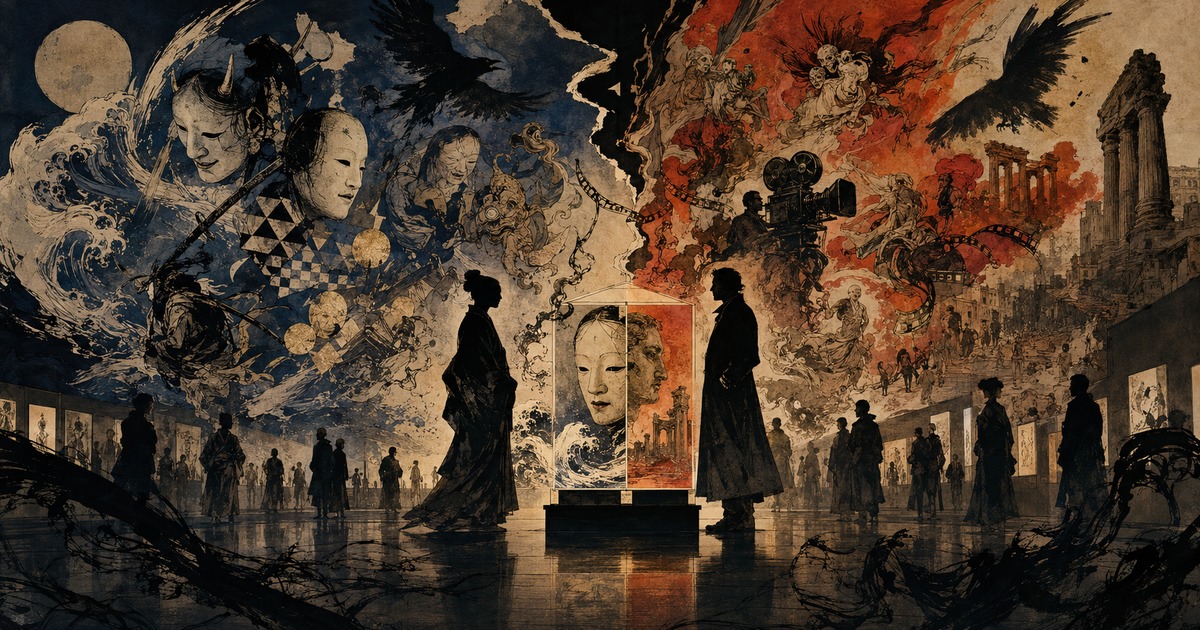
On one wall, Yukio Mishima sits within the severe elegance of his own house, photographed by Kishin Shinoyama in 1970. Across the room, Pier Paolo Pasolini holds The Ashes of Gramsci, his face caught by Sandro Becchetti. Between them are manuscripts, books, film posters, press images and objects that once belonged to separate national histories. There is no prescribed route. The visitor supplies the line of argument.
That freedom matters on the final day of “Yukio Mishima and Pier Paolo Pasolini: Clues for a Confrontation—Without Silence, Without Looking Away.” The exhibition closes Wednesday, July 29, at the Italian Cultural Institute in Tokyo’s Kudan district after a run that began June 26. Admission is free. The last day’s hours are 10:30 a.m. to 5:30 p.m.
The project has taken about three years to assemble. Conceived by Marco Minuz, with Roberto Carnero curating the Pasolini material and Mishima Yukio Literary Museum director Hideaki Sato overseeing the Japanese writer’s section, it is organized around seven words: body, responsibility, literature, cinema, theater, artistic relations and society. Archives, original manuscripts, photographs, drawings, interviews and printed matter form two parallel tracks without forcing them into a single biography.
The danger of such a display is obvious. Mishima and Pasolini have become icons so magnetic that resemblance can replace history. Both were famous writers who entered cinema. Both dramatized sexuality, sacrifice, the sacred and the body. Both attacked the cultural flattening produced by rapid economic growth. Both died violently within five years of one another. Those facts can make them look like doomed twins.
They were not. Mishima moved toward emperor-centered nationalism and founded a private militia. Pasolini was a Marxist, anti-fascist and openly homosexual dissident whose relationship with the Italian Communist Party was combative and unstable. Mishima staged his own death as a political-aesthetic action. Pasolini was murdered. Any comparison that erases those differences does not deepen either life; it turns two difficult histories into a poster.
The Exhibition Refuses to Choose a Winner
The absence of a fixed route is more than exhibition design. It resists the courtroom structure implied by the word “confrontation.” Mishima does not stand in a dock before Pasolini; Pasolini does not correct Mishima from the moral high ground. Visitors move backward and sideways, comparing a photograph to a manuscript, a cinematic role to a political statement, a public pose to a private contradiction.
That structure is especially valuable because both men provoke loyalty. Mishima can be defended as a supreme stylist while his politics are quarantined as an unfortunate final chapter. Pasolini can be elevated as a prophetic critic of consumer capitalism until his arguments appear to predict everything. The exhibition’s archival density interrupts those simplifications. A page written by hand has labor and hesitation. A publicity still has staging. A film poster has a market. An interview answers the pressures of its particular date.
The title’s command—do not remain silent, do not lower the gaze—should not be mistaken for an instruction to admire courage in the abstract. History contains many courageous commitments to destructive ideas. The harder task is to remain attentive long enough to distinguish diagnosis from remedy. Mishima and Pasolini could recognize related symptoms in postwar society while prescribing incompatible futures.
Two Economic Miracles, Two Forms of Unease
The comparison begins in the speed of postwar transformation. Japan emerged from defeat, occupation and material devastation to become the world’s second-largest capitalist economy by the late 1960s. The 1964 Tokyo Olympics, bullet train, television ownership and rebuilt cities became signs of a future arriving with extraordinary force. Old neighborhoods, work patterns, landscapes and political memories were displaced or repackaged.
Italy experienced its own miracolo economico from the late 1950s into the 1960s. Rural populations moved toward industrial cities. Cars, appliances and television reorganized daily life. Regional dialects encountered standardized mass language. The country remained marked by fascism, war, Catholic power, north–south inequality and bitter ideological division even as consumer goods promised national modernity.
Both writers refused the happy version of the miracle. Mishima saw postwar Japan as prosperous but emptied of a binding metaphysical center. The emperor’s renunciation of divinity after defeat became, in his work and politics, part of a broken relation between language, sacrifice and national form. Pasolini believed the consumer society that followed fascism could destroy local cultures more completely than older political repression. Television, commodities and bourgeois aspiration were producing what he called an anthropological transformation.
Yet neither man stood outside modern media. Mishima was an international celebrity, photographed obsessively, translated widely, appearing on screen and managing his image with precision. Pasolini wrote newspaper columns, made internationally distributed films and transformed controversy into a public platform. They criticized homogenization through the very systems of publicity that made a cultural figure reproducible.
Body: Not a Symbol but a Battleground
The exhibition begins its seven-part argument with the body because language alone could not contain either artist. Mishima’s early public identity was that of the precocious, physically delicate literary prodigy. In the mid-1950s he began weight training. Muscle became discipline, image and philosophical material: an answer to the writer’s fear that words could describe action without ever becoming it.
In Eikoh Hosoe’s Barakei, first published in 1963 and known in English as Ordeal by Roses, Mishima is not merely a portrait subject. He is a collaborator performing eroticism, entrapment, Saint Sebastian, birth and death inside Hosoe’s high-contrast, baroque theater. The Metropolitan Museum of Art describes the publication as an exploration of sex, isolation and mortality. The photographs do not document a stable self; they manufacture one with him.
That distinction helps visitors read the portraits in Kudan. A photograph of Mishima’s body is never straightforward evidence of strength. It is a proposition about how an author can turn flesh into text. In his 1966 film Patriotism, which he wrote, directed and performed, ritual suicide becomes controlled image, ceremony and anticipated autobiography. The camera does not simply record conviction. It perfects its visibility.
Pasolini’s body entered public culture differently. His sexuality made him vulnerable to scandal, legal pressure and attack. His cinema returned repeatedly to the faces and gestures of people outside respectable bourgeois representation: young men of Rome’s peripheral districts, sex workers, peasants and nonprofessional performers. He played football intensely, appeared in his films and drawings, and understood physical presence as a language that power had not yet completely standardized.
But Pasolini did not romanticize the body consistently. His early films gave marginal life a sacred visual gravity; the “Trilogy of Life” embraced sexuality and popular storytelling. He later repudiated that optimism, arguing that consumer culture had absorbed and commodified sexual liberation. Salò, or the 120 Days of Sodom turned the body into an object administered, consumed and destroyed by power.
Literature: The Mask and the Dialect
Mishima, born Kimitake Hiraoka in Tokyo in 1925, first used his pen name as a schoolboy. Confessions of a Mask made him famous in 1949 by turning same-sex desire, self-invention and social performance into the structure of a novel. The “mask” did not simply conceal an authentic person underneath. It became the means by which the narrator existed.
The Temple of the Golden Pavilion in 1956 transformed a real 1950 arson into an inquiry about beauty so absolute that it provokes destruction. His modern Noh plays reworked classical forms without pretending modernity could be reversed. The four-volume Sea of Fertility, completed on the morning of his death, stretched reincarnation across the 20th century only to arrive at radical uncertainty.
Pasolini, born in Bologna in 1922, began by writing poetry in Friulian, the language associated with his mother’s family and Casarsa. Choosing dialect was aesthetic and political: a defense of particular sound, place and memory against standardized national culture. After moving to Rome, novels including Ragazzi di vita and A Violent Life carried the speech and precarity of the urban margins into literature, provoking acclaim, obscenity charges and political hostility.
The Ashes of Gramsci exposed a conflict Pasolini never resolved: attachment to Marxist history alongside bodily, religious and aesthetic desires that refused party discipline. The late, unfinished Petrolio expanded that contradiction into a fractured investigation of industry, sexuality and hidden power. Where Mishima refined the mask, Pasolini made impurity a method—mixing dialect and standard Italian, sacred art and street speech, analysis and confession.
| Exhibition key | Mishima | Pasolini |
|---|---|---|
| Body | Bodybuilding, staged photographs, martial discipline and ritual image | Queer vulnerability, football, nonprofessional performers and bodies controlled by power |
| Responsibility | The author moves toward direct nationalist action | The intellectual intervenes through journalism, film and public dissent |
| Literature | Mask, beauty, classical form and postwar rupture | Dialect, marginal speech, Marxist contradiction and unfinished inquiry |
| Cinema | Actor, screenwriter, director and object of adaptation | Cinema as a second language of reality and a challenge to bourgeois vision |
| Theater | Modern Noh, kabuki and highly controlled tragedy | A “new theater” of ideas, speech and civic argument |
| Artistic relations | Collaborations with photographers and designers build the icon | Painting, drawing, music, performers and art history enter the films |
| Society | Postwar Japan seen as materially successful and spiritually severed | Italy’s consumer revolution seen as erasing local and subaltern cultures |
Cinema: One Performed Death, One World of Survivors
Mishima’s relationship to cinema was more extensive than the familiar final images suggest. He acted as a gangster in Afraid to Die, appeared in Yasuzō Masumura’s Black Lizard, wrote for film and closely monitored adaptations. The exhibition includes material from Kon Ichikawa’s Enjo, the 1958 film drawn from The Temple of the Golden Pavilion. Adaptation made the author confront a productive loss of control: a novel’s interior architecture became another artist’s image.
Pasolini entered directing with Accattone in 1961 after poetry, novels and screenwriting. He brought the Roman periphery into compositions informed by early Renaissance painting and sacred music. The Gospel According to St. Matthew joined nonprofessional performers, political intensity and a reverence available even to a nonbelieving Marxist. Teorema invaded a bourgeois family with erotic and spiritual absence. Medea, starring Maria Callas, made myth a collision between sacred reality and rational conquest.
A necklace worn by Callas in Medea appears in the Tokyo exhibition, according to ArtReview—a small object carrying cinema, opera, costume, celebrity and ancient tragedy at once. Nearby promotional images for The Decameron and Salò show the extraordinary distance Pasolini traveled in four years, from the comic abundance of bodies to their bureaucratic torture.
For Mishima, cinema offered the perfect repeatability of a chosen gesture. For Pasolini, it could preserve faces and physical languages threatened with disappearance, then reveal how images themselves could be captured by commerce. Both believed cinema made thought bodily. One sought the fatal unity of word and action; the other kept producing contradictions that refused unity.
Theater: Speech Under Pressure
Both writers treated theater as more than literature performed. Mishima’s Five Modern Noh Plays moved the ghosts, masks and temporal folds of Noh into modern rooms. Madame de Sade, My Friend Hitler and his kabuki works place language inside formal structures where beauty cannot excuse power. Control is intense: the stage becomes a machine for exposing desire through elegance.
Pasolini’s 1968 “Manifesto for a New Theatre” rejected both conventional bourgeois theater and a theater of pure gesture. His “theater of the word” asked spectators to encounter ideas through speech. The six tragedies he wrote in this period turn myth, family, sex and political authority into civic dispute. If Mishima used old forms to sharpen modern rupture, Pasolini sought a new public hearing for language damaged by mass culture.
Their theatricality also escaped the theater. Mishima’s public appearances, uniforms, debates and final balcony speech were staged for witnesses and cameras. Pasolini’s trials, interviews, poems in newspapers and deliberately scandalous films forced intellectual argument into mass spectacle. Each understood that modern authority belongs partly to whoever controls the scene.
1968: Neither Man Fit His Assigned Side
The social upheavals of the late 1960s tested both men. At the University of Tokyo in 1969, Mishima debated radical students associated with Zenkyōtō. The encounter has often been remembered because mutual seriousness survived political opposition. Mishima could recognize their willingness to risk themselves while rejecting their revolution; the students could confront a nationalist without reducing him to a slogan.
Pasolini’s response to the 1968 clashes at Valle Giulia in Rome was even more explosive. In a poem, he provocatively identified the policemen as poor sons confronting middle-class students. The intervention was not a simple endorsement of police violence, and it did not make him conservative. It was an attack on the class innocence of a movement that believed its revolutionary identity was self-evident.
Both episodes are easily converted into internet quotations that reverse the men’s politics. The exhibition’s category of “responsibility” asks a better question: what did each believe an artist owed the present? Mishima increasingly answered with exemplary action and sacrifice. Pasolini answered with contamination—remaining inside journalism, cinema, Marxism and public scandal while attacking the institutions that gave him an audience.
Neither model is comfortable. Mishima’s action culminated in authoritarian fantasy and self-destruction. Pasolini’s dissent could become sweeping, nostalgic and paternalistic, idealizing cultures whose people were changing for reasons beyond television. Their value lies not in providing a political program for 2026, but in demonstrating how mercilessly a public figure can interrogate the story his society tells about progress.
Photography Did Not Capture Them; It Helped Invent Them
Photography is the exhibition’s hidden eighth theme. Ken Domon’s 1955 Mishima portrait, Shinoyama’s images and the writer’s larger photographic collaborations chart the transformation of an author into a bodily icon. Federico Garolla, Tullio Farabola and Sandro Becchetti show Pasolini as worker, director, footballer, accused outsider and public intellectual.
These images do not offer transparent access to character. The camera selects, crops and circulates. Mishima mastered the still image’s capacity to make the body monumental. Pasolini often appears in motion or relation—on a set, with a book, amid a team—yet that apparent informality is also a public construction.
A color snapshot noted by ArtReview turns comparison into an almost comic historical accident: the football team from Pasolini’s Salò production faces the crew of Bernardo Bertolucci’s 1900. Pasolini is caught awkwardly between standing and crouching. The photograph punctures the solemn prophet. It reminds viewers that an archive contains waiting, play and bad posture alongside masterpieces and manifestos.
Two Deaths That Must Not Be Made Equivalent
Mishima died on November 25, 1970. After delivering the final installment of The Decay of the Angel, he and members of his Shield Society entered the Japan Self-Defense Forces headquarters at Ichigaya, took a commanding officer hostage and called soldiers to reject the postwar constitutional order. The speech failed. Mishima returned inside and died by seppuku, assisted after a disastrous first attempt by his followers.
The event was political theater, an attempted incitement, a ritual and a suicide. Mishima had prepared its visual and literary precedents. To discuss it only as madness removes politics; to admire it only as aesthetic completion removes coercion, nationalism and the real people forced into its scene.
Pasolini was killed near Ostia on November 2, 1975. A young man, Giuseppe “Pino” Pelosi, was convicted, later withdrew his confession and alleged other attackers. Investigations, testimony and speculation have continued, and the full circumstances remain disputed. Pasolini’s sexuality, enemies, unfinished work and accusations about Italian power have made the murder a magnet for theories.
The closeness of the dates encourages symmetry: two controversial artists, two violent endings. Ethics requires asymmetry. Mishima authored the structure of his death while involving others in danger. Pasolini was the victim of a killing whose responsibility is still argued. To aestheticize both as the inevitable final acts of genius repeats the media’s appetite for bodies that both men understood too well.
Why Kudan Is the Right Place for the Argument
The Italian Cultural Institute stands in Kudan, not far from the Imperial Palace, Yasukuni Shrine and Ichigaya, where Mishima died. The geography cannot settle the exhibition’s argument, but it intensifies it. Italy’s cultural diplomacy places an openly communist, queer and anti-fascist Italian artist beside one of Japan’s most internationally famous nationalist writers within walking distance of sites dense with imperial and war memory.
The exhibition also marks 160 years of diplomatic relations between Italy and Japan, traced to the 1866 Treaty of Amity and Commerce. Commemorations of bilateral friendship often prefer agreement, influence and exchange. Mishima and Pasolini offer something more serious: a relationship built through incompatibility. Cultural exchange does not require two national figures to confirm one another. It can create a room in which each nation’s unresolved history makes the other harder to simplify.
That is why the Japanese-and-Italian bilingual presentation matters. Translation is visible rather than seamless. Pasolini’s dialects, Marxist vocabulary and Catholic imagery do not become Japanese equivalents; Mishima’s imperial terms, classical forms and postwar references do not become Italian ones. The gap is part of the knowledge.
How to Use the Final Day
Do not begin with death. Start with one of the seven keywords and follow it across the room. Under “body,” ask who controls the pose and who is exposed by it. Under “literature,” compare the disciplined mask with the disruptive dialect. Under “society,” identify exactly what each man believed modernization destroyed—and whom he imagined as the subject of loss.
Then look for resistance to the curatorial thesis. Which object shows irreducible difference rather than resonance? Which photograph was made for publicity? Which handwritten page weakens the myth of effortless genius? Why does a necklace worn by Maria Callas belong beside a poster for Enjo? What happens when ordinary production material survives while grand declarations become familiar?
- Does the pairing clarify a historical problem, or merely create a dramatic resemblance?
- When does the body function as artistic material, and when is a real body endangered?
- How did each man use mass media while condemning cultural homogenization?
- What is lost when their deaths become the key to everything they made?
- Which differences remain after the seven themes have done their comparative work?
Visitors should also know what the exhibition is not. It is not a complete retrospective of two immense careers. The room is largely archival rather than a conventional display of autonomous artworks. It is not an English-language exhibition: interpretive material is presented in Japanese and Italian. And it offers clues, as its title says, not a verdict.
At 5:30, the Confrontation Remains Open
On Wednesday afternoon, the final visitors will leave the exhibition hall and the documents will begin to separate again. Mishima’s manuscripts return to the institutions and stories that preserve him. Pasolini’s photographs, drawings and film matter return to theirs. The temporary power of the exhibition lies in having made that separation visible rather than pretending to overcome it.
The two men shared an intensity of attention. Each refused to accept prosperity as proof of cultural health. Each understood that bodies, images and language are places where political power becomes intimate. Each crossed forms because no single medium was sufficient for the argument he wanted to have with his century.
But intensity is not innocence, and prophecy is not a political program. Mishima’s critique of postwar emptiness moved toward nationalism, hierarchy and a fatal performance. Pasolini’s critique of consumer power emerged from Marxism, queer exclusion, Christian imagery and solidarity with marginal life, but it too carried nostalgia and contradiction. The exhibition is strongest when it leaves that distance intact.
A confrontation worth having does not end when one side defeats the other. It changes the questions we can ask. At 5:30 p.m. on July 29, the room in Kudan will close. Mishima and Pasolini will not have reconciled. They will have done something more useful: made it impossible to look at the postwar miracle without also seeing what its light erased.
Reporting Notes and Sources
This report reflects information available by 10:29 a.m. Japan time on July 28, 2026. The exhibition closes July 29. Its curatorial premise is treated here as an invitation to comparison, not proof that Mishima and Pasolini held equivalent politics or met equivalent deaths. Interpretations of their works and public actions remain contested; disputed circumstances surrounding Pasolini’s murder are identified as such.
- Italian Cultural Institute Tokyo: official exhibition information, organizers and seven themes
- Italian Ministry of Foreign Affairs: exhibition opening and curators
- Bijutsu Techo: opening report, installation, archival contents and diplomatic-anniversary context
- Tokyo Art Beat: schedule, access and English exhibition overview
- ArtReview: critical description of exhibited manuscripts, drawings, Medea necklace and football photograph
- Mishima Yukio Literary Museum: official chronology and major works
- Mishima Yukio Literary Museum: English collection and museum guide
- Metropolitan Museum of Art: Eikoh Hosoe and Mishima’s Barakei
- Aperture: Hosoe’s collaborations, postwar photography and Ordeal by Roses
- Centro Studi Pier Paolo Pasolini: biographical chronology
- Museum of Modern Art: Pasolini film retrospective and career periods
- Museum of Modern Art: Pasolini as writer, political figure, filmmaker and visual artist
- Criterion: Pasolini’s development as a filmmaker
- Italian Ministry of Culture: Italy–Japan cultural partnership and exhibition origins