A seventy-centimeter message from deep time
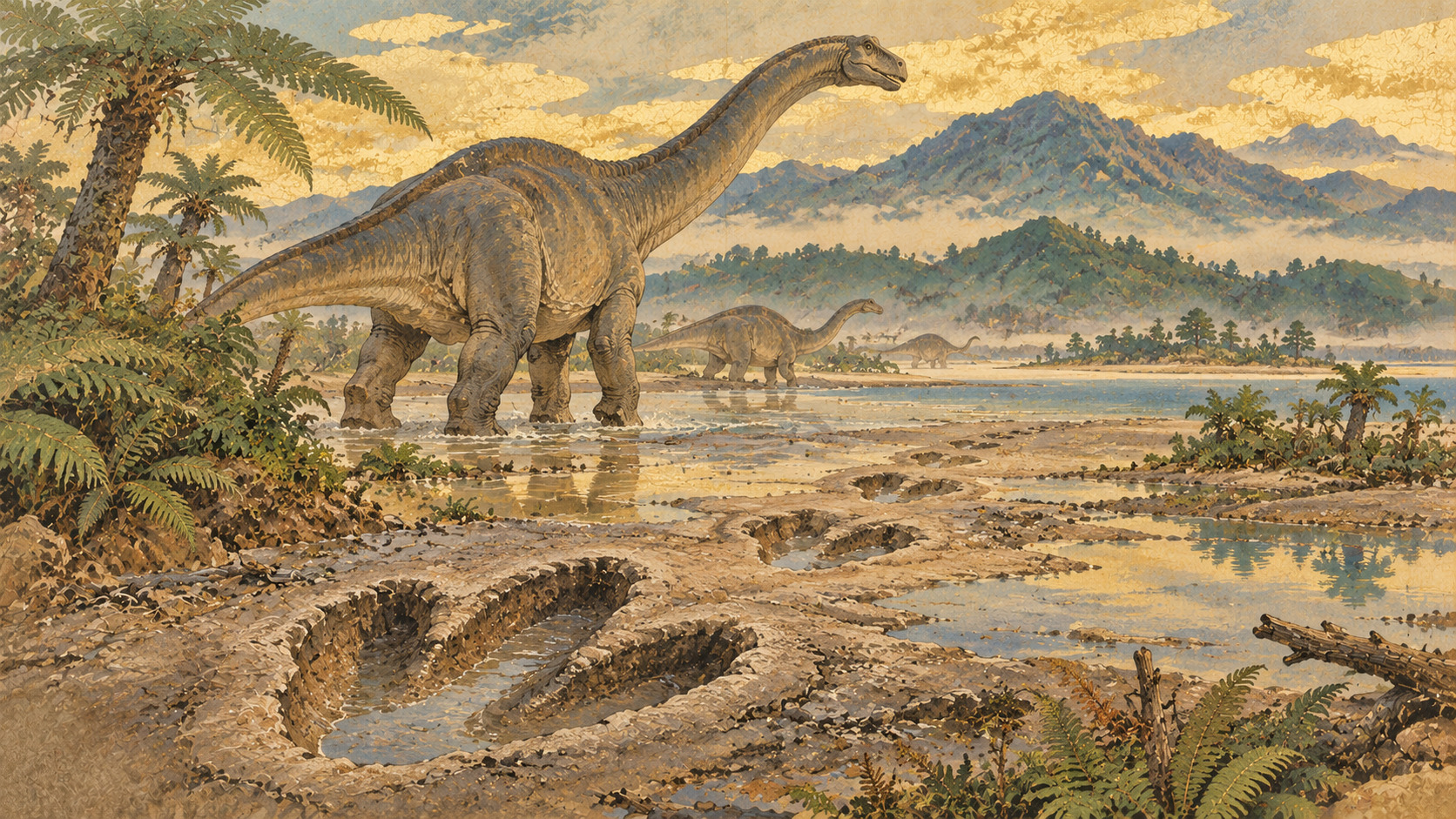
Beneath the hills of Minamisoma in Fukushima Prefecture, a single impression has widened the story of prehistoric Japan. City officials announced on October 22 that researchers had identified a dinosaur footprint about 70 centimeters long in the Late Jurassic Tochikubo Formation, dating to roughly 160 million years ago. Minamisoma calls it the largest dinosaur footprint of Jurassic age yet found in Japan.
That qualification is essential. It is not a claim to the largest footprint from every dinosaur period, nor is it a fossil skeleton identifying a particular species. It is a physical trace of an animal passing across sediment that eventually became rock.
What was found — and when
The find emerged from a dinosaur fossil exploration and public education initiative run through Minamisoma City Museum. The city says more than ten new footprints were identified, approximately doubling the number known locally. The program was formalized in fiscal 2025 and involves researchers from inside and beyond the municipality, including Junki Yoshida, an associate curator at Fukushima Prefectural Museum.
The public announcement came October 22; the city updated its detailed museum notice October 27. Fukushima Television reported that survey work during 2026 found the large impression on the fifth day of excavation after researchers selected the site in July. The announcement date should not be mistaken for the moment the track was uncovered.
Why the Tochikubo Formation matters
The Tochikubo Formation belongs to the Soma-Nakamura Group, a geological succession preserving changing landscapes from the Jurassic into the earliest Cretaceous. Minamisoma has long described itself as a place of fossils. Earlier finds included smaller dinosaur tracks, fossil plants and marine organisms from associated layers.
Sedimentary rocks are an archive of environments rather than a photographic film of a vanished world. Mud and sand accumulated, hardened, were buried and subsequently exposed. A footprint can establish an animal’s presence at a particular ancient surface, but it cannot alone map an entire wetland, establish a herd size or reconstruct a complete ecosystem.
A likely sauropod, not an identified species
Japanese reporting says the tracks probably belong to a large, long-necked herbivorous sauropod. Such animals were among the giants of the Jurassic, and broad impressions are consistent with their weight-bearing feet. But tracks are ambiguous evidence at the level of species: a footprint changes with substrate moisture, depth of penetration and subsequent geological distortion.
A series of connected tracks may reveal stride, direction and potentially speed. Researchers must first establish which marks belong together and whether deformation below the original walking surface has altered their shape. Those questions are still more useful than announcing an unsupported species name or body length.
The science of traces, not bones
A dinosaur skeleton tells us about anatomy. A footprint, classified as a trace fossil, offers another kind of evidence: behavior recorded at the interface between an animal and its surroundings. It says, within the limits of geological interpretation, that a large animal traversed this terrain.
The widely repeated 70-centimeter figure is the measured length of an impression, not an independently verified measurement of the animal’s foot bones or height. Responsible reconstruction depends on careful measurements, sedimentology, comparison with tracks elsewhere and acknowledgement of uncertainty.
Fukushima has more than one historical timeline
Minamisoma is rightly known internationally for its experience of the 2011 earthquake, tsunami and Fukushima Daiichi nuclear disaster. The region’s history, however, is neither exhausted by that tragedy nor defined solely by recovery. Its traditions include the Soma Nomaoi horse festival and archaeological sites telling far older human stories.
The dinosaur discovery adds another timescale altogether. An ancient walking surface can coexist in the same civic identity with medieval heritage, modern industrial change and the unfinished work of post-disaster reconstruction. That complexity is a more compelling picture of Fukushima than any single label.
An exhibition that does not pretend the fossil is on display
Minamisoma City Museum began showing a full-size panel of the excavation site on October 23. The official announcement describes a life-size reproduction of the site, not an authenticated public display of the original footprint-bearing rock. This distinction matters to visitors deciding what they will actually see.
Minamisoma Central Library is also hosting Fossil World Minamisoma, an exhibition of books and related materials, through January 17, 2027. By connecting a geological find to accessible public learning, the city is making a local scientific result tangible to schoolchildren and families.
Turning a discovery into a local itinerary
A dinosaur-themed stamp rally runs from October 23, 2026, through January 17, 2027. Announced stops include Haranomachi Station, the Central Library, Minamisoma City Museum, Sedette Kashima, the Urajiri Shell Mound Jomon-no-Oka Park and the headquarters of Abukuma Shinkin Bank.
The scheme encourages visitors to move between local institutions and businesses rather than treating the fossil as a single photo opportunity. Whether it materially increases hotel nights, sales or regional spending remains unmeasured in the material reviewed. Economic impact is a hypothesis, not a result.
Planning a visit
Minamisoma City Museum is at 194 Deguchi, Gōrai, Haramachi-ku, Minamisoma. Its published hours are 9 a.m. to 4:45 p.m., with final admission at 4 p.m. It generally closes Mondays, with an alternative weekday closure when Monday falls on a holiday.
During the scheduled special exhibition through November 23, admission is listed at ¥400 for adults, ¥200 for high-school students and ¥100 for elementary and junior-high students; November 3 is a free admission day. The excavation site itself is not confirmed as open to visitors. Travelers should check museum updates and should not enter or collect from research locations without authorization.
The questions scientists need to answer next
The obvious next steps are to document the geometry, sequence and preservation of the footprints, reconstruct their depositional setting and compare them with plant fossils and other geological evidence nearby. Even a simple question — whether several impressions form a trackway of one animal — can change the scientific interpretation considerably.
At present the public materials do not establish a definitive species, the number of animals responsible, the animal’s exact dimensions or the behavior of a herd. Researchers may eventually narrow these uncertainties. Journalism should not race ahead of their evidence.
A place worth looking at again
The most arresting thing about a footprint is its modest origin. One step on a soft surface became a lasting geological record while the animal, the landscape and the world around it changed beyond recognition.
Minamisoma now has a discovery capable of inviting people to see it with fresh eyes: a city of present-day families and businesses, centuries of cultural memory and — far beneath that familiar story — the passage of a Jurassic giant. Its greatest value may be the questions it prompts the next generation to ask.
Sources and verification
Based on Minamisoma municipal and museum primary sources, supplemented by local reporting. Researchers were not interviewed directly.
- Minamisoma City Museum: Discovery report
- Minamisoma City: October 22 press conference
- Minamisoma City: Dinosaur project and stamp rally
- Minamisoma City: Fossil heritage and geology
- Minamisoma City: Fossil World library exhibition
- Minamisoma City Museum: Visitor information
- Minamisoma City: Museum cultural heritage exhibition
- Fukushima Television: October 25 coverage