- The sea is the subject; the Moon is the light
- A childhood encounter with the sky
- From Mongolian landscapes to the space shuttle
- How a coastal museum shaped the work
- Understanding the word lunation
- The bridge between the vast and the intimate
- The meaning of a 1.3-second exposure
- Images that resemble distant worlds
- An exhibition designed for the act of looking
- A photographer with another career in cinema
- Photography, astronomy and the limits of proof
- A catalogue for the years after the closing
- The final day, and the question that remains
The sea is the subject; the Moon is the light
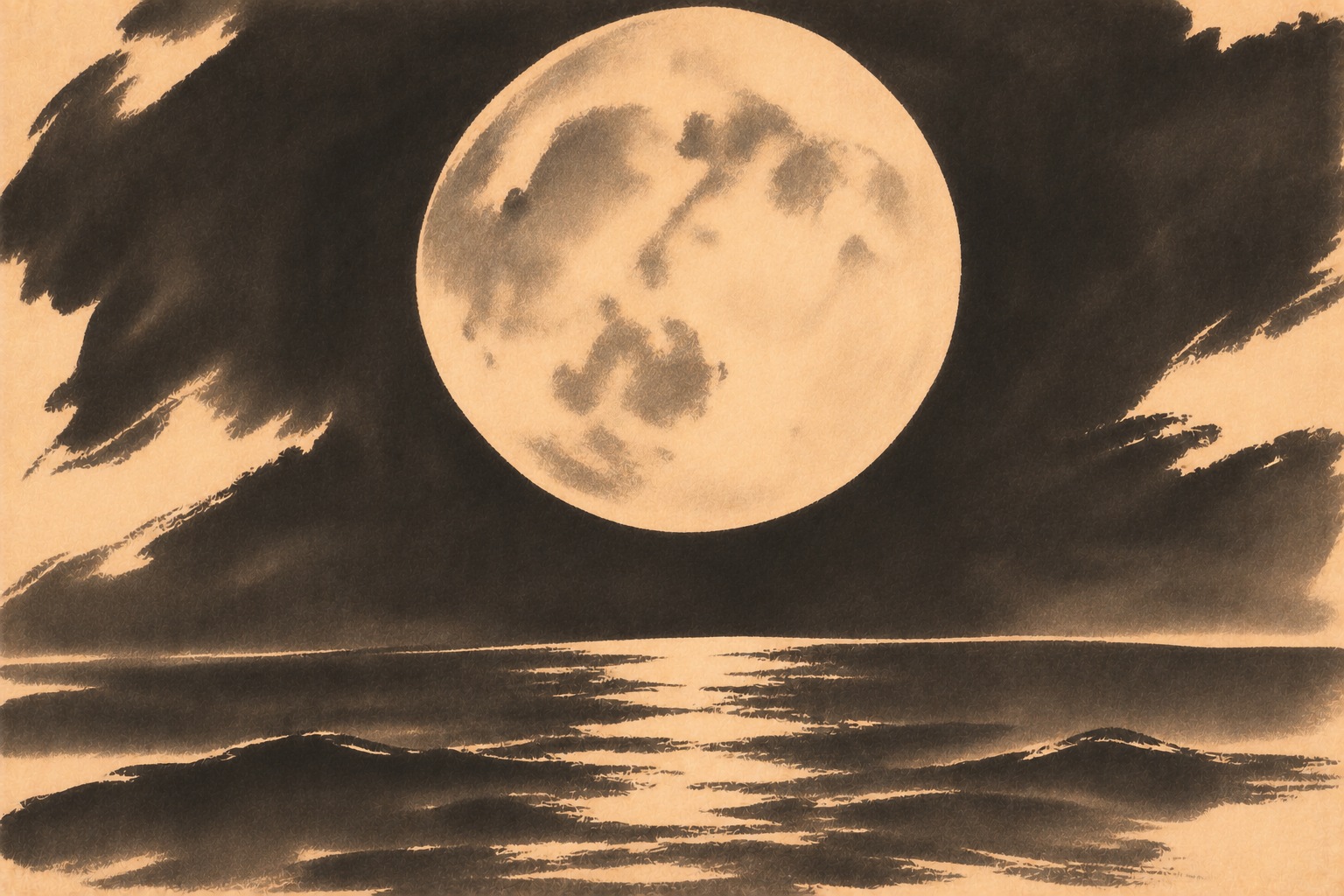
At the edge of Chigasaki, moonlight does something a telescope cannot show. It breaks apart on moving water, turning one source of illumination into thousands of transient points. Photographer Mikiya Takimoto has made that transformation the subject of LUNATION, a new body of work exhibited at the Chigasaki City Museum of Art until Sunday, November 8, 2026.
The title is more specific than it first appears. The Japanese word sakubō, written 朔望, joins the new Moon and full Moon. The photographs are not conventional lunar portraits. They concern the Earth’s response to the Moon: reflections, water, darkness, and a sense of time too large to see directly. The exhibition is billed as the artist’s first large-scale solo presentation at a museum in Japan.
A childhood encounter with the sky
Takimoto was born in Aichi Prefecture in 1974. The museum traces his visual curiosity to nights spent observing stars and, at age eleven, attaching a camera to a telescope to photograph a celestial object. The experience did not lock him into astronomical photography. Instead, it changed the scale at which he looked at everything.
He entered photography at sixteen and established his own office in 1998. Over decades of advertising, editorial images, commercials and cinema, he kept developing autonomous projects. The result is a career in which the same artist can photograph a spacecraft, a field of grass, a shoreline or a human face, and make each feel connected to a larger world.
From Mongolian landscapes to the space shuttle
His early MONGOLIAN TRIBE (1997) studied nomadic life. LAND SPACE (2011) juxtaposed the spacecraft at Florida’s Kennedy Space Center with the Earth’s much older processes, bringing the products of industrial technology into a planetary frame. GRAIN OF LIGHT (2014) investigated the changing texture of the sea.
These are more than shifts of location. By moving between the manufactured and the natural, close detail and immense scale, Takimoto repeatedly asks what ordinary perception leaves out. A spacecraft makes human ambition visible; an ocean surface exposes motions that will continue long after the image has been taken.
How a coastal museum shaped the work
The Chigasaki project began with an earlier connection. Takimoto created the key visual for a 2021 exhibition by designer Dai Fujiwara at the museum; a later invitation led to about eighteen months of preparation, according to a September interview published by the Japanese photography publication SHOOTING.
Its position near the coast mattered. Rather than bringing an unrelated touring exhibition to a regional museum, Takimoto wanted to create new work on the nearby beach. The exhibition therefore belongs to Chigasaki in more than a geographic sense. The setting generated its central idea: moonlight on water.
Understanding the word lunation
The Moon takes roughly 29.5 days to pass from one new Moon to the next, as viewed from Earth. The visible phases arise because the Sun illuminates different portions of the Moon’s Earth-facing surface as the geometry changes. The Moon does not create the light; it reflects sunlight.
The Moon’s gravity also drives much of the ocean’s tidal motion. Together with the Sun, its effects tend to create larger tidal ranges near new and full Moon, called spring tides, while first and last quarter often bring neap tides. Coastal geography, weather and seafloor shape complicate the result. The exhibition uses these relations as an artistic framework, not as a quantitative study of ocean tides. NASA’s published explanation supports the distinction.
The bridge between the vast and the intimate
During the pandemic period, Takimoto turned to subjects near at hand: vegetation and quiet sacred buildings in the LUMIÈRE and PRIÈRE works, dating from 2020 to 2024. This did not negate his interest in spacecraft and oceans; it moved the investigation to another scale.
His September interview describes an exhibition arranged so that broad views and small, close subjects occupy different levels of the building. LUNATION serves as a visual intermediary. It looks at small movements on the beach, but those movements are legible only through the Moon and the physics of illumination.
The meaning of a 1.3-second exposure
One of Takimoto’s most revealing choices was a 1.3-second exposure for images made in moonlight. In the SHOOTING interview, he related that duration to the approximate time light takes to travel from the Moon to Earth. Rather than claim an instrument had measured the speed of light at the shore, he wanted the camera’s exposure to carry a suggestion of celestial time.
The distinction matters. The Earth–Moon separation varies, and about 1.3 seconds is an approximate light-travel time. Shutter duration does not directly measure the journey of any single photon reflected from the sea. As an artistic constraint, however, it gives the act of taking a photograph a temporal structure: the image gathers faint light while invoking the distance from which it came.
Images that resemble distant worlds
The museum identifies newly made works such as LUNATION: CHIGASAKI #01 and SURFACE PULSE: CHIGASAKI #01, both dated 2026. It also presents the earlier GRAIN OF LIGHT and SPACE series. Close views of light on water can resemble astronomical clusters, though no galaxy is actually being photographed.
That resemblance is a productive ambiguity. In the image, a tiny ripple can become monumental. What looks like a star field may be a scattering of reflected light. Takimoto allows viewers to move between interpretations without pretending the surface is literally the cosmos.
An exhibition designed for the act of looking
Published coverage of the museum describes a darkened display zone for LUNATION, including a viewing tube through which visitors can inspect the marine glimmer, and moving-image works alongside still photographs. Such staging draws a line back to the telescope Takimoto handled as a child.
This description comes from documented exhibition reporting, not from an independent visit by JAPAN.co.jp. It nevertheless highlights a significant curatorial decision: distance, darkness and the physical act of looking are part of the experience. The spectator is asked to discover a scene rather than merely scroll past it.
A photographer with another career in cinema
Takimoto’s cinematography includes three films by director Hirokazu Kore-eda: Like Father, Like Son (2013), Our Little Sister (2015) and The Third Murder (2017). His cinematography for Our Little Sister received a Japan Academy Film Prize. The honors awarded to the films themselves at international festivals must not automatically be described as awards personally given to their cinematographer.
What connects still photography and film is an unusually strong attention to how light changes over time. The pause of a still image and the movement of cinema make different demands, but both involve decisions about perspective, duration and the weight of what remains unseen.
Photography, astronomy and the limits of proof
Since the nineteenth century, cameras attached to telescopes and microscopes have extended what people can observe. Every such picture is mediated by exposure, optics, sensitivity and processing. Photographs are powerful records, but not transparent copies of unaided eyesight.
LUNATION belongs to that long conversation between observation and interpretation. The Moon changes tides; moonlight creates reflections; a photographer chooses an exposure and frame. None of these facts alone establishes a claim about the origin of life or the structure of distant galaxies. The exhibition invites a philosophical connection between sea and cosmos, and its poetic strength comes partly from leaving the connection open.
A catalogue for the years after the closing
The museum published a 104-page catalogue in September featuring approximately one hundred works from Takimoto’s career. The book includes essays by Héloïse Conésa of the Bibliothèque nationale de France and Takahiro Ito of the Tokyo Photographic Art Museum, according to the institution. The listed price is ¥3,800.
The catalogue offers a record of the show when the installation is dismantled. A print reproduced in a book is never identical to one experienced in a particular room, at its original size and under museum lighting. Still, the publication preserves an opportunity to examine how one body of work connects the planetary scale to the close observation of a beach.
The final day, and the question that remains
The exhibition runs through Sunday, November 8, at the Chigasaki City Museum of Art, 1-4-45 Higashikaigan-kita, Chigasaki, Kanagawa. Hours are 10 a.m. to 5 p.m., with last entry at 4:30 p.m. General admission is ¥1,200; university students pay ¥1,000; visitors of high-school age or younger are admitted free. The museum says payment is cash only. Check its official page for any late changes.
On any other night, the coast will look different. The water will not hold the same arrangement of reflected light. That is the paradox of Takimoto’s project: a photograph freezes an instant in a world defined by motion. Its lasting invitation is to look at a familiar stretch of sea and recognize, however briefly, the enormous universe involved in seeing it.
Sources and reporting method
Primary museum and artist materials are distinguished from an independently published interview and secondary reporting. The artist’s comments derive from SHOOTING, not a JAPAN.co.jp interview. NASA is used only for the physics of lunar tides.
- Chigasaki City Museum of Art — official exhibition page
- Mikiya Takimoto Photography Office — exhibition announcement
- Chigasaki City Museum of Art — exhibition catalogue
- SHOOTING — September 18 interview with Mikiya Takimoto
- Bijutsutecho — independent exhibition visit
- NASA Science — Moon and ocean tides
- National Art Center — Art Commons exhibition record
- Museum publicity materials