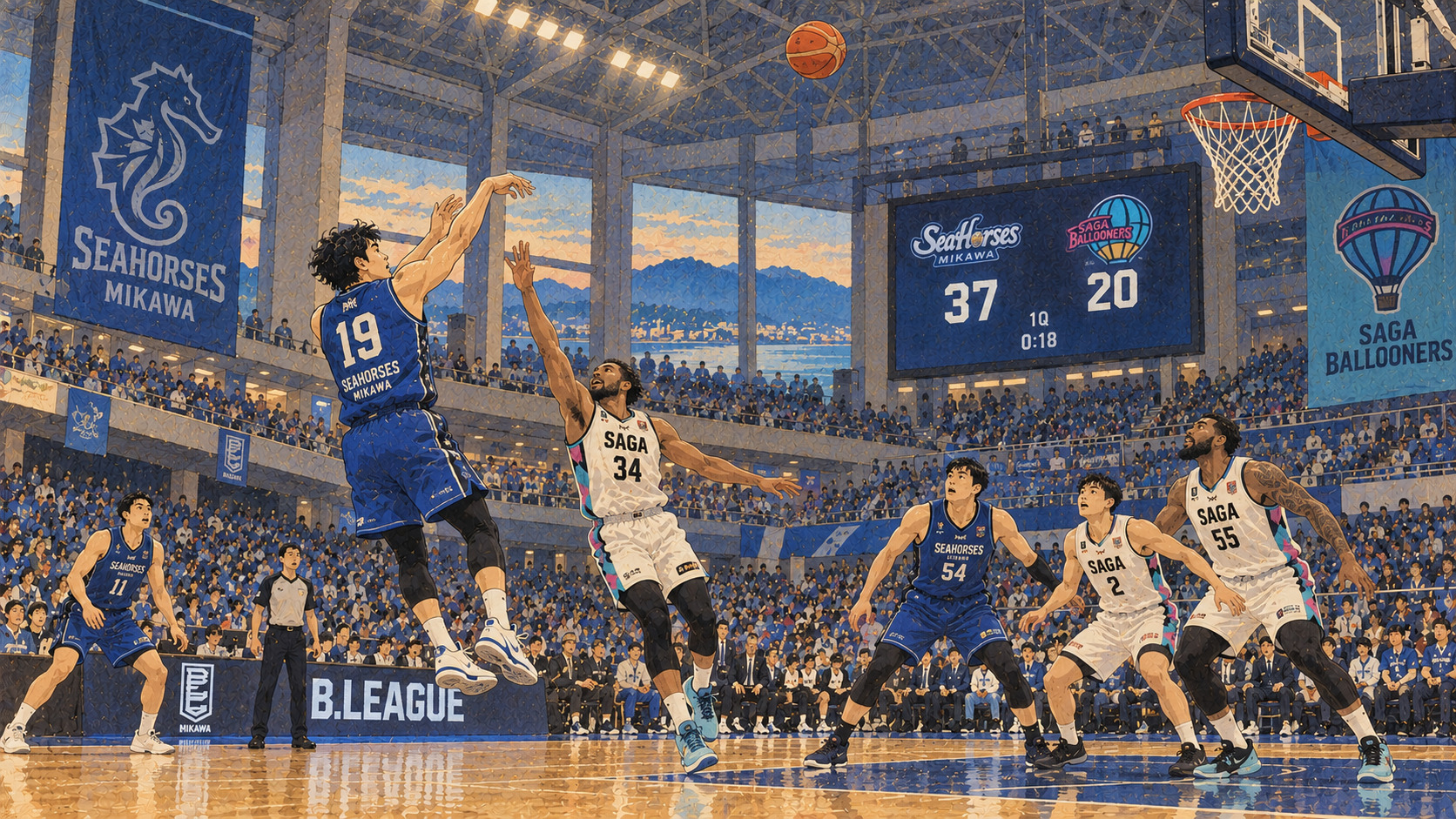
The 17 made threes tell one story. Mikawa’s 45 rebounds and 29 assists tell the other.
A ten-minute eruption in Kariya
The Seahorses Mikawa turned an October 31 home game into a shooting showcase, beating the Saga Ballooners 100–83 at Kariya City Gymnasium before 2,172 spectators. The opening quarter was almost startling: 37 points for Mikawa, 16 for Saga. This was a B.LEAGUE PREMIER contest in the inaugural 2026–27 season of the reorganized competition. Yet the opening ten minutes are only half the explanation of how Mikawa reached triple figures.
The number behind the fireworks: 17
Mikawa made 17 of 32 three-point attempts, a conversion rate of 53.1%, versus Saga’s 11 of 34, or 32.4%. The six-make gap represents 18 additional points from beyond the arc. Mikawa also shot 19-for-34 on two-pointers, yielding an overall 54.5% field-goal rate. Those are exceptional figures for a single game, but they should not be treated as the team’s normal shooting baseline or proof of a permanent change in offensive quality.
The comeback that did not become a comeback
Saga did respond. After a 37–16 opening period, it won the second quarter 31–21 and reached halftime down 58–47. The visitors then saw Mikawa control the third period 24–11, restoring a 24-point advantage entering the final ten minutes. Saga won the fourth quarter 25–18, but the scoreboard had little remaining room for drama. The quarter scores show a game with momentum changes, not forty uninterrupted minutes of dominance.
The hidden contest on the glass
A 45–21 rebounding advantage may reveal as much as the shooting percentages. Mikawa collected 12 offensive rebounds to Saga’s three, gaining more chances to extend possessions. The home side also recorded 29 assists to 21. Effective perimeter shooting, timely passing and a sizable advantage in recovered missed shots combined to make Mikawa’s offense difficult to contain. Box-score data alone, however, cannot establish every tactical cause behind a rebound or assisted basket.
Who made the difference
Ryogo Sumino led Mikawa with 22 points, while Davante Gardner scored 19. Shawn O’Mara secured 12 rebounds. On the opposite side, Nassir Little scored a game-high 24, and Taiki Sumida registered eight assists. Those contributions deserve attention because the losing side did not simply disappear: it scored 31 in the second quarter and 25 in the fourth. Mikawa won through collective efficiency and possession control rather than by shutting down every individual opponent.
What a fast start changes
A large lead gained in the first quarter can force difficult choices: defend the arc more aggressively, protect the paint or gamble for turnovers. It can also alter rotations and the emotional rhythm of a game. But those are basketball principles, not verified accounts of either coach’s instructions on October 31. What the official record does show is that Saga temporarily narrowed the margin before Mikawa’s third-quarter response decisively restored separation.
Statistics that complicate the easy narrative
Saga actually recorded more steals, eight to four, and committed fewer turnovers, five to Mikawa’s 14. It also held a 10–6 advantage in fast-break points. The winner therefore was not superior in every statistical category. Mikawa offset those disadvantages with shooting precision and rebounding, particularly second chances around the basket. Its largest lead was 26 points; the official summary credits Saga with no lead during the contest.
The Seahorses and Japan’s corporate sports tradition
Mikawa’s club identity is embedded in the industrial heartland of Aichi Prefecture, a region where company-supported sport has long been part of community life. The professional B.League era asks teams to build brands and enduring spectator relationships beyond their industrial origins. A packed or lively local game offers one glimpse of that relationship, but a single announced attendance of 2,172 should not be used to infer attendance trends or the financial impact of the club.
Saga and the other story of Japanese basketball
Saga represents a different path to the national spotlight: a regional basketball organization that advanced through the lower league and built a following outside Japan’s largest metropolitan centers. The club’s previous B2 title is recorded in league history. Its difficult start in the new competition should be examined alongside the realities of roster construction, competition and regional support—not reduced to a judgment on the long-term prospects of basketball in Saga.
A new league era starts on the court
The 2026–27 season introduces B.LEAGUE PREMIER, the top competition within Japanese professional basketball’s reorganization. The reform places renewed emphasis on sustainable clubs, arenas and fan development as well as elite competition. For international readers, this is part of Japan’s attempt to make basketball a more visible, professionally structured product. The reform’s commercial success remains a longer-term question that one October box score cannot answer.
Can Mikawa repeat its performance?
No team should assume that shooting above 53% from three will persist indefinitely. The more useful forward-looking questions concern whether Mikawa can keep creating high-quality attempts, continue rebounding well and reduce unnecessary turnovers. Saga, meanwhile, must examine its 21–45 deficit on the glass and the defensive breakdowns that permitted a 37-point first quarter. Those are observations from the official statistics, not claims about unpublished team meetings.
More than a three-point exhibition
The most memorable statistic may remain 37–16. The more durable lesson of the 100–83 win is how different parts of the sport interact: accurate outside shooting becomes much more punishing when a team also gains extra possessions and finds open teammates. In the first season of B.LEAGUE PREMIER, Mikawa offered a vivid example of that combination. Saga’s responses showed that a lopsided final score can still contain meaningful resistance.
Sources and verification
Final score, leaders and team totals are checked against the league’s published game record. Tactical interpretation is analysis of those statistics, not a claim of interviews with coaches or players.