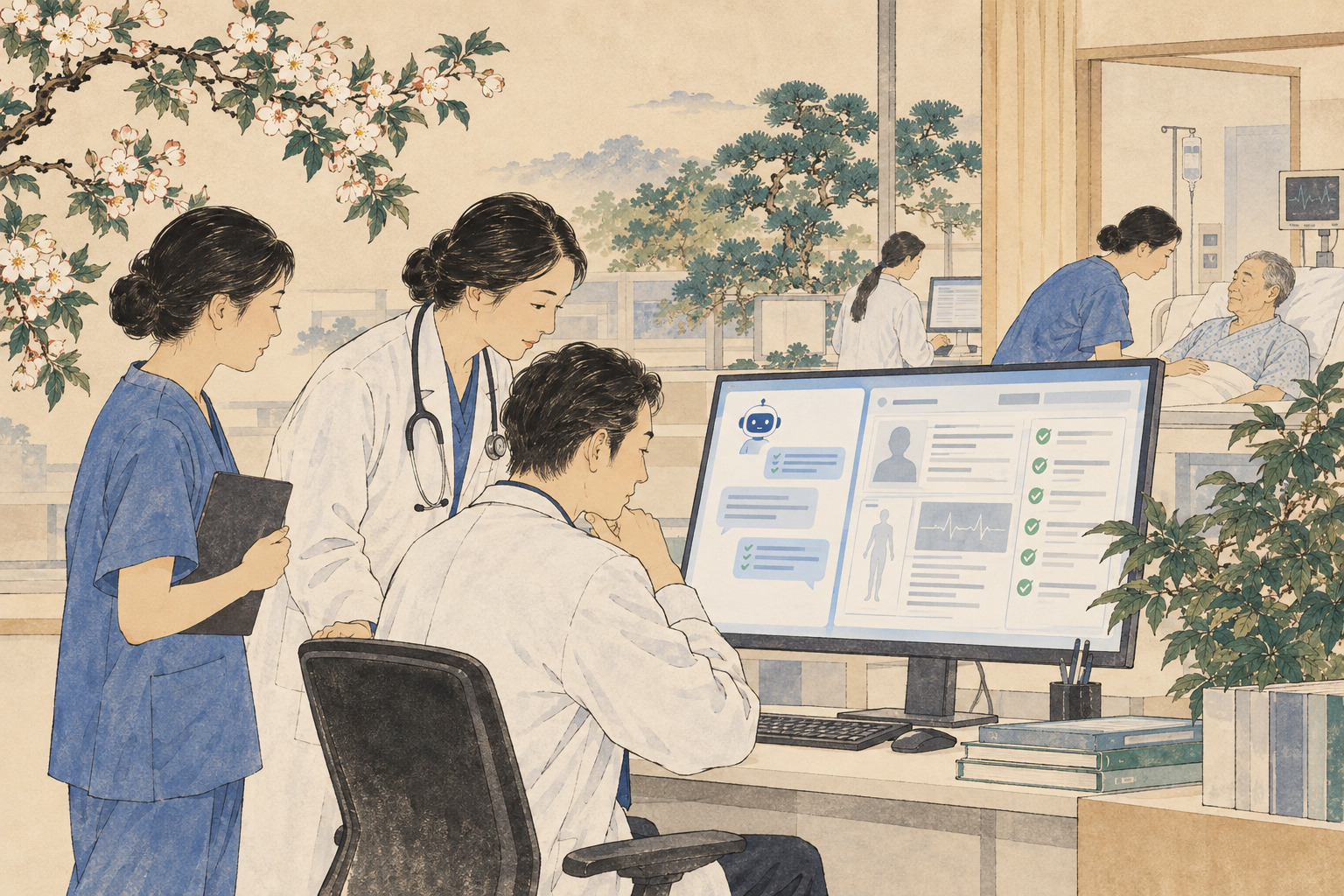
The most consequential change in hospital generative AI may not be a better chatbot. It may be the moment the AI stops waiting for a clinician to copy information into a prompt and instead becomes connected—under controlled access—to the hospital's own operational data. That is the direction Nagai Hospital in Tsu, Mie Prefecture, is taking with Apollo AI, a system developed by the medical-technology startup Albatrus and linked to the hospital's MI・RA・Is electronic medical record environment. [1][3]
Albatrus said on September 18 that Nagai Hospital had moved Apollo AI into full-scale operation for documentation and administrative workflows. With cooperation from electronic-medical-record vendor CSI, the system has been connected to MI・RA・Is data so AI agents can support discharge summaries, nursing summaries, detailed medical-claim narratives, pre-visit information review, voice transcription and other workflows. Nagai Hospital is a 199-bed institution with 477 employees. It opened in Tsu on February 16, 1947 and marked its 79th anniversary in 2026. [1][4][5]
From “ask the AI” to “let the AI move through the workflow”
Conventional generative-AI use in hospitals often resembles office use: a clinician gives the model a prompt and receives a draft or summary. Albatrus says Apollo AI is intended to go further by using AI agents that can assemble a sequence of tasks, draw on hospital data and complete multiple steps rather than only returning an answer. [1][2]
The Nagai Hospital examples are operational. Physicians can use the system to combine ordering information and chart history before an outpatient encounter. Nurses can consolidate information documented by multiple professions into a nursing summary. Medical social workers can use smartphone-based voice AI during patient and family interviews to support discharge planning. [1]
The important distinction is that the target is not only faster writing. It is the chain around the writing: finding information, combining records, creating a draft, checking what is missing and moving work between physicians, medical clerks and administrative staff. Albatrus says it is redesigning some workflows around task shifting as well as automation. [1]
Why the MI・RA・Is connection matters
The electronic medical record is one of a hospital's central information systems. It contains clinical progress notes, orders, prescriptions, test information and nursing documentation. If an AI system cannot access relevant data through a controlled integration, staff must repeatedly search, copy and paste information into the AI. That can erase much of the promised productivity gain.
Nagai Hospital says Apollo AI is connected with MI・RA・Is with CSI's cooperation. Albatrus calls the integration seamless. The public materials do not, however, disclose the API design, exact data fields, whether information can be written back to the EHR, the latency of the interface or the architecture of the connection. Japan.co.jp therefore describes the confirmed fact—data integration with the EHR—without assuming the undisclosed technical implementation. [1]
MI・RA・Is is CSI's electronic-medical-record product family. CSI says the series operates at more than 900 facilities in Japan. The vendor has also been participating with MI・RA・Is in the government's model project for the national EHR information-sharing service, which is part of Japan's wider medical-DX program. [6][7]
Nagai Hospital had already spent two years learning how staff use AI
Apollo AI did not arrive in a hospital that had never used generative AI. Nagai Hospital and Albatrus had already been developing and testing the earlier Mediraku AI product for roughly two years. Nagai's own DX website describes Mediraku as a general-purpose generative-AI tool for staff and documents its use in summaries and other medical paperwork. [1][3]
The hospital's DX site reports that, in one participating ward, summary-writing time fell from approximately 37.4 minutes to 13.6 minutes after Mediraku AI, a 63.8% reduction. Staff comments on the same hospital site say the system also helped reduce missing information and revisions in some documentation. [3]
In an earlier product announcement, Albatrus said a Nagai Hospital pilot cut nursing-summary work by 80% and reduced the average number of supervisory revisions from 2.8 to 1.3. Those are hospital/vendor pilot findings, not independently controlled clinical-study results. [15]
“NAGAI 100” began in 2024; the centenary is in 2047
Albatrus describes the hospital's broader program as “NAGAI 100,” a digital-transformation initiative begun in 2024 in preparation for Nagai Hospital's 100th anniversary. Because the hospital opened in 1947, that centenary will fall in 2047. Albatrus says the hospital introduced or tested seven AI systems over the first two years of the program. [1][5]
Nagai Hospital's own DX site shows how broad the effort is. It covers Mediraku, Ubie AI intake, the Reze AI claims-management tool, the Caretomo conversational documentation system, Smart FAX, cloud-based referral letters, web reservations and a hospital smartphone nicknamed the “Nagai-phone.” The hospital launched a dedicated DX website in March 2026 to explain these efforts to patients and staff. [3][14]
That history may be as important as the model itself. The hospital had already built teams that adjusted prompts, worked with vendors and tested workflow changes department by department. AI adoption in a hospital is partly a software problem and partly an organizational-learning problem.
The headline metrics are striking—but the measurement sets differ
In the September 18 Nagai-specific release, Albatrus says adoption in several major documentation workflows—discharge summaries, nursing summaries and detailed claim narratives—was about 95%. It reports discharge-summary creation falling from 37 minutes to 3 minutes with Apollo AI, compared with 10 minutes under Mediraku AI. It reports informed-consent transcription falling from 15 minutes to 4 minutes, versus 7 minutes with the earlier system. [1]
Eight days earlier, however, Albatrus's September 10 Apollo AI launch release presented a different Nagai Hospital pilot set: 30 minutes to 2 minutes for discharge summaries and 15 minutes to 3 minutes for informed-consent records. The same launch release also used 37-to-3 and 15-to-4 figures in its product-example section. [2]
The public materials do not explain whether the differences reflect different departments, case mixes, measurement periods or calculation methods. Japan.co.jp therefore does not combine the numbers into one time series. The latest Nagai-specific September 18 figures are used as the primary figures in this report, with the earlier values disclosed as a separate measurement set.
| Public source | Discharge summary | IC record / transcription |
|---|---|---|
| Sept. 18 Nagai-specific release | 37 min → 3 min Mediraku: 10 min | 15 min → 4 min Mediraku: 7 min |
| Sept. 10 Apollo AI launch release | 30 min → 2 min in pilot-results section | 15 min → 3 min in pilot-results section |
| Nagai Hospital DX site, earlier Mediraku | Approx. 37.4 min → 13.6 min | Not stated |
The sources do not establish that these datasets use identical definitions or samples, so direct statistical comparison is not warranted. [1][2][3]
What does “95% adoption” actually mean?
Albatrus describes an approximately 95% “adoption rate” in major workflows. The release does not disclose the denominator, measurement period, number of staff, number of eligible documents or whether “adoption” means percentage of documents created with the tool, percentage of users, or another measure. It should not automatically be read as “95% of all hospital staff use Apollo AI every day.” [1]
What can be independently observed on Nagai Hospital's own site is the organizational effort behind earlier AI adoption: staff training, repeated prompt refinement, cross-department coordination and attempts to make the tools usable by employees who were initially unfamiliar with AI. [3]
Security is a medical-information issue before it is an AI issue
Connecting generative AI to an EHR means the system may handle clinical information rather than ordinary office text. Authentication, authorization, audit logs, encryption, vendor management, endpoint security, backup, continuity planning and cyberattack response all become part of the safety model.
Japan's Ministry of Health, Labour and Welfare updated its Guidelines for the Safety Management of Medical Information Systems to Version 7.0 in June 2026 and tells healthcare institutions to manage their systems in accordance with the guidance. The update is accompanied by cybersecurity checklists and business-continuity materials. [9]
Albatrus says Apollo AI is designed so patient inputs are not used for model training or retained by the AI, and describes encryption, anonymization, domestic cloud infrastructure, closed-network VPN, a web application firewall, multi-factor authentication and IP-address restrictions. It also says its design is aligned with healthcare-sector guidelines. [2][8]
Those are vendor claims, not an MHLW certification of Apollo AI. Security also depends on the hospital's access rules, device controls, staff behavior, vendor contracts and incident-response procedures—not only on the software architecture.
Who owns the final clinical record when AI drafts it?
A discharge summary or nursing summary is not generic administrative copy. It transfers information to the next clinician, rehabilitation service or community-care provider. A fluent AI draft can still omit facts, misread chronology or introduce an error.
The public announcements do not describe Apollo AI as an autonomous diagnostic or treatment-decision medical device. Its highlighted functions are documentation, information retrieval, audio processing, OCR, workflow automation and document-management support. Clinical responsibility and final review therefore remain workflow-design questions for the hospital and the relevant professionals. [1][2]
That distinction matters when interpreting time savings. A document that is generated in three minutes may still require human review. To judge the full impact, a hospital needs to measure total workflow time, correction burden, error rates and any effect on patient safety—not only draft-generation time.
Japan's national medical-DX strategy is moving from “install an EHR” to “connect the data”
Nagai Hospital's local experiment fits into a national shift. MHLW is building a nationwide medical-information platform, standardizing EHR information, expanding electronic prescriptions and modernizing reimbursement systems. In March 2026 it published Version 1.0 of standard requirements for EHR and billing systems aimed at small and medium-sized hospitals, emphasizing cloud capability, standard APIs, interoperability and data portability. [10][11]
On September 9, MHLW published a new Electronic Medical Record Dissemination Plan, continuing the push toward much broader EHR adoption. The policy direction is increasingly about creating systems that can exchange and reuse medical data safely, not merely digitizing paper charts inside one facility. [13]
That architecture matters for AI. Standardized data and workable interfaces can make it easier to use AI across institutions without building a unique connection for every department and every hospital. Fragmented systems do the opposite: they turn each AI project into another integration project.
After physician work-style reform, documentation time is also a management issue
Japan applied new overtime and holiday-work limits to employed physicians from April 2024. Under the standard A-level framework, the annual overtime/holiday-work limit is 960 hours, while special categories exist for institutions meeting conditions tied to regional medical coverage or intensive skill development. [12]
AI documentation is not, by itself, a compliance program for those rules. But if physicians spend less time searching charts, drafting records and reconstructing informed-consent notes, hospitals can potentially change the composition of working time. Task shifting to medical clerks and administrative teams can matter as well.
The management question is therefore larger than “minutes saved per document.” Hospitals need to know where the recovered time goes: patient communication, clinical work, discharge coordination, staff education—or simply another administrative task.
An unusual startup origin: a regional hospital and University of Tokyo-linked technology
Albatrus was established in January 2024, with headquarters in Tsu and a Tokyo office in Shinjuku. The company describes its identity as combining “the field strength of a regional general hospital” with technology rooted in the University of Tokyo ecosystem. [1][2]
That model is different from the classic pattern in which a large vendor develops a finished hospital IT product and sells it to a customer. Nagai Hospital has functioned as a development partner, helping shape not only the product but how it is used in real workflows. Albatrus said that after formal sales began in April 2026, Apollo AI was being introduced or built at more than 10 hospitals—including national university hospitals—and that five hospitals were development partners as of September 10. [2]
Those deployment figures come from the company; the release does not identify every institution or specify the implementation stage at each one.
“Core system” does not mean Apollo AI replaced the EHR
Albatrus calls Apollo AI an “AI core system.” That wording can be misleading if read too literally. The hospital still uses MI・RA・Is as its electronic medical record. The public information says Apollo AI connects to that environment and provides a common AI-agent and data-utilization layer across departments. It does not say that Apollo AI replaced the hospital's EHR, billing, laboratory, pharmacy, imaging and accounting systems. [1][6]
A more precise interpretation is that Albatrus wants Apollo AI to become the hospital-wide AI platform sitting across existing systems, rather than a replacement for all existing hospital core applications.
What remains undisclosed
The public materials do not disclose Nagai Hospital's implementation fee or monthly cost, the exact MI・RA・Is interface architecture, the foundation model or models used, patient-data retention details, inference-processing architecture, hallucination or error rates, clinician correction rates, incident counts or measured patient-outcome effects.
The 95% adoption figure and time-savings figures are reported by the vendor and hospital project participants. They are not results of an independently designed controlled trial or a peer-reviewed clinical study. Faster documentation is not automatically equivalent to better care or stronger hospital finances.
The moment hospital AI becomes valuable
The most compelling part of the Nagai Hospital experiment is not whether the model can write medical Japanese elegantly. Hospitals are enormous information-processing organizations. Physicians search history before seeing a patient. Nurses read notes from multiple professions. Social workers record family conversations. Clerks look for missing documentation. Small information-handling tasks accumulate across every shift.
If EHR-connected agents can move the right information to the right workflow rather than forcing people to repeatedly move the data themselves, the productivity gain could be meaningful. But because the information is clinical, the tolerance for inaccurate output, improper access or unclear responsibility is far lower than in an ordinary office deployment.
Nagai Hospital still has 21 years before its 100th anniversary in 2047. The real test of “NAGAI 100” will not be whether one document can be drafted in three minutes. It will be whether the minutes returned by automation become more time with patients, lower staff burden and reliable clinical records without creating new safety or security problems. The meaningful outcome of hospital AI will ultimately appear not on the AI screen, but in the ward and consultation room.
Sources & documents
- Albatrus: Apollo AI in full-scale use at Nagai Hospital with MI・RA・Is EHR integration (Sept. 18, 2026; Japanese release)
- Albatrus: Formal launch of hospital AI platform Apollo AI (Sept. 10, 2026; Japanese release)
- Nagai Hospital: Hospital DX program
- Nagai Hospital: Hospital profile
- Nagai Hospital: Corporate history
- CSI: MI・RA・Is electronic medical record product family
- CSI: MI・RA・Is participation in Japan's EHR information-sharing model project
- Albatrus: Apollo AI product information and FAQ
- Japan Ministry of Health, Labour and Welfare: Guidelines for the Safety Management of Medical Information Systems, Version 7.0 (June 2026)
- MHLW: Medical DX policy
- MHLW: Standard requirements for EHR and medical billing systems for small and medium-sized hospitals
- MHLW: Physician work-style reform
- MHLW: Electronic Medical Record Dissemination Plan (Sept. 9, 2026)
- Nagai Hospital: Launch of its DX special website (Mar. 13, 2026)
- Albatrus: Mediraku AI document-assistance release and Nagai Hospital pilot results