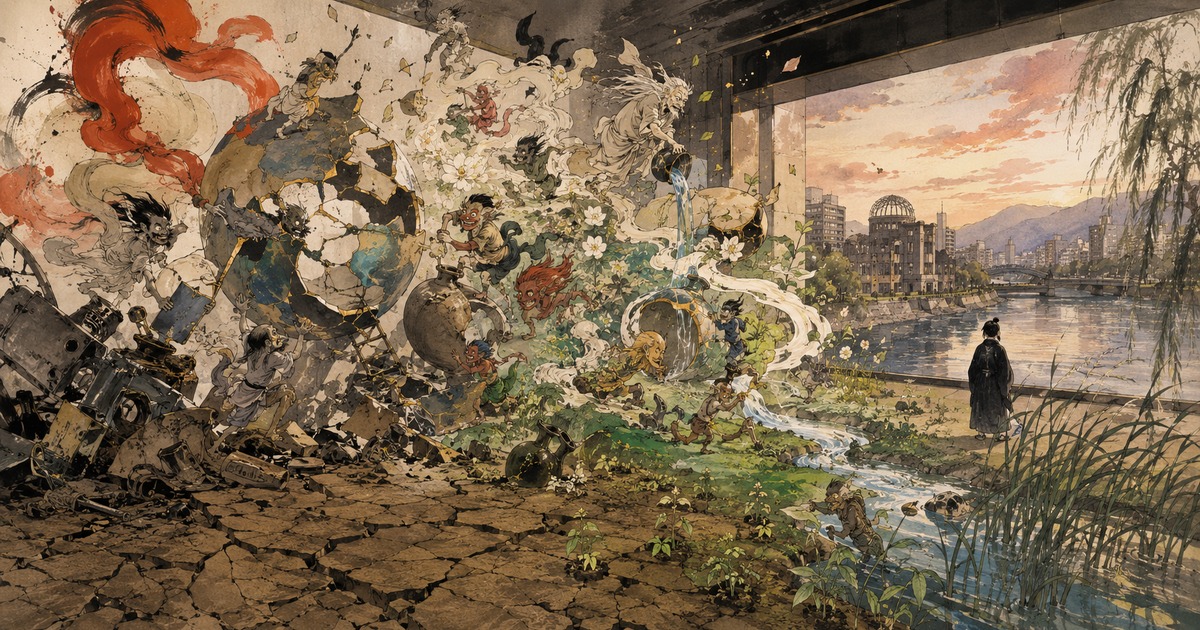
On Hijiyama, the city is visible through summer green. Hiroshima City Museum of Contemporary Art stands above the streets in a building whose materials appear to move from stone to tile to aluminum—from earthbound weight toward a metallic future. Inside, an exhibition that opened Saturday asks visitors to make another difficult passage: from the word “peace,” familiar enough to become ceremonial, toward the practical work of changing damaged systems.
“The 12th Hiroshima Art Prize: Mel Chin” is the Houston-born artist’s first solo exhibition in Japan. It runs from July 25 through October 12 in Exhibition Room B and spans almost half a century, from the elemental vessels of Vertical Palette to ecological fieldwork, political sculpture, collage, animation and participatory projects. Representative works are joined by new work made for Hiroshima. A free companion presentation in the museum’s Media Library shows Chin’s hand-drawn film 9-11/9-11 throughout the exhibition.
The show arrives under a prize created by Hiroshima City in 1989 to recognize artists whose achievements contribute to the peace of humanity and carry what the city calls the “Spirit of Hiroshima.” That language can sound noble and safely abstract. Chin’s art will not leave it that way. He has worked with toxicologists, schoolchildren, television producers, software engineers and communities living with contaminated soil. His materials include plants that absorb metal, rifles welded into a cross, a bomb enlarged into a strange flower and hundreds of thousands of hand-drawn dollar bills.
None of those works restores an undamaged world. That is precisely why they belong in Hiroshima. Repair after irreversible harm cannot mean returning history to its unopened state. It can mean measuring poison instead of hiding it; making a test where institutions failed to fund one; giving private injury a public form; changing who can participate; and refusing the claim that violence is inevitable. Chin’s career proposes art not as proof of goodness, but as a tool whose effects—and limits—must be examined.
A Museum Built to Look Forward Without Looking Away
Hiroshima’s cultural landscape holds several kinds of time. The atomic bombing of August 6, 1945, made the city a global witness to nuclear destruction. The Peace Memorial Museum, opened in 1955 in Kenzo Tange’s larger Peace Memorial Park plan, preserves material evidence and survivor testimony so that catastrophe cannot dissolve into a slogan. Yet memorial work, indispensable as it is, looks toward what happened. A living city also had to ask what artistic language could address violence not yet named.
Hiroshima City Museum of Contemporary Art opened on May 3, 1989, as Japan’s first public museum devoted entirely to contemporary art. Its architect, Kisho Kurokawa, called for symbiosis rather than a clean break between opposites. The building’s upward change of materials suggests civilization moving from the past toward the future, while its place in wooded Hijiyama Park keeps nature and city in the same frame. The museum’s opening exhibition, “Hiroshima, HIROSHIMA, HIROSHIMA,” commissioned responses from 78 artists.
The Hiroshima Art Prize began that same year. Awarded every three years, it is not a competition for the gentlest image of peace. Its laureates have confronted exile, racism, state violence, displacement, the ethics of architecture and the instability of memory. Issey Miyake, a survivor of the atomic bombing, was followed by Robert Rauschenberg; Leon Golub and Nancy Spero; Krzysztof Wodiczko; Daniel Libeskind; Shirin Neshat; Cai Guo-Qiang; Yoko Ono; Doris Salcedo; Mona Hatoum; Alfredo Jaar; and now Chin.
Seen together, those names prevent “peace” from becoming a decorative noun. Wodiczko projects suppressed testimony onto monuments. Neshat examines power, gender and exile. Salcedo gives absence and political murder a physical weight. Hatoum turns domestic forms into unstable territories. Jaar tests how images represent suffering without consuming it. Chin enters not because his work offers reassurance, but because it asks how ecological damage, militarized symbols and public indifference become normal—and how that normalization might be interrupted.
When Plants Became Chisels
Revival Field, begun in 1991, is the work most likely to rearrange a visitor’s idea of sculpture. Chin encountered research by U.S. Department of Agriculture scientist Rufus Chaney on hyperaccumulator plants—species capable of taking unusually high concentrations of metal from soil into their tissues. Chaney’s laboratory ideas needed a field test. Chin recognized both a scientific possibility and an artistic one.
At Pig’s Eye Landfill, a Superfund site near St. Paul, Minnesota, the collaborators marked out a 60-by-60-foot square. Within it, a circle containing 96 test plots held different combinations of plants, soil acidity and fertilizer. A crosshair-like geometry made the contaminated ground appear targeted, not for bombing but for recovery. Plants were cultivated, harvested and analyzed to learn whether they could remove heavy metals from soil—a method now known broadly as phytoremediation.
For Chin, the plants were chisels. Instead of removing marble to reveal a figure, they would remove contamination; the changed earth would be the sculpture. The aesthetic result might be invisible to an unaided eye and legible only through chemical measurement. The work therefore made scientific validity part of its beauty. It also redirected the artist’s ego: the most important artifact could be a usable technique rather than an object bearing a signature.
The story is inspiring only if its limits remain visible. The field test did not magically cleanse the whole Superfund site. The Walker Art Center’s later account notes that alpine pennycress performed best, but none of the plants proved effective enough during the project to remediate the entire location. Revival Field mattered as a real experiment, a bridge between a scientist’s underfunded research and public imagination, and an early model of ecological art. It did not repeal chemistry.
That distinction gives the work its ethical force. Art is often praised for “raising awareness,” a phrase so vague it can excuse the absence of results. Chin went further: he helped create conditions for a test with measurements that might disappoint. Repair began not with a triumphant claim, but with a willingness to submit an artistic proposition to the resistance of the world.
After Katrina, Money That Could Not Be Spent
The Fundred Project emerged from another poisoned landscape. After Hurricane Katrina in 2005, Chin studied New Orleans and learned that the city’s children faced danger not only from the storm but from lead that had accumulated in soil and buildings over decades. Lead poisoning damages developing brains and disproportionately burdens communities already shaped by poverty and discriminatory housing policy. The contamination was largely invisible; its social distribution was not accidental.
Chin’s response was a currency that could buy nothing. Children and adults drew their own one-hundred-dollar “Fundred” bills. A specially designed armored truck collected them across the United States. The bills traveled as drawings, petitions and declarations that a child’s health had value. More than 450,000 were made over years of workshops and tours, and selections were presented to political leaders.
A counterfeit bill normally attempts to pass as official value. A Fundred made the opposite move: it was visibly handmade and demanded that official institutions recognize a value they had neglected. Each drawing preserved difference—names, colors, jokes, fear, local styles—while joining a count large enough to become political evidence. The artist did not ask participants to copy his image. He designed a system in which their images could accumulate authority.
Again, participation must not be confused with completed repair. The drawings did not themselves finance national lead removal, and the campaign could not force Congress to fund its original multibillion-dollar goal. Its achievement was to connect art education, public health, local organizing and policy language over more than a decade. It turned children usually treated as data points into authors of the demand.
Smuggling Ideas Into Prime-Time Television
Chin’s social method does not always look like environmental repair. Between 1995 and 1998, he worked with the GALA Committee, a collective linking students and faculty at the University of Georgia and California Institute of the Arts. Their unlikely exhibition space was the prime-time soap opera Melrose Place.
The collective created props and minor script interventions that entered episodes as noncommercial product placements. A patterned bedsheet, a takeout container, a bottle or a background object could carry an argument about violence, reproductive politics, sexuality or American power while appearing inside the familiar flow of television. The project, In the Name of the Place, reached viewers who had not chosen to visit an art institution and might never know they had encountered a collective artwork.
Its stealth raises uncomfortable questions. Is an idea democratic merely because it reaches a mass audience? Does covert insertion respect viewers, or reproduce advertising’s manipulation? Chin’s answer was not a simple moral rule but a redistribution of access. Commercial products already occupied the screen. The committee used the same logistical passage to circulate contested thought, removed the privilege of single authorship and later directed auction proceeds toward educational charities.
This is repair at the level of infrastructure. Rather than manufacture another message and hope an audience arrives, the artists entered an existing distribution system and altered what it could carry. The method anticipates a media environment in which platforms, recommendation systems and branded content determine visibility. Public culture is never just a collection of images; it is the pipes through which images travel.
Two September Elevens Share One Screen
The exhibition’s free companion screening makes the ethics of connection explicit. Chin’s 2007 hand-drawn animated film 9-11/9-11 places two dates beside one another: the attacks in the United States on September 11, 2001, and the Chilean military coup of September 11, 1973. The latter overthrew President Salvador Allende and installed Augusto Pinochet’s dictatorship after years of U.S. intervention in Chilean politics.
Chin began the project with 28 drawings made during an intense 96-hour session one year after the World Trade Center’s collapse. They became a graphic novella published under the name Ignacio Morales, with 1,000 copies distributed free on New York streets on September 11, 2002. The 24-minute animation was later made with artists, performers and musicians in the United States and Chile. It premiered simultaneously in New York and Santiago on September 11, 2007, with the cities linked by live video.
The comparison does not claim that the two events are identical. It breaks the isolation in which national memory can become innocent. Violence experienced at home and violence assisted abroad enter the same field of inquiry; terror, state power and private life cease to belong to separate stories. That approach is especially charged in Hiroshima, where memory is both local testimony and a warning addressed to governments far beyond Japan.
A weak politics of remembrance asks which tragedy owns the greater claim. Chin’s parallel structure asks what becomes visible when histories are allowed to accuse, complicate and illuminate one another. The film does not “heal” either September 11. It repairs a broken circuit of attention.
Flowers, Crosses, Bats and Doves
Several works in the Hiroshima survey operate by making familiar symbols turn against themselves. Our Strange Flower of Democracy (2005) takes the form of a huge blossom built around the shape of a BLU-82 aerial bomb. The title’s promise of organic growth collides with a weapon once nicknamed the “Daisy Cutter.” The sculpture asks what it means to export democracy through explosive force, then describe the result with the language of liberation.
Cross for the Unforgiven (2002) cuts and welds eight AK-47 rifles into a Maltese cross. The geometry invokes sanctity, crusade, military order and resistance at once. The weapon is not neutralized into tasteful abstraction; neither is the religious symbol allowed to remain pure. Each contaminates the other, exposing how moral authority is manufactured around organized violence.
In the drawing Bat and Dove (2007), two airborne emblems—one associated with darkness, the other with peace—meet in an inky sky. Chin’s symbols rarely settle into one-to-one code. A dove can become propaganda. A frightening creature can be ecologically essential. A flower can hide a bomb. The ambiguity is not evasive. It asks visitors to inspect the point at which visual shorthand stops thought.
Hiroshima is vulnerable to shorthand more than most cities. The dome, the crane and the flash can be repeated until specific lives and political decisions disappear behind universally recognizable icons. Chin’s unstable symbols offer a useful discipline: do not reject the emblem, but force it to disclose what it has been made to conceal.
Repairing an Encyclopedia by Cutting It Apart
The Funk & Wag from A to Z (2012) begins with an obsolete authority: a 25-volume Funk & Wagnalls encyclopedia published from 1953 to 1956. Chin cut images from its printed pages and recombined them into 524 collages. Figures, machines, landscapes and diagrams escaped the categories that once fixed their meaning.
An encyclopedia promises the world arranged, complete and knowable. Its exclusions are often harder to see than its entries. Mid-century assumptions about race, empire, gender, nature and technological progress can survive inside supposedly neutral captions and taxonomies. Chin did not annotate the volumes with a superior final answer. He broke their sequence and made inherited knowledge encounter its own contradictions.
The strategy reaches back to Vertical Palette, developed between 1976 and 1985. Lead, wood, water, smoke and clay occupy scientific glass bottles in a rack, translating the creative and destructive cycles of Chinese Five Element theory into material relationships. The work looks at first like a laboratory inventory. Then classification begins to move: element becomes process; palette becomes cosmology; the scientific vessel holds a cultural theory of change.
Together, the early bottles and later encyclopedia collages show that Chin’s environmental practice did not begin with a simple wish to protect “nature.” It began with systems of relation. What appears separate—material and meaning, data and power, destruction and generation—can be reorganized. Repairing knowledge may require more than adding missing facts. Sometimes the shelf itself must be rebuilt.
A Flooded Times Square Seen Before the Water Arrives
In 2018, Chin brought a full-scale skeleton of history and an invisible future into Times Square. Wake resembled both a shipwreck and a whale, incorporating an animatronic figurehead based on the nineteenth-century clipper ship USS Nightingale. The vessel’s history touched commerce, the slave trade, arms and military service. Its bones rose amid one of the world’s brightest districts of advertising and consumption.
A companion mixed-reality work, Unmoored, developed with Microsoft, let participants look upward and see boats floating between skyscrapers in a future New York submerged by unchecked climate warming. The actual pavement remained dry. The technology did not predict a precise waterline; it converted distant risk into immediate spatial experience.
Climate communication often fails because its timescales are mismatched with daily life. Statistics describe planetary danger while a person stands in ordinary weather. Unmoored made the future occupy the present without pretending the simulation was fact. Wake connected that possible flood to the histories of extraction and trade already embedded in the city.
Such work cannot substitute for emissions policy, resilient infrastructure or climate justice. It can change the perceptual conditions under which those policies are judged. A disaster imagined vividly enough may stop feeling like fate and begin to look like the result of choices.
What Art Can Repair—and What It Cannot
The phrase “art can change the world” is often offered as encouragement. It can also protect artists and institutions from accountability. A museum exhibition may give ecological crisis exquisite lighting. A participatory project may collect testimony without transferring power. A symbolic gesture may allow its audience to feel politically complete.
Chin’s strongest work survives that skepticism because it does not demand belief in art’s purity. It enters impure systems: contaminated land, public-health bureaucracy, commercial television, military iconography, encyclopedic bias and corporate technology. It recruits expertise beyond the studio. It accepts that a chemical assay, a failed funding goal or a participant’s independent voice may matter more than the artist’s intention.
Still, the exhibition should be judged by more than the ambition of its history. The new Hiroshima-made work must earn its relation to a city whose suffering has too often been borrowed as instant moral gravity. The presentation must make collaborators visible and distinguish documented outcome from aspirational language. Visitors should be permitted to ask who benefits, what changed, what continued and which costs remained elsewhere.
This is not hostility to socially engaged art. It is the form of attention such art requests. A painting can be evaluated through perception, history and material intelligence. A project that claims civic consequence adds further criteria: evidence, consent, durability, distribution and the right of participants to exceed the artist’s frame.
Hiroshima Is Not the End of the Argument
At the museum, visitors can move from toxic soil to a soap-opera prop, from a bomb-flower to a hand-drawn dollar, from a cut encyclopedia to two September Elevens. That variety is not evidence that Chin lacks a medium. His medium is the problem—and the network of people, materials and institutions a problem requires.
Hiroshima gives that method an exacting setting. The city knows that reconstruction can be physically astonishing while historical damage remains unrecoverable. It knows that peace museums and ceremonies are essential, yet no memorial can enforce the political decisions it urges. It knows that a universal message must remain accountable to particular bodies and dates.
In accepting the prize, Chin described the honor as strengthening his refusal to support indefensible brutality and his pursuit of ideas and relationships that resist violence and expand empathy. The statement does not promise victory. It treats an award as an obligation to continue.
That may be the most useful definition of repair offered by the exhibition. Art does not descend after catastrophe to make the world whole. It can expose what has been naturalized, connect knowledge that institutions keep apart, invent a test, rehearse participation and leave a tool in other hands. Then the work passes beyond the museum, where its claims meet chemistry, budgets, law, memory and choice.
From Hijiyama, the city below is neither a symbol of perfect recovery nor a ruin held still. It is a living place carrying an impossible history forward. Chin’s exhibition asks whether art can do the same: not erase the break, not beautify it, but create enough shared capacity that damage does not get the final word.
Reporting Notes and Sources
This report reflects exhibition information available by 10:29 a.m. Japan time on July 28, 2026. “Repair the world” is Japan.co.jp’s editorial framing, not the exhibition’s official subtitle. The museum states that the survey includes new work made for Hiroshima but does not publicly identify every new title; none is invented here.
- Hiroshima MOCA: official “The 12th Hiroshima Art Prize: Mel Chin” exhibition page
- Hiroshima MOCA: 9-11/9-11 screening and graphic novella
- Hiroshima MOCA: Hiroshima Art Prize history, criteria and laureates
- Hiroshima MOCA: museum history, architecture and collecting principles
- Hiroshima MOCA: 1989 opening exhibition
- Mel Chin Studio: biography and project overview
- Art21: Chin on Revival Field
- Walker Art Center: history and results of Revival Field
- Art21: Fundred Project history and participation
- Mel Chin Studio: GALA Committee and In the Name of the Place
- Mel Chin Studio: 9-11/9-11
- Mel Chin Studio: Our Strange Flower of Democracy
- Mel Chin Studio: Cross for the Unforgiven
- Mel Chin Studio: The Funk & Wag from A to Z
- Queens Museum: 2018 career survey, Wake and Unmoored