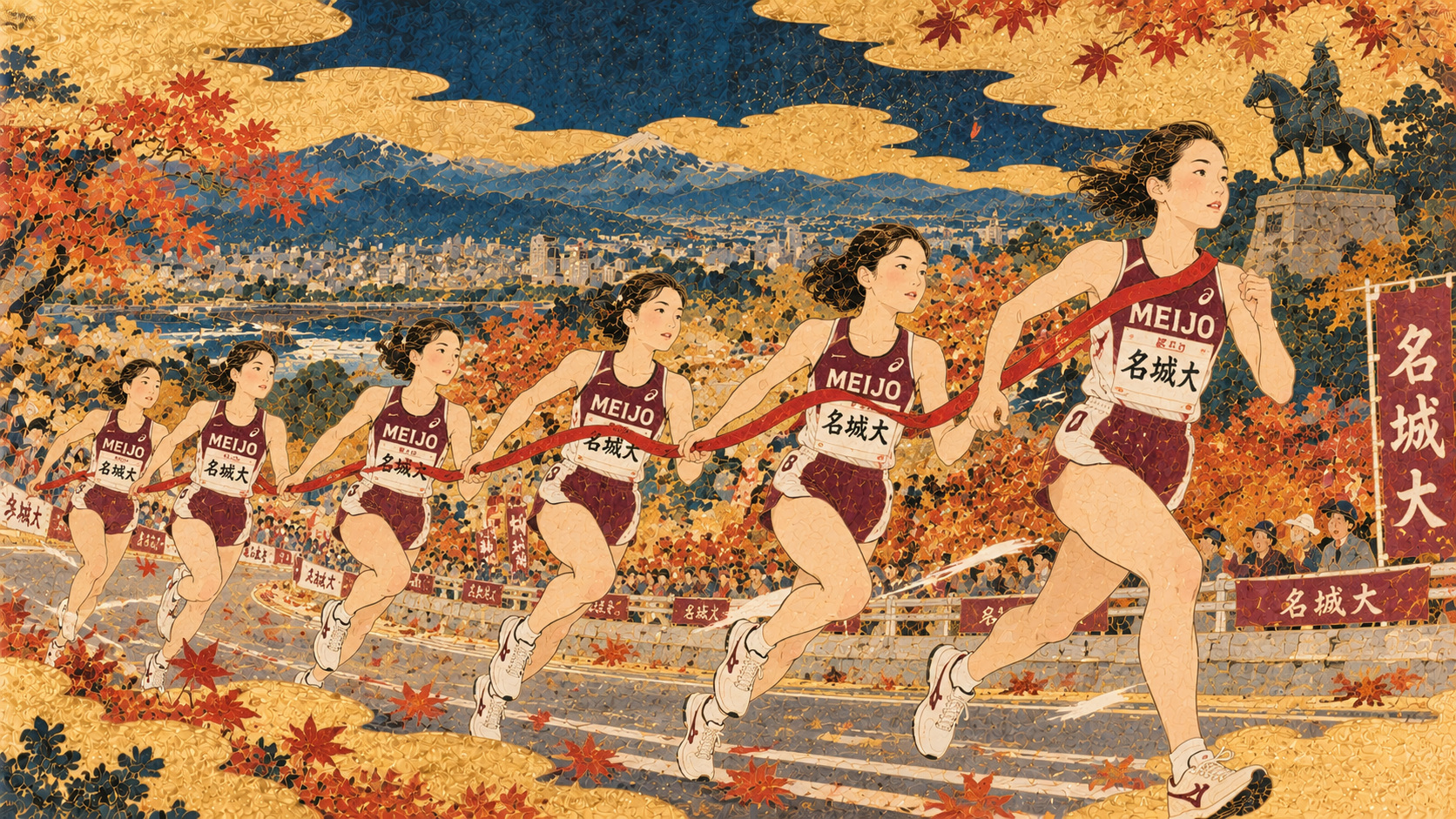
The lead arrived on stage two. Turning it into a record title required the five other runners—and the team behind them.
A 38-kilometer answer to two years of frustration
The rain fell on Sendai, and Meijo University ran as if the wait had sharpened its purpose. At the 44th All-Japan University Women’s Ekiden on October 25, six runners covered 38 kilometers in 2 hours, 2 minutes, 21 seconds—a championship record and the university’s ninth title. It was Meijo’s first victory since 2023, when its remarkable seven-year championship streak ended. The most revealing detail is not simply the final time. First-year runners started and transformed the contest; two seniors reinforced the lead; and a sophomore carried the sash to the tape.
How the six stages unfolded
Airi Mashiba opened the 6.6-kilometer first stage with 21:09, second fastest on the leg. Nozomi Kondo then ran the 4.0-kilometer second stage in a course-record 12:36 to put Meijo first. Kaede Rikimaru was second-fastest on the 5.8-kilometer third leg with 18:59. Miku Muraoka placed third on the 4.8-kilometer fourth leg in 16:02. Mao Kimura won the long 9.2-kilometer fifth stage in 28:50, while Wakana Hashimoto closed 7.6 kilometers in a stage-winning 24:45. The individual times reflect the published preliminary splits.
The small stage that changed everything
Kondo’s leg lasted only 12 minutes and 36 seconds. Yet it flipped the championship: she caught the early leaders and handed over with Meijo nine seconds in front, according to Japanese athletics reporting. Her 12:36 trimmed two seconds from the previous record. That sounds almost negligible until one considers the rhythm of a relay race: a short leg rewards high sustained speed, and the position of the next runner matters as much as the clock. Kondo also won Japan’s collegiate women’s 3,000-meter steeplechase title in September—a different test of pace and endurance.
The unglamorous art of extending a lead
Neither Rikimaru nor Muraoka won her individual stage. That fact makes their contribution more interesting rather than less. Third-leg runner Rikimaru was second-fastest and fourth-leg runner Muraoka third-fastest, while Meijo enlarged its advantage to 42 seconds by the fourth exchange. The university’s returning seniors did the work of a championship team: preserve momentum when rivals have strong runners of their own. Ekiden performance is not accurately explained by counting stage victories alone; cumulative position and the order in which strengths are deployed decide the larger race.
Mao Kimura and the longest leg
Kimura, a freshman whose given name the university identifies as Mao, tackled the longest section: 9.2 kilometers. She ran 28:50 for the stage win. Daito Bunka’s Sarah Wanjiru, a formidable fourth-year runner, clocked 29:08, 18 seconds slower on the leg. Meijo’s overall advantage stretched to about 1 minute, 8 seconds before the final handoff. It would be easy to describe Kimura as a miraculous rookie. The more credible story is how a first-year athlete handled the event’s most demanding assignment while a seasoned rival pursued.
A composed final stage
Wakana Hashimoto, a sophomore, ran the last 7.6 kilometers in 24:45 to secure both the stage award and the team title. Meijo finished 70 seconds ahead of Daito Bunka’s 2:03:31. Defending champion Josai University was third in 2:05:02. A final-leg runner inherits both a numerical lead and five teammates’ work. Protecting that advantage while running the fastest split in the leg is a persuasive end to the performance, without implying the result was inevitable at the start.
A record by 42 seconds
The previous meet record was 2:03:03, set by Ritsumeikan University in 2024. Meijo lowered it by 42 seconds. Its ninth title is impressive but not the all-time record for number of wins: Ritsumeikan has eleven. These distinctions matter. The event history is richer than any single dynasty, with the competitive balance moving among institutions. Meijo won seven consecutive titles from 2017 through 2023, slipped to fifth in 2024 and third in 2025, then returned to the top this year.
A university centenary and a generation in transition
Meijo University marked its institutional centenary in 2026. Before the race, coach Katsuro Yoneda spoke in a university-issued preview about wanting the title back in this anniversary year. Captain Ayaka Segi described a season built on conviction and shared ownership of the team’s identity. Segi was not among the six race-day runners—a useful reminder that a relay squad also depends on training partners, leaders and substitutes whose labor is invisible in the result sheet. Four years of college competition make the handing down of habits especially important.
What makes ekiden different
For readers outside Japan, ekiden is not simply a marathon divided into segments. Athletes hand a fabric sash, or tasuki, from one runner to the next, and the order matters strategically because stages vary in distance and terrain. Universities, corporate teams and local organizations have built powerful traditions around this format. Japan’s major collegiate relays occupy a prominent place in the national sporting calendar. The women’s championship in Sendai has its own course, eligibility rules and history, and its records should not be conflated with those of men’s races.
An exacting course through Sendai
The event’s official route begins and ends at Koshin Rubber Athlete Park Sendai and comprises legs of 6.6, 4.0, 5.8, 4.8, 9.2 and 7.6 kilometers. Meijo struck early in the short second leg and reinforced that advantage on the long fifth. Another school might allocate its fastest athletes differently. Placing Kondo where seconds are difficult to claw back, then assigning the longest distance to Kimura, was a coherent match of runner to task. The race result shows how that arrangement worked; only a coach’s account would establish every reason behind the selection.
Other histories made on the same day
Daito Bunka finished second for the fourth consecutive year and twelfth time overall, still pursuing a first title. Josai, the defending champion, finished third. Juntendo placed fifth and earned its first seeded position for the following year. Ritsumeikan, eleven-time winner, finished ninth and outside the top eight seed places. A championship always alters more than the victor’s record. Several institutions departed Sendai with a different understanding of where their programs stood.
What the evidence can—and cannot—tell us
The leg times, rankings and meet record are documented in the organizers’ event materials and Japanese athletics reports. Meijo’s university communications provide a valuable firsthand institutional account of preparation and team leadership, but are not independent analysis. This article does not claim original interviews with its athletes, nor infer their emotions from race positions. In a sport built on minute time differences, verifying the six names, the 42-second record improvement, and the distinction between a stage record and a championship record is essential.
The sash carries more than a time
Meijo’s victory would have mattered even without a record. Its athletes returned to the top after two seasons in which the championship belonged elsewhere. But the pace made their success impossible to dismiss as mere nostalgia for a former dynasty. A freshman began the relay. A junior seized the lead. Two seniors defended it. Another freshman accelerated away. A sophomore delivered the sash to the finish. The number on the clock was 2:02:21. What it measured was six separate runs made into one result.
Sources and verification
Based on event-organizer materials, Meijo University releases and reported competition splits. Some individual times were published as provisional and should be reconciled with the final organizer PDF. No original athlete interviews were conducted.
- Official championship: stage entries and race results
- Official championship: 2026 event outline and route
- Japan Association of University Athletics: 2026 competition listing
- Meijo University: coach and captain’s pre-race remarks
- Meijo University: pre-race team briefing
- Meijo University: Kondo’s steeplechase title
- Nikkan Sports: six-stage results and runner names
- Monthly Athletics: detailed winning race narrative
- Nikkan Sports: record and all-time winners
- Monthly Athletics: Daito Bunka’s runner-up finish