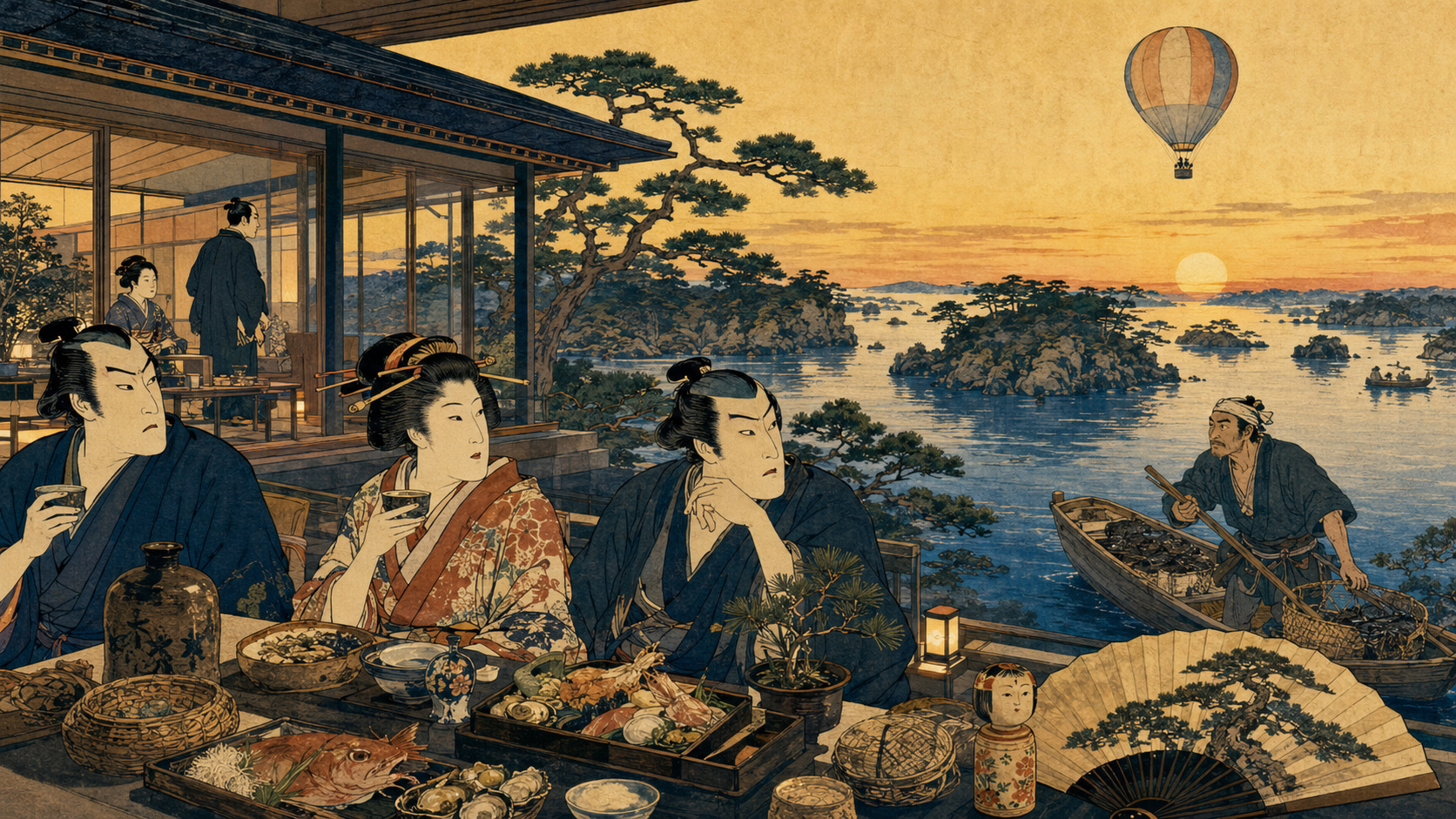
Matsushima tourism has a visible tide. In the afternoon, passengers step off the bay cruise, photograph Godaido and Zuiganji, gather their shopping bags and move toward Matsushima-Kaigan Station. The Senseki Line reaches Sendai in roughly 40 minutes. Proximity is the destination’s great advantage—and an overnight economy’s structural weakness. The visitor’s time and dinner money can return to the city before sunset burns gold across the water.
YOKI MATSUSHIMA, which Granvista Hotels & Resorts says will open on August 10, 2026, is designed to reverse that current for at least one night. Its 26 rooms all face the bay and all have either an open-air or semi-open-air Matsushima Onsen bath. Fish, rice, miso, sake, craft and local interpreters are edited into the stay. Guests will be offered Sendai tansu metalwork, armor, sunrise ballooning, a small-boat journey through Oku-Matsushima, a hotel-led temple walk and private excursions to Matsushima’s Four Great Views.
The word “new” requires context. This is not a hotel raised on an empty site. The property opened in April 2003 as Hotel Ubudo. Granvista acquired the hotel business from Marinepia on February 28, 2025, closed it and undertook a complete renovation and rebranding. YOKI is therefore the second life of a 23-year-old, 26-room property. Reusing a building does not by itself make a project sustainable, but it gives the hotel’s language of maturation and unhurried time a more substantial beginning than a ground-up luxury development would.
A Small Hotel Built Around a Longer Clock
The five-story building has 4,043.53 square meters of floor area. Nine rooms have an open-air bath and 17 a semi-open-air bath; rooms range from 41 to 69 square meters. The restaurant seats 54 and the bar lounge 15. A private rooftop-view bath is offered for 45 minutes at ¥5,500, with the hotel framing moonlight on the water as kinpa and ginpa—golden and silver waves. Pickup is planned from both JR Matsushima Station on the Tohoku Main Line and Matsushima-Kaigan Station on the Senseki Line.
A launch package announced in February started at ¥67,500 per person for two guests sharing a 46-to-51-square-meter Japanese-Western room, including dinner and breakfast. A separate one-group-per-day package visiting two of the Four Great Views was advertised from ¥78,300 per person in an example using a 58-to-62-square-meter room with open-air bath. Rates vary by date, occupancy and room and may change. The proposition is plainly not low-cost accommodation; it is to use scarcity and a high spend per guest to finance a denser relationship with place.
| Pillar | What the hotel promises | What regional renewal should require |
|---|---|---|
| EXPERIENCE | Craft, armor, ballooning, boats, temple walks and the Four Great Views | Disclose what guides, operators and artisans receive, and whether bookings create year-round work. |
| FOOD | Sanriku fish, Miyagi beef, rice, miso and seaweed, craft vessels and local sake | Measure local purchasing, name producers, pay viable prices and adapt when harvests are poor. |
| SPACE | Interiors evoking islands, pines and moonlight, with oyster shell incorporated into wall plaster | Show whether local material reduces waste, lasts and can be repaired rather than functioning only as décor. |
“Slow” Is Not a Polite Word for Delayed Service
The slow vocabulary travelled outward from the Slow Food movement, founded in Rome in 1986 and organized internationally in 1989. It opposed the flattening effects of speed and standardization by treating food as a relationship among taste, producers, place, biodiversity and a fair economy. In 1999, Italian towns began Cittaslow, an international network organized around the idea of towns in which it is good to live.
Applied to travel, slow should mean more than an uncrowded itinerary. It means reading a season, meeting the makers of a place, circulating expenditure locally and refusing to consume landscape as a disposable backdrop. Granvista defines its “slow luxury” as a journey not of material opulence but of contact with local tradition and nature and an appreciation of time itself. The definition is appealing. The moment it is coupled to luxury pricing, it also becomes testable.
Putting Tohoku on the Plate
The restaurant calls its concept Wabi Shungō, a coined phrase joining Japanese beauty, season and homeland. Its changing kaiseki menu is to feature Shiogama bluefin tuna and Sanriku returning bonito, some straw-seared, with Kampo Wagyu from Sekimura Farm in Kurihara grilled over charcoal. A sample August menu listed Onagawa sea urchin, Ogatsu scallops, Matsushima conger eel, Ishinomaki sea bream, Yuriage whitebait, Jusanhama clams and zunda.
At breakfast, rice contracted from regional farmers is cooked in a hagama pot. The accompaniments include a special blend from a long-established miso brewer, seaweed from Omagarihama in Higashi-Matsushima and katsuobushi from Ishinomaki. The fuel is said to include “raft charcoal,” made from bamboo retired from oyster-farming rafts. Traditional craft vessels and local sake extend the map from ingredients into workshop and brewery.
A menu rich in place names, however, is not the same thing as an economy rich in local value. What proportion of annual food purchasing comes from Miyagi and Tohoku? How many primary producers have direct contracts? Will the kitchen substitute rather than press suppliers in a poor harvest? Do makers of tableware receive later orders and repair work? If the hotel publishes annual local-spend figures and supplier counts, “local” can move from storytelling into accounting.
Reading Matsushima by Hand, Sky, Sea and Land
The experience program moves in four directions. By hand, guests can work with the ornamental metal fittings of Sendai tansu cabinetry and encounter armor. From the sky, a balloon site about five minutes from the hotel is presented as a place to watch the craft inflate and ascend at sunrise. By sea, a small vessel moves through Oku-Matsushima and connects the bay’s geology with places of disaster recovery. On land, hotel staff guide a walk through Zuiganji and the temple district.
There is also a private tour of two of the Four Great Views, limited to one party a day. From Otakamori on Miyato Island in Higashi-Matsushima, the panorama is called Sōkan, the magnificent view. Tomiyama is Reikan, the beautiful view; Tamonzan in Shichigahama is Ikan, the commanding view; and Ōgitani in Matsushima is Yūkan, the secluded view. The four overlooks transform an impression of low islands seen from water level into a reading of the whole bay.
This is where a hotel can become regional infrastructure. The more it sends guests beyond the room, the more expenditure can reach guides, taxis, boats, restaurants and workshops. The opposite is also possible. If craft is consumed inside the hotel, dinner is self-contained and a private vehicle connects only selected landmarks, the resort may enclose the region while claiming to reveal it. Whether YOKI becomes a window or a well-appointed box depends on whom guests meet—and who gets paid—outside its walls.
Before It Was a View, Matsushima Was Sacred Ground
The bay’s more than 260 islands were known as a poetic utamakura by the Heian period. In the medieval era, Oshima and Enpukuji formed a sacred landscape of mourning and prayer for the dead. Caves and memorials cut into the soft stone still testify to a place understood as a threshold between water and land, life and death. Beneath the modern route of photographs and cruises lies a much older journey undertaken not first to look, but to pray.
Temple tradition traces the site to 828, when the monk Ennin established a Tendai center. It became a Zen temple in the Kamakura period and declined amid later conflict. Date Masamune, founder of the Sendai domain, began rebuilding in 1604. Timber came from Kumano and Kishu, and 130 master craftsmen were brought from the Kinai region. Completed in 1609, Zuiganji holds brilliant gold paintings and carving within an outwardly restrained Zen complex. Its main hall and kitchen are now National Treasures.
Godaido, rebuilt by Masamune in 1604 on a small island reached by open slatted bridges, became Matsushima’s defining emblem. In other words, the landscape was already being “designed” four centuries ago through an arrangement of view, ritual, authority and craft. A contemporary hotel borrowing the bay’s moon, pine and island forms inherits not just attractive motifs but layers of meaning for which it assumes interpretive responsibility.
Japan’s “Three Scenic Views” Was a Seventeenth-Century Media Brand
In 1643, the Confucian scholar Hayashi Shunsai grouped Matsushima, Amanohashidate and Itsukushima as three remarkable sights in Nihonkoku Jisekikō. The formulation later settled into Nihon Sankei, the Three Scenic Views of Japan. It was less a numerical ranking than a portable editorial idea: three distant seascapes could travel together in one phrase. Guidebooks, prints, souvenirs and railway advertising repeated it until they formed a national list of places one ought to see.
Matsuo Bashō came to Matsushima in 1689 during the journey later shaped into Oku no Hosomichi. The doggerel commonly rendered as “Matsushima, ah Matsushima, Matsushima” is not his. A related comic verse attributed to the later poet Tawara-bō became attached to Bashō in popular memory. Bashō instead wrote intense prose about islands, moonlight and a landscape like cranes. The story that beauty left him without a famous haiku became part of Matsushima’s brand.
YOKI describes the hotel as performing a media-like role, connecting visitors with Matsushima and the wider Tohoku region. This is a contemporary version of an old practice. Hayashi’s sentence, Bashō’s travel writing and Masamune’s architecture all edited Matsushima. The hotel now edits it through the plate, the window, the tour and social media. That makes omission as important as selection. Whose labor, loss and present-day difficulty are visible beside the serene view?
How Convenience Made a Half-Day Masterpiece
Modern Matsushima is exceptionally accessible. The fastest trains cover Tokyo to Sendai in roughly 90 minutes, and the Senseki Line continues to Matsushima-Kaigan in about 40. From the station, the cruise pier, Godaido and Zuiganji cluster within walking distance. This convenience supports visitor traffic in the millions. It also makes it easy to consume the destination before dinner.
Matsushima’s 2026 Sustainable Development Plan acknowledges the tension in numbers. The town recorded 3.13 million visitor entries in 2024, its highest total since the 2011 disaster. Yet overnight stays had not returned to their 2019 level and were declining. The town’s target for 2030 is 3.15 million entries—only 20,000 more than 2024—while policy emphasizes stay-based, circulating tourism linked with surrounding cities. The arithmetic signals that the next task is not simply more bodies. It is more time and wider distribution.
Twenty-six rooms cannot redirect the flow of 3.13 million entries. Even at full occupancy, the hotel’s annual guest count will be small beside the day-trip market. It can nevertheless serve as a prototype if its spending commissions local work and if other hotels, restaurants and attractions can use the same guide training, booking and quality systems. A destination is renewed not by monopolizing “exclusive” experiences, but by building regional capacity that survives one property’s marketing cycle.
2011: The Islands Reduced the Wave, but the Story Is Not a Miracle
Matsushima is often said to have suffered less than neighboring coasts in the Great East Japan Earthquake and tsunami of March 11, 2011. The island-filled bay helped diminish the force of the water. That is one factor, not a complete explanation, and “miracle Matsushima” is too clean a story. The town’s official plan records 21 deaths including disaster-related deaths, inundated and collapsed homes and the loss of electricity, gas, water and telephone service. At Zuiganji, cedars damaged by seawater were later removed.
Tourism endured a secondary shock. Visitor entries averaged about 3.6 million before the disaster and fell to roughly 2.6 million in 2012. Oyster farmers lost facilities and rafts. Reconstruction projects reached a formal milestone in fiscal 2021, and town policy moved from disaster reconstruction toward regional revitalization. If YOKI’s Oku-Matsushima excursion enters places of recovery, it should present not only a triumphant return of scenic beauty but evacuation, bereavement, fisheries rebuilding and present-day preparedness—preferably through local narrators authorized and paid to tell it.
A Town of Three Million Visits—and Official Depopulation
The trajectory of visitor volume runs opposite to that of resident population. Matsushima peaked at 17,568 residents in 1985. The 2020 census counted 13,323, a 7.61 percent decline in five years, while 39.2 percent were 65 or older. The town was designated a depopulated area in 2022. The national population institute projection used in the town plan falls below 10,000 by 2040.
The fishery tied so closely to tourism is losing people as well. Matsushima is a major oyster producer, but its 2026 plan says the 2023 fishing workforce was about half its 2013 size, with young entrants continuing to decline. Eating an oyster does not automatically produce an oyster-farming successor. Stable purchasing, added value through processing, off-season work and adaptation to warmer water and damage from invasive sea squirts are the longer time scales on which hospitality must meet the fishery.
The hotel says oyster shells recovered in Ishinomaki are incorporated into interior wall plaster. It is an evocative conversion of discard into material and story. But the quantity used, processing method, durability and recoverability at the next renovation have not been published. As symbolism, it is elegant. As a circular-economy claim, it needs kilograms diverted from waste and the amount of conventional material replaced.
High Value Is Not a Synonym for High Price
Japan’s tourism policy increasingly stresses regional distribution, longer stays and higher spending per traveler rather than arrivals alone. The logic suits Matsushima: earn more locally without placing proportionally more pressure on a compact heritage district. But a high-priced room does not become high value by arithmetic.
A stay beginning in the high ¥60,000s per person is inaccessible to many residents and family travelers. If local culture becomes a stage reserved for affluent outsiders, residents may become psychologically distant from their own place. Restaurant access days, craft learning for local children, baths or lectures for townspeople, paid internships and guide training could make the property useful on both sides of the front door.
Ballooning, private vehicles, hot-spring baths in every room and individually composed meals use energy and labor. The words “slow” and “local” do not guarantee a low environmental burden. The operator could measure the carbon avoided through renovation rather than replacement, renewable electricity, hot-spring water management, food waste, plastics, staff commuting and emissions per guest-night. Measurement is how an atmospheric brand becomes a credible practice.
Five Numbers That Would Make Renewal Measurable
| Measure | Why it matters |
|---|---|
| Value and share of local purchasing | Translates “local ingredients” into the hotel’s actual annual transactions. |
| Experience fees paid to regional businesses | Shows how much of the guest price reaches guides, boats, workshops, farmers and fishers. |
| Average nights and time circulating in town | Tests whether the property actually changes the day-trip problem. |
| Year-round jobs, wages and training | Reveals whether tourism leaves skills and livelihoods rather than seasonal low-paid service work. |
| Environmental load per guest-night | Measures water, energy, food waste, transport and onsen use behind the promise of “slow.” |
The hotel could also disclose how many guests it sends to Ishinomaki, Higashi-Matsushima, Shiogama and Oku-Matsushima, and how many bookings it passes to other local businesses. If a hotel is media, it should follow more than impressions. It should follow referrals, transactions and repeat work.
Matsushima Does Not Need One More Photograph
For more than a millennium, Matsushima has welcomed travelers by editing time. The sacred landscape organized time with the dead. Masamune’s temple expressed dynastic time. Hayashi and Bashō created literary time. Trains and excursion boats compressed modern tourist time. After 2011 came the time of loss, reconstruction and preparedness.
Time is also what YOKI MATSUSHIMA ultimately proposes to sell: the moon beyond a room, the seconds in which straw flame wraps a fish, the year in which a fisher raises oysters, the repetition by which an artisan strikes a fitting, the decades through which a town recovers. Packed breathlessly into one night, these become expensive busyness. The hotel’s real task is to leave spaciousness with the guest and recurring orders with the region.
In the evening, a traveler chooses not to board the train. In the morning, islands catch light beyond the curtains. That night changes Matsushima not merely because the visitor looked longer, but when the money paid remains for the next harvest, the next repair, the next young guide and the next season.
Sources and references
Hotel specifications, experiences, menus and prices reflect operator announcements available through July 23, 2026. Activities, dishes and rates may change. Where the operator has not published quantities for local economic or environmental effects, this article treats them as measures for future evaluation, not accomplished results.
- Granvista: YOKI MATSUSHIMA opening announcement, August 10, 2026
- YOKI MATSUSHIMA official website
- Granvista: 26-room plan, onsen, “slow luxury” and “local focus”
- Granvista: Wabi Shungō dinner, breakfast and regional ingredients
- Granvista: One-party-per-day Four Great Views tour
- Granvista: Acquisition of Hotel Ubudo and the property’s history since 2003
- Granvista in English: oyster-shell reuse and regional collaboration
- Matsushima Town Tourism Promotion Plan, March 2024
- Matsushima Town Depopulated Area Sustainable Development Plan, March 2026
- National Treasure Zuiganji: history, Date Masamune and architecture
- Zuiganji: sacred landscape, Godaido and the 2011 tsunami
- Official Three Scenic Views council: Nihon Sankei and Hayashi Shunsai
- Japan Policy Forum: Bashō, the misattributed Matsushima verse and travel after 2011
- Japan National Tourism Organization: Matsushima Bay
- Disaster Prevention + Tourism: Matsushima Bay recovery storyteller cruise
- Nippon.com: Matsushima tourism and recovery after 2011
- Slow Food: History of the movement since 1986
- Cittaslow International: The movement since 1999
- Japan Tourism Agency: Tourism-area policy encouraging stays of two nights and three days or longer