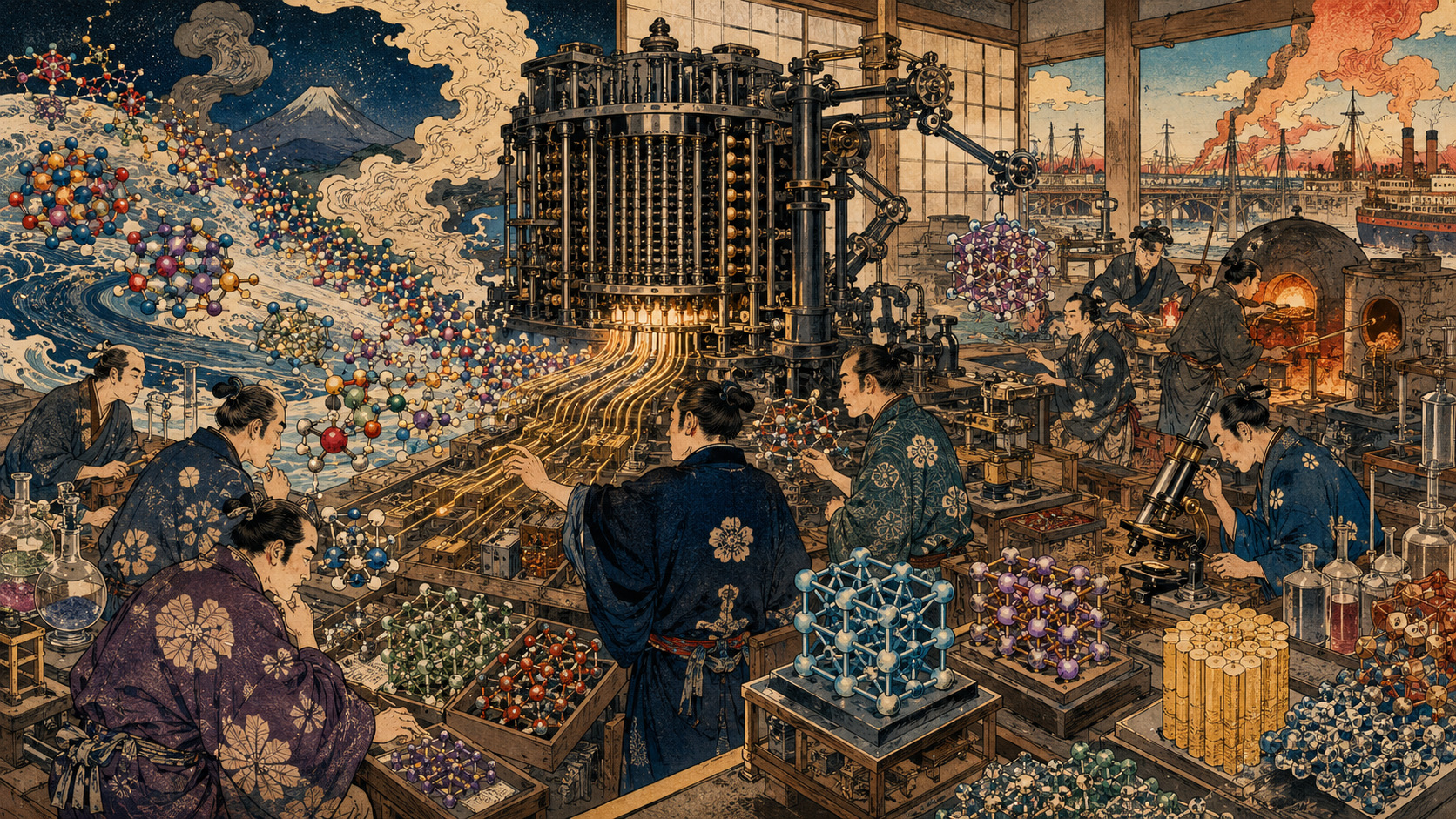
An ocean no laboratory can cross one vial at a time
The most important materials in modern life often look unremarkable. A powder makes hydrogen more cheaply. A thin film lets a battery charge without cracking. A lubricant keeps a turbine alive. A porous crystal traps carbon dioxide while letting another gas pass. Their usefulness begins in arrangements too small to see: atoms separated by fractions of a nanometre, electrons reorganizing as bonds stretch, surfaces inviting one molecule and rejecting another.
Human experiment has always navigated this invisible territory indirectly. Mix, heat, press, coat, measure, fail, revise. The method is powerful because nature gives the final answer, but the space of possibilities is savage. Change one element, concentration, surface, defect, temperature or crystal phase and the result may become a different material. Even a gifted chemist can explore only a microscopic fraction.
Matlantis’s name combines “material” and the lost island of Atlantis. The romance is deliberate: an unknown continent below a numerical sea. On April 15, 2026, the Tokyo company said it had attached new NVIDIA machinery to its vessel. The promise was not that artificial intelligence had discovered a miracle material. It was that a virtual laboratory could move faster through candidate structures—and that more of the journey could stay on the GPU instead of waiting on old computational roads.
The announcement inside the announcement
The headline said Matlantis had integrated the NVIDIA ALCHEMI Toolkit. The footnote supplied the essential precision: this stage integrated Toolkit-Ops, one foundational layer of ALCHEMI. Earlier work used NVIDIA Warp-optimized kernels for neighbor-list construction and DFT-D3 dispersion corrections. Matlantis and NVIDIA reported speedups of up to tenfold in those key calculations.
LightPFP, a smaller potential trained for a selected materials category, was moving to a server-based architecture. Server calls make computing resources more flexible, but communication between a notebook and the model can become a bottleneck. Matlantis said replacing neighbor-list construction during inference with Toolkit-Ops reduced that pressure. The company described LightPFP availability as near future.
Then came the roadmap: integration of the flagship PFP universal machine-learning interatomic potential with the broader ALCHEMI toolkit was planned. NVIDIA’s own technical account was similarly careful. It said Matlantis was exploring components and that the collaboration had the potential to progress from single-structure optimization toward high-throughput parallel relaxation of millions of configurations. Potential is not a benchmark result. Parallel relaxation is not experimental discovery. The distinction is the first rule for reading this story honestly.
Why a list of neighbours can slow an atomic universe
An atom does not need to compare itself with every atom in a large simulation at every step. Most interatomic models use a cutoff: calculate the local environment around each atom, identify nearby neighbours, then infer forces and energy. Constructing and updating those neighbour lists sounds like bookkeeping. At hundreds of thousands of atoms, across thousands of time steps or many candidate structures, bookkeeping becomes infrastructure.
Dispersion corrections create another cost. Ordinary density-functional approximations may not capture long-range van der Waals attraction adequately, yet those weak interactions matter in molecular crystals, adsorption and layered materials. DFT-D3 adds an empirical correction. Electrostatics, geometry optimization and molecular dynamics add their own kernels. A fast neural network surrounded by CPU-centred software can spend its day waiting.
NVIDIA designed ALCHEMI—AI Lab for Chemistry and Materials Innovation—as a collection rather than one model. Toolkit-Ops supplies GPU kernels for neighbour lists, dispersion and electrostatics. The wider PyTorch-native toolkit handles data flow, batched geometry relaxation and dynamics; NIM microservices offer cloud-ready deployment. Keeping positions, graphs, forces and updates on the GPU avoids repeated transfers across the CPU–GPU boundary—the digital equivalent of a laboratory that stores its instruments in different buildings.
What the GPU toolkit does—and does not do
| Layer | Job | Status in the Matlantis story |
|---|---|---|
| PFP | Universal learned potential predicts energy and forces for atomic structures | Flagship model; broader ALCHEMI integration described as future work in April |
| LightPFP | Category-specific, lighter potential aimed at systems with hundreds of thousands of atoms | Server-based version linked to Toolkit-Ops was described as coming soon |
| ALCHEMI Toolkit-Ops | GPU kernels for neighbour lists, dispersion, electrostatics and related operations | Integration announced; selected operations reported up to 10× faster |
| ALCHEMI Toolkit | Composable, batched, PyTorch-native simulation workflows | Wider exploration and PFP integration roadmap, not a completed end-to-end claim |
| Laboratory | Synthesis, characterization, safety, scale-up and cost validation | Still indispensable; no toolkit manufactures or certifies a material |
The equation that made the dream possible
The historical road begins with the quantum revolution. Erwin Schrödinger’s 1926 equation described matter through a wavefunction. For more than a few electrons, however, exact solution becomes brutally difficult. Each added electron enlarges a many-dimensional problem; chemical realism demands approximations and enormous calculation.
Walter Kohn and Pierre Hohenberg changed the object of attention in 1964. They showed that a ground-state system’s properties could, in principle, be determined from its electron density—a function of three spatial coordinates—rather than the vastly more complicated many-electron wavefunction. Kohn and Lu Jeu Sham supplied a practical set of equations in 1965. Density-functional theory, or DFT, became the working language behind much of computational materials science. Kohn shared the 1998 Nobel Prize in Chemistry with John Pople, honored for computational methods in quantum chemistry.
DFT did not abolish approximation. Researchers choose exchange-correlation functionals, pseudopotentials, basis sets, convergence criteria and finite models. A surface may behave differently from a bulk crystal; strongly correlated electrons remain difficult; calculated stability is not synthesizability. But DFT created an extraordinary bargain: enough quantum mechanics to calculate useful structures, energies and reactions on computers.
From one expensive answer to a learned landscape
A molecular-dynamics simulation is a film. At each frame, the program needs forces on every atom, advances their positions for a tiny time step, then asks again. DFT can provide high-fidelity forces, but calculating them at every frame for a large system makes the film impossibly expensive. Classical force fields are quick because human-designed equations approximate bonds and interactions, but they can struggle when chemistry changes or bonds break outside the situations for which they were parameterized.
Machine-learning interatomic potentials attempt the middle route. First, expensive electronic-structure calculations produce examples of atomic structures, energies and forces. A neural network learns the potential-energy surface implied by those examples. During later simulations, inference is far cheaper than recalculating electrons from first principles at every step.
Jörg Behler and Michele Parrinello’s 2007 paper was a landmark. It represented a high-dimensional potential-energy surface as a sum of atomic neural-network contributions, demonstrated on silicon, and reported several orders of magnitude speed over DFT. The field has since exploded into graph neural networks, equivariant architectures and foundation-style “universal” potentials. Matlantis’s PFP belongs to that lineage.
A Japanese marriage of AI and oil-company chemistry
Preferred Networks built its reputation applying deep learning and high-performance computing to industrial problems. ENEOS, descended from more than a century of Japanese petroleum enterprise, brought chemists, catalysts, lubricants, surfaces and the stubborn reality of materials R&D. Their collaboration turned into Preferred Computational Chemistry in June 2021: PFN owned 51%, ENEOS 49%, and the new joint venture had paid-in capital of ¥310 million.
Matlantis launched as a cloud service on July 6 that year. Users did not need to install a cluster or train a potential from scratch. They could write familiar Python workflows around the Atomic Simulation Environment while the proprietary PFP model and computing ran behind the service. The original release supported arbitrary combinations of 55 elements and advertised calculations that could move from hours or months under selected DFT setups to seconds.
The corporate structure evolved. Mitsubishi Corporation entered a business and capital alliance in 2024 to help expand international sales. Preferred Computational Chemistry renamed itself Matlantis Corporation in July 2025. The ownership story matters: this is neither a lone academic codebase nor simply an NVIDIA product. It is a Japanese industrial software company built from an AI firm, an energy-and-chemicals incumbent and a global trading house.
How PFP learned to be “universal”
Universality does not mean that a model has solved all chemistry. It means one trained potential is intended to handle many elements and structure classes without fitting a new model for every material. The peer-reviewed 2022 PFP paper described a system covering arbitrary combinations of 45 elements. Its training data ranged across molecules, crystals, slabs, clusters, adsorption configurations and disordered structures.
Crucially, the authors included many unstable, high-energy and out-of-equilibrium geometries. A model trained only on beautiful equilibrium crystals is like a navigator taught only calm harbours: molecular dynamics will soon push it into distorted states it has never seen. Diverse configurations improve robustness across the route between structures.
The paper demonstrated lithium diffusion, adsorption in metal–organic frameworks, a copper–gold order–disorder transition and catalyst screening for Fischer–Tropsch chemistry. In the catalyst example, selected activation energies had a reported correlation of 0.98 with reference calculations and a mean absolute error of 0.097 electron volts; vanadium emerged as a promoter consistent with literature. These are serious scientific tests. They are not independent certification of every later commercial version: many authors were affiliated with PFN or ENEOS, and the trained model remains proprietary.
Fifty-nine million structures, then a new functional
By PFP v7 in 2024, the supported set had grown to 96 elements, including all naturally occurring elements under the company’s definition. PFN said the training corpus contained 59 million molecular, crystal and other structures, and that generating it represented 2,264 single-GPU years of work. The model was developed using PFN machines and AIST’s ABCI public AI supercomputer.
PFP v9, released July 16, 2026—three months after the NVIDIA announcement—made an r²SCAN calculation mode the default across the 96 elements and expanded data for surfaces, adsorption, coordination complexes and molecular crystals. Matlantis reported better agreement in tests involving crystal and surface stability, melting points and water viscosity. Those are company validations, not a declaration that DFT’s known errors disappeared; a learned potential inherits the character and limitations of the electronic-structure data used to teach it.
The sequence reveals what a commercial universal potential really is: not a finished oracle, but a maintained scientific instrument. Its coverage grows, reference calculations change, problem classes are added and customer failures feed the next version. Versioning becomes part of reproducibility. A result from PFP v5 is not automatically a result from v9.
LightPFP trades universality for scale
Some materials questions are not small. A crack, grain boundary, polymer interface or battery electrode may require hundreds of thousands of atoms to display the phenomenon of interest. The universal model is useful across chemical space, but its computational weight limits system size.
LightPFP reverses the emphasis. A user restricts the category of material, then trains a lighter potential using PFP-generated reference data instead of beginning with a huge new DFT campaign. Matlantis says the method can reach hundreds of thousands of atoms—more than ten times the scale then available to PFP. It is a teacher–student arrangement: the broad model creates a specialized apprentice that runs more cheaply.
This is where the NVIDIA integration is strategically logical. Server deployment, distributed workflows and larger atomic systems magnify communication and neighbour-list costs. Accelerating the surrounding kernels may deliver more practical value than making an already-fast neural-network layer a little faster.
The dangerous simplicity of “20 million times faster”
Matlantis has variously described PFP as tens of thousands, and in some material as up to 20 million, times faster than DFT. Both can be true for a chosen comparison. Neither is a universal conversion rate. Performance changes with atom count, hardware, DFT settings, target accuracy, batching, precision, model version and whether one measures a single force evaluation or a complete workflow.
Imagine a DFT job requiring two months and a learned-potential inference taking a fraction of a second. The ratio is spectacular. But the model’s training data required vast DFT computation in advance. A candidate near a decision boundary may need fresh high-fidelity calculation. A promising powder must be synthesized, purified, characterized and tested under heat, pressure and time. Manufacturing scale, toxicity, raw-material supply and intellectual property remain untouched by inference speed.
The April “up to 10×” figure is different again. It refers to selected kernels in the simulation pipeline, not PFP versus DFT. The honest presentation keeps the denominators attached.
| Number | Comparison | Responsible interpretation |
|---|---|---|
| Up to 10× | Warp/ALCHEMI-optimized neighbour-list and DFT-D3 operations | Component-level, company/NVIDIA reported result |
| Tens of thousands× | Broad Matlantis marketing comparison with conventional physical/DFT simulation | Workload-dependent inference comparison, not total R&D time |
| Up to 20 million× | Selected PFP versus DFT examples | Upper-bound promotional figure requiring benchmark context |
| Hundreds of thousands of atoms | LightPFP target scale | Category-specific model; universality is deliberately narrowed |
A searchlight, not a certificate
A materials-discovery funnel begins with hypotheses or generated structures. A fast potential can reject obviously unstable candidates, relax geometries, estimate energies and simulate motion. The best candidates move to more expensive DFT, then synthesis and measurement. Every stage answers a different question.
Predicted low energy does not prove a crystal can be made. A stable bulk phase may decompose in air. A simulated catalyst surface may reconstruct or become poisoned. A battery electrolyte may conduct ions beautifully and burn. An alloy may work at atomic scale but require an impossible manufacturing temperature. The farther a claim moves from energy and force prediction toward a market product, the more experimental evidence it needs.
Matlantis’s January 2026 crystal-structure-prediction service illustrates the opportunity and the boundary. The company reported thirteen previously unknown candidate structures in a gallium–gold–calcium system and Honda R&D adopted the capability early. “Candidate” is the correct word. DFT recalculation and laboratory confirmation decide whether the map points to land.
- Generate: propose compositions and structures from chemistry, enumeration or generative models.
- Screen: use an ML potential to relax and rank a very large candidate set.
- Recalculate: apply higher-fidelity DFT to the small, consequential subset.
- Synthesize: determine whether the candidate can exist under practical conditions.
- Characterize: measure structure, property, degradation, safety and uncertainty.
- Scale: prove cost, supply, process control and performance in a product.
Where universal potentials can fail
A model interpolates best inside the world represented in its training data. Defects, unusual charge states, extreme temperature, new coordination, long-range polarization and reaction transition states can carry it outside that world. A smooth and confident prediction can still be wrong. This is the materials version of distribution shift.
Recent independent work on other universal potentials—not PFP specifically—has documented systematic “softening”: some models underpredict energy and forces in complex, out-of-distribution environments such as surfaces, defects, solid solutions and ion-migration barriers. The warning cannot be transferred as a verdict on Matlantis, but it applies to the class. Benchmarks on clean crystal relaxations do not settle performance on every industrial interface.
Task-based benchmarks also show why one aggregate error is not enough. A model can have a respectable energy error yet produce false positives near the stability boundary, where tiny differences decide whether a candidate is advanced or discarded. Researchers need uncertainty estimates, out-of-domain detection, version-specific tests and high-fidelity escalation rules—not simply a faster score.
The competition is open, proprietary and global
Matlantis does not cross the atomic sea alone. MACE, CHGNet, M3GNet, SevenNet, MatterSim, Orb, eSEN and other models compete across accuracy, speed, element coverage, licensing and usability. Some are open source or provide downloadable weights. Others are services. NVIDIA’s own ALCHEMI ecosystem integrates multiple model families, which makes it infrastructure for competition as much as a partner to one company.
Matlantis’s proprietary cloud approach offers a maintained environment, a huge precomputed training investment and industrial support. It also limits inspection of weights and training data and creates questions about reproducibility, data residency, model continuity and vendor dependence. Open models offer auditability and local control, but a company must assemble, validate and operate them. The right choice depends on the material, the laboratory’s skills and the consequence of error.
Why this matters for Japanese industry
Japan’s manufacturing strength has often rested in process knowledge and materials invisible inside finished goods: photoresists, battery components, specialty chemicals, ceramics, catalysts, bearings and precision films. These businesses defend narrow advantages accumulated through experiments and tacit craft. AI simulation can turn some of that craft into a searchable, repeatable workflow without making domain expertise less important.
PFN contributes algorithms and computing; ENEOS contributes chemical questions and industrial data; Mitsubishi contributes channels into global supply chains; AIST contributes public supercomputing; NVIDIA contributes an accelerator ecosystem. The arrangement is a miniature industrial policy even without a subsidy label. It connects domestic scientific capability to a global hardware platform.
That connection also creates economic-security questions. Research data and candidate structures can be trade secrets. Cloud services must control access and audit trails. GPU supply and software dependencies can be geopolitical choke points. A Japanese materials platform running on an American accelerator stack is both an export opportunity and a dependency to manage.
A white-paper note: the citation could not be verified
The original story brief described Matlantis as a named company case in Japan’s 2026 White Paper on International Economy and Trade. Japan.co.jp checked the searchable full Japanese text released by METI and could not verify a Matlantis, Preferred Networks or ENEOS materials-simulation case by name. The white paper does profile other digital exporters, including TIER IV.
Matlantis fits the AI-and-digital-manufacturing themes of the 2026 Manufacturing White Paper, but thematic fit is not the same as a named case. This article therefore bases its account on the April Matlantis and NVIDIA releases, the peer-reviewed PFP paper, company histories and independent scientific literature rather than repeating an unverified attribution. The correction does not diminish the technology; it keeps a government citation from becoming evidence it is not.
From Schrödinger to ALCHEMI: one century of approximation
1926 Schrödinger publishes wave mechanics; exact many-electron solutions remain intractable for realistic materials.
1964–1965 Hohenberg, Kohn and Sham establish the foundations and practical equations of density-functional theory.
1985 Car and Parrinello unite molecular dynamics with electronic-structure calculation, accelerating first-principles simulation.
1998 Walter Kohn shares the Nobel Prize in Chemistry for developing DFT; John Pople is honored for computational quantum chemistry.
2007 Behler and Parrinello publish a landmark high-dimensional neural-network potential.
2013 The Materials Project formalizes large-scale, high-throughput DFT databases for open materials discovery.
June–July 2021 PFN and ENEOS form Preferred Computational Chemistry and launch Matlantis in the cloud.
May 2022 The peer-reviewed PFP paper reports a universal potential covering combinations of 45 elements.
April 2023 Matlantis begins U.S. sales.
June 2024 Mitsubishi Corporation joins through a business and capital alliance.
September 2024 PFP v7 expands to 96 elements and a reported 59 million-structure training set.
January 2025 LightPFP launches for category-specific simulations at much larger atomic scale.
July 2025 Preferred Computational Chemistry becomes Matlantis Corporation.
January 2026 Matlantis launches crystal-structure prediction; Honda R&D is an early adopter.
April 14–15, 2026 NVIDIA introduces the broader ALCHEMI Toolkit; Matlantis announces Toolkit-Ops integration and a wider roadmap.
July 16, 2026 PFP v9 makes r²SCAN mode the default and expands surface, adsorption and molecular-crystal data.
A ledger of what is proved
| Claim | Evidence by August 7, 2026 | Status |
|---|---|---|
| Matlantis integrated NVIDIA ALCHEMI | Company and NVIDIA announcements specify Toolkit-Ops and prior Warp kernels | Confirmed, with limited scope |
| Key calculations became up to 10× faster | Jointly reported for selected neighbour-list and DFT-D3 operations | Interested-party benchmark |
| The full PFP model was integrated in April | Matlantis called this future work | No |
| PFP is scientifically published | 2022 Nature Communications paper, 45-element version and several applications | Peer reviewed |
| PFP v9 supports 96 elements | July 2026 company release | Company-reported product capability |
| Matlantis has more than 150 users | Company announcements | Not independently audited |
| Simulation has discovered a market-ready material | No such result in the ALCHEMI announcement | Not claimed or demonstrated |
| Matlantis is a named 2026 Trade White Paper case | No match in METI’s searchable full Japanese text | Could not verify |
What would make the integration consequential
- End-to-end benchmarks: disclose model version, GPU, atom count, batch size, precision and time for complete workflows—not only kernels.
- Quality alongside speed: report energy, force, geometry and task errors before and after optimization.
- Out-of-domain alarms: show when PFP or LightPFP knows that a structure lies beyond training coverage.
- Reproducible funnels: publish how many generated structures survive ML screening, DFT recalculation and synthesis.
- Experimental wins: validate a genuinely new composition or structure and show that simulation shortened the route.
- Industrial economics: measure researcher time, GPU cost, failed experiments avoided and time to a product decision.
- Version provenance: preserve the model, settings and data trail behind each candidate.
The new bottleneck is judgment
When calculation is expensive, a scientist spends judgment choosing which question the computer deserves. When inference becomes cheap, the machine can flood the laboratory with plausible answers. The bottleneck moves from arithmetic to triage: which candidates are distinct, robust, synthesizable, safe and valuable?
That shift changes work. Chemists must design search spaces and validation thresholds. Data engineers must preserve provenance. Experimentalists become the scarce court of appeal. Managers must resist the attractive metric of “structures screened” when the real measure is better decisions per yen and month.
ALCHEMI’s batching and Matlantis’s universal potential could make millions of invisible experiments routine. Their success will be measured not by how many trajectories a GPU can draw, but by how few misleading candidates reach the bench—and how often a strange, valuable one survives.
A fair verdict in August 2026
Matlantis has built a substantial Japanese materials-AI platform. PFP has a peer-reviewed scientific foundation, has expanded from 45 elements in its 2022 paper to a company-reported 96 in v9, and is used across catalysts, batteries, semiconductors, alloys, lubricants, ceramics and chemicals. The partnership with NVIDIA attacks a real engineering problem: the slow, CPU-centred plumbing around fast learned models.
The April milestone should not be inflated. The demonstrated integration was Toolkit-Ops, not the completion of every ALCHEMI component inside flagship PFP. The tenfold figure was for selected calculations. The much larger DFT comparisons are workload-specific and exclude training, verification, synthesis and scale-up. The “millions of configurations” vision remains a forward-looking consequence of batching, not a reported discovery result.
That narrower truth is still consequential. DFT made quantum chemistry usable by replacing an impossible description with a tractable one. Neural potentials learned a fast approximation to repeated DFT. GPU-native toolkits now remove the friction around those models. Every layer trades some directness for reach. The responsible laboratory keeps the ladder intact: AI proposes, quantum calculation checks, experiment decides.
Reporting notes and principal sources
Public information was checked through August 7, 2026, 9:02 a.m. JST. Matlantis, PFN, ENEOS and NVIDIA releases are treated as interested-party accounts. Performance figures retain their comparison scope. The 2022 PFP article is peer reviewed but includes company-affiliated authors. The independent “softening” literature concerns other universal potentials and is used as a class-wide caution, not evidence of a PFP defect. No named Matlantis case was found in METI’s searchable 2026 Trade White Paper.
- Matlantis: April 15, 2026 ALCHEMI Toolkit-Ops integration, LightPFP architecture and PFP roadmap
- NVIDIA: ALCHEMI Toolkit architecture, requirements, batching and Matlantis integration
- Takamoto et al., Nature Communications: peer-reviewed PFP model and applications
- Preferred Networks: 2021 joint venture and Matlantis cloud launch
- Preferred Networks: PFP v7, 96 elements, 59 million structures and ABCI
- Matlantis: LightPFP scale, training design and users
- Matlantis: 2024 Mitsubishi Corporation alliance
- Matlantis: crystal-structure prediction launch and Honda R&D adoption
- Matlantis: PFP v9, r²SCAN mode and expanded training domains
- Nobel Prize: Walter Kohn, John Pople and the history of computational chemistry
- Behler and Parrinello: 2007 neural-network potential
- Jain et al.: the Materials Project and high-throughput materials discovery
- npj Computational Materials: independent study of systematic softening in universal ML potentials
- Matbench Discovery: task-based benchmarking for inorganic crystal stability
- METI: searchable 2026 White Paper on International Economy and Trade
- METI: 2026 Manufacturing White Paper and its AI/digital manufacturing context