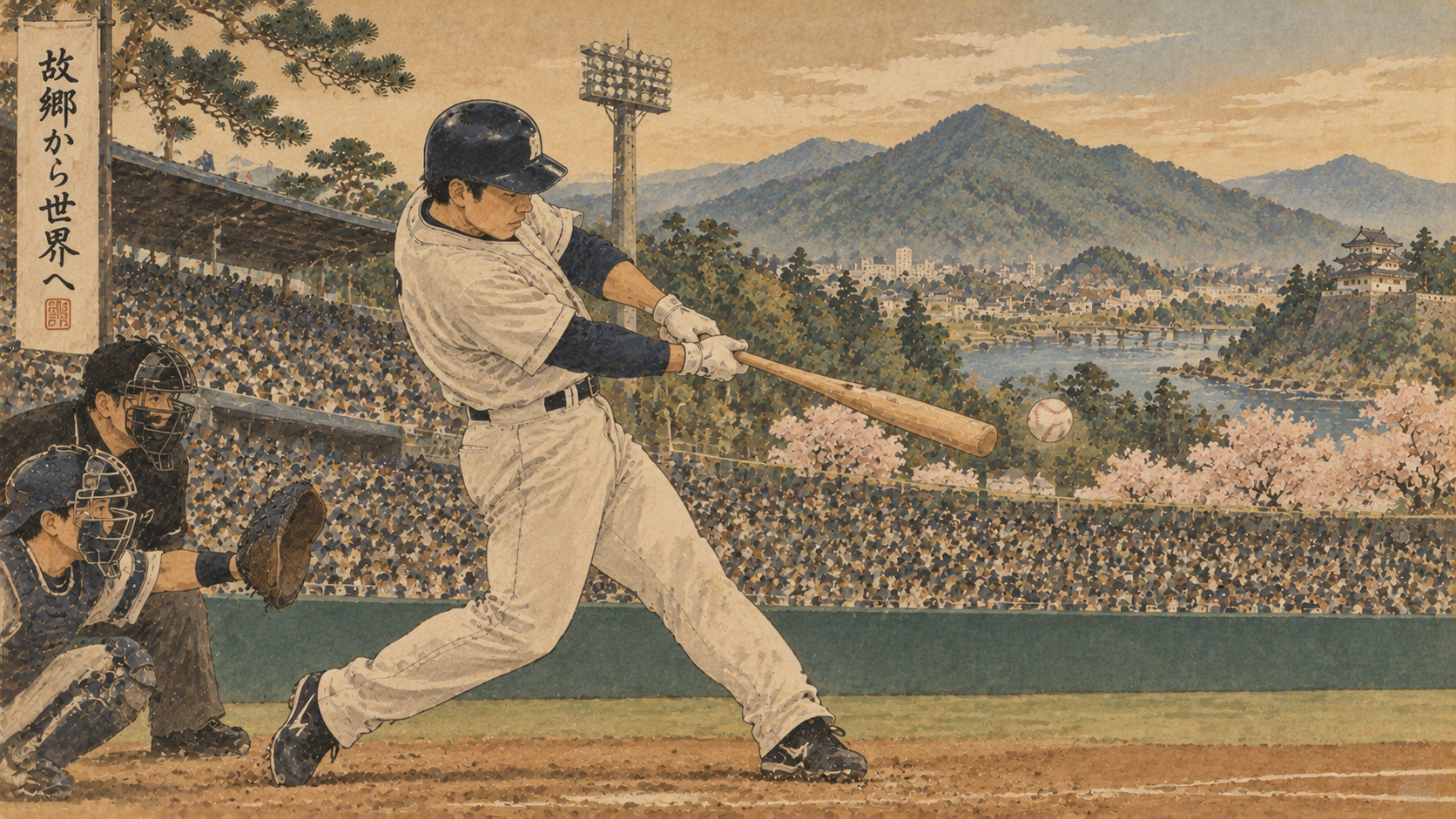
From a local diamond in Fukui to Fenway Park: talent meets time, patience and uncertainty.
An August double and an abrupt ending
Masataka Yoshida’s 2026 season took an unexpected turn in Pittsburgh on August 15. Hustling into second base, the Boston Red Sox hitter hurt his left leg and left the game. On August 16 the club placed him on the 10-day injured list with a left hamstring strain. Two days later, team officials described the injury as substantial and warned that his season might be over. His recorded 2026 regular-season line stands at 87 games, 72 hits in 263 at-bats, five home runs, 28 runs batted in and a .274 average. It is not the glittering finish that a celebratory hometown profile might prefer. It is, however, an honest place to begin: a gifted hitter from a small Japanese prefecture encountering the fragility of a professional career far from home.
The baseball map starts in Fukui
Born in Fukui on July 15, 1993, Yoshida began playing baseball at six, inspired, according to a Japanese national-team questionnaire, by his older brother. His official Japanese baseball biography identifies an unusually clear local progression: Asozu Yankees at Asozu Elementary School, Sabae Boys while attending Asuwa Junior High School, and then Tsuruga Kehi High School. These are not merely names on a résumé. They trace the community and school structures through which regional talent can develop long before recruiters or television audiences become interested. Fukui’s contribution to baseball is not limited to one celebrated player; it includes the local foundations that made his ambition practical.
A college hitter already prepared for bigger stages
From Tsuruga Kehi, Yoshida entered Aoyama Gakuin University in 2012 and immediately earned playing time. The university’s announcement after the 2015 draft documents a remarkable senior year: a .389 average in the spring second-division league and an autumn triple crown with a .400 average, five home runs and 15 RBI. Yoshida also represented Japanese university baseball in the 2013 Japan–USA Collegiate Championship, the 2014 Haarlem Baseball Week and the 2015 Universiade. College competition became a bridge between Fukui and the demands of the international game. His skill was not simply hitting balls hard; it was controlling the strike zone and making the kind of consistent contact scouts prize.
A first-round choice in Osaka
The Orix Buffaloes used a first-round selection in the October 22, 2015 NPB draft to choose Yoshida. Standing 173 centimeters tall and batting left-handed, he did not fit every conventional image of a power hitter. Yet his combination of bat control, selective aggression and physical strength offered something more valuable than size alone. Yoshida debuted for Orix in 2016 and grew into one of the Pacific League’s most difficult outs. His progress also coincided with the Buffaloes’ eventual rise to the championship stage.
The arithmetic of a remarkable NPB career
Across seven Orix seasons, 2016–22, Yoshida appeared in 762 games, collected 884 hits, hit 133 home runs and drove in 467 runs. His batting average was .327. He won consecutive Pacific League batting titles in 2020 (.350) and 2021 (.339), then hit .335 in 2022 while drawing 80 walks against only 41 strikeouts. Those relationships matter. The ability to get on base even when opponents refuse to throw inviting pitches is a central form of offensive value. A look at the Japanese statistics shows not just power, but a player unusually skilled at controlling what happens during an at-bat.
The walk-off that helped make history
One of the defining images of Yoshida’s Japanese career came in Game 5 of the 2022 Japan Series. Facing the Tokyo Yakult Swallows, he homered in the fifth inning and then delivered a two-run, ninth-inning walk-off home run for a 6–4 Orix victory. Japan’s professional baseball organization records the finish as a Japan Series landmark. Orix went on to win the championship, and Yoshida’s swing became part of the club’s enduring memory. For baseball followers in Fukui, it was the kind of national moment in which a familiar local biography suddenly belonged to the whole country.
Representing a country, not only a club
Yoshida was representing Japan long before his move to Major League Baseball. College international tournaments, national-team preparation games, the delayed Tokyo 2020 Olympics and the 2023 World Baseball Classic brought him into lineups facing talent from across the world. He was part of Japan’s Olympic gold-medal team and its 2023 WBC championship campaign. His dramatic contribution to that tournament helped establish his name with American audiences even before his first regular-season MLB game. International competition is also a reminder that a player’s national identity and his professional club responsibilities operate on different calendars and under different pressures.
Crossing the Pacific to Boston
Yoshida signed a five-year, $90 million agreement with Boston in December 2022 and made his MLB debut on March 30, 2023. He arrived with strong batting credentials but no guarantee that success would translate cleanly across leagues. Major-league pitching depth, defensive positioning, Fenway Park’s distinctive dimensions and travel demanded adjustments. His first season produced a .289 average with 15 home runs and 72 RBI over 140 games. He had justified some of the expectations, while still confronting questions about defensive use, his role as designated hitter and how to maintain his hitting approach over a long American season.
What contact skill actually looks like
The 2026 numbers illustrate why Yoshida remains analytically interesting. He struck out 33 times in 297 plate appearances and drew 28 walks. He posted a .347 on-base percentage and a .399 slugging percentage, for a .746 OPS. These are useful measures, not a final verdict. Hitting value also depends on a player’s defensive role, availability, the quality of opponents and the circumstances of individual games. The important technical lesson in his career is that patient strike-zone judgment and consistent contact can create substantial offensive value without depending on unusually tall stature or towering home-run totals.
The injury and the limits of a narrative
Boston’s public records show how the last three seasons differed: 108 games and a .280 average in 2024, 55 games and .266 in 2025, then 87 games and .274 in 2026. It would be irresponsible to infer one simple cause from those totals. Health, competition for roster spots and deployment as an outfielder or designated hitter all form part of the broader story. What can be stated directly is that Boston placed him on the injured list in August 2026 with a serious left hamstring strain. His contract runs through 2027; claims about a precise recovery date or future playing status would require later confirmation.
Why a hometown star matters
The milestones can obscure the supporting cast of teachers, coaches, peers and family. Yoshida’s route through Fukui youth baseball, Tsuruga Kehi and then Aoyama Gakuin is a reminder that global careers depend on local sporting institutions. Maintaining those pathways means more than displaying a famous player’s photograph. Families need affordable opportunities; children need safe facilities and competent coaches; young athletes need ways to remain students and citizens even if professional sports never becomes their livelihood. Yoshida’s example supplies inspiration, but his hometown’s opportunity is to build enduring access for the next generation.
The next at-bat is still unwritten
As of the Sunday edition of October 18, Yoshida’s 2026 MLB season is best understood as a year of useful production interrupted by injury—not as evidence that his story has ended. From childhood diamonds in Fukui to Orix’s Japan Series victory, Olympic gold and Fenway Park, he has already covered extraordinary ground. His career includes triumph and uncertainty, just as real sporting careers do. The lesson is less about celebrity than persistence: the practice and discipline learned in a regional Japanese community can travel across an ocean, even when no one knows what the next season will bring.
The Conversation Continues
Japan.co.jp welcomes documented contributions from Yoshida, his representatives, coaches, schools and Fukui baseball communities about his early development and international career. This report does not imply a direct interview. Verified contributions may inform a follow-up. Contact the editorial desk.
Sources and Methodology
Japanese national-team, NPB and Aoyama Gakuin primary records establish names and early career. MLB and Boston club records anchor the 2026 statistics and injury reporting. No original interview is claimed.
- 野球日本代表「侍ジャパン」吉田正尚選手経歴
- オリックス・バファローズ 吉田正尚選手名鑑 2022
- 日本野球機構 吉田正尚 年度別打撃成績
- 青山学院大学 ドラフト1位指名 2015年10月23日
- 日本野球機構 2022年日本シリーズの記録
- Boston Red Sox August 16, 2026 roster transaction and 2026 statistics
- MLB August 18, 2026 injury update
- MLB player profile and statistics
- Baseball-Reference 2023–2026 major-league batting register
- 野球日本代表 大学代表選手紹介