A painter who changed the act of looking
A pine tree can be painted without painting its snow. A bird can inhabit a room without ever moving. These are among the possibilities opened by Maruyama Ōkyo, an artist whose achievement lay not simply in the accuracy of his drawings but in the experience he created for the person standing before them.
Born in 1733 in Ano, a farming village in the old province of Tanba, now part of Kameoka in Kyoto Prefecture, Ōkyo came to the city while young. The artist studied with Ishida Yūtei, a painter associated with the Kanō tradition. Details of his early employment and the exact age at which he entered training differ among accounts. The chronology maintained by Daijōji acknowledges these uncertainties.
Kyoto offered an unusually fertile artistic environment. Religious institutions, wealthy merchants and members of the imperial aristocracy supported painting, while imported pictures and a growing interest in the natural world opened other routes to knowledge. Ōkyo would bring several of those routes together, building a career that encompassed intimate studies of animals and monumental architectural commissions.
From optical toys to a new language of nature
Before becoming a celebrated painter, Ōkyo worked on pictures intended for optical viewing devices, known as megane-e. Such pictures exploited perspective to produce a convincing impression of depth. Their importance was not that they made him a Western painter, but that they offered another way to organize the relationship between an image and its observer.
His association with the imperial Buddhist prince Yūjō of Enman-in in the 1760s gave him access to Chinese paintings and opportunities to study older models. Around 1766 he adopted the name Ōkyo. By 1775 he headed the painters listed in the Kyoto directory Heian Jinbutsushi, according to the temple chronology.
The method associated with his school, shasei, means drawing from observation. It involves more than copying appearances: the painter must decide what makes an object recognizable, how its surfaces respond to light and which details can be omitted. Ōkyo combined that discipline with inherited decorative conventions. A study of an animal and a screen intended to transform a large room could therefore emerge from the same artistic outlook.
Pine Trees in the Snow: the light of untouched paper
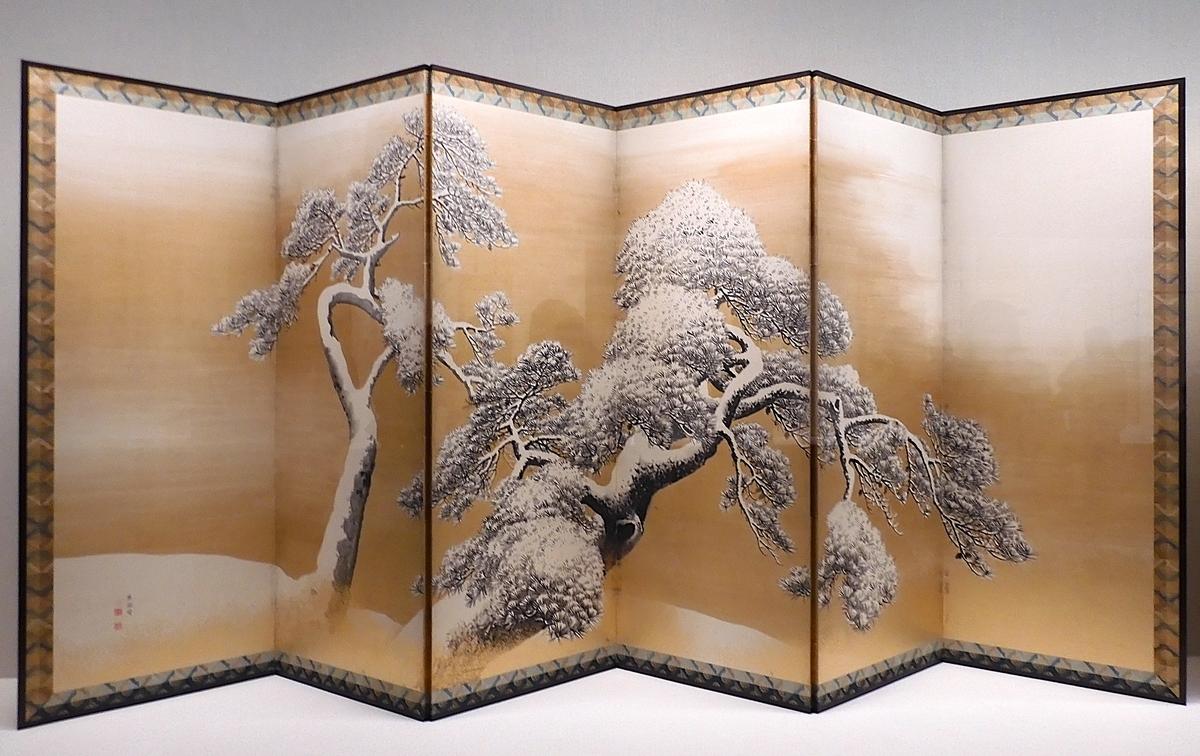
The first image represents one screen of Pine Trees in the Snow (Yukimatsu-zu byōbu), a National Treasure held by the Mitsui Memorial Museum. The original consists of a pair of six-panel screens, each measuring 156.1 by 362.1 centimeters in the museum’s current catalogue. It dates the work to the eighteenth century, without specifying a definitive year.
Look at the white covering the branches: much of the snow is the unpainted paper. The brush defines what surrounds it. Ink gives the needles and branches their weight; powdered gold changes the atmosphere around them. The mokkotsu, or boneless, approach builds form without enclosing it in a rigid drawn outline. The open space between the two screens is essential to the ensemble, suggesting an expanse beyond the visible trees.
The screens were formerly held by the principal Mitsui family, part of a merchant dynasty whose patronage supported Ōkyo. A specific commission is plausible but not established in detail. Evergreen pines also carried associations with endurance and longevity. The work is simultaneously a natural scene and a decorative presence in a human interior.
A high-resolution facsimile of the screens was created through the Tsuzuri Project in 2010–11. The source and circumstances of the photograph reproduced here do not establish whether it shows the original or a reproduction.
Tiger and pine: when a masterpiece has an afterlife
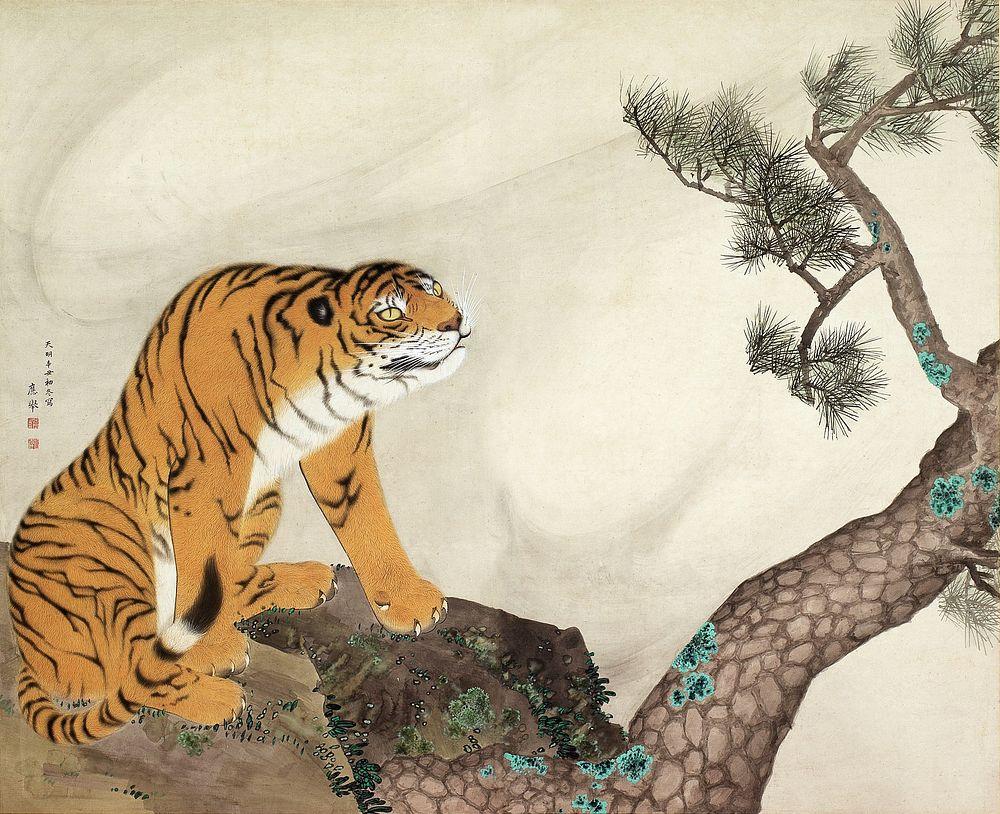
The second image makes an especially useful lesson in attribution. The seated tiger, patterned coat and diagonal pine match the tiger half of Tiger and Dragon at the Detroit Institute of Arts, accession 81.693.1. Its current catalogue dates the work to the nineteenth century and attributes it to an artist working after Maruyama Ōkyo. Older descriptions, including the museum’s own reproduction credit, still give 1781 and Ōkyo’s name. The current object classification is the more appropriate basis for our caption.
This does not diminish the picture’s value as evidence of a tradition. Notice how the tiger’s upward gaze crosses the empty space and how its stripes contrast with the bark of the pine. The pairing of tiger and dragon belongs to an established East Asian pictorial vocabulary. Here the tiger screen can be examined as a transmitted interpretation of Ōkyo’s manner rather than as a securely authenticated autograph work.
For direct evidence of the original artist’s observational practice, the Homma Museum of Art preserves a study of a tiger skin. The artist recorded the coat and pattern using an actual pelt at a time when observing a living tiger in Japan was difficult. A convincing representation of fur could thus coexist with an imperfect understanding of a living animal’s anatomy. Naturalism was an inquiry conducted with the evidence available, not a guarantee that every detail was right.
That distinction also makes the Detroit screen an appropriate companion to the snow pines. One reveals the artist’s mastery; the other reveals how his language could survive him.
Peacock and pine: painting becomes architecture
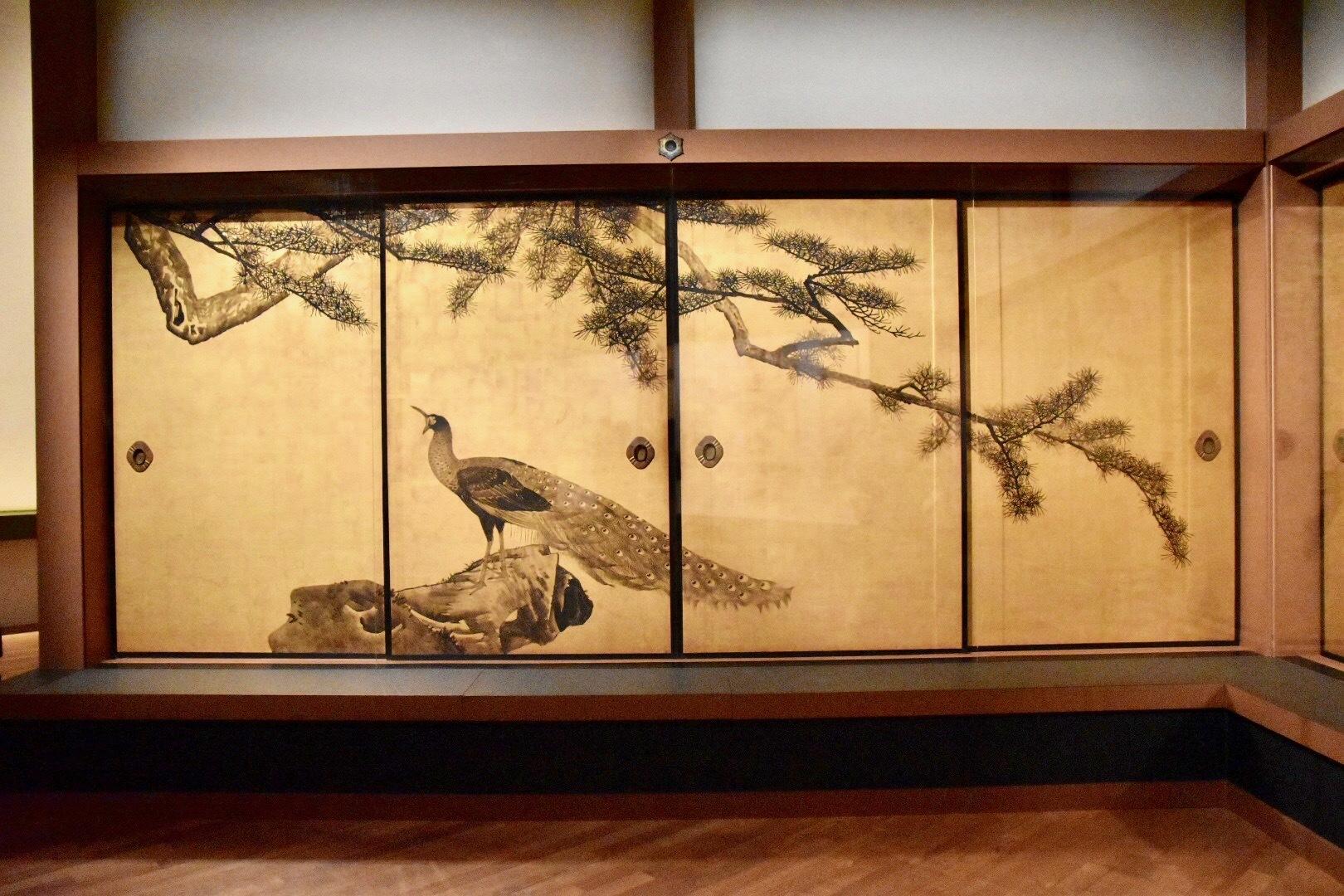
The third photograph depicts the composition of Pine and Peacock at Daijōji, a Buddhist temple in Kami, Hyogo Prefecture. The surviving ensemble is an Important Cultural Property dated 1795. The Tokyo National Research Institute for Cultural Properties records sixteen panels, painted in ink on gold-covered paper. Our photograph shows four of the panels’ composition, not the complete room.
Daijōji’s chronology records the loss of an earlier peacock composition in Kyoto’s great fire of 1788. The surviving work was completed in April of Ōkyo’s final year. Its scale and sophistication reveal an artist still confronting large spatial problems late in life.
The Peacock Room has sliding doors on three sides and opens onto a garden on the fourth. The temple explains that the branches are arranged to retain visual continuity when the doors are moved. Subtle variations in ink against gold suggest the colors of the pine and bird even without a full palette of colored pigments. A visitor experiences the painting differently as distance, illumination and position change.
Preservation now adds another layer to that experience. Daijōji normally keeps the original paintings by Ōkyo in protected storage and displays digital facsimiles in its guest quarters. The date of the photograph here is unknown, so it is not described as a photograph of the original panels.
A school, not simply a signature
A building filled with paintings requires more than individual brilliance. Daijōji’s artistic program involved Ōkyo and painters associated with his circle, including Nagasawa Rosetsu, Goshun and Ōzui. Their assignments demonstrate how a workshop could coordinate large commissions without eliminating the distinct character of each painter.
After Ōkyo’s death in 1795, his methods continued to inform the Kyoto art world. The Maruyama school and the related Shijō tradition associated with Goshun helped shape later painting in Kyoto. These were living artistic lineages rather than a single immutable style.
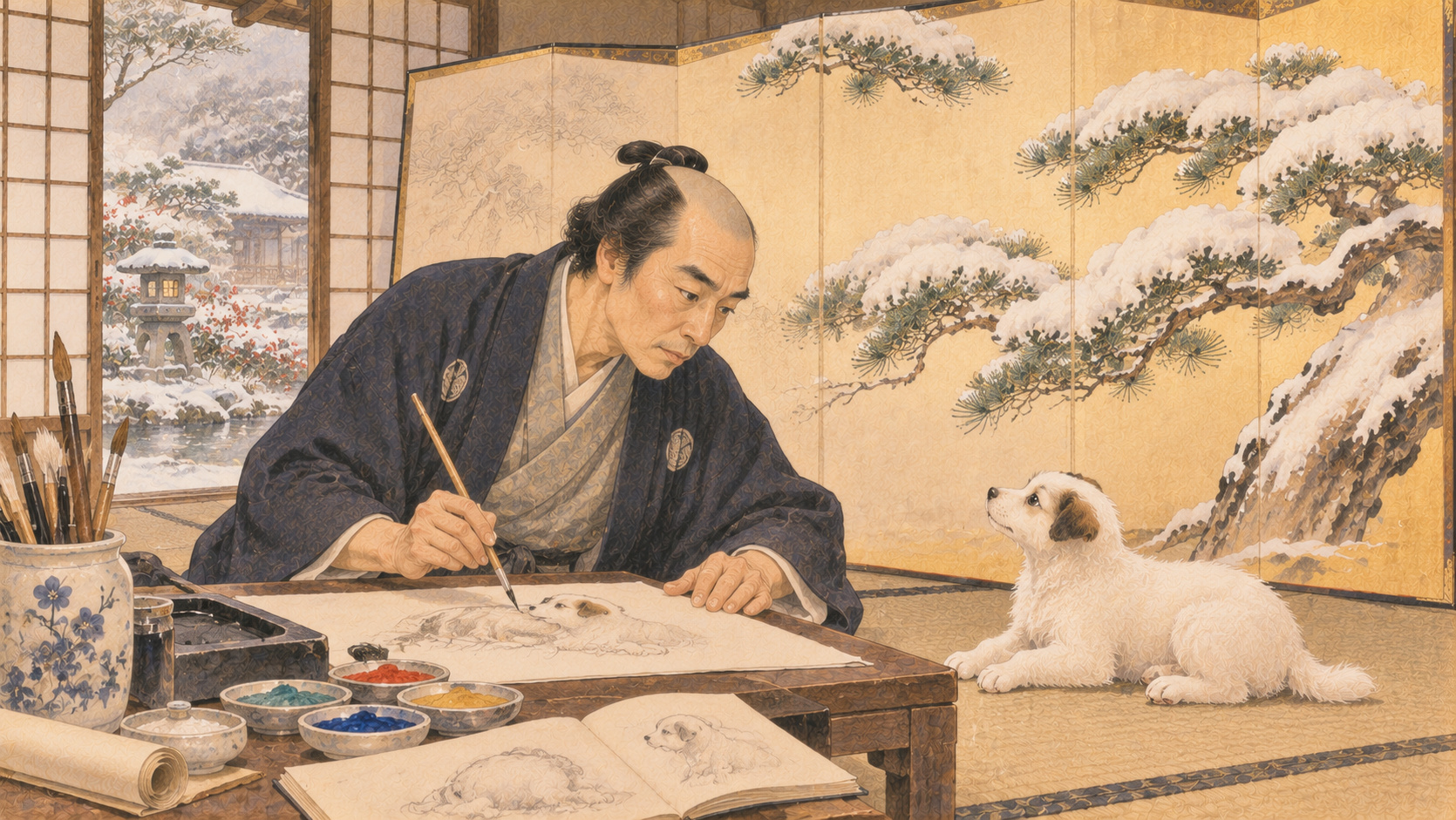
The charm of Ōkyo’s puppy paintings offers a smaller-scale counterpart to the temple rooms. Their appeal depends upon the sensitivity with which weight, fur and proximity are suggested. Whether working on a small animal study or a screen many feet wide, the artist made observation serve the experience of looking.
Looking again in 2026
The Edo-Tokyo Museum’s retrospective, scheduled to begin on November 28, offers an opportunity to revisit Ōkyo’s career. Our separate exhibition report explains the program and visitor information. The tiger illustrated here should not be confused with the different tiger painting listed for that exhibition.
An especially rewarding way to approach these pictures is to alternate between close inspection and a wider view. From nearby, a branch may dissolve into marks of ink. From farther away, its shape becomes convincing, and the unpainted space around it acquires an almost physical character. A sliding door is no longer merely a support for a picture; it becomes a part of the picture’s design.
That approach also informs today’s original JAPAN.co.jp editorial illustrations, which are explicitly distinguished from historical art. Ōkyo’s most enduring lesson is not a particular color scheme or a repertoire of pine trees. It is the discipline of looking carefully, recognizing the limits of the evidence, and allowing a picture to communicate more than the sum of its marks.
Related report: the Ōkyo retrospective in Tokyo · Art Gallery
Sources and further reading
- Shizuoka Prefectural Museum of Art — artist biography
- Daijōji — chronology
- Mitsui Memorial Museum — Pine Trees in the Snow
- Homma Museum of Art — Tiger Skin Study
- Detroit Institute of Arts — Tiger and Dragon: Tiger
- Daijōji — Peacock Room interpretation
- Tokyo National Research Institute for Cultural Properties — Pine and Peacock
- Daijōji — conservation and display
- Official 2026–27 exhibition
- Mitsui Public Relations Committee — the Mitsui family and Ōkyo
- Canon Tsuzuri Project — snow pine screen facsimile