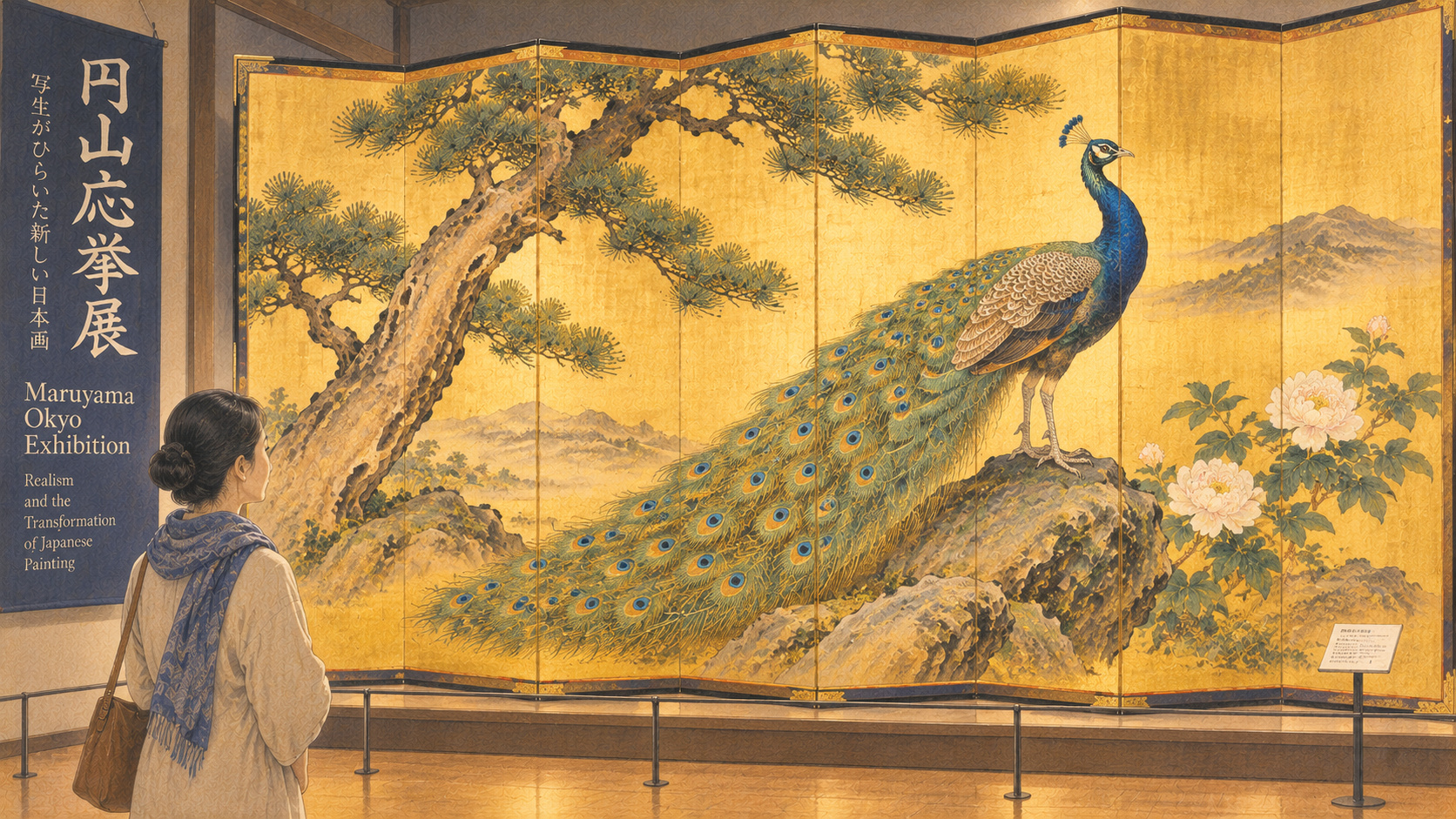
A painting that does not end at its edge
A framed picture usually asks us to look into another world. A painted sliding door in an Edo-period Japanese room does something more complicated: it changes the world in which the viewer is standing. That distinction lies at the heart of a major exhibition of Maruyama Ōkyo, scheduled to open at the Tokyo Metropolitan Edo-Tokyo Museum on November 28.
The exhibition, officially titled Maruyama Ōkyo: Beyond Realism—Spatial Revolution, runs through January 24, 2027. Its organizers released the list of works on November 25. Rather than treating Ōkyo (1733–1795) exclusively as a master of convincing animals and plants, the show follows his development into an artist who could organize an entire architectural interior through painting.
The principal works come from Daijōji, a Buddhist temple in Kami, Hyogo Prefecture. They provide a useful introduction to a Japanese art tradition in which the physical support of a painting is not incidental: doors, walls and folding screens can be part of the artwork's meaning.
An optical experiment in eighteenth-century Kyoto
To understand the ambition of these large compositions, begin with something small. Early in his career, Ōkyo trained under Ishida Yūtei and encountered the pictorial traditions associated with the Kanō school and the Chinese painter Shen Nanpin. He also worked with pictures designed to be viewed through optical devices, known as megane-e.
The Kobe City Museum's Maruyama interior view, scheduled for display from November 28 to December 13, offers an example. Japan's Cultural Heritage Online database attributes the work to Ōkyo rather than certifying its authorship outright. The exhibition also includes an optical viewer during the first display period.
The importance of these objects is not that an Edo painter discovered a single Western technique and abandoned Japanese conventions. Optical pictures encourage a painter to think about the relationship between the viewer's position, the scale of objects and the continuity of apparent space. These problems would remain relevant when Ōkyo moved from intimate pictures to room-sized commissions.
What observation can and cannot tell us
The Japanese term shasei describes drawing from observation. For Ōkyo it became a foundation for constructing persuasive images, not a demand to reproduce everything with equal detail. A brushstroke can suggest the softness of fur, the weight of a branch or the atmosphere between two objects without delineating every contour.
The Tokyo show schedules a 1780 tiger painting from the Sainsbury Centre throughout its run and a 1778 puppy painting from Tsuruga City Museum during the later period. Viewers can compare the treatment of the animals' bodies and surfaces. It would be wrong, however, to assume that every convincing creature was necessarily studied in person. The distinction between observation and artistic reconstruction matters even in the work of a celebrated naturalist.
A separate example is Pine Trees in the Snow, held by the Mitsui Memorial Museum. In its catalogue, the museum describes an approach in which the paper itself supplies the white of the snow. The absence of an outline and the selective use of ink and gold create mass, light and distance. The blank spaces are not unfinished portions of the painting; they are active elements in its spatial design. The work is discussed here as historical context, not as a confirmed loan to the Tokyo exhibition.
Daijōji: when a building becomes a painting
Daijōji is often associated with Ōkyo because of the extraordinary ensemble of paintings made for its interiors. Kami Town records 165 painted surfaces by the master and twelve pupils, designated as an Important Cultural Property. That figure describes the temple's collection, not the number of panels on loan to Tokyo.
A Japanese sliding partition, or fusuma, is both an architectural component and a potential painting surface. A composition must negotiate the vertical joins between panels and the changing views that appear as doors open. A viewer seated on the floor encounters the work from a different angle from someone standing in a modern gallery. These constraints also create possibilities: a branch may lead the eye across a seam, while an unpainted area may suggest space beyond the room.
Among the Tokyo exhibition's announced works are Ōkyo's 1795 Pine and Peacock sliding-door paintings and his 1787 landscape sliding doors, both scheduled throughout the exhibition. A visitor can examine the movement of the composition across the panels and consider how it might have interacted with the proportions of its original room.
There is an important conservation dimension. Daijōji explains that it now stores Ōkyo's original paintings for protection and uses digital reproductions in the reception building. Viewing originals in a museum and seeing reproductions arranged in the temple's architecture are complementary experiences. Neither alone can convey every aspect of the original setting.
The economics of a room-sized artwork
Large-scale painting in eighteenth-century Japan depended on patrons, materials, skilled assistants and careful planning. Prosperous merchants and religious institutions provided commissions that allowed an artist to move beyond individual hanging scrolls. A room of coordinated panels demanded a different organizational skill from a small picture.
Ōkyo's association with the Mitsui family illustrates the connection between commercial wealth and artistic production in Kyoto. The formation of his school also allowed a shared visual language to be applied across large commissions, while individual pupils developed their own approaches.
The chronological structure of the exhibition puts this development in context, from the artist's early experiments through the Meiwa, An'ei, Tenmei and Kansei eras. After Kyoto's major fire of 1788, Ōkyo participated with his school in the decoration of the rebuilt imperial palace. The late Daijōji paintings belong to a career in which the organization of architectural space became an enduring artistic concern.
A reopened museum and a traveling exhibition
The Edo-Tokyo Museum opened in 1993 and closed for major renovation in April 2022. It reopened on March 31, 2026. Its mission includes the interpretation of urban history through material culture and reconstructed environments, a context particularly suited to thinking about paintings as components of lived spaces.
The exhibition will travel to the Osaka City Museum of Fine Arts, where it is scheduled for February 6 to April 4, 2027. The rotations differ between the two venues, so travelers planning a visit around a specific painting should consult the relevant checklist rather than assume that the entire Tokyo selection will be present in Osaka.
Planning a visit—and learning to see space
The Tokyo exhibition has two principal display periods, with additional changes for individual works. Visitors interested in the optical pictures should plan for the early part of the run; those hoping to see the puppy painting should consult the later-period schedule. The special exhibition is not included in the museum's ordinary senior free-admission day arrangements.
For a further comparison, the Mitsui Memorial Museum is planning a separate exhibition centered on the National Treasure Pine Trees in the Snow from December 12 through January 30. That offers a second opportunity to study how an artist can make unpainted paper convey an entire winter landscape.
One practical way to approach the exhibition is to alternate between distance and proximity. First look at how the composition occupies the entire surface; then examine the transitions of ink and pigment and the joins between panels. Finally step back again. The subject of this exhibition is not simply what Ōkyo painted, but how his paintings ask us to occupy the space around them.
| Venue | Tokyo Metropolitan Edo-Tokyo Museum, first-floor special exhibition room, 1-4-1 Yokoami, Sumida |
|---|---|
| Dates | November 28, 2026–January 24, 2027 |
| Display periods | Nov. 28–Dec. 24 / Jan. 2–24 |
| Hours | 9:30–17:30; Saturdays until 19:30; last admission 30 minutes before closing |
| Closures | Mondays except Jan. 4 and 11; Dec. 25–Jan. 1; Jan. 12 |
| Same-day tickets | Adults ¥2,100; age 65+ ¥1,600; university/vocational students ¥1,300; high-school age and younger free |
| Access | JR Ryogoku west exit: 3-minute walk; Oedo Line Ryogoku A3/A4: 1 minute |
Official exhibition website, checklist and ticket information
Explore the JAPAN.co.jp Art Gallery
Primary sources and references
- Edo-Tokyo Museum — exhibition and curatorial outline
- Official exhibition website — November 25 checklist announcement
- Kami Town — designated cultural property at Daijōji
- Daijōji temple — room paintings and display arrangements
- Cultural Heritage Online — Maruyama interior view
- Mitsui Memorial Museum — Pine Trees in the Snow
- Mitsui Memorial Museum — separate winter exhibition
- Edo-Tokyo Museum — reopening and museum history
- Agency for Cultural Affairs — National Treasure designation