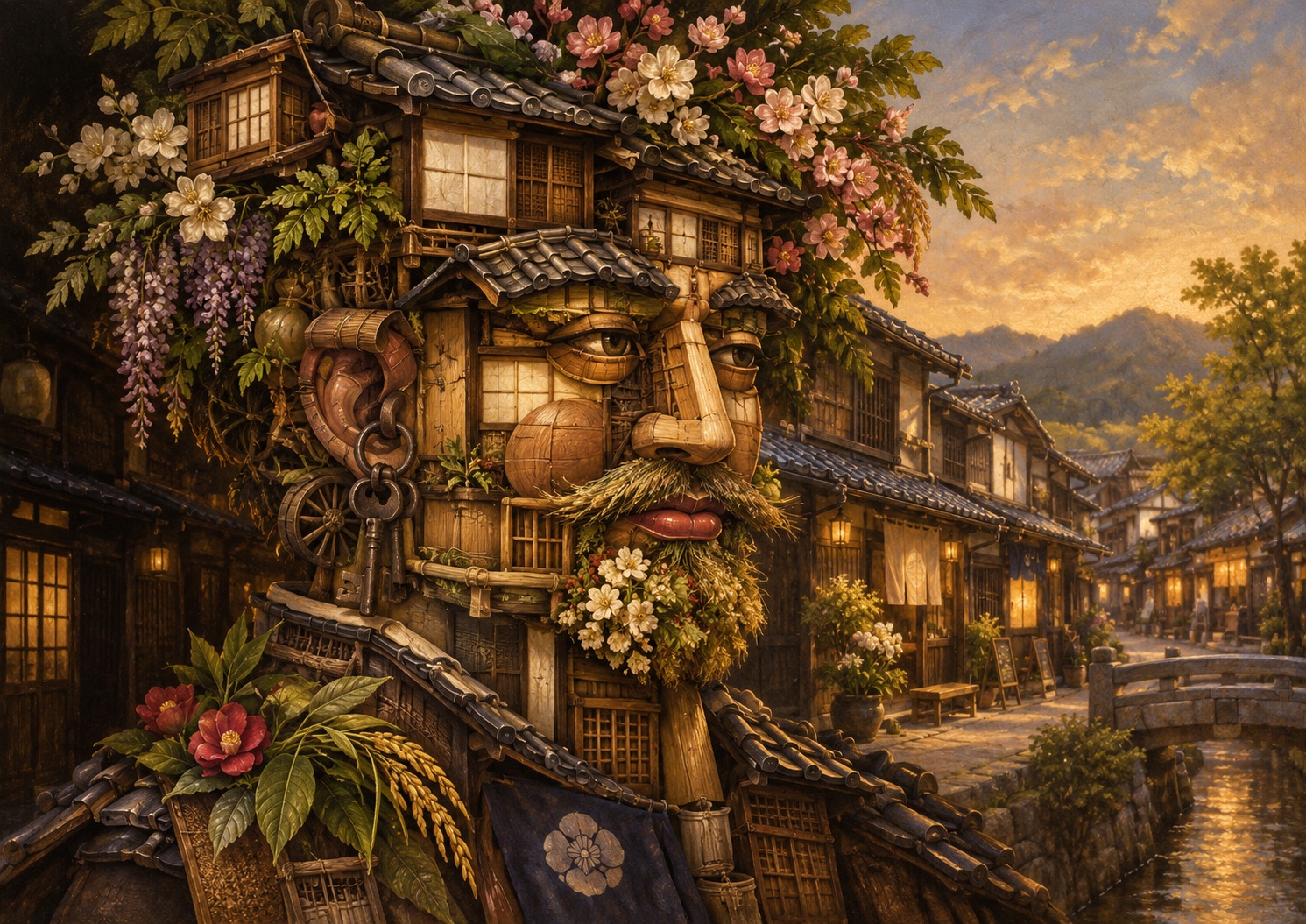
A historic building can survive and still fail to make a town feel alive.
In Makabe, a 17.6-hectare Important Preservation District in Sakuragawa, Ibaraki Prefecture, the city and Japan Post are preparing a small experiment on October 10. The question is not simply whether visitors will enter two registered cultural properties. It is whether one building can make people walk to another — and whether the streets, shops and townscape between them become part of the experience. [1] [2] [3]
The two anchors are the former Makabe Post Office, built in 1927, and the former Kimura residence, dating to 1853 or earlier. At the former post office, visitors will be offered tastings and sales of Makabe Jochu, a distilled product made from sake brewed in the district. At the Kimura residence, bamboo lights will be installed in coordination with the Makabe Machiakari Jūsan-ya Festival. Japan Post and Sakuragawa say they will study visitor response and movement through the district. [1]
The two buildings were already connected by the history of the post
The pairing is not arbitrary. Each building carries a different chapter of Makabe’s postal and commercial history.
The former Kimura residence consists of a misegura storefront and main house built no later than 1853. The Kimura family had operated a sake business in the Edo period and in 1872 opened the Makabe-machi postal handling office there. Sakuragawa says four generations of the family later served as local postmasters. The building itself retains characteristic late-Edo storehouse construction. [6]
The former Makabe Post Office, by contrast, was not built for the postal service. It was constructed in 1927 as the Makabe branch of the Fiftieth Bank. After later changes in use, it served as Makabe Post Office from 1956 to 1986. Sakuragawa describes it as a landmark of the central district and an example of early-Shōwa provincial bank architecture. [4] [5]
Using the pair together therefore creates more than a two-stop heritage route. It traces how communications, finance and commerce moved through different buildings as Makabe modernized.
At the former post office, a local drink becomes the experiment
The October 10 program at the former post office centers on Makabe Jochu. Japan Post says sake from two Makabe breweries — Murai Jōzō and Nishioka Honten — is used by Naorai, whose patented low-temperature distillation process converts the sake into a distilled product while retaining aromatic characteristics. Visitors will be offered tastings, and organizers will survey reaction and sales. [1]
The more interesting question is not simply how many bottles sell. The test links a 1927 landmark with contemporary local production. Can a reason to taste something create a reason to enter the building? Can interest in the building extend outward toward local breweries and other businesses?
Heritage reuse often needs such a second layer. Architecture alone can produce a short visit. Food, drink, retail, exhibitions or workshops can create a reason to stay. But each added use brings operating costs, safety requirements, neighborhood impacts and conservation constraints. The pilot is testing that balance rather than assuming the answer.
At the Kimura residence, the attraction is light rather than retail
The former Kimura residence will use bamboo lighting rather than a product sale. A workshop on October 4 will prepare bamboo harvested in Sakuragawa, drilling patterns and installing lights. The pieces will illuminate the building during the October 10 Makabe Machiakari Jūsan-ya Festival. [1]
The contrast is deliberate. One site asks visitors to taste; the other asks them to look. Organizers can then observe whether those different attractions encourage people to move between buildings and through the intervening streets.
Japan Post says the 2026 festival is the 12th edition, using handmade lanterns and other lights around the Makabe Denshōkan area to encourage evening walking through the townscape. The pilot inserts the two heritage buildings into an event that already has a circulation pattern of its own. [1]
Makabe was already a town built to be read on foot
Makabe’s street pattern took shape in the late Sengoku period under the Makabe clan and is said to have been completed in the early Edo period under the Asano family. Characteristic castle-town intersections survive, and much of the basic road structure has changed remarkably little. [2] [13]
The architecture, however, belongs to many periods. After a major fire in 1837, merchants increasingly built fire-conscious misegura storefronts and storehouses. In the Meiji era, silk production, commerce and banking expanded. Textile merchants lined Ojinya-mae Street, and merchant families built formal gates. The opening of the Tsukuba Railway in the Taishō period brought another layer of development, followed by Western-influenced buildings in the early Shōwa years. [2]
That mixture is precisely what makes Makabe distinctive. It is not a reconstructed Edo street. It is a long-lived urban structure carrying late-Edo, Meiji, Taishō and early-Shōwa buildings on the same street grid.
In 2010, Makabe became Ibaraki’s first Important Preservation District
On June 29, 2010, the national government selected about 17.6 hectares of Makabe as an Important Preservation District for Groups of Traditional Buildings. The Agency for Cultural Affairs classifies it as a zaigōmachi — a market and service town serving a rural region — and notes the survival of both traditional buildings and historic parcel/street patterns. It was the fourth such district in the Kanto region and the first in Ibaraki Prefecture. [2] [3]
Sakuragawa says the surrounding area contains about 100 registered cultural properties. The modern preservation movement accelerated in 1993, when local residents formed a group, commissioned a professional townscape survey and began exhibitions, concerts and public-awareness work. From 1999, the former Makabe municipality used Japan’s registered-cultural-property system aggressively, registering 104 buildings in a short period. [2]
The preservation story therefore began locally before national designation arrived. Residents watched old buildings disappear, then built the surveys and public support that made formal protection possible.
One year after designation, the earthquake hit
The Great East Japan Earthquake struck in March 2011, less than a year after the national designation.
Sakuragawa records damage to more than 90% of Makabe’s traditional buildings and describes the district as one of the most heavily damaged traditional-building districts in Japan. There were no reported injuries in the district, but walls, roofs and structural elements across the townscape required repair. [2]
By September 2014, the city said only about 40% of affected buildings had been completely restored. Some disaster repairs were combined with restoration work intended to recover lost historic appearance as well as structural safety. [2]
That history changes the meaning of “reuse” in 2026. Makabe has already spent enormous effort simply keeping buildings standing. The next challenge is whether those buildings can remain part of economic and social life rather than becoming a collection of expensive shells.
The Hina Festival already proved that opening many doors can move a town
Makabe has an earlier example of heritage generating foot traffic: the Makabe Hina Festival.
The event began in 2003 from a simple local impulse — to welcome people who visited Makabe during the cold season. It started with about 21 participating houses and has grown to more than 100 shops and homes displaying hina dolls. The 2026 event was the 22nd edition. [11] [12]
Its strength is spatial. There is no single giant attraction. Dolls appear in shops, houses and historic buildings across the district, so the visitor has to move through the town to experience the event.
The October pilot is much smaller, but the logic is similar: put different reasons to stop in different buildings and see whether walking between them becomes part of the product.
Another old house is already being used as a test shop
Sakuragawa is also using the registered former Takaku residence as a challenge shop. The program gives people hoping to start a business in the city a temporary place to test retail, services or simple food operations before committing to a permanent opening. [9]
City progress material says one operator in fiscal 2025 used the building three days a week to sell simple food, prepared items and tableware. The same report says follow-up is needed to connect challenge-shop users with permanent openings in Makabe through vacancy information and support programs. [10]
That matters because it shows a broader shift in policy. A preserved building is not merely being opened for a festival weekend. It is being tested as infrastructure for entrepreneurship.
Why is Japan Post helping draft a townscape vision?
On March 24, 2025, Sakuragawa and Japan Post signed an agreement concerning use of the former Makabe Post Office and former Kimura residence, visitor attraction to the preservation district and local economic revitalization. In fiscal 2026, Japan Post received a contract from the city to support formulation of the district’s future vision. [1] [7]
Sakuragawa’s historic-townscape plan says the 2026–2030 program will interview key local players and stakeholders, investigate buildings including vacant properties, identify realistic tourism uses and produce an action plan combining physical improvements with operational measures. [7]
Japan Post says this is its first project in which it has supported the formulation of a preservation-district vision through actual event-based testing as well as interviews and reporting. That is Japan Post’s characterization of its own work; Japan.co.jp has not independently established a nationwide “first.” [1]
The strategic logic is clear enough. Postal networks have long connected residents, businesses and local government. Makabe is testing whether that institutional network can also connect heritage buildings, local producers and visitors.
Makabe Jochu is a test of whether heritage can point beyond itself
The local drink matters because it links the building to a living industry. A visitor who enters the former post office for a tasting is not only consuming the architecture; he or she encounters two active Makabe sake breweries through the product.
Japan Post says it will study reception to the drink as a regional product as well as visitor response to the building. The pilot does not assume that Makabe Jochu will become a permanent flagship product. Its acceptance is one of the things being tested. [1]
This is a useful way to think about heritage economics. A historic building may need another local story inside it — food, craft, agriculture, performance, entrepreneurship — to create a longer chain of value. But if commercialization overwhelms local life, the district can lose the very qualities visitors came to see.
How exactly will “circulation” be measured?
The release says organizers will study visitor reaction and movement through the district, but it does not publish the full methodology. It does not specify whether tracking will rely on surveys, manual counts, location data, dwell time or another method.
Japan.co.jp therefore does not assign a success threshold that the organizers themselves have not announced. The published evaluation themes are visitor response, reaction to Makabe Jochu, circulation between heritage sites and compatibility with existing local life and activity. [1]
- Former Makabe Post Office: Makabe Jochu tasting, response survey and sales
- Former Kimura residence: bamboo-light installation
- Linked event: Makabe Machiakari Jūsan-ya Festival
- Purpose: observe visits, response and movement through the district
- Policy role: evidence for the preservation-district vision
- Still unresolved: permanent uses, long-term operators, revenue model and detailed success metrics
“Use” is not the opposite of “preserve”
Commercial use of heritage can create understandable anxiety: at what point does a protected town become a stage set for visitors? The opposite risk is also real. A building that no longer has a viable use can become financially and physically difficult to maintain.
Sakuragawa’s historic-scenic policy explicitly defines historic character as the combination of physical buildings and the human activities — commerce, festivals, traditions — that continue around them. [8]
Under that logic, use does not automatically undermine preservation. If the use respects the fabric, fits local life and brings people or resources needed for maintenance, it can help make preservation durable.
The difficult word is “if.”
Walk from one post office history to another
The former Kimura residence carries the memory of an 1872 postal handling office. The 1927 former bank building carries the memory of Makabe Post Office from the postwar decades. Walking between them almost accidentally turns into a chronology of local postal history.
Between the two are storehouses, gates, merchant houses, early modern streets, sake businesses, shops and homes where people still live.
Makabe’s next challenge may not be to make every historic building a destination by itself. It may be to make each one a reason to enter the district, then let the town between destinations become the main exhibit.
October 10 is a small test of that proposition.
Buildings alone do not preserve a town. A town survives when people find reasons to enter those buildings, move between them and value the life that remains in the streets around them.
- Japan Post, pilot project using historic buildings to encourage circulation in Makabe, Sept. 16, 2026
- Sakuragawa City, Makabe Important Preservation District for Groups of Traditional Buildings
- Agency for Cultural Affairs, national list of Important Preservation Districts
- Sakuragawa City, former Makabe Post Office
- Agency for Cultural Affairs, registered cultural property database: former Makabe Post Office
- Sakuragawa City, former Kimura residence
- Sakuragawa City, historic-townscape plan and 2026–2030 revitalization vision project
- Sakuragawa City, Historic Scenic Maintenance and Improvement Plan
- Sakuragawa City, challenge shop program at former Takaku residence
- Sakuragawa City progress report on heritage utilization and Japan Post agreement
- Sakuragawa City, 2026 Makabe Hina Festival
- Sakuragawa City, history and concept of Makabe Hina Festival
- Sakuragawa City, Makabe townscape history
- Sakuragawa City, heritage-led town development around hub facilities
