Rust is usually the bill that arrives after iron has done its useful work. It weakens bridges, stains machinery and turns precision surfaces into maintenance problems. In a laboratory at Tohoku University, however, oxidation was not treated as failure. It was recruited as the manufacturing step.
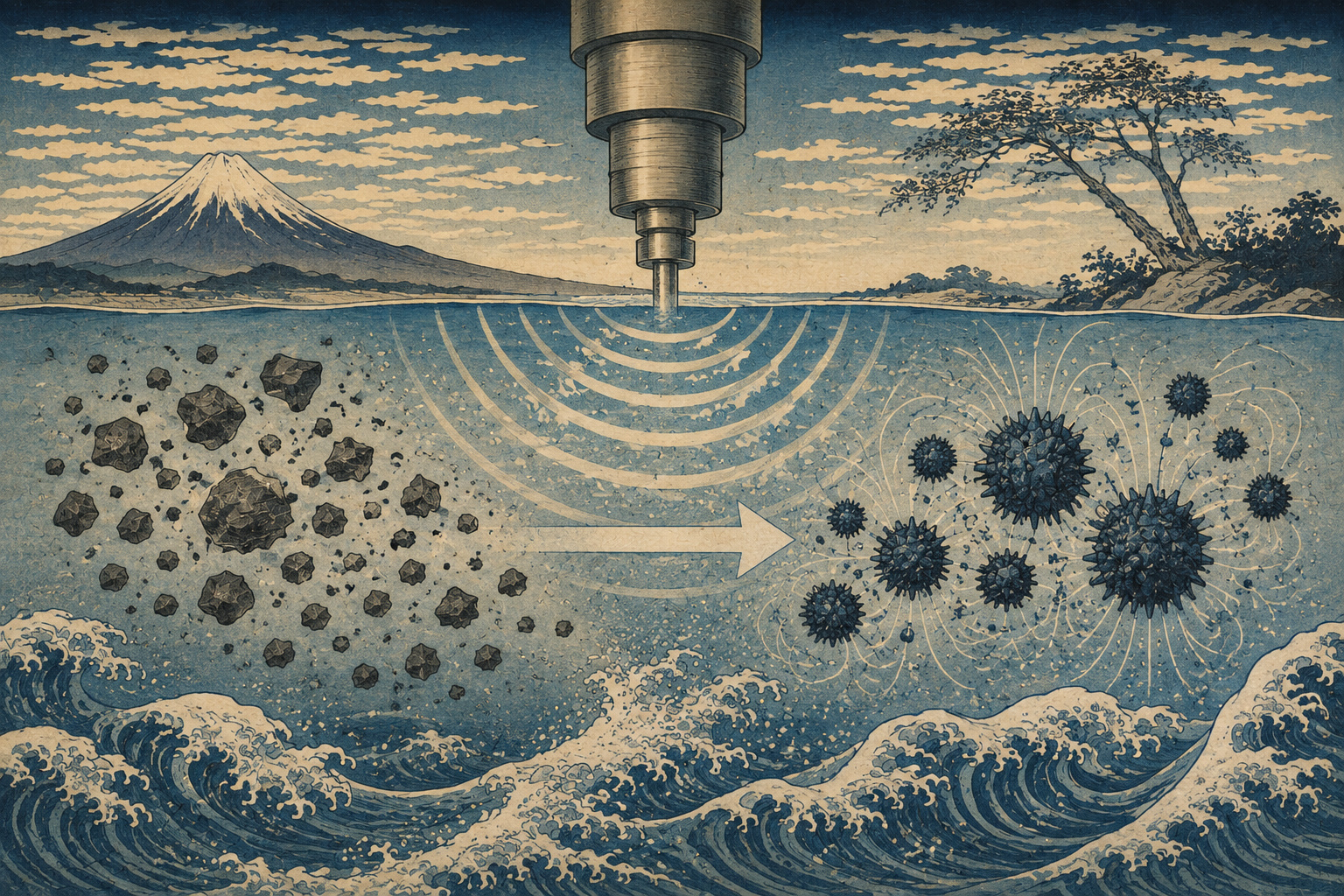
The research team—Associate Professor Yamato Hayashi, Professor Hirotsugu Takizawa and graduate student Madoka Yoshikawa of Tohoku University’s Graduate School of Engineering—started with a notably spare recipe: iron powder and water. Ultrasound supplied the active environment. Under selected conditions, collapsing bubbles continually disturbed the metal-water interface and helped generate nanoscale, magnetic iron oxide in the liquid.
The result matters because conventional iron-oxide nanoparticle synthesis often begins one chemical step later, with soluble iron salts. A widely used coprecipitation route combines ferrous and ferric salts, changes the pH with compounds such as ammonia or sodium hydroxide, and then separates and washes the precipitate. The Tohoku work asks a more elemental question: can bulk metallic iron itself become the chemical feedstock, without first being converted into a soluble salt?
A bubble collapses, and the surface starts again
Ultrasound creates alternating pressure cycles in a liquid. Microscopic cavities form, grow and implode. That event—acoustic cavitation—can produce extremely localized high-temperature and high-pressure conditions. It can also launch microjets and shock waves into nearby solid surfaces. Sonochemistry uses those fleeting events as a reaction environment.
Iron in water tends to acquire an oxide layer. That layer may slow further reaction by shielding the fresh metal beneath it. The mechanism proposed by the Tohoku team is therefore less like gentle mixing and more like repeated surface renewal. Cavitation-generated impacts damage and remove portions of the oxide layer, expose fresh iron, accelerate interfacial chemistry and help detach newly formed particles into the surrounding liquid.
The distinction is important. Ultrasound is not simply shaking a beaker faster. Its chemical and mechanical effects converge at the solid-liquid boundary. The same bubble collapse may create reactive species in the liquid while physically eroding the surface on which oxidation is occurring.
“Reagent-free” is a boundary, not a green certificate
The paper’s title uses the term reagent-free. In this context, it means that the researchers did not add iron salts, alkaline precipitating agents or comparable chemical reagents to make the oxide. Iron powder and water supplied the chemical matter, while ultrasound supplied energy and the reaction field.
That definition is narrower—and more useful—than calling the process “chemical-free.” Water and iron are chemicals. The ultrasound generator consumes electricity. Temperature control, particle recovery, drying and any later surface treatment also carry material and energy costs. A route can eliminate salt-derived ions and washing steps while still using more electricity per kilogram than a competing method.
Tohoku University’s detailed release explicitly places total power consumption, energy per unit of product, recovered mass, material balance, reaction rate, productivity and scale-up among the next measurements. Those omissions are not flaws hidden in the study; they define its present stage. The work demonstrates a reaction concept. It does not yet provide a life-cycle assessment or an industrial process balance.
Four questions behind the word “reagent-free”
- Inputs: How much electricity, heat, cooling, water and atmosphere control are required?
- Yield: What fraction of the starting iron becomes recoverable target material?
- Finishing: How much separation, washing, drying, classification or coating remains necessary?
- Consistency: Can phase composition, size distribution, purity and magnetic behavior be repeated from batch to batch?
The 40°C result
The team dispersed 1.0 gram of iron powder in water and tested ultrasound at 23 or 43 kilohertz while varying temperature and irradiation time. X-ray diffraction, electron microscopy and magnetization measurements were used to evaluate the products.
At 43 kilohertz, 40°C and 24 hours, the reported particles had an average diameter of about 32 nanometers. Their magnetization reached 85.6 emu/g at the maximum applied field. The wording matters: the university’s detailed release does not label that value a saturation magnetization, so it should not be reported as one.
Using an analysis that assumed the stoichiometric composition of Fe3O4, the estimated conversion from iron to spinel-type iron oxide was 36.1% at 30°C, 68.5% at 40°C and 63.7% at 60°C after 24 hours at 43 kilohertz. Average particle size changed little between 40°C and 60°C. Temperature therefore appeared to affect the progress of oxidation more strongly than particle size over that interval.
| Condition | Reported observation | How to read it |
|---|---|---|
| 43 kHz, 30°C, 24 h | Estimated conversion: 36.1% | Calculated by assuming stoichiometric Fe3O4 |
| 43 kHz, 40°C, 24 h | 68.5% estimated conversion; ≈32 nm average diameter; 85.6 emu/g at maximum applied field | Does not establish pure magnetite or a saturation-magnetization value |
| 43 kHz, 60°C, 24 h | Estimated conversion: 63.7%; little average-size change versus 40°C | Conversion did not rise monotonically with temperature |
| Mechanical stirring, 40°C, 72 h | Oxide remained mainly as submicrometer particles attached to iron surfaces | A mechanistic comparison, not an equal-energy process comparison |
A 68.5% estimated conversion is high enough to make the phenomenon difficult to dismiss, but low enough to keep the engineering arithmetic visible. After a full day, a substantial part of the starting iron had not become the assumed target oxide. A commercial assessment would need the actual recovered mass, the fate of unreacted iron, separation losses and the amount of equipment required for a given daily output.
Stirring oxidized iron; ultrasound released nanoparticles
The most revealing control experiment may be the least glamorous. The researchers mechanically stirred iron in water at 40°C for 72 hours. Oxidation still occurred, but the oxide remained mainly as submicrometer particles attached to the iron surface. Under ultrasound, finer nanoparticles formed and were observed detaching into the liquid phase.
That result supports the proposed role of cavitation-driven microjets and shock waves. Ordinary stirring renews the bulk liquid around a particle. Cavitation can attack the passivating layer itself. If that interpretation holds, ultrasound is doing more than increasing mass transfer: it is changing the physical history of the interface and allowing newly formed oxide to leave as a dispersed product.
The comparison does have limits. The stirring run lasted three times longer, and the detailed release does not present a matched energy input. It is evidence about morphology and detachment, not a complete efficiency comparison between an agitator and an ultrasonic reactor.
Two pathways, neither directly watched from beginning to end
The team proposes two routes that may operate together. In the first, iron species dissolve from the metal surface and then nucleate and grow into particles in the liquid. In the second, oxide forms directly on the iron surface and is subsequently detached as fine particles. Hydroxyl radicals and hydrogen peroxide generated in the cavitating liquid may also contribute to oxidation.
This is a mechanistic model, not a frame-by-frame observation. The researchers say that time-resolved measurements of Fe2+, Fe3+, hydroxyl radicals and hydrogen peroxide are needed to quantify dissolution, oxidation, nucleation, growth and detachment. Until that work is done, the relative contribution of each pathway remains unresolved.
That uncertainty is scientifically productive. If particle formation is controlled mainly by dissolved iron species, reactor chemistry and solution conditions may dominate. If surface formation and mechanical detachment dominate, acoustic field geometry, erosion and metal surface state may be more decisive. Scale-up strategies would differ accordingly.
Why the correct name is “spinel-type iron oxide”
Magnetite, Fe3O4, is the familiar magnetic iron oxide. Maghemite, γ-Fe2O3, has a related spinel structure and is also magnetic. The university release deliberately describes the product as spinel-type iron oxide, a category that can include both.
That restraint should survive into news coverage. Assuming Fe3O4 for a conversion calculation is not the same as proving that every particle is pure magnetite. Nanoscale peak broadening and structural similarity can complicate quantitative phase separation by X-ray diffraction. The Fe2+/Fe3+ balance, vacancy structure, residual metal and continuing oxidation can all affect performance.
The distinction matters commercially. A wastewater adsorbent, a catalyst, a magnetic separation medium and a biomedical formulation do not ask the same questions of phase purity, surface chemistry or long-term stability. “Magnetic iron oxide” is an enabling material family, not a single interchangeable commodity.
A century from collapsing cavities to direct metal conversion
The physics underlying the experiment has deep roots. In 1917, Lord Rayleigh published a mathematical treatment of pressure generated during the collapse of a spherical cavity in a liquid. A decade later, William T. Richards and Alfred L. Loomis reported chemical effects of high-frequency sound waves. Those works helped establish the intellectual path from cavitation as a source of erosion and noise to cavitation as a controllable chemical environment.
Iron-oxide nanoparticle history followed a different track. René Massart’s influential 1981 paper described aqueous magnetic liquids prepared from ferrous and ferric salts, part of the coprecipitation lineage that remains central because it is comparatively simple and offers useful control. Much later, ultrasound was often added to salt-based systems to improve mixing, nucleation or precipitation.
The Tohoku group’s research program has pushed toward using the metal itself as the precursor. Its publication record includes room-temperature synthesis of γ-Ga2O3 nanoparticles from gallium metal in 2021 and size-controlled spherical silica from silicon metal in 2024. The 2026 iron-water study extends that direct metal-to-oxide concept to a cheap, abundant and magnetically useful element.
1917: Rayleigh analyzes pressure during spherical-cavity collapse.
1927: Richards and Loomis report chemical effects of high-frequency sound.
1981: Massart publishes an aqueous magnetic-liquid preparation based on iron salts.
2021: Hayashi and colleagues report ultrasound-driven γ-Ga2O3 nanoparticles from gallium metal.
2024: The research line produces size-controlled spherical silica from silicon metal through a sonochemical route.
2026: Iron powder and water yield magnetic spinel-type iron-oxide nanoparticles under acoustic cavitation.
The novelty, then, is not simply “iron oxide made with ultrasound.” Sonochemical iron-oxide syntheses already existed. The sharper claim is that solid elemental iron can serve directly as the starting material in water, with cavitation activating and renewing the interface rather than merely assisting precipitation from dissolved salts.
The attractive future tense: turning scrap into a higher-value material
Tohoku University points to fine iron powder and iron-bearing scrap as possible future feedstocks. The proposition is elegant. Fine metallic waste is often troublesome precisely because its high surface area makes it prone to oxidation. A process that exploits that reactivity could convert a liability into a functional nanomaterial rather than simply returning it to bulk metal production.
But scrap was not the demonstrated feedstock in this study. Real manufacturing waste may contain carbon, chromium, nickel, zinc, lubricants, cutting fluids, abrasives and other contaminants. Those substances could alter cavitation, reaction rate, phase composition, magnetic response and toxicological properties. Pretreatment may erase part of the economic or environmental advantage.
A credible upcycling claim therefore requires more than showing that pure iron powder reacts. It requires feedstock specifications, contaminant tolerance, recovery data, product-grade definitions and a destination for every impurity. The cheapest waste is not always the cheapest qualified raw material.
A material used in medicine is not automatically a medical material
Spinel iron oxides are studied for ferrofluids, adsorption, catalysis, magnetic separation, magnetic resonance imaging and magnetic hyperthermia. That broad application list explains why a simpler synthesis route is interesting. It does not certify the particles produced here for any of those uses.
Biomedical deployment would require control and testing far beyond average diameter and bulk magnetization: surface coating, colloidal stability, aggregation, dissolution, impurity profile, sterility, heating performance, cell toxicity, biodistribution, clearance and manufacturing reproducibility. The Tohoku study is a materials-synthesis paper, not a preclinical or clinical evaluation.
The same caution applies outside medicine. A catalyst must be tested in a defined reaction. An adsorbent needs capacity, selectivity and regeneration data. Magnetic separation requires field-response and cycling tests. A synthesis method creates candidates; applications are earned through separate evidence.
Japan.co.jp analysis: eight tests before calling it an industrial process
- Mass balance: How many grams of recoverable nanoparticles emerge from each gram of iron?
- Throughput: Can a 24-hour batch become a fast or continuous operation?
- Energy: What is the total electrical demand per kilogram, including temperature control and recovery?
- Phase: Can magnetite, maghemite, other oxides and residual metal be quantified?
- Size: Can the full distribution, aggregation state and batch variation be controlled?
- Recovery: Can nanoparticles be separated with low loss and redispersed when needed?
- Feedstock: Can real iron waste meet application-specific purity requirements?
- Benchmark: Does the process outperform coprecipitation or other routes on the same functional basis?
The next result is an accounting result
The university’s own research agenda points to the proper next chapter: recovered nanoparticle mass, material balance, reaction rate, total electricity consumption, energy per unit mass, productivity and scale-up. The mechanism needs time-resolved chemistry; the process needs accounting.
Acoustic frequency alone will not define a larger reactor. Power density, amplitude, horn or transducer geometry, vessel shape, iron concentration, gas atmosphere, heat removal and acoustic shielding can all change where cavitation occurs. A laboratory volume can be filled with active bubbles; an industrial tank can develop dead zones and destructive hot spots. Scale-up may require numbering-up many controlled reactors rather than simply building one enormous sonication vessel.
The study’s most durable contribution may be conceptual. It takes iron’s tendency to oxidize—one of engineering’s most familiar problems—and treats it as a feedstock property. Whether that concept becomes a cleaner factory process will depend on measurements that are less visually dramatic than collapsing bubbles: kilowatt-hours, grams recovered, impurities removed, cycles repeated and specifications met.
For now, the achievement is neither a miracle recipe nor a finished recycling technology. It is a well-defined opening: iron, water and sound can be made to produce a functional nanoscale oxide by directly working the metal-liquid interface. The next test is whether the same idea can survive the arithmetic of manufacturing.
Sources and methodology
- Tohoku University, “Direct synthesis of iron oxide nanoparticles from iron powder and water” (September 1, 2026; Japanese)
- Tohoku University detailed research release (experimental conditions, proposed mechanism and next measurements; Japanese PDF)
- Yoshikawa M., Takizawa H., Hayashi Y., “Reagent-free sonochemical synthesis of iron oxide nanoparticles from iron powder and water promoted by acoustic cavitation,” Ultrasonics Sonochemistry (2026)
- Tohoku University researcher profile: Yamato Hayashi (position, research program and publication record)
- Tohoku University researcher profile: Hirotsugu Takizawa (career and related research)
- Rayleigh, “On the Pressure Developed in a Liquid during the Collapse of a Spherical Cavity,” Philosophical Magazine (1917)
- Richards and Loomis, “The Chemical Effects of High Frequency Sound Waves I. A Preliminary Survey,” Journal of the American Chemical Society (1927)
- Massart, “Preparation of Aqueous Magnetic Liquids in Alkaline and Acidic Media,” IEEE Transactions on Magnetics (1981)
- Takano Y. et al., “Room-temperature synthesis of γ-Ga2O3 nanoparticles from gallium metal via ultrasound irradiation,” Advanced Powder Technology (2021)
- Zushi R. et al., “Facile room temperature synthesis of size-controlled spherical silica from silicon metal via simple sonochemical process,” Ultrasonics Sonochemistry (2024)
The English edition was independently structured rather than translated from the Japanese article. Numerical claims follow Tohoku University’s detailed release. The 85.6 emu/g result is described as magnetization at the maximum applied field, not as saturation magnetization. The product is called spinel-type iron oxide rather than pure magnetite. Scrap use, environmental superiority, scale-up and biomedical readiness are treated as future questions, not demonstrated outcomes.
Image rights: © 2026 Japan.co.jp. This AI-assisted editorial illustration may not be republished or reused without permission. For licensing, use the contact page.