- A dog-shaped pot and a remarkably big question
- What does it mean to call a 600-year-old object cute?
- From a Vietnamese dog to a Spanish glass
- A suburban museum with an international collection
- How gifts built the collection
- The museum building stopped displaying art in 2019
- Why the choice of a library matters
- Kawaii as a question, not a historical verdict
- The proposed future of Machida's craft collections
- A practical guide to visiting
- The small encounter that keeps a collection alive
A dog-shaped pot and a remarkably big question
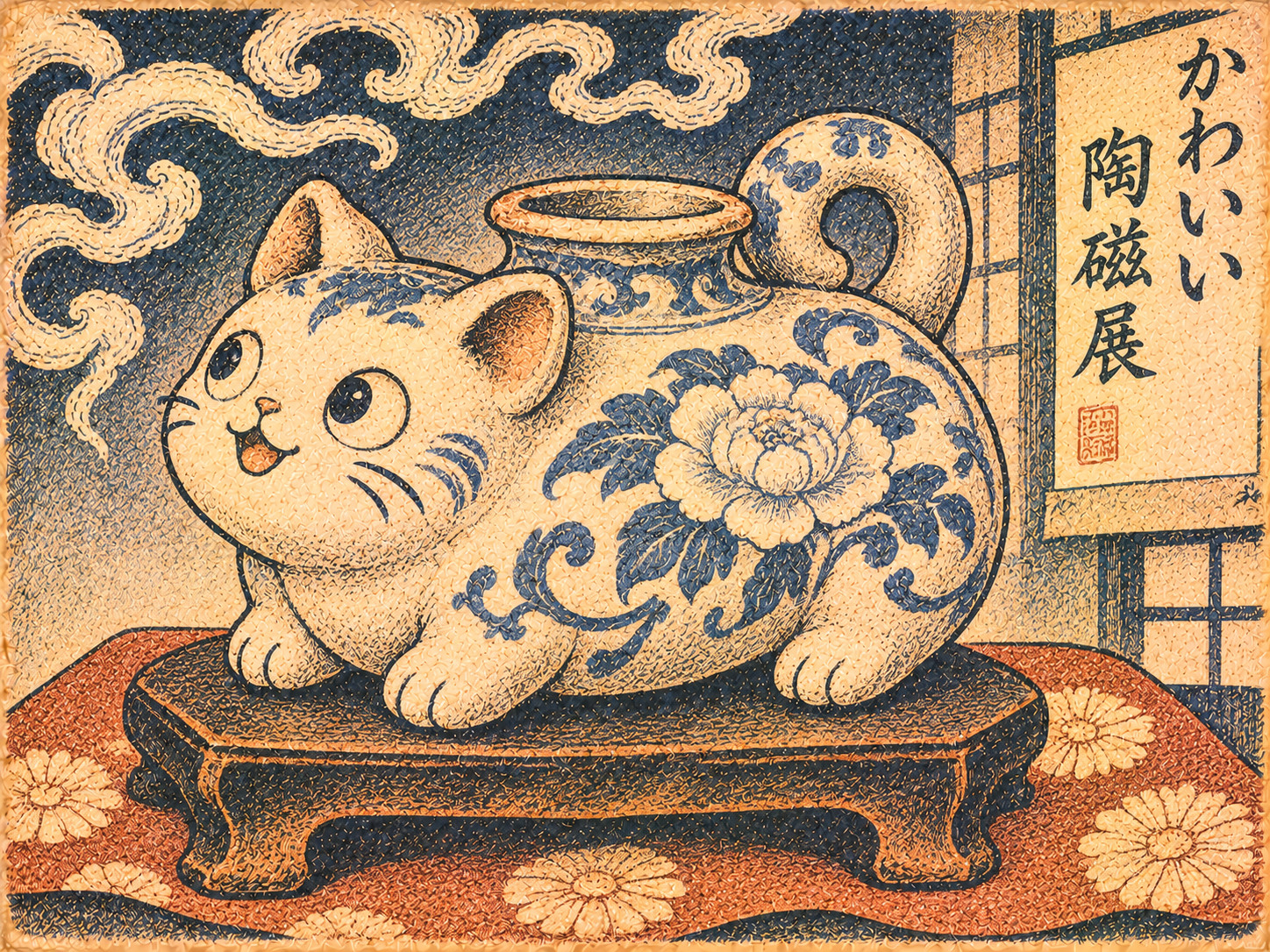
A dog-shaped vessel made in Vietnam during the fourteenth or fifteenth century offers an unexpected invitation to reconsider the history of design. It is not being shown in a glass case in Tokyo. Its image is appearing on an exhibition panel at Machida City Central Library, where an institution without an operating exhibition building is finding another way to make its collection visible.
Machida City Museum's exhibition, —roughly, “All Together! Cute Glass and Ceramics”—opened November 13 and runs through December 6, 2026. The free exhibition presents photographs of approximately 20 collection objects on roughly 40 panels. Its premise sounds simple: a piece of pottery or glass can make a visitor smile. The questions underneath that reaction are much more substantial.
What does it mean to call a 600-year-old object cute?
The city identifies one featured object as a Vietnamese dog-shaped iron-painted container from the fourteenth to fifteenth century. The broad date and attribution come from the organizer's collection label. Publicly available exhibition information does not establish its maker, exact original function or the reaction of the people who first handled it.
Those limits matter. Calling the vessel “cute” is a present-day response, not evidence that its makers used the same category of taste. A shape that today feels whimsical may once have conveyed familiarity, protection, status or something else entirely. Without documentation, none of those explanations should be promoted from possibility to fact. The better starting point is curiosity: why do humans across times and places turn useful things into animals?
From a Vietnamese dog to a Spanish glass
The other object featured by the organizer is an eighteenth-century Spanish tumbler with a coat-of-arms design. It makes an important counterpoint. A ceramic dog communicates largely through its outline; a decorated glass expresses itself through surface ornament, transmitted light and the proportions of a vessel made to hold in the hand.
Visitors should not be promised access to the objects themselves. Photographs offer details that may be easier to study than an object behind glass, but they cannot fully reproduce thickness, weight, translucency or the way light moves through historic glass. The exhibition is best understood as an invitation to the collection, not a substitute for seeing it in person.
A suburban museum with an international collection
Machida City Museum began in 1973 as the Machida Local History Museum. It was renamed in 1976 as its mission widened beyond local history. The city says it began collecting glass art in 1983 and gradually assembled collections embracing Southeast Asian ceramics, European and Chinese glass, traditional Japanese folk paintings and other forms of craft.
This history explains how a municipal museum in the Tokyo metropolitan area came to hold objects created far beyond Japan. A local institution does not have to be parochial. In Machida's case, collecting global craft traditions became part of its distinctive cultural identity—and now allows a small library exhibition to move between Asia and Europe without leaving the city.
How gifts built the collection
The city's published chronology documents important donations: 105 glass works associated with Iwata Kōgei Garasu in 2002, 265 Southeast Asian ceramic works in 2008, and 132 Chinese and Southeast Asian ceramic works in 2013. Those are historical donation figures, not a verified count of current holdings or proof that any particular featured object arrived in one of those transfers.
They nevertheless illuminate what a museum collection really is: the accumulated result of decisions made by collectors, curators, benefactors and a public institution. The path of an old vessel from its place of manufacture to a modern Japanese collection is itself a research question. Collections are not merely inventories; they preserve evidence of exchange, collecting taste and changing attitudes to art.
The museum building stopped displaying art in 2019
The original Machida museum ended exhibitions in its building on June 16, 2019. The city continues to describe its work as collecting, researching, conserving and interpreting glass and ceramics, even as the physical exhibition site remains closed. A museum, in other words, has continued as an institution after losing regular use of its gallery.
A predecessor photo-panel presentation at the central library in December 2025 displayed recent acquisitions. The city also advertises craft workshops, including animal-shaped pottery and glass-related activities in November 2026. These programs cannot replicate an open permanent gallery, but they provide educational access while the future of the institution's exhibition space remains in transition.
Why the choice of a library matters
A central library is an unusual but effective place to encounter a museum object. Visitors may arrive to study, borrow a book, take a child to an activity or simply pass through. An exhibition spread across the fourth and fifth floors can meet people who would not plan a separate museum visit.
Approximately 40 photographic panels for around 20 objects potentially permit multiple views and close-up interpretation. That is a useful curatorial choice, but the number of panels is not the number of artifacts on physical display. The distinction is important for families, tourists and journalists describing the event.
Kawaii as a question, not a historical verdict
The Japanese word has become internationally associated with contemporary popular culture. It would be misleading, however, to treat that modern cultural category as an unchanged universal theory of beauty reaching back centuries. Historic objects acquired meaning through the different societies in which they were designed and used.
Machida's premise works precisely because it does not require an equivalence between those cultures. Visitors can begin with a spontaneous reaction and then ask harder questions about materials, trade, ornament and social context. An object that seems endearing can also be a serious record of expertise and historical circumstance.
The proposed future of Machida's craft collections
Machida City has advanced plans for a proposed International Craft Art Museum connected to the Serigaya Park cultural area. Municipal planning documents have cited an April 2029 opening target, while more recent construction-procurement documents identify related work planned in fiscal 2026. These are planning references, not confirmation of an irrevocable opening date.
A future facility could improve access to collections that have spent years without a permanent public exhibition venue. But the most important measure will not be an architectural rendering: it will be whether the objects become easier to research, teach with and see. The city must balance capital plans with the continuing work of conservation and curatorial interpretation.
A practical guide to visiting
The exhibition is at Machida City Central Library, 3-2-9 Haramachida, Machida, Tokyo, on the fourth- and fifth-floor exhibition areas. It runs November 13–December 6, with November 16 and 30 listed as closure dates. Published regular hours are 10 a.m.–8 p.m. on Tuesdays, Wednesdays and Fridays, and 10 a.m.–5 p.m. on Thursdays, Saturdays and Sundays; visitors should consult the city's official page for holiday variations. Admission is free.
The museum's old building is not the venue. What visitors will see are photographic panels, not the original Vietnamese and Spanish vessels. That makes the visit less about confronting rare objects at close range, and more about beginning an investigation into why forms that crossed oceans and centuries can still strike a stranger as charming.
The small encounter that keeps a collection alive
A museum does not preserve only beautiful things. It preserves contexts, questions and the possibility that future generations will interpret a familiar object differently. The Vietnamese dog-shaped container is an appealing emblem for that mission: modest in scale, separated from its makers by centuries, yet capable of directing attention back toward a broader material history.
At a time when cultural institutions are asked to justify buildings and budgets, Machida's modest exhibition demonstrates another form of public service. It keeps an international collection in conversation with local residents while the museum's next home remains unsettled. A photograph is not the thing itself. But sometimes it is enough to open the door to the history behind it.
Sources and reporting limitations
This independently composed analysis is based on official information published by Machida City through November 16, 2026. It does not claim an on-site visit, interview with curators or examination of the original artifacts. Precise historic uses, makers’ intentions and the future museum’s confirmed opening date remain unresolved.