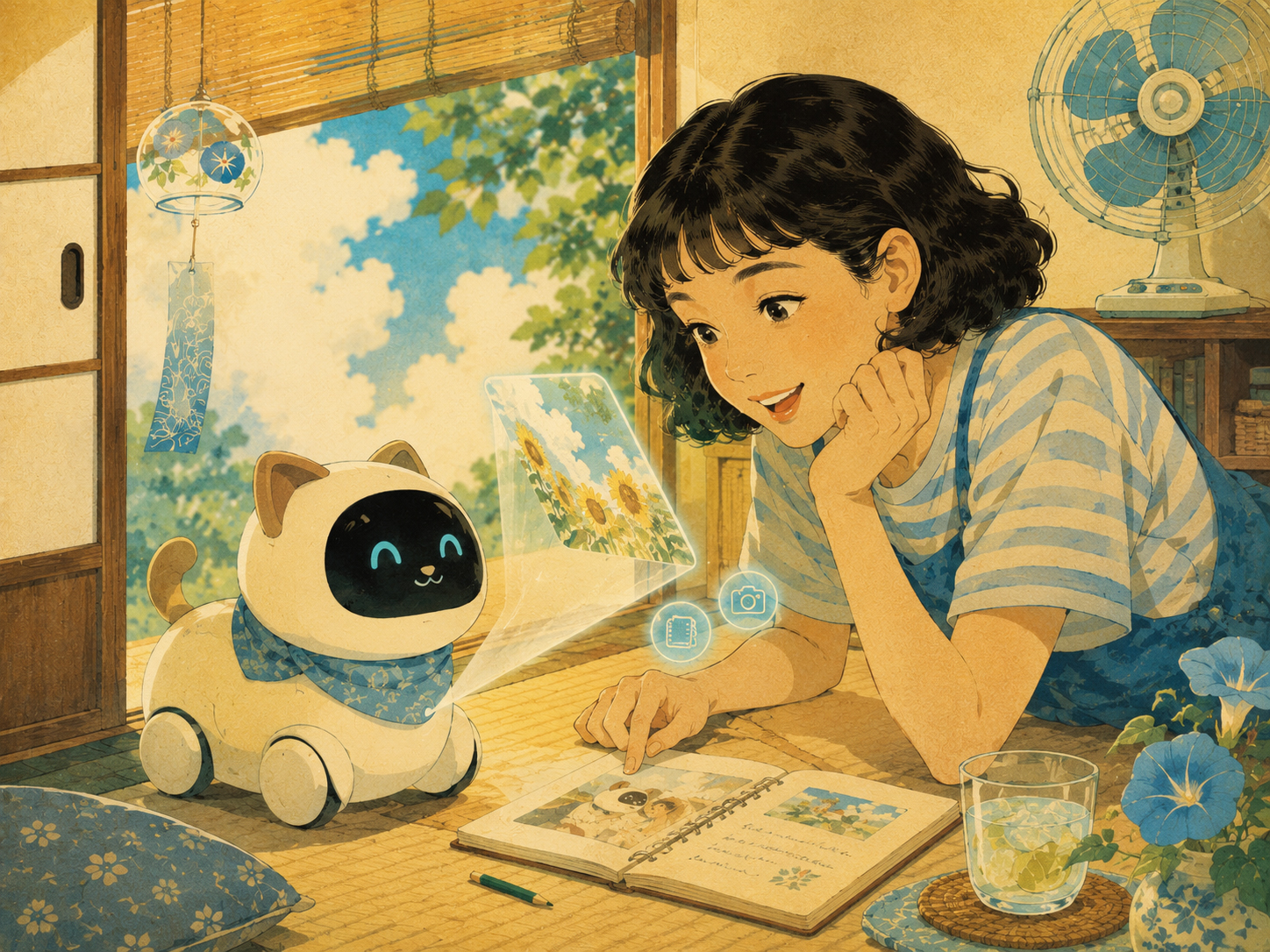
At first glance, the news around the AI pet robot lopeto looks like a cheerful consumer-gadget update: new diary and gallery features, remote care, a richer status system, and a Prime Day campaign. But the deeper story is more interesting. Japan has spent three decades learning how to care for machines, name them, worry about them, mourn them, and let them sit beside the family. Now, generative AI is giving that old emotional-robot tradition a new memory layer.
On July 2, ROPET LIMITED announced that global sales of lopeto had passed 20,000 units and that several new features had been released: Gallery, lopeto Diary, remote-care functions, and a new condition/status system. According to the company, lopeto has been used in more than 50 countries and regions since global shipments began in September 2025. In Japan, SB C&S, a SoftBank Group company, serves as an authorized distributor, with sales through Amazon, Rakuten, Yahoo! Shopping, Bic Camera, Yodobashi Camera, Edion, Robot Planet, and other channels.
What makes the update notable is that the robot’s value is shifting from what it can do to what it can remember. It takes photos. It writes a diary. It can be cared for remotely. It expresses conditions such as energetic, lonely, sleepy, or absent-minded through movements and facial cues. This is not just a toy patch. It is a small consumer signal that companion AI is moving into the realm of household memory.
Twenty thousand is not a toy number
Twenty thousand units would be small in smartphones or game consoles. In household robots, and especially in the still-forming AI pet robot category, it is not trivial. When Sony introduced the first AIBO in 1999, the robotic dog was a symbol of the future. Yet price, durability, pre-cloud AI, and unclear household utility kept robot pets moving between dream and niche for many years.
lopeto’s sales figure suggests that home robots are inching from rare machines toward giftable companions. They are more expensive than toys, more emotional than appliances, and more persistent than most gadgets. For that to work, cuteness is not enough. A robot needs a reason to be touched today, spoken to tomorrow, and remembered next month. This update places that reason in memory and continuity.
From Tamagotchi to AIBO: Japan’s care-machine culture
Japan’s mass-market culture of caring for non-living companions arguably began with Tamagotchi. Released on November 23, 1996, the egg-shaped handheld pet asked users to feed, play with, clean up after, and worry about a digital creature. It was not just a game. It was a responsibility simulator. Bandai’s official history says Tamagotchi became a major fad among high-school girls and has shipped more than 100 million units worldwide as of July 2025.
Three years later, Sony released AIBO. The 1999 ERS-110 was a four-legged autonomous entertainment robot that could learn and express emotion. AIBO placed the phrase “robot pet” in the living room. Owners treated it like a dog, named it, photographed it, repaired it, and in some cases even held funerals when support ended. It proved that humans could form attachments to a machine even when everyone understood it was a machine.
Japan then expanded the emotional robot idea into therapy and care. PARO, the seal-shaped therapeutic robot developed in Japan, became known in hospitals and nursing homes as a device that could stimulate emotional responses similar to animal-assisted therapy. LOVOT, from GROOVE X, placed love rather than usefulness at the center of its design. Warm, soft, eye-contact-driven and huggable, LOVOT helped normalize the idea that a robot may matter because it is lovable.
What lopeto is trying to change
lopeto sits in that lineage. The difference is that it is built for the generative-AI and app-connected age. The central feature in this update, lopeto Diary, uses conversations, photos and daily interactions to create a written diary. The company says the diary expresses not only the day’s events but also lopeto’s own feelings and thoughts, giving users the sensation of reading the diary of a family member living with them.
In human relationships, diaries and photos are not merely archives. They select memory, attach meaning, and lengthen relationships over time. A child’s album, a family trip photo, an old letter, a picture of a pet that has passed away — these objects support present emotion by shaping the past. When an AI pet writes a diary, the robot is stepping into that emotional record-keeping role.
Academic research is already exploring this direction. A 2023 paper proposed an automatic diary generation system that uses shared experiences between humans and robots, including interaction and dialogue history. In the evaluation, diaries containing shared-experience information were selected more highly than diaries without it because they conveyed more cooperation and intimacy between the robot and the human. In other words, a robot’s memory can become relationship language, not just data storage.
Photos, galleries and the household lifelog
The update also adds a Gallery feature. lopeto can preserve everyday scenes such as family gatherings, time with friends, and interactions with pets. The important detail is that these photos are described not only as user memories but also as material that helps lopeto understand the owner’s life.
That is charming, but it is also a serious frontier. Household photos, voices, reactions, touch data and usage time are deeply private forms of data. The company says lopeto can enjoy various functions even without an internet connection, that it is designed with privacy in mind, and that there is no monthly subscription fee. Those details matter. As AI companions enter homes, cuteness will not be enough; data handling, children’s use, consent among family members, and cloud dependence will matter just as much.
The future of home AI may not be a giant screen in the living room. It may be a small plush-like robot at the edge of the sofa, listening to voices, taking photos, writing a diary, and quietly becoming part of the family’s story. A useful AI assistant may answer questions; an AI pet may be easier to invite into a home because people want to care for it.
The psychology of remote care
The remote-care feature is more than app control. When users are away on business trips or travel, they can feed lopeto, check its condition, give it medicine when it has overeaten or caught a cold, and continue monitoring its growth. This is not veterinary medicine. It is a simulation of embodied care.
There is a familiar Japanese emotional pattern here: the Tamagotchi feeling of not wanting to neglect a digital creature. The being is not alive, yet it becomes hard to ignore. It has no biological need, yet people open the app to check on it. Humans do not use technology only for rational utility. Concern, habit, affection, guilt, humor and cuteness all drive repeated use.
For robot businesses, that repetition is everything. ROPET says core users average more than 20 hours of daily operation and more than two hours of interaction time, with a 90-day retention rate of 80–90 percent. These are company-reported figures, not independent measurements, but if they are close to reality, lopeto is becoming less like a novelty toy and more like a device that remains in daily life.
Loneliness, aging and pet-restricted housing
AI pets are gaining attention in Japan not only because they are cute, but because society gives them a job. Japan has more single-person households, a rapidly aging population, small urban apartments, pet-restricted rentals, allergies, long workdays, and families that may want companionship but cannot take on a living animal. Real pets require food, medical care, training, walks, waste management, travel arrangements, aging, and death.
Robot pets remove some of that burden. They do not replace dogs or cats. But for people who cannot keep a pet, the experience of touching something, talking to it, receiving a response, and feeling that something at home is waiting can be meaningful. That emotional middle ground is why PARO found a place in care settings, LOVOT found fans in homes, and AIBO found a second life after its original discontinuation.
The lopeto release quotes users who describe giving it to a mother grieving a deceased dog, or feeling that the robot joins family conversation. Those comments are more important than a spec sheet. The market for home robots is built in those small scenes: a gift, a laugh, a daily greeting, a moment when the household speaks to the robot as if it belongs there.
Japan.co.jp’s view
lopeto is not a Japanese-made robot. ROPET LIMITED is based in Hong Kong, and the company says the product was developed by a Stanford-origin technical team and robotics specialists from around the world. Yet lopeto matters in Japan because Japan already has a culture ready to understand it: Tamagotchi, AIBO, PARO, LOVOT, Hatsune Miku, mascot characters, plush toys, and a long willingness to project feeling onto non-human companions.
In that sense, the lopeto update is both a small product story and a large AI story. Public debate often asks whether AI will take jobs, manage people, transform search, or consume energy. Meanwhile, another kind of AI sits in the living room, writes a diary, saves photographs, and makes a lonely face. The future of technology will not arrive only in data centers. It may also arrive beside the coffee table.
Japan’s robot culture has moved from Astro Boy dreams to factory automation, from AIBO’s robotic dog to PARO’s therapy seal and LOVOT’s warm embrace. lopeto belongs to the next chapter: small, soft, connected, and diary-writing. Cute AI is now trying to enter the household memory.
Reader guide
| Topic | How to read it |
|---|---|
| What happened | lopeto passed 20,000 global sales and added diary, photo/gallery, remote-care and richer status features. |
| Why it matters | The value of home robots is moving from response to memory, continuity and attachment. |
| Japan context | It follows the emotional-machine line from Tamagotchi to AIBO, PARO and LOVOT. |
| Watch point | Diary and photo functions are compelling, but household AI raises privacy, family-consent and cloud-dependence questions. |
| Japan.co.jp view | lopeto is a cute product story — and a small sign that AI is entering family memory. |
Sources and references
This article is based on company releases, official product/history pages, robotics references, and academic research on human-robot companionship.
- PR TIMES / ROPET LIMITED: lopeto 20,000 global sales, July 2026 feature update, Prime Day campaign, sales channels and usage claims.
- PR TIMES / ROPET LIMITED January release: Japan launch details, SB C&S distribution, price, Makuake results and product description.
- Ropet official site: product positioning, emotional-companion language and global sales messaging.
- Sony History / Robotics milestones: 1999 first-generation AIBO autonomous entertainment robot milestone.
- Official Tamagotchi history: 1996 release and global shipment history of the handheld care toy.
- PARO Therapeutic Robot: therapeutic seal robot background and sensor/therapy positioning.
- LOVOT official site: Japan’s warm companion-robot line and emotional robotics positioning.
- Ichikura et al.: automatic diary generation using shared human-robot experiences and LLMs.
- Amazon Japan listing: Japanese retail listing and user-facing product claims.