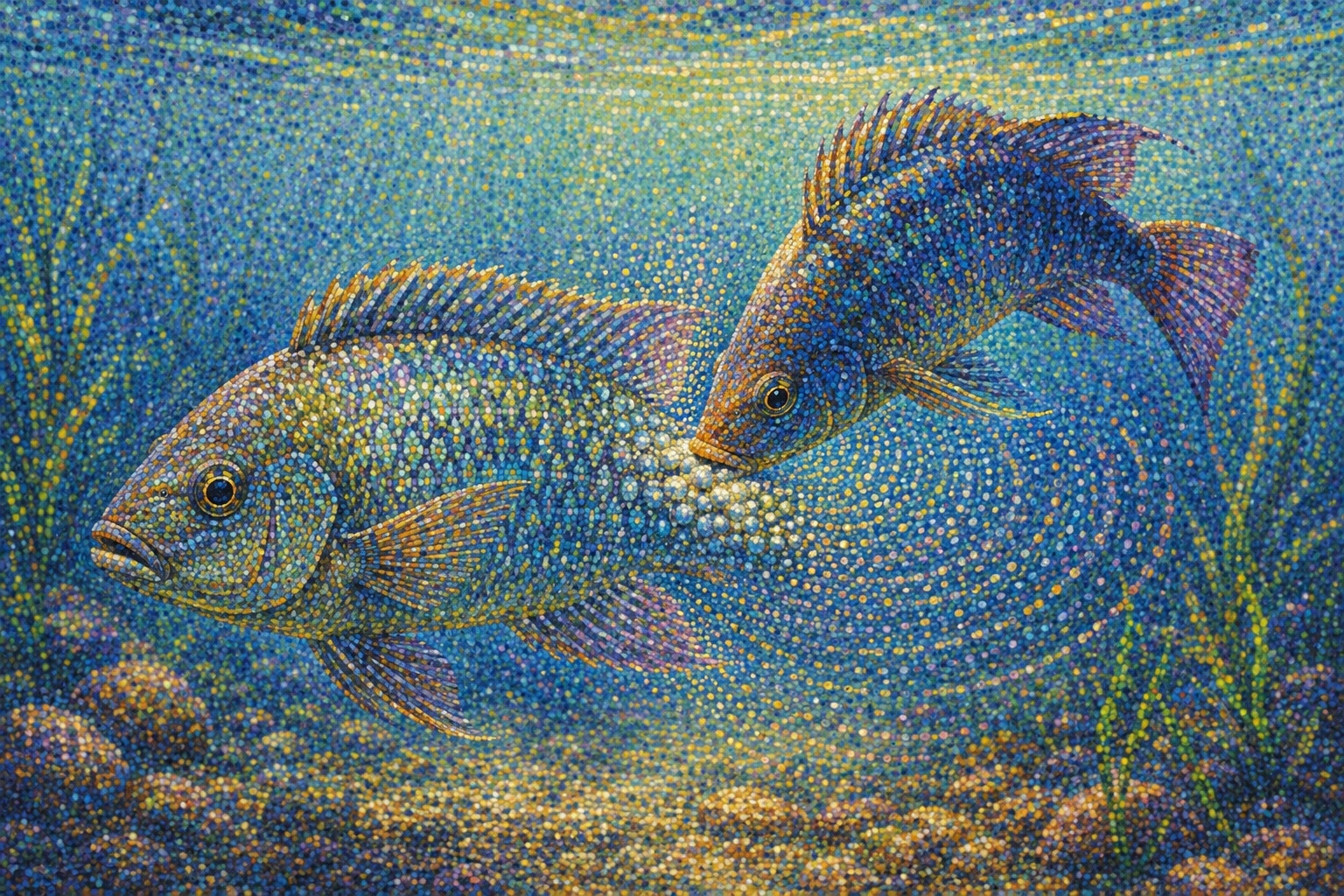
An attack does not begin at the moment of impact. In the clear water of Africa’s Lake Tanganyika, a small cichlid notices another fish. It does not intend to swallow the animal whole. It wants the armor. The hunter closes from behind or from the flank, sets its body into an S-shaped spring, whips its front half to one side and presses a crooked mouth against the victim. With a twist, it tears away a mouthful of scales. The full sequence lasts less than a second.
The scale-eater, Perissodus microlepis, occurs in mirror-image forms. In the terminology used by Hokkaido University neuroethologist Yuichi Takeuchi and his colleagues, a “lefty” has a larger left lower jaw, opens its mouth toward its own right and usually strikes the prey’s left flank. A “righty” reverses all three. The asymmetry is not a decorative quirk. It is tied to the direction in which the fish can bend faster, aim more accurately and remove scales more successfully.
A study by Kai Koike of Hokkaido University’s Faculty of Fisheries Sciences, Matasaburo Fukutomi and Takeuchi, published online in Biology Open on July 20, 2026, moved the clock backward. The question was no longer only, “Which flank gets bitten?” It was, “Where is the predator when it decides to begin?”
The team reanalyzed previously recorded high-speed video of scale-eaters attacking goldfish. Using DeepLabCut, a markerless pose-estimation system, they tracked points on predator and prey frame by frame and converted an encounter into coordinates. Lefties tended to initiate attacks while already on the prey’s left; righties tended to begin on its right. The bias was present before the terminal muscular blow—in the spatial setup of the hunt.
Making a living from scales
Scale eating has a name—lepidophagy—and it has evolved more than once. Fish scales look like poor food: thin, mineralized plates designed to protect the body beneath. Yet they contain collagen and mineral, and they arrive with mucus and tissue attached. The predator need not kill, carry and process an entire fish. Its victim can even regrow the missing covering. The difficulty lies elsewhere. A scale is a shallow target spread across a fast-moving surface; the attacker must make precise contact without becoming predictable enough to be evaded.
Evolution has solved that problem repeatedly. Scale feeding occurs in several unrelated freshwater and marine lineages. South America’s wimple piranha, Catoprion mento, uses a high-speed, open-mouthed ram. Some marine species scrape or nip. Tanganyika’s perissodine cichlids evolved their own equipment: elongated jaws, recurved teeth, rapid body flexion and, in P. microlepis, a mouth that opens sideways.
The species was described by George Albert Boulenger in 1898, but its eccentricity became scientifically powerful only when researchers stopped treating asymmetry as damage or noise. One fish’s mouth appears to bend one way; another bends the other. Each tends to harvest the opposite side of the prey from its counterpart. This natural pairing offered a rare way to watch morphology, perception, movement, learning and natural selection converge on the same left–right axis.
The diet is broader than the image of a specialist on a single victim might suggest. In a 2019 study, researchers identified more than 300 scales from the stomachs of wild P. microlepis and assigned them to 39 prey species. The hunter was an opportunist across the rocky-shore cichlid community. Mouth type and body color did not dictate which species it took. Specialization, in other words, lies mainly in what part of a fish it eats and how it removes it, not in fidelity to one prey species.
An ancient lake built an evolutionary theater
Lake Tanganyika is one of the world’s oldest, deepest and most biologically distinctive lakes: a narrow inland sea roughly 670 kilometers long and as much as 1,470 meters deep. Its age is commonly placed around 9 to 12 million years. Along its shores, rocks, sand, open water and deep-water habitats sit close together. Cichlids repeatedly split into species that scrape algae, crush snails, sift sediment, pluck plankton, pursue fish—or steal scales.
The lake contains about 200 formally recognized cichlid species, with broader estimates around 250, and most occur nowhere else. Their spectacular radiation is not just a parade of colors. It is a diversification of jaws, teeth, sensory systems, courtship and parental care. Closely related species occupy feeding jobs so different that they resemble an evolutionary experiment repeated in dozens of niches.
Phylogenetic work places the scale-eating perissodines within a lineage that moved from more general carnivory toward extreme specialization. That transition matters. A scale-eater could not simply acquire a bent jaw in isolation. Teeth must grip, the body must accelerate and twist, the eye must judge distance, and the brain must choose a favorable side. A feeding niche is assembled from coordinated traits, not bestowed by a single novelty.
Lake Tanganyika also supplies the other half of the experiment: an exceptionally varied audience of prey. A common attack can be learned. A rare one carries surprise. The ecology therefore rewards not only mechanical excellence but strategic diversity—left and right, close and far, rear and side.
The 1993 pendulum that entered textbooks
In 1993, Kyoto University ecologist Michio Hori published one of the best-known studies of animal handedness. By comparing jaw direction, the side from which stomach scales had been taken and the changing proportions of mouth forms in nature, he argued that prey defenses push the population toward a moving balance.
When one morph is common, prey encounter attacks from that direction more often and become better prepared for it. The rarer morph then gains a surprise advantage and leaves more descendants. As its frequency rises, the advantage shifts. This is negative frequency-dependent selection: success depends not on being absolutely “best” but on being uncommon relative to the opponent’s expectations.
Hori’s long field series showed the two forms oscillating around an approximately even split rather than allowing one to eliminate the other. The study became a compact explanation for how diversity can be maintained by natural selection. It also made P. microlepis a textbook animal—the fish whose crooked mouth seemed to expose an evolutionary pendulum.
Later work complicated the inheritance and measurement of the jaw forms, but it did not erase the ecological logic. In 2018, an underwater-cage experiment manipulated the composition of hunting groups. Groups containing both mouth orientations achieved greater attack success than groups composed of only one. Behavioral variety itself can raise the performance of a predator population because prey cannot concentrate defense on a single side.
A left–right naming trap
There is a genuine terminology hazard in this literature. Different research traditions have named a fish by different landmarks: the side with the larger lower-jaw element, the direction the mouth bends or opens, or the flank of the prey that is attacked. Those conventions can assign opposite labels to the same geometry. A “left” fish in a classic or European paper may correspond to what recent Hokkaido papers call a “righty.”
| Convention used here | Lower jaw | Mouth opens | Preferred prey flank | Eye facing the prey |
|---|---|---|---|---|
| Lefty | Left element larger | Toward the fish’s right | Prey’s left | Right eye |
| Righty | Right element larger | Toward the fish’s left | Prey’s right | Left eye |
This article follows Takeuchi’s recent convention because it matches the new study: lefties begin and strike from the prey’s left, righties from its right. When comparing papers, the label alone is unsafe. The reliable translation is to ask three concrete questions: Which lower-jaw side is larger? Which way does the mouth open? Which flank of the prey is attacked?
The distinction is not pedantry. Reversing a label would also reverse the proposed relation among jaw, eye, brain and attack path. The fish itself is consistent; the human vocabulary has not always been.
The 600-millisecond strike, opened frame by frame
Hori’s field evidence connected mouth form with feeding side. A 2012 study by Takeuchi, Hori and Masayuki Oda exposed the mechanics. They filmed 20 scale-eaters at 500 frames per second and obtained 43 attacks clear enough for detailed measurement. A typical encounter lasted about 600 milliseconds and unfolded as a sequence rather than an instantaneous bite.
The fish first dashed toward the prey, then slowed into a stealthier approach. It formed an S-shaped posture, rapidly flexed its front body toward the target and finally twisted and released after mouth contact. Approximate average durations in that analysis were 370 milliseconds for the initial approach, 128 for stealth, 26 for the S posture, 32 for the decisive flexion and 72 for the twist-and-release phase. Most of the time was spent creating the opportunity; the power stroke was measured in tens of milliseconds.
Eighteen of the 20 fish directed more than 80 percent of attacks to one side, and 13 attacked only their preferred side during the trials. On that side, maximum angular velocity and flexion amplitude were greater, and success was higher. Yet escape responses showed that a fish could bend in both directions. The bias was not simple paralysis on the weaker side. It arose upstream, in the neural and mechanical organization of predation.
That finding changed the meaning of the crooked jaw. The mouth did not merely fit one flank after contact; it belonged to a lateralized package. Preferred-side vision, trajectory and body acceleration could deliver the specialized teeth to the target with greater speed.
AI became a coordinate reader, not a mind reader
The 2026 study returned to high-speed recordings with a new analytical tool. DeepLabCut, introduced in 2018, uses deep neural networks and transfer learning to estimate the positions of body landmarks without attaching markers. A human labels representative video frames; the trained system then follows the chosen points across the remaining sequence.
For a fast fish encounter, the advantage is not simply automation. Both animals can be tracked in the same coordinate system. Researchers can define the prey’s midline, calculate the predator’s angle and distance, and ask how those quantities change from approach through body flexion. A behavior that looks like one blur to the eye becomes a path with measurable turning points.
DeepLabCut did not identify a thought, read neural activity or declare that a fish had a conscious plan. It estimated pose. “Planning” is the biological inference drawn from the relation between initial position and later action. The important evidence is that a fish’s handedness predicted where the encounter began, before the final strike could mechanically force the outcome.
The study was also a reanalysis of laboratory video in which scale-eaters attacked goldfish. It was not a new underwater survey of wild attacks in Tanganyika. That reuse is scientifically valuable: improved tracking can extract questions from recordings that were originally collected for a different purpose. But the setting places limits on how directly the result can be carried into a three-dimensional reef full of rocks, shoals, currents and many prey species.
Finding one: handedness was visible at the starting position
When the trajectories were centered on the prey, lefties were more likely to initiate from the prey’s left and righties from its right. Earlier work had established where the bite landed. The new result moves the bias earlier in time—to the choice or emergence of an approach position.
The geometry makes mechanical sense. A lefty opens its mouth toward its right and attacks the prey’s left while keeping its right eye directed at the target. Starting on that favorable side lets the fish aim with the appropriate eye and bend into the stronger direction without a large last-second course correction. Position, gaze, mouth opening and muscular performance align.
That is why the finding is more interesting than a simple reconfirmation of attack side. A final bite could be explained by jaw shape alone. A biased starting location implies that sensory information and movement selection are already organized around the future strike.
It remains an inference about behavior, not evidence of human-like foresight. The experiment did not record brain activity or demonstrate that the fish mentally pictured a route. Nor can this analysis alone fully separate predator choice from the prey’s contribution. Did the hunter move to its favorable side, did the goldfish’s escape produce that relation, or did both animals create it together? Simultaneous tracking narrows the problem; manipulations of prey orientation, vision and motion will be needed to identify cause.
Finding two: stalk from behind or sprint from the side
The researchers classified approaches by the angle at attack initiation. Directly behind the prey was defined as zero degrees. A start within 45 degrees to either side of that axis was a posterior approach; a start beyond that boundary was lateral. The two groups were not merely slow and fast versions of one maneuver. They differed in starting distance, path, body flexion and timing relative to escape.
| Strategy | Approach | Terminal attack | Possible advantage |
|---|---|---|---|
| Posterior approach | Tracks from farther away in or near the prey’s rear blind zone | Closes to shorter range and uses a larger body bend | May reduce early visual detection and preserve a choice of flank |
| Lateral approach | Begins closer and more to the prey’s side | Rushes quickly and strikes from greater range | Shortens preparation and may reach the prey before escape develops |
Posterior approaches began from farther away but reached a shorter strike distance before the predator flexed. Success in this route was associated with the attacker beginning its bend before the prey initiated escape. The lateral route started closer to the side and used a rapid rush, allowing the fish to launch the terminal movement from farther away. Under the experimental conditions, both routes produced high success.
Two tools are useful in an evolutionary contest. If prey become vigilant to a long shadow behind them, a sudden lateral sprint can work. If they react readily to motion in the visual field, a rear approach can exploit a blind zone. One route trades time for concealment; the other trades concealment for speed.
One of the most important questions remains open: Does the same fish switch strategies as geometry changes, or do individuals specialize? If one animal carries both routes, the system demonstrates flexible decision-making layered onto handedness. If individuals specialize, strategy adds another dimension of population diversity. The 2026 authors identify this distinction as a next step.
The mouth-opening eye became the dominant eye
In 2025, Takeuchi’s team reported that the eye on the mouth-opening side acts as a dominant eye: the right eye in a lefty and the left eye in a righty. When looming black discs were presented from either side, each morph responded more sensitively to stimuli seen with that eye. In fish, each laterally positioned eye sends much of its information toward the opposite optic tectum, so an eye preference can connect external geometry to asymmetry in the brain.
The strongest evidence came from experimentally impairing vision in one eye. Weakening the non-dominant eye did not greatly disturb attack direction or success. Weakening the dominant eye reduced preferred-side attacks from more than 90 percent to below 50 percent, roughly halved body-flexion velocity and lowered success. The total number of attacks remained similar. The fish had not simply lost appetite; it had lost precision in its usual aiming system.
The 2026 starting-position result fits that model. A hunter may first move to the side from which its dominant eye can best evaluate posture, distance and the patch of scales it will target. Yet the new experiment did not manipulate vision. “The dominant eye determines approach position” is therefore a compelling hypothesis, not an established causal result.
Earlier work in 2017 had already found associations among behavioral laterality, asymmetry in brain regions including the optic tectum and differences in gene expression between hemispheres. Correlation cannot specify direction. Repeatedly using one eye and one turning direction could remodel neural systems; preexisting neural asymmetry could guide the behavior; or each could amplify the other.
Born crooked, or bent by eating scales?
Hori’s 1993 account proposed a simple genetic model for the two forms. Subsequent evidence replaced the clean “genes or environment” choice with a feedback loop between inherited bias and experience. Young fish show small jaw differences and weak side preferences. In the wild they begin significant scale feeding at roughly 35 to 45 millimeters standard length, and both mouth asymmetry and attack preference strengthen as they grow. Large individuals over 80 millimeters feed almost exclusively on scales.
In a 2022 laboratory study, scale-naive juveniles around four months old showed a weak initial preference. Brief experience improved their ability to take scales on the favored side. Learning was still possible at eight months, but fish deprived of the experience until about 12 months showed little improvement. The result points to a sensitive developmental period in which practice can tune lateralized movement.
Bone is also less fixed than it looks. A 2025 Evolution study compared fish taking ordinary granular feed with fish that had to pull scales from prey. Scale-eating experience enhanced growth and asymmetry of the dentary. Force applied repeatedly in one direction can reshape the feeding apparatus; the reshaped apparatus then makes that same direction more effective. Behavior builds bone, and bone rewards behavior.
The genetic architecture is not a single handedness switch. A 2016 genomic study implicated multiple regions. In 2025, whole-genome sequencing and micro-CT analysis of 102 wild fish associated head asymmetry with 72 genomic regions. Nearby candidates included genes involved in body symmetry, facial development and the nervous system. Genes may provide an initial direction and capacity to respond; experience then magnifies the difference.
The long argument: two morphs or a continuum?
Researchers have also debated whether the population falls cleanly into two mirror-image morphs or spans a continuous range that includes nearly symmetric individuals. A 2010 developmental and genetic study described continuous variation in young fish and stronger bimodality in adults. A larger 2012 measurement study reported a continuous, single-peaked distribution in both juveniles and adults, challenging the iconic two-bin picture.
Measurement helps explain the disagreement. Visual classification of mouth opening, height at the rear of the lower jaw, bone length and three-dimensional shape of the entire skull are not identical traits. Age matters. So does the treatment of weakly asymmetric individuals. Exclude fish near the middle and two categories become crisp; include the complete distribution and the boundary softens.
A 2025 micro-CT study found consistent three-dimensional volume differences in the premaxilla, maxilla and mandible that could distinguish the opposing head groups. But the discovery of 72 associated genomic regions, together with experience-dependent bone remodeling, does not support an organism controlled by only one binary switch. Strongly two-sided behavior can rest on polygenic, quantitatively varying anatomy.
Natural selection does not award points for a human classification. It acts on performance. A slightly asymmetric fish may succeed if it chooses the correct side, aims with its dominant eye and learns a forceful bend. A dramatically crooked jaw is less useful if the animal cannot create a favorable trajectory. The 2026 study adds starting position as another performance variable—one that can connect small anatomical biases to a decisive behavioral outcome.
For the prey, left and right are a prediction problem
The hunter’s skill is mesmerizing, but prey behavior drives the evolutionary exchange. Potential victims watch with lateral eyes, sense water displacement through the lateral line, move in groups, accelerate away and remember damaging encounters. Historical field estimates place wild scale-removal success around 20 percent. The high success observed in a controlled tank should not be read as the hunter’s ordinary yield in the lake.
A posterior approach can exploit a visual blind zone, but its longer duration may give the lateral line or nearby shoal mates time to detect the pursuer. A lateral attack is short and fast, yet it occurs within the visual field. The two routes may represent alternative answers to the same trade-off: remain unnoticed, or allow too little time for escape.
A population split between left and right prevents prey from practicing only one defense. If posterior and lateral strategies are also mixed within each type, prediction becomes harder still. Diversity is not merely preserved in the predator population; it becomes one of the population’s weapons.
The analogy to left-handed athletes is tempting: a rare angle can be difficult for opponents accustomed to the majority. But in the lake the consequences are not a lost point. They are hunger for the predator, injury for the prey and, over generations, altered frequencies of bodies, eyes and behaviors.
Future studies need to measure the opponent as carefully as the hunter—the side bearing old wounds, eye orientation, escape onset, previous attack experience and the behavior of the shoal. A predator trajectory shows which route unfolded. It cannot by itself explain everything that made that route effective.
What this study shows—and what it does not
Three results are central. First, the scale-eater’s handedness was related to its initial position around the prey: lefties tended to begin on the prey’s left, righties on the right. Second, trajectories separated into posterior and lateral approaches with different distances and timing. Third, both strategies achieved high predation success under the experimental conditions.
The study does not show that fish consciously plan in the human sense. DeepLabCut did not read brains or intention. It tracked selected body points in video. “Strategy” describes a repeatable relationship among position, route and outcome, not an inner monologue.
The footage came from laboratory encounters with goldfish, not from free-ranging cichlids among Lake Tanganyika’s three-dimensional rocks, currents, shoals and diverse prey. Experimental success is not wild success. The analysis also does not yet determine whether an individual changes routes, whether dominant-eye vision causes the initial-position bias, or how much of the pattern comes from jaw mechanics, earlier learning and the prey’s own motion.
- Give the same individual repeated rear and side opportunities to test strategy switching.
- Manipulate prey orientation, speed, visual field, shoal context and prior attack experience.
- Synchronize activity from the two eyes and optic tectum with freely swimming, three-dimensional trajectories.
- Track attacks on multiple prey species in the lake to test whether the laboratory classification survives in nature.
- Follow genotype, juvenile experience, adult skeletal form, starting position and attack success in the same fish through development.
The step before the bite carries the history of evolution
A crooked mouth described more than a century ago became, in 1993, an emblem of frequency-dependent selection. In 2012, high-speed cameras opened a 600-millisecond strike into its component movements. Brain asymmetry followed in 2017; a juvenile learning window in 2022; dominant-eye experiments, skeletal plasticity and 72 genomic regions in 2025. In 2026, AI-assisted reanalysis located the left–right bias still earlier, in where an attack begins.
Together, those findings say that handedness is not only a property of the final moving part. One eye, a coordinate relative to the prey, an approach route, a prepared bend, a crooked jaw, early experience and rarity within the population all contribute to one strike. Laterality is a system connecting sensation, choice, execution and consequence.
The scale-eater is a small thief, but it is not simple. It can stalk a blind zone from afar or rush a flank from nearby. Before committing, it places itself where its mouth, eye and body work best. Prey learn the pattern; predators retain the opposite side and perhaps another route. Left and right in Tanganyika are not fixed marks on a map. They are a battlefield redrawn by prediction.
The most important result is therefore not merely that a lefty bites left. Successful action is assembled before its visible climax. By measuring the step before the bite, researchers have begun to trace one continuous path from anatomy and brain to learning, behavior and evolution.
Primary sources and further reading
This report centers on the 2026 paper and Hokkaido University material, then checks the finding against the 1993 frequency-dependent-selection study; research on phylogeny, diet and genetics; the 2012 kinematic analysis; and work on development, brain laterality, dominant vision, plasticity and three-dimensional anatomy. Because left/right names reverse across parts of the literature, prey flank, jaw side and mouth-opening direction are stated explicitly.
- Koike, Fukutomi & Takeuchi, “Prey Capture Strategies Relate to Prey Position in the Scale-Eating Cichlid Perissodus microlepis,” Biology Open (2026)
- Hokkaido University, “Lefty Fish Initiate Attacks from the Prey’s Left” (2026)
- Hokkaido University detailed release with methods, figures and terminology (2026)
- Hori, “Frequency-Dependent Natural Selection in the Handedness of Scale-Eating Cichlid Fish,” Science (1993)
- Takeuchi, Hori & Oda, “Lateralized Kinematics of Predation Behavior,” PLOS ONE (2012)
- Takeuchi et al., dominant eye-dependent lateralized behavior, Scientific Reports (2025)
- Takeuchi et al., experience-dependent learning of behavioral laterality (2022)
- Takeuchi et al., acquisition of lateralized predation behavior and mouth asymmetry (2016)
- Marubayashi et al., “Phenotypic Plasticity Drives the Development of Laterality,” Evolution (2025)
- Tian, Li & Meyer, genetic basis of bilateral head asymmetry, Science Advances (2025)
- Tian et al., bilateral craniofacial asymmetry and attack kinematics (2025)
- Indermaur et al., “Mouth Dimorphism Advances Individual Fitness,” Evolution (2018)
- Stewart & Albertson, evolution and genetics of the predatory feeding apparatus, BMC Biology (2010)
- Raffini et al., genomic basis of left–right asymmetry, Molecular Ecology (2016)
- Lee et al., asymmetrical neuroanatomy and gene expression, Genome Biology and Evolution (2017)
- Kovac et al., the diverse prey spectrum of Perissodus microlepis (2019)
- Takahashi et al., evolution of feeding specialization in Tanganyikan scale-eaters (2007)
- Mathis et al., DeepLabCut markerless pose estimation, Nature Neuroscience (2018)
- Raffini & Meyer, development and adaptive significance of head asymmetry (2019)
- Takahashi, adaptive radiation of Lake Tanganyika cichlids (2011)
- Janovetz, functional morphology of scale feeding in Catoprion mento (2005)