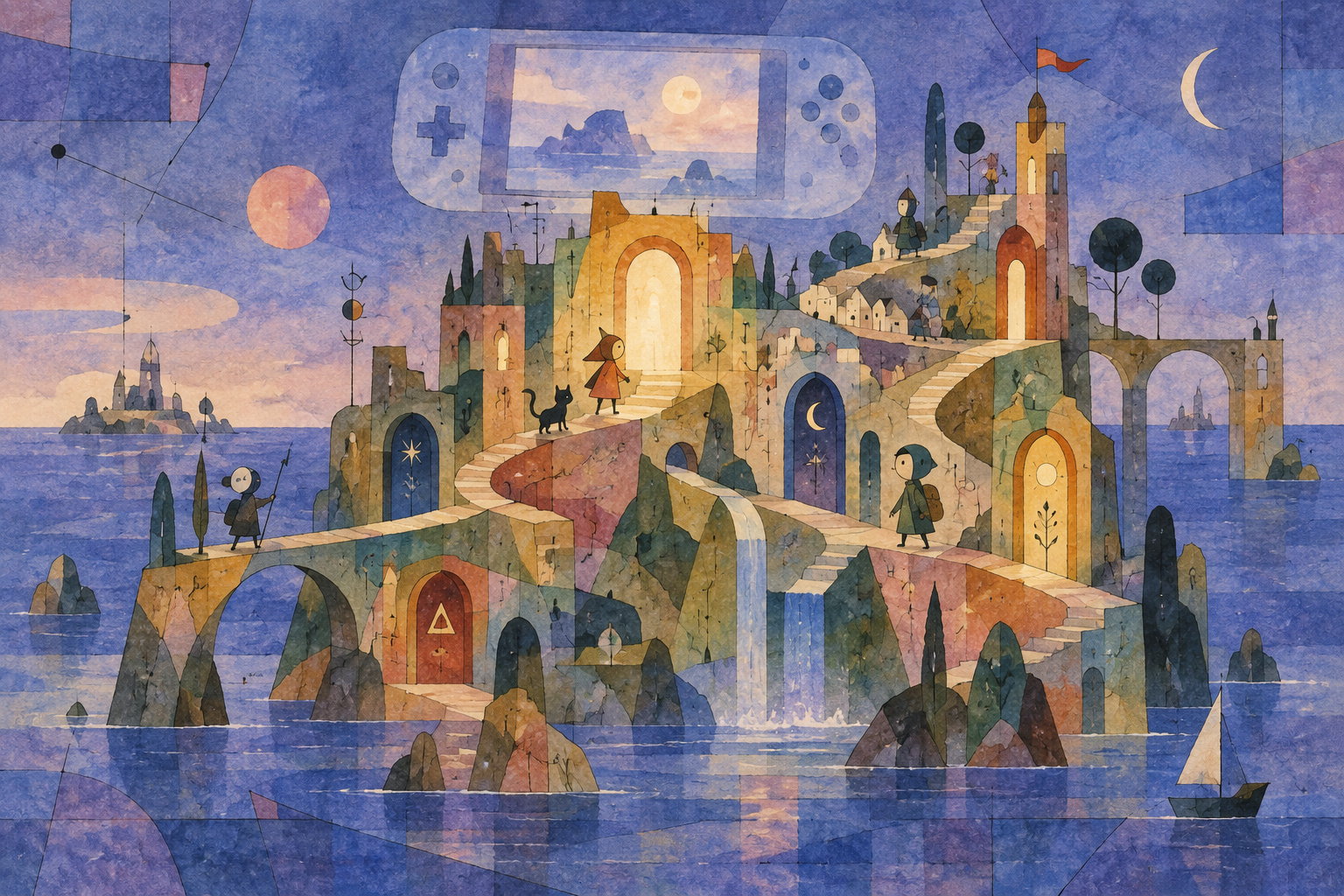
A game can ask for attention without asking for speed. A face changes, a reply becomes available, and a reader must decide what to say before knowing everything that the other person means. That is the territory entered by Le Mirage Mystique, the Nintendo Switch romance adventure released in Japan on September 17. Publisher Broccoli confirmed the launch and the availability of a playable demo that day.[1]
Its arrival offers a useful way into Japan’s tradition of games built around reading and relationships. The question is not simply whether a game has a good story. It is what happens when the reader must act inside that story. This article examines the published design and its historical context; it is not a review based on completing the game.
An invitation with a boundary around it
The official introduction begins in early summer 1917. Aria, a girl living in the capital of a republic, receives an unexpected invitation to the celebrated resort island of Mirage. Anticipation precedes the discovery that something troubling awaits her.[3] The world description places the island apart from a surrounding world at war. This is the game’s fictional setting, not a travel destination or a claim of documentary historical accuracy.[4]
Two details in the publisher’s glossary sharpen the premise. Mirage contains both an affluent new district and an older urban quarter. During a three-week festival beginning at the summer solstice, currents prevent departure from the island.[5] Beauty can draw a visitor in; an inability to leave changes the meaning of that invitation.
As a narrative device, the bounded island makes proximity consequential. Meeting someone again may be unavoidable, while learning more about that person may alter the apparent meaning of an earlier conversation. That is an interpretation of the announced premise, not a disclosure of the plot’s eventual solution. A useful starting question for players is how the promise of refuge affects their willingness to trust.
Making reading an action
The publisher describes a text adventure branching into five character routes. Choices affect relationships and subsequent developments. Live2D supplies animated character expressions, while reading aids include a backlog, chapter selection, skipping previously read material and quick saving and loading.[6]
Branching alone does not guarantee meaningful participation. What matters is whether a decision changes the reader’s understanding as well as the direction of travel. A choice might make a conversation intimate, awkward or newly suspicious. The test for a finished work is whether those consequences feel earned. A list of features cannot answer that question.
There is also a less conspicuous design problem: memory. A reader of a printed novel can turn back to an earlier exchange. A game must provide a practical way to recover that context. Tools for revisiting passages can therefore support interpretation, not merely convenience. They make it possible to compare what a person said with what the player now knows.
This helps explain why a reading game deserves to be discussed in terms of its interface as well as its script. How easily can someone recover a missed sentence? Does returning to a passage interrupt concentration? Those are questions to bring to the demo, rather than qualities to assume from the promotional description.
The work around the words
The production credits separate character design, scenario writing, direction and music. Character design and original artwork are credited to およ; the main scenario is credited to いちの恵理 of かずら本舗. These Japanese credit forms are retained here to avoid inventing romanized professional names.[2] A text-led work still depends on several forms of authorship meeting on one screen.
In the official music commentary, composer 和田俊輔 describes trying to convey the anticipation and small sense of adventure associated with an unfamiliar town. Opening-theme artist あみゅり connects “Paradise” with dangerous affection and secrets beneath beauty. These are the creators’ stated intentions, not our assessment of their execution.[7]
They suggest a productive way to pay attention. Rather than treating music as decoration, a player can ask what emotional expectation it establishes before a line is read. An expression and a sentence may reinforce each other, or leave a small uncertainty between them. Visual storytelling lives partly in that gap: the audience is invited to interpret, rather than simply receive information.
A longer history of listening and choosing
Nintendo’s Famicom Detective Club provides one historical reference point. Its original games appeared for the Family Computer Disk System in 1988–89; Switch versions followed in May 2021. Nintendo describes progression through commands for movement, questioning and investigation, with notes available to check gathered information.[8] Reading and deciding what to investigate were already central to this form of console play decades before the current release.
A different landmark arrived on September 23, 1994: Angelique. Koei Tecmo’s official anniversary account identifies it as Ruby Party’s first game and places it within the history of romance games made for women.[9] It supplies a relevant historical anchor for the audience and relationship-centered tradition in which a brand such as LicoBiTs operates.
These examples should not be collapsed into a single formula. Investigating a mystery and pursuing a relationship organize attention differently. Nor do they establish that the creators of Le Mirage Mystique borrowed directly from either work. Their value here is comparative: both show that understanding people can be an active task in a game, even when the player is not navigating an action sequence.
The historical continuity is therefore a question of design possibilities. A conversation can conceal evidence, invite sympathy or require commitment. New presentation tools may change how that conversation looks, while the underlying challenge remains: persuading a player that paying closer attention will matter.
Continued production is not a sales forecast
LicoBiTs is the women-oriented game brand established by Broccoli and TIS Creation. Its catalogue includes 泡沫のユークロニア, released in April 2024, and UN:LOGICAL, released in January 2026. The brand identifies Le Mirage Mystique as its third project.[10] That is concrete evidence of continued production in this area.
It does not establish a national boom, the preferences of all Japanese players or the commercial success of the new title. Release activity and measured demand are different kinds of evidence. Keeping that distinction clear leaves room for a more interesting cultural question: what kinds of attention are developers still willing to build a whole game around?
Here, the answer offered by the design is attention to individuals: their words, expressions and possible motives. Whether the resulting experience rewards that attention is something players and subsequent criticism will have to judge. The announcement alone cannot do that work.
Before beginning the journey
The official Japanese product listing gives the following specifications. The price refers to the standard edition, not a retailer’s merchandise bundle.[2]
| Item | Product information |
|---|---|
| Japanese title reading | ル ミラージュ ミスティーク |
| Japan release | September 17, 2026 |
| Platforms / players | Nintendo Switch and Nintendo Switch Lite / one player |
| Standard edition | ¥8,580 including tax, physical or download |
| Age rating | CERO C: ages 15 and over |
| Production / publisher | TIS Creation / Broccoli |
The demo runs through chapter two of the common route, and the publisher says its save data can transfer to the full game.[1] It offers a practical way to assess reading comfort and the opening’s pace. Trying it also helps distinguish attraction to the premise from enjoyment of the act of playing. Neither experience, however, establishes the quality of every later route.
A launch-day notice announced version 1.0.1, described as correcting minor bugs, and asked players to update.[11] Checking the official notice before starting is a useful part of preparing the software, especially for anyone planning to play away from an internet connection.
The invitation to Mirage is ultimately an invitation to look again: at a line remembered imperfectly, a face that seems different after a revelation, or the expectation behind one’s own answer. That is a modest but demanding proposition for a game. Its promise rests on making the reader’s attention feel like participation.
- LicoBiTs: September 17 launch and demo
- LicoBiTs: product specifications
- LicoBiTs: story introduction
- LicoBiTs: fictional setting
- LicoBiTs: fictional-world glossary
- LicoBiTs: game systems
- LicoBiTs: music and creator comments
- Nintendo: Famicom Detective Club
- Koei Tecmo Games: Angelique’s 25th anniversary
- LicoBiTs: brand and release catalogue
- LicoBiTs: version 1.0.1 update
Based on official materials checked through September 17. Interpretation and historical comparisons are Japan.co.jp analysis.