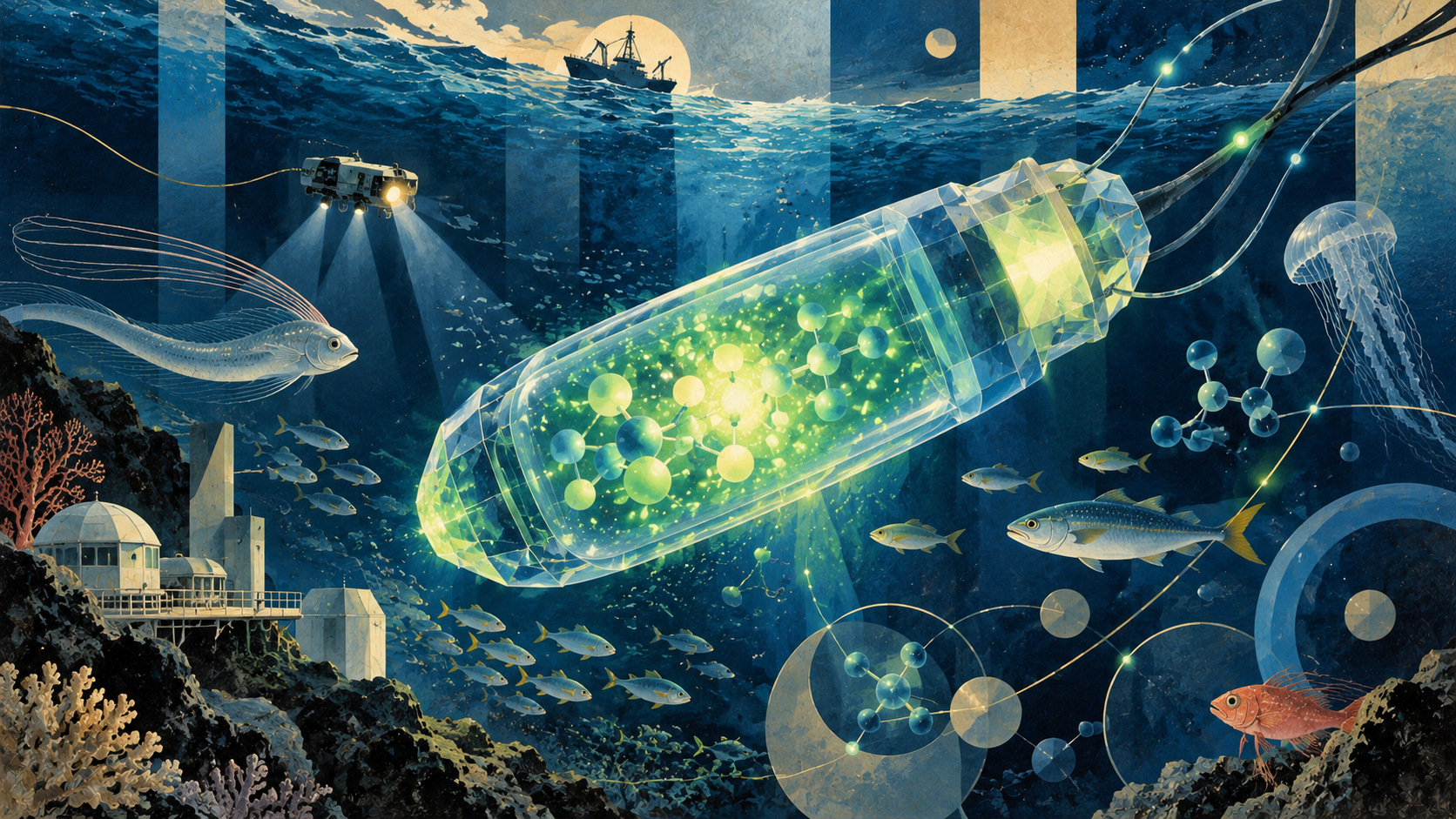
An ocean of pressure, translated into light
The ocean does not need to be particularly deep before pressure becomes an invisible force that reshapes the conditions for chemistry and life. Engineers can measure it with conventional instruments. The harder question is how to read the pressure experienced in a tiny, watery region, on scales where a mechanical gauge cannot readily be placed.
Researchers working across Kyushu University, Institute of Science Tokyo and other Japanese institutions have developed a fluorescent nanosensor whose response can be tuned by changing the stiffness of its surrounding polymer membrane. It is a materials-science advance with intriguing possible uses in marine biology and microscopic experiments, not a report that scientists have deployed a working sensor on the seafloor.
The capsule is the invention
The team starts with a polyion complex vesicle, commonly called a PICsome: a tiny capsule made from oppositely charged polymers. It is modified with pyrene, a fluorescent organic molecule. The resulting sensor is called Pyr-PICsome.
Rather than simply changing the dye, the researchers alter the membrane’s cross-linking, and therefore its mechanical stiffness. That adjustment changes how the encapsulated pyrene responds when hydrostatic pressure increases. The key engineering idea is to program optical behavior through a material’s mechanical design.
Two forms of fluorescence carry the message
Pyrene can emit light as individual molecules and as an excited pair, called an excimer, when molecules interact closely. Pressure can shift that balance. By comparing the intensities of two emission signals, researchers can obtain a ratiometric measurement that is less dependent on absolute brightness alone.
The pressure response depends on the membrane. Softer capsules facilitate strong changes in the intensity ratio, while stiffer ones display useful differences in fluorescence lifetime—the interval between excitation and emission. The same general nanocapsule platform can thus be optimized for different optical measurement approaches.
What the 0.1–50 MPa result means
The researchers report high sensitivity for soft-membrane capsules across a measured range from 0.1 to 50 megapascals. One megapascal is roughly ten atmospheres, so that scale reaches pressures associated with depths of thousands of meters of seawater.
That correspondence is a useful sense of scale, not evidence of a successful deployment at a particular depth. Pressure sensitivity in controlled experiments is not the same as depth rating, measurement accuracy, or long-term performance in a changing marine environment. The study establishes the optical response of a material platform under laboratory conditions.
A clock hidden in the glow
A fluorescence lifetime measurement relies not only on how much light arrives but on how long the excited state persists. According to the paper, the pyrene excimer signal has a lifetime of roughly 55–75 nanoseconds, longer than typical biological autofluorescence. In principle, detectors can use such timing differences to reduce background interference.
That makes the stiffer membranes attractive for fluorescence lifetime imaging microscopy, or FLIM. But a promising lifetime signature and a functioning microscope system are distinct achievements, especially when the experiment requires high pressure and specialized ultraviolet optics.
An international laboratory effort based in Japan
The study includes Gaku Fukuhara of Kyushu University’s Institute for Materials Chemistry and Engineering, Hayato L. Mizuno and Yasutaka Anraku of Institute of Science Tokyo, and Yuki Akagi of Tokyo University of Agriculture and Technology, together with other coauthors. The research appears in ACS Applied Nano Materials under the title “A Programmable Nanovesicle Platform for Megapascal Pressure Sensing.”
The paper went online August 15, 2026, and appeared in the September 11 issue. Kyushu University presented the research in an October 5 announcement, with an institute posting dated October 9. These dates describe a previously published scientific result, not a new undersea expedition in October.
A long history of measuring the sea
Oceanographers have relied on pressure readings to estimate depth, understand currents and describe water-column conditions. Such measurements ordinarily involve calibrated equipment capable of operating in salt water and, often, under severe physical constraints. A laboratory fluorescence sensor does not replace those instruments merely because it responds in the same pressure range.
Its promise lies elsewhere: conventional probes can be too large, intrusive or poorly suited to local measurements in microscale aqueous environments. A dispersed optical reporter might eventually help answer questions inaccessible to bulk instruments.
Why pressure is a biological question
Deep-sea organisms exist where high hydrostatic pressure can influence molecular conformations, membrane behavior and reaction rates. Researchers studying pressure-adapted life would benefit from finer-scale probes that could reveal how a local environment changes. Similar questions arise in controlled high-pressure microbiology and biochemistry experiments.
The published work does not report pressure measurements inside a deep-sea animal. Nor does it demonstrate a newly discovered biological mechanism. Marine and biological applications are credible motivations that still require experimental validation.
The medical possibility needs separate proof
A water-compatible nanocapsule that registers pressure changes might someday become useful in studying microscopic environments in living tissue. The language of that possibility should be precise: hydrostatic pressure is not interchangeable with tissue stiffness, shear stress or the many other forces that matter in physiology.
The sensor’s optical properties alone do not establish safety for human use, delivery to target tissue, biological clearance or clinical value. Any biomedical application would need independent toxicology, compatibility and imaging-system studies.
The limit stated plainly in the paper
The original article includes an unusually important constraint. Its authors say that a demonstration of real-time microscopy under high pressure was not feasible with their available instrumentation. Pressure monitoring relies on deep-ultraviolet excitation at about 300 nanometers and specialized detection optics that cannot easily be combined with a high-pressure chamber in an ordinary fluorescence microscope.
This does not invalidate the laboratory pressure-response measurements. It does, however, set a firm boundary for headlines: the scientists built and characterized a pressure-responsive nanomaterial; they did not show continuous microscopic pressure maps inside living tissue, or a deep-sea camera that can already use the sensor.
From promising fluorescence to dependable instruments
A future instrument would have to handle far more than a bright signal. Calibration under changing temperature and salinity, chemical stability, signal drift, accurate time resolution, and compatibility with actual samples all matter. Researchers would also need to package the illumination and detectors into a system that performs reliably in a real observation environment.
Commercial and operational relevance therefore remain open questions. The study offers two different design routes—greater intensity-ratio sensitivity with softer membranes and distinctive lifetime response with stiffer ones—rather than a finished product with a quoted market launch date.
The bigger story is about making hidden physics visible
A molecular probe can turn something that cannot be seen directly into a signal a scientist can measure. What is striking here is that the sensor’s response can be modified not simply by replacing the optical molecule, but by engineering the nanoscale structure that surrounds it.
From Fukuoka, that deceptively simple idea points toward a larger ambition: tools that can interrogate the watery microenvironments where chemistry and life respond to pressure. The researchers have not yet mapped those environments in the wild. They have designed a new way of asking the question.
Sources & Research Notes
Based on the peer-reviewed paper and Kyushu University releases. No successful deep-sea deployment or live high-pressure tissue imaging was reported, and researchers were not independently interviewed.