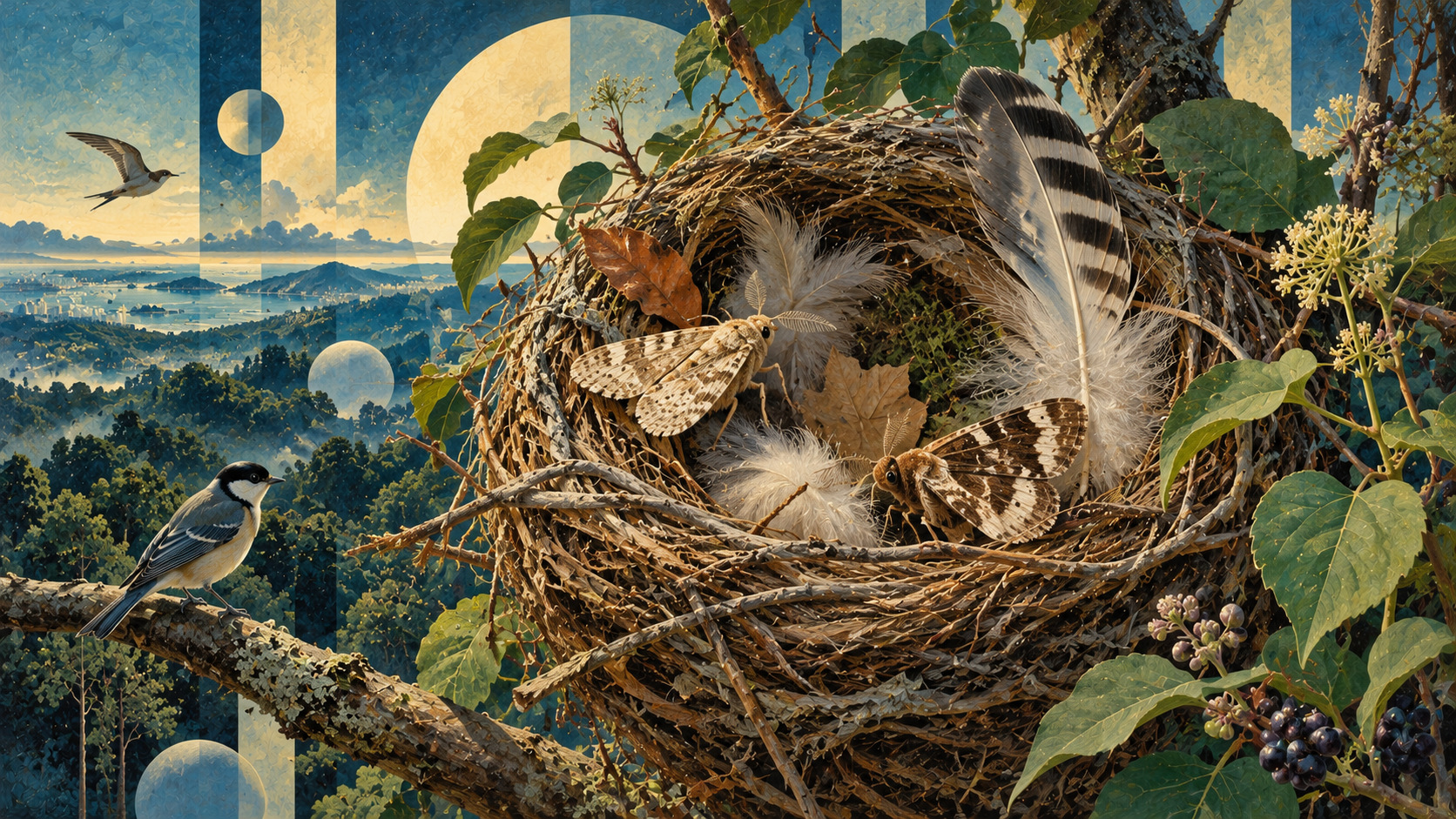
A bird nest produced moths—and an ecological puzzle
The mystery began with tiny moths emerging from bird nests on Japanese islands. Were these insects somehow adapted to nesting birds? Were their young eating feathers, twigs, or other material gathered by the birds? The specimens had long raised questions about their identity and life history.
Researchers led by Kyushu University have now identified two different insects and traced their larvae to the flowers of introduced plants. One moth is newly described to science; the other was already known elsewhere but is newly confirmed in Japan. The birds, unexpectedly, may have been accidental transporters rather than essential hosts.
Two moths, two different kinds of discovery
The team formally named Gisilia ryukyuensis, known in Japanese as minami-kobukazariba, as a new species. A second moth, Ithome lassula, was identified as a first national record and given the Japanese name ginnemu-kobukazariba. The research is also the first record of the genus Ithome in Japan.
A new species and a new country record are not equivalent. The former adds a scientifically described species; the latter adds a place to the known geographic distribution of a previously identified organism. Calling both moths newly evolved, or both newly discovered species, would overstate the paper.
The islands and the old evidence
The small moths had been collected from nests of birds including Lidth’s jays and shrikes in the Nansei Islands. Yet their precise classification, their caterpillars’ food and the reason the insects emerged from nests were uncertain.
The researchers returned to museum and university collections, carried out fieldwork in the Ryukyu and Ogasawara islands, examined physical characteristics and used DNA sequence comparisons. Specimens preserved years earlier became a starting point for fresh ecological investigation.
The caterpillars eat flowers, not nests
Larval searches and rearing established a strikingly specific diet. Gisilia ryukyuensis feeds on flowers of Acacia confusa, an acacia associated with Taiwan and the Philippines. Ithome lassula uses flowers of Leucaena leucocephala, commonly called leucaena or leadtree, native to Mexico and Central America.
Both plants belong to the legume family and both were introduced to Japan through human activity. That does not make the moths interchangeable. Their relationship is specific: different insect species use different imported flower resources.
How an insect could arrive in a nest
The researchers suggest that nesting birds may have gathered plant matter bearing larvae or pupae and accidentally carried the insects into their nests. That explanation turns an apparent bird–moth relationship into a consequence of nest-building behavior.
It is a plausible mechanism, not a continuously observed chain of events. The team did not establish that the moths depend on nests to reproduce, nor prove exactly how an individual larva traveled from a flower into a particular nest.
An introduced plant may carry an invisible entourage
Plants move with people: as ornamentals, farm crops, soil-improvement species and components of landscaping. Organisms that feed upon them sometimes follow. In this case, geography, host associations and DNA evidence led the authors to propose that the moths themselves may have reached Japan through the movement of nonnative host plants.
The route is not reconstructed to the level of a shipment, date, port or founding population. No one has demonstrated precisely when either moth arrived or whether arrivals happened repeatedly. The paper supports a hypothesis of introduction, not a complete immigration history.
The work behind naming a moth
The researchers combined traditional taxonomy with the examination of larval habitats and mitochondrial COI DNA barcodes. Comparing those sequences offers clues about relationships and distribution, while morphological examination allows species to be diagnosed and described.
But a sequence database alone cannot show what a caterpillar eats or why an adult emerges from a nest. For those answers, the team needed live organisms, host-plant identification and rearing. Natural history remained the essential bridge between a name and a life.
A small chapter in the history of field biology
For centuries, the study of insects has relied on collecting organisms, describing anatomy, comparing collections and preserving vouchers that later scientists can reexamine. Molecular techniques have transformed this work without replacing the need for traceable specimens.
The Kyushu-linked study illustrates why collections matter. What once seemed an odd nest observation became useful evidence after new field surveys and genetic methods made a more complete explanation possible.
An introduced species is not automatically a proven pest
The plants are nonnative in Japan, and the moths may have arrived with them. Neither fact establishes serious ecological damage or an agricultural emergency. The published abstract and university announcements do not quantify crop losses, harms to native species or a management cost.
Conservation decisions require more than origin labels: they need evidence of spread, abundance, ecological effects and exposure of vulnerable species. This finding helps establish what organisms are present and what plants sustain them; risk assessment is a separate investigation.
Why Fukuoka belongs in this story
The research grew out of work involving Kyushu University’s agricultural science community and collaborators. The six authors listed in Zootaxa are Kiyoshiro Goto, Yuki Tagawa, Johei Oku, Sadahisa Yagi, Yoshitsugu Nasu and Toshiya Hirowatari. The university announced the results in Japanese on October 14, 2026.
The insects were investigated on islands in southern Japan, not discovered inside Fukuoka Prefecture. The prefecture’s link is scientific leadership and institutional research, a distinction worth preserving in a region-focused edition.
What remains unanswered
The precise routes and dates of arrival in Japan remain unsettled. So does the frequency with which birds transport developing moths in nest materials. The scientists also have not established the long-term consequences of the insects’ relationships with introduced plants for native ecological communities.
That uncertainty is not a weakness to hide. The work resolves identification, establishes larval diets and supplies comparative evidence. It makes subsequent field studies possible precisely because researchers now know which species—and which flowers—they should seek.
The smallest discoveries can change the map
A moth that emerges from a bird nest invites the most obvious question: what does it have to do with the bird? Kyushu University researchers answered by looking away from the nest and toward flowers on plants carried around the world by humans.
Their finding does not turn these inconspicuous insects into a documented catastrophe. It reveals something more interesting: how fragments of evidence preserved across years, disciplines and islands can expose a hidden ecological connection. The next time a small insect appears somewhere unexpected, its story may begin far beyond that place.
Sources & Research Notes
Based on Kyushu University’s Japanese announcement and the peer-reviewed Zootaxa abstract. The arrival route and mechanism of carriage into bird nests remain hypotheses. Researchers were not independently interviewed.