- A mirror that asks who ruled ancient Japan
- The Chinese record that made one hundred mirrors famous
- What is a triangular-rimmed deity-and-beast mirror?
- An inscription dated 240—and the limits of an inscription
- The unresolved question: where were these mirrors made?
- When near-identical mirrors appear in distant tombs
- The maritime geography behind the objects
- What the Tomio Maruyama discovery adds
- Did Himiko’s country become the Yamato kingdom?
- From ritual mirrors to armor and swords
- Why the exhibition belongs in Dazaifu
- Visiting, and looking beyond the mystery
A mirror that asks who ruled ancient Japan
An exhibition that opened at the Kyushu National Museum in Dazaifu on October 31, 2026, invites visitors to reconsider how political authority first spread across the Japanese archipelago. “Himiko and Her Mirrors: The Making of a Kingdom” brings together bronze mirrors whose backs carry intricate images of divinities, fantastical animals and inscriptions. Some were buried with powerful people in the third and fourth centuries; others reveal how the symbols of leadership evolved. The exhibition continues through January 11, 2027.
The tempting question is whether any of these objects was among the one hundred mirrors that a Chinese emperor reportedly presented to the queen Himiko. No surviving mirror has a securely documented chain of possession from that imperial gift. The more rewarding story is what archaeology can demonstrate—and what remains a contested reconstruction of early state formation.
The Chinese record that made one hundred mirrors famous
The section on the Wa people in the Chinese Records of the Three Kingdoms, commonly called the Wei Zhi account of Wa, describes diplomatic contacts involving the ruler Himiko. It reports that she sent an embassy to the state of Wei in 239 and that bronze mirrors formed part of the imperial return gift. That written report has guided archaeological debate for generations.
But a reference to one hundred mirrors is not a catalogue of excavated objects. It supplies neither burial locations nor a unique inventory number. Scholars must compare the text with styles of casting, dates inscribed on mirrors, tomb construction and distribution patterns. A historical document and a burial object are different kinds of evidence.
What is a triangular-rimmed deity-and-beast mirror?
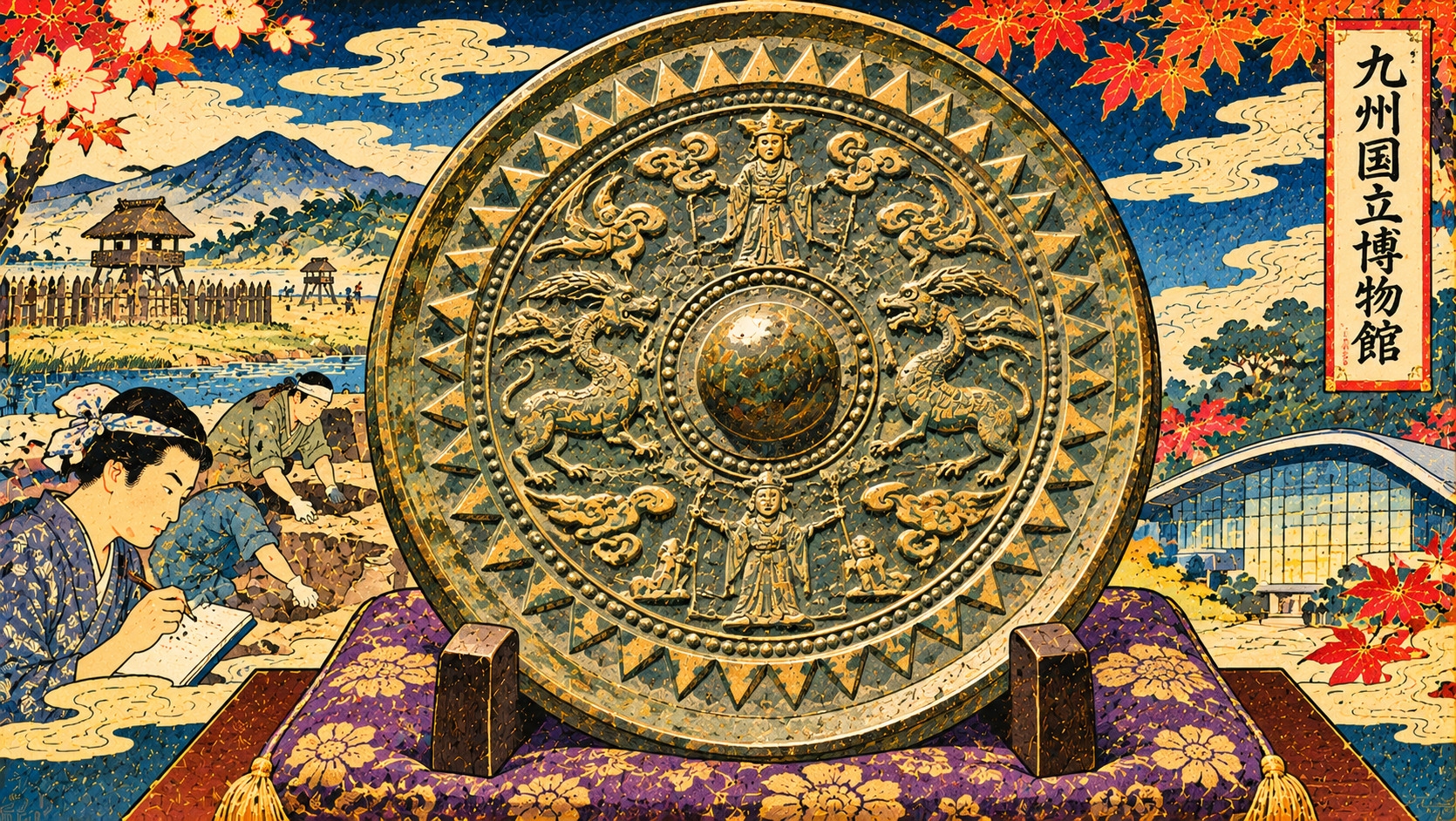
The Japanese term sankakubuchi shinju-kyo describes a family of large bronze mirrors with a triangular cross-section at the edge and relief images of deities and creatures on the back. The central boss may have held a cord. Their motifs are connected to ideas of supernatural beings and longevity that circulated in ancient China. What originally reflected the face was the polished opposite side.
Today a museum visitor is usually looking at the decorated back. That shift of perspective is revealing: a mirror can be both a personal object and a carrier of messages about prestige, ritual and long-distance cultural contact. It is not enough to call it an antique looking glass.
An inscription dated 240—and the limits of an inscription
Among the exhibition’s important works is a mirror excavated from the Kanizawa burial mound in present-day Gunma Prefecture, held by the Tokyo National Museum. Its inscription refers to Zhengshi year one, corresponding to 240 CE, the year after the mission associated with Himiko. The exhibition identifies it as an Important Cultural Property.
That chronological proximity makes the object compelling. It does not automatically establish that the mirror was cast in a Wei imperial workshop or personally handed to Himiko. An inscription can be copied, a casting can imitate another object and an object may remain in circulation before burial. Archaeologists must investigate all those possibilities rather than letting a date do more work than the evidence warrants.
The unresolved question: where were these mirrors made?
Kyoto National Museum archaeologist Teiichi Miyagawa has emphasized the extraordinary length of the debate over triangular-rimmed mirrors. Although the mirrors display Chinese-style imagery and inscriptions, examples of the precise type have not been securely excavated on the Chinese mainland. One argument is that Wei workshops made them specifically for export to Wa. Other scholars have proposed manufacture in the archipelago or by immigrant craftspeople drawing on Chinese models.
These positions cannot be resolved by calling the objects “Chinese” or “Japanese” in a modern national sense. Production in the third century involved artisans, models, trade networks and political contacts that did not follow today’s borders. Technical examination is indispensable, yet even an answer about casting location would not by itself reveal who ordered distribution.
When near-identical mirrors appear in distant tombs
Similar designs and related molds have made the mirrors central to attempts to map a political network across the early archipelago. Finds in the Kansai region, Kyushu and farther east raise the possibility that influential people exchanged prestigious objects, perhaps as gifts from a leading political center. This is one reason mirror distribution figures prominently in arguments about the emergence of the Yamato kingship.
But the map cannot be read as a simple chart of direct imperial control. Mirrors might have been copied, gifted more than once or buried decades after manufacture. A shared design can establish relationships worth investigating without proving the precise chain of command between rulers.
The maritime geography behind the objects
Kyushu National Museum lists mirrors from the Ishizukayama tomb in Fukuoka and the Takeshima Okaro-yashiki tomb in Yamaguchi among its exhibits. These places connect the archaeological story to northern Kyushu and the western Inland Sea, regions intimately involved in maritime movement between the Korean peninsula, the Japanese islands and other parts of East Asia.
The significance of the mirror is thus not solely the story of a queen. It is also the story of how raw materials, manufactured goods, casting knowledge and symbols moved through communities. Regional leaders may have been active negotiators in those exchanges rather than passive recipients of commands from a single capital.
What the Tomio Maruyama discovery adds
An exhibit from the Tomio Maruyama burial mound in Nara Prefecture adds a modern excavation story to the ancient one. The tomb has attracted renewed archaeological attention, and the exhibition identifies a triangular-rimmed deity-and-beast mirror among its objects. Its burial context can help researchers place a mirror alongside other material expressions of rank and power.
A newly documented find should not be confused with a newly manufactured object. The date of excavation, the age of the tomb and the age of the mirror can differ substantially. Each layer of dating informs, but does not replace, the others.
Did Himiko’s country become the Yamato kingdom?
Debate continues over the location of Yamatai, the realm associated with Himiko in Chinese sources. Accounts of ancient routes and distances have been interpreted differently; researchers compare them with settlement archaeology and the geography of early tombs. Mirror distributions are part of the evidence frequently cited in favor of a powerful Kinai-centered political formation.
The exhibition’s title suggests a close relationship between the diplomatic world of Himiko and the kingship that emerged in the Yamato region. It is an illuminating framework, not a universally accepted proof of institutional continuity or an answer that has settled the Yamatai-location controversy.
From ritual mirrors to armor and swords
The exhibition also follows later changes in elite material culture, presenting a fifth-century mirror, helmets and armor, and a later sword. Such pieces suggest that the language of power was never static. Burial customs, military equipment and ceremonial objects changed as regional relationships and elite identities changed.
That sequence should not be flattened into a one-way progression from religion to warfare. Mirrors could carry political and ritual meanings at the same time, while weapons could function as symbols of prestige as well as instruments of force. Material history rarely fits a single neat category.
Why the exhibition belongs in Dazaifu
Dazaifu, in Fukuoka Prefecture, is a fitting location for a story about ancient international exchange. Kyushu National Museum places cultural contact at the center of its work, and this exhibition brings loans from widely separated tombs and collections together for comparison. The museum lists an additional November 23 lecture on what three-dimensional data can reveal about the manufacture of triangular-rimmed mirrors.
That future lecture points toward an important distinction. Three-dimensional measurement, comparisons of casting traces and materials analysis can reveal how objects were made and which may share technical histories. Understanding what an ancient ruler intended when exchanging a mirror remains an interpretive task, informed by that evidence but never mechanically produced by it.
Visiting, and looking beyond the mystery
The exhibition runs from October 31, 2026, to January 11, 2027. Standard admission is ¥2,000 for adults and ¥1,200 for university students; those under 18 and high-school students are admitted free under the museum’s stated conditions. Most open days run from 9:30 a.m. to 5 p.m., with extended Saturday hours scheduled until 7 p.m.; the museum lists holiday and year-end exceptions. Tickets are sold at the museum, and conditions should be rechecked before travel.
The exhibition is worth approaching neither as proof of a familiar legend nor as a puzzle with one guaranteed answer. A mirror traveled because someone made it, valued it, carried it and eventually buried it. Those human decisions, rather than the fantasy of an identified royal reflection, offer a more durable way to understand how authority and connection developed in ancient Japan.
Sources and reporting method
The museum’s exhibition descriptions are compared with national museum archaeological essays and cultural-property records. Exhibition interpretations are distinguished from established excavation evidence.
- Kyushu National Museum: exhibition, objects, dates and admission
- Kyushu National Museum: official English exhibition page
- Kyushu National Museum: public lecture program
- Kyoto National Museum: Teiichi Miyagawa on the unresolved mirror debate
- Kyoto National Museum: history and interpretation of the mirrors
- Cultural Heritage Online: bronze mirror and Zhengshi inscription
- National Institutes for Cultural Heritage: deity-and-beast mirror iconography
- National Museum of Japanese History: ancient mirrors and Yamatai discussion
- Shimane Museum of Ancient Izumo: dated inscriptions and mirror debate
- Kyushu National Museum: original exhibition press information