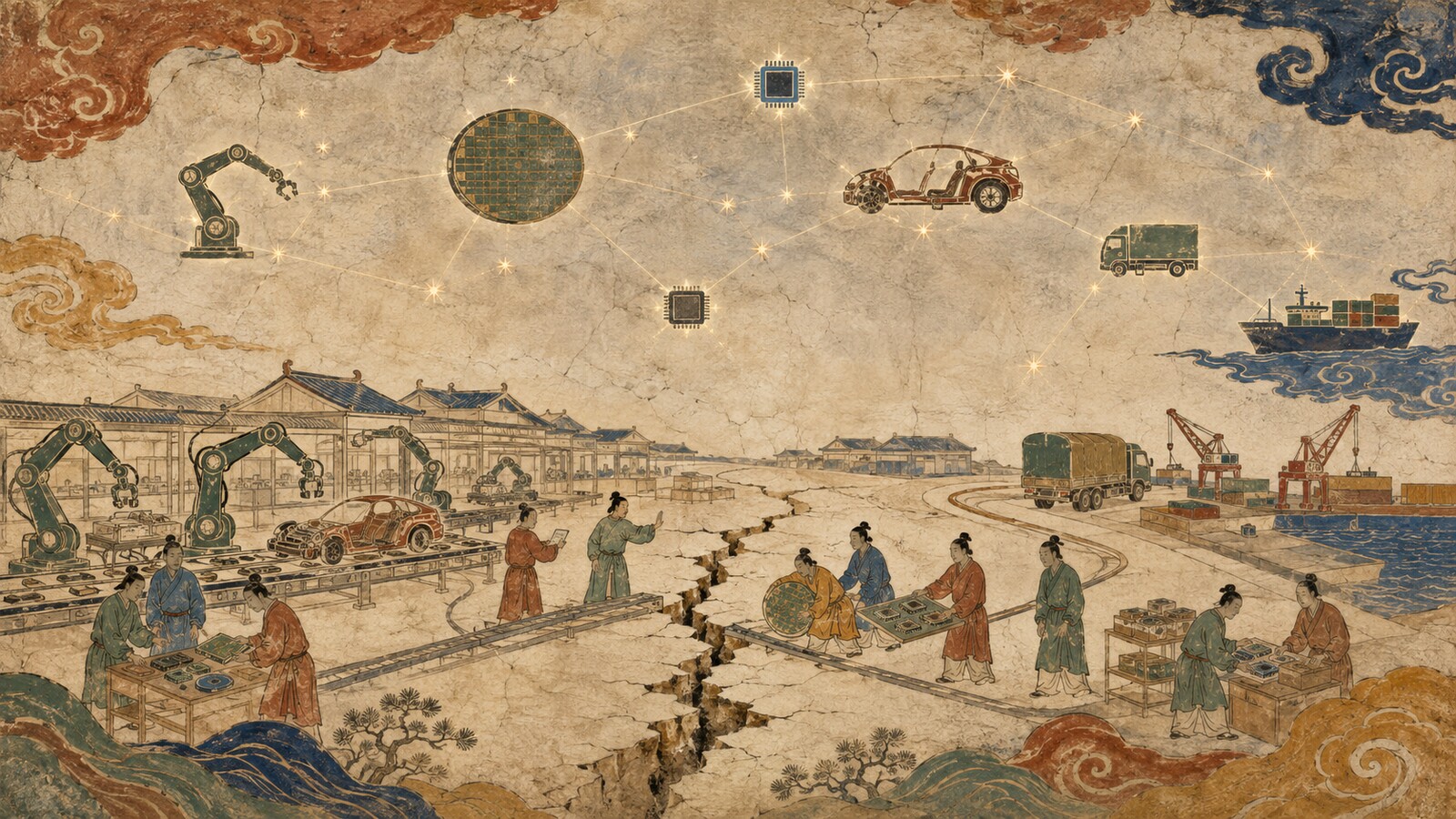
At 4:27 p.m. Tuesday, the map of industrial Japan briefly changed. It was not visible on a corporate organization chart. It appeared instead in emergency shutdowns: a Lexus line in Fukuoka, a motorcycle plant in Ozu, image-sensor production in Kikuyo, Renesas cleanrooms in Kumamoto City and Nishiki, and the closely watched JASM semiconductor complex northeast of the epicenter.
The first reports sounded reassuring. Employees were evacuated. Major buildings at several sites were standing. Some plants began restarting. Then came Wednesday’s harder calculation. A factory can be structurally safe and still be unable to manufacture. A plant can be undamaged and still lack a part. A truck route can be open on a map and unusable for the precise, repeated deliveries on which just-in-time production depends.
Toyota Motor Kyushu offered the clearest illustration. Its Miyata, Kanda and Kokura plants stopped after the quake, resumed Wednesday morning and then were ordered down again from the second shift through the second shift on Friday, July 31. Toyota cited safety, logistics and the condition of suppliers. The restart had proved that the assembly sites could move. The second stop showed that the network around them could not yet be trusted.
That is the central fact of Kyushu’s industrial emergency. It is not one broken factory. It is uncertainty moving through two industries that have become one system: automobiles dense with semiconductors, and semiconductor plants whose customers, investors, equipment makers and skilled workers increasingly cluster around the same island.
The restart that lasted only hours
Toyota’s three affected plants sit in Fukuoka Prefecture, north of the most heavily damaged area, but their roles extend far beyond one prefecture. Miyata assembles Lexus vehicles and has annual capacity of about 430,000 units. Kanda produces engines. Kokura makes hybrid transaxles and other electrified-vehicle components. A disruption there can move from finished cars to powertrains and then into schedules at other sites.
The decision to halt again was therefore a form of industrial triage. Toyota had to know not only whether its own buildings, robots and utilities were safe, but whether workers could travel, suppliers could ship, roads could carry heavy vehicles, and repeated aftershocks might force another evacuation. Resuming a line and starving it hours later is not efficient recovery. Nor is filling a yard with partly completed vehicles while a missing electronic or mechanical component remains somewhere in the damaged zone.
Honda extended the suspension at its Kumamoto Factory in Ozu through Friday. The site makes motorcycles and other products and had experienced water intrusion after sprinklers activated. Honda also cited continued aftershocks and assessment of suppliers. The factory is important not only for motorcycles assembled in Kumamoto but for parts sent to Honda operations elsewhere—a dependency exposed dramatically by the 2016 earthquake.
Nissan presented the counterexample. It said it did not plan to stop its Fukuoka plant, which builds the Rogue, sold in Japan as the X-Trail, but it was monitoring suppliers and logistics. “Operating” and “unaffected” are not synonyms. Nissan’s position meant the plant could run at the time of the statement; it did not remove the possibility that a lower-tier supplier or interrupted route could become a constraint later.
A semiconductor building can stand while production waits
For chipmakers, the distinction between structural safety and production readiness is even sharper. A semiconductor fab is a controlled environment built around power quality, ultrapure water, gases, vacuum systems, temperature, humidity and extremely low particle counts. Hundreds of tools perform sequences whose tolerances are measured far below anything visible to the human eye. Shaking can trigger automatic interlocks without toppling a wall.
After an earthquake, engineers must first account for people and hazardous materials. They then inspect the building and utilities, preserve the cleanroom environment, verify tool position and calibration, and determine the condition of wafers caught mid-process. A wafer that looks intact may still require metrology or test runs before it can continue. A stable structure therefore permits recovery work; it does not certify every tool or every lot.
TSMC said all personnel at Japan Advanced Semiconductor Manufacturing, or JASM, were safe after a precautionary evacuation. Structural inspections found the buildings safe, and the company began a gradual restart. Detailed inspections and impact assessments continued. The company also said the second-fab construction site was unaffected, although some work had been paused because of aftershock risk. Local reporting later said equipment inspection and adjustment at the first fab would take time.
Sony’s language was more cautious. Its Semiconductor Manufacturing unit said production at the Kumamoto Technology Center in Kikuyo had remained halted since the quake while building and facility damage was assessed. No employee injuries were reported. Sony said its Nagasaki, Oita and Kagoshima production bases had no major building or facility damage—a measure of geographic diversification that matters precisely when one node stops.
Renesas reported physical effects at both suspended Kumamoto sites. At Nishiki, ceiling panels had fallen and walls were cracked, though power, air conditioning and the cleanroom environment remained available. At Kawajiri, cracks and water leakage temporarily interrupted the ultrapure-water supply, while power, air conditioning and cleanroom conditions were maintained. Equipment and work-in-process remained under investigation.
That last phrase—work-in-process—is one of the most important in the entire industrial response. Semiconductor production can take weeks and many hundreds of steps. The loss is not measured only in days that a plant door is closed. It includes wafers already carrying accumulated processing value, customer-specific production schedules and the time needed to prove that restarted tools are again producing within specification.
| Company or site | Position by the reporting cutoff | What still mattered |
|---|---|---|
| Toyota Motor Kyushu Miyata, Kanda, Kokura | Stopped again from Wednesday’s second shift through Friday’s second shift. | Safety, supplier status, roads and logistics; decision on August 3 operations due July 31. |
| Honda Kumamoto Factory | Suspension extended through July 31. | Repairs, water intrusion, aftershocks and supplier assessment. |
| TSMC / JASM Kikuyo | Structures declared safe; gradual restart begun. | Detailed tool inspection, adjustment, wafer impact and aftershock precautions. |
| Sony Semiconductor Kumamoto Technology Center | Production remained stopped; employees safe. | Building, facilities and manufacturing-line assessment; restart timing not announced. |
| Renesas Kawajiri and Nishiki | Both plants stopped; cleanroom checks underway. | Wall and ceiling damage, water leakage, ultrapure water, equipment and work-in-process. |
| Tokyo Electron / Ebara | Regional equipment sites paused for safety checks; no major damage reported at the sites cited by local authorities. | Ebara planned a July 30 restart; Tokyo Electron Kyushu planned an August 3 restart. |
| Nissan Fukuoka plant | No suspension planned. | Supplier and logistics monitoring continued. |
The cluster beyond the famous names
The companies in international headlines are only the visible layer. Semiconductor manufacturing depends on equipment makers, specialty materials, pumps, gas systems, precision cleaning, packaging, testing and maintenance. Automobile production depends on castings, seats, door mechanisms, rubber, wiring, electronics and a dense transport rhythm. Many of the most consequential suppliers are not household names.
Ebara stopped its Nankan operation, which makes semiconductor-manufacturing equipment, and planned to reopen July 30 after inspections found no major damage. Tokyo Electron Kyushu halted sites in Koshi and Ozu for safety checks and planned an August 3 return. Mitsubishi Electric stopped semiconductor operations in Koshi and Kikuchi for equipment checks. Bridgestone’s Kumamoto plant remained stopped after minor wall cracking. HORIBA STEC paused its Aso plant, a base connected to mass-flow control and other semiconductor production technology, despite reporting no significant building or equipment damage.
Kumamoto Prefecture said that by 2:00 p.m. Wednesday it had confirmed building or equipment damage at 63 of 515 companies attracted to the prefecture, including semiconductor-related firms. That figure did not mean 63 factories had been destroyed. It did show why early national statements could not settle the supply-chain question. Each damaged ceiling, interrupted utility or inaccessible road had to be matched to a product and customer.
Logistics added another layer. Yamato suspended acceptance of parcels to and from Kumamoto and parts of northwestern Miyazaki and stopped collections and deliveries within Kumamoto. Industrial freight is not identical to parcel delivery, but the suspension was a public indicator of disrupted roads, depots and labor. For a just-in-time plant, the relevant infrastructure is not simply whether an expressway exists. It is whether the correct truck can make the correct window repeatedly.
- People: workers can reach the site safely and evacuation systems can withstand further aftershocks.
- Utilities: electricity, water, ultrapure water, gases, ventilation and communications remain stable.
- Equipment: production tools are anchored, calibrated and qualified—not merely switched on.
- Material: work-in-process, inventories and incoming parts pass inspection.
- Network: lower-tier suppliers and transport routes can sustain more than a trial shift.
How Kyushu became “Silicon Island”
Kyushu’s semiconductor identity predates TSMC by more than half a century. Mitsubishi Electric established its first semiconductor plant in Kumamoto in 1967. Other manufacturers followed, drawn by land, abundant clean water, a workforce suited to precision assembly, improved transport and proximity to the growing markets and production networks of East Asia. By its earlier peak, Kyushu was associated with roughly a tenth of world semiconductor output and earned the name “Silicon Island.”
The cluster changed as Japanese memory manufacturing lost global share and production shifted abroad. Kyushu did not cease making chips; it became more specialized. Image sensors, automotive microcontrollers, power semiconductors, analog devices, materials and production equipment gave the region a new industrial base. The island’s automotive expansion in northern Kyushu then created a powerful local customer for the electronics around it.
By 2024, Kyushu’s integrated-circuit production value had reached ¥1.3126 trillion, up 13.8 percent from the previous year and equal to 48.6 percent of Japan’s total, according to the Kyushu Bureau of Economy, Trade and Industry. Production volume accounted for 54.7 percent of the national total, its first move above half. Separately, the bureau estimates that four finished-vehicle manufacturers give Kyushu annual production capacity of about 1.54 million vehicles, roughly 15 percent of Japan’s four-wheel capacity.
Those numbers explain why an earthquake centered near Kumamoto is not a local business interruption. Semiconductors and automobiles together account for roughly two-fifths of Kyushu’s industrial output. The same geography that creates skilled labor, supplier density and efficient collaboration also concentrates exposure when power, water, roads and workers are hit at once.
TSMC turned a mature cluster into a national strategy
The opening of JASM in 2024 gave “Silicon Island” a new geopolitical meaning. Japan was no longer only preserving a regional industry; it was using public support and corporate partnership to rebuild domestic chip capacity after pandemic shortages and intensifying technology rivalry. TSMC brought the foundry model. Sony and Denso invested as strategic customers. Toyota later took a minority stake.
TSMC’s 2024 expansion plan said two Kumamoto fabs would represent more than $20 billion in investment and, once both are operating, more than 100,000 12-inch wafers a month. Planned processes span 40 nanometers through 6/7 nanometers for automotive, industrial, consumer and high-performance-computing applications. The second fab was scheduled to begin operation by the end of 2027. Those are future combined figures, not the output of the first fab at the moment of the quake.
The ownership structure makes the auto-chip connection literal: TSMC about 86.5 percent, Sony 6 percent, Denso 5.5 percent and Toyota 2 percent under the announced expansion arrangement. In May 2026, Sony and TSMC also signed a non-binding memorandum to explore a Sony-controlled joint venture for next-generation image sensors at a new fab in Koshi City, Kumamoto.
That concentration brings resilience as well as risk. A dense cluster puts equipment engineers and suppliers close to the factory. It shortens normal delivery routes and accelerates collaborative recovery. But it also means one regional disaster can challenge the foundry, sensor maker, automotive customer and production-equipment network together. The correct response is not to declare clustering a mistake. It is to understand which dependencies are duplicated elsewhere and which remain single points of failure.
2016: the warning written into every recovery plan
The July 2026 earthquake arrived ten years after Kumamoto taught many of the same companies how quickly local damage can become national production loss. In April 2016, two major shocks struck on April 14 and 16. Toyota’s Kyushu assembly site itself was intact, but parts shortages forced the company to suspend vehicle assembly lines across Japan in stages from April 18 through April 23.
Aisin’s badly damaged Kumamoto operations became one of the crucial bottlenecks. Door parts, seats and other products had to be made in borrowed space at supplier and customer sites. Equipment and dies were moved, and employees were dispatched to substitute lines. University of Tokyo researchers later documented how Toyota’s recovery teams reached affected suppliers faster than in 2011 because a new database made lower-tier plants more visible.
Sony’s Kumamoto Technology Center suffered damage to buildings, cleanrooms and production equipment. Testing resumed May 9, assembly was due to restart from May 17 and wafer processing from May 21. Sony estimated the earthquake’s negative effect on fiscal-year operating income at ¥115 billion before insurance recoveries—evidence that a shutdown’s cost includes lost opportunity and delayed output, not only physical repairs.
Renesas stopped Kawajiri in 2016 and began restoring selected processes on April 22 after assessment. Honda’s recovery was much longer. Its Kumamoto factory partially resumed in May, brought back key motorcycle assembly at reduced volume in June and was not virtually normalized until August 22. The plant also supplied parts to Honda production elsewhere, spreading the effect beyond Kumamoto.
The comparison with 2026 should be made carefully. Early evidence this time suggested less direct infrastructure and factory destruction than in 2016, and several shutdowns were precautionary. But the lesson of 2016 is precisely that the first view from the factory gate is incomplete. The duration is determined by the slowest critical supplier, utility, process qualification or transport link—not by the first company able to announce that its building is standing.
2011: the disaster that made hidden suppliers visible
Five years before Kumamoto, the Great East Japan Earthquake exposed how little even the world’s most sophisticated manufacturers knew about the lower levels of their own networks. Toyota’s official history records 659 damaged supplier sites and procurement risk across 1,260 items, potentially affecting as much as 80 percent of its global vehicle production.
Renesas’s Naka factory became a defining bottleneck for automotive microcontrollers. Automakers and other companies sent workers to help, and partial production returned in June, months earlier than the first September forecast. Yet the global industry still learned that a tiny electronic component made deep in the supplier network could stop assembly lines on several continents.
Toyota responded by mapping more than 10,000 factories and companies, recording locations, products, customers and usual transport routes. The system improved triage in 2016: teams could find damaged lower-tier suppliers sooner, assess whether recovery or substitute production was faster and direct engineers to the true constraint.
But visibility does not eliminate physical dependency. The 2026 second shutdown at Toyota’s Kyushu plants shows the limit and value of that lesson. Better data can reveal that the network is not ready sooner; it cannot instantly repair a road, restore ultrapure water or qualify a shaken semiconductor tool. Sometimes resilience looks like a quick restart. Sometimes it looks like the discipline to stop again.
What the next production reports must answer
The most important numbers will not be the count of factories whose lights are on. They will be sustained output, qualified equipment and customer deliveries. At JASM, Sony and Renesas, attention will turn to tool-recovery percentages, scrapped or held wafers, cleanroom stability and the schedule for normal volume. At Toyota and Honda, it will turn to supplier clearance, parts inventory and whether August operations can run without repeated interruption.
Company language should be read precisely. “Building safe” concerns structure. “Operations gradually resuming” describes a process, not completion. “No major damage” leaves room for inspection and lost shifts. “No plan to suspend” is a current decision, not a guarantee. “Production resumed” can mean a limited line, a trial lot or full volume; companies should say which.
The same precision is needed for economic estimates. Nomura Research Institute economist Takahide Kiuchi told Reuters that the impact was likely to be temporary and losses could remain below ¥1 trillion because home and infrastructure damage appeared lighter than in other recent major earthquakes. That is an informed early estimate, not a measured loss. Aftershocks, supplier findings and yield data can change it.
Investors will watch listed manufacturers. Customers will watch delivery dates. Kumamoto’s communities will watch something more immediate: whether employers reopen safely without diverting power, water, fuel, accommodation and transport from rescue and household recovery. Industrial speed cannot be separated from the public emergency surrounding the factories.
The silence before a line restarts
Modern manufacturing is usually represented by motion: robots welding, wafers moving overhead, engines turning on test stands. After an earthquake, resilience begins in stillness. Workers wait outside. Engineers read sensors. Cleanroom teams inspect utilities. Purchasing departments call suppliers that most customers have never heard of. Truck routes are tested. One machine, then one line, then one shift is allowed to move.
Kyushu entered the disaster as both Japan’s Silicon Island and one of its great vehicle-production centers. That combination was built over six decades, from Mitsubishi Electric’s 1967 plant to TSMC’s multibillion-dollar campus and Toyota’s Lexus lines. It created jobs, technical depth and a supply network capable of extraordinary output. It also made the region’s internal connections globally important.
At 10:12 a.m. Thursday, there was no evidence of a 2011-scale industrial collapse. There was also no basis to declare the supply-chain risk over. Toyota had stopped again. Honda, Sony and Renesas remained down. JASM was restarting, not fully cleared. Dozens of smaller companies had reported damage. The honest conclusion lay between panic and reassurance.
The earthquake’s industrial verdict will not be written by the first press release. It will be written by whether Kyushu can turn a collection of safe buildings into a synchronized network again—and whether the lessons of 2011 and 2016 allow that network to return without asking workers or communities to accept another preventable risk.
Reporting Notes and Sources
Information was checked through 10:12 a.m. JST on July 30, 2026. Company operating conditions were changing rapidly. Suspensions, inspections and phased restarts are reported with the status and attribution available at the cutoff; none should be read as a forecast of final damage or production loss.
- Reuters: Kyushu automotive and semiconductor supply-chain disruption
- Reuters: Company-by-company operating status after the quake
- Sony Semiconductor Solutions: July 2026 earthquake impact statement
- Renesas: Kawajiri and Nishiki factory status
- Reuters: TSMC/JASM evacuation, inspection and gradual restart
- Kumamoto Nichinichi Shimbun: Local semiconductor-site inspections and restart plans
- HORIBA: Aso Factory status on July 29
- Kyushu Bureau of Economy, Trade and Industry: Profile of Kyushu
- Kyushu Bureau of Economy, Trade and Industry: regional auto-production capacity and national share
- Kyushu Semiconductor Human Resources Consortium: 2024 IC production data
- Mitsubishi Electric: Kyushu semiconductor history and the 1967 Kumamoto plant
- TSMC: JASM second-fab investment, ownership and capacity plan
- Sony and TSMC: May 2026 image-sensor partnership memorandum
- Toyota: 2016 nationwide production suspension after the Kumamoto earthquakes
- Honda: 2016 Kumamoto Factory recovery chronology
- Sony: 2016 Kumamoto production-restart chronology
- Sony: estimated fiscal impact of the 2016 Kumamoto earthquakes
- Renesas: 2016 Kawajiri recovery update
- University of Tokyo: Toyota’s evolving disaster-response and supplier-recovery capabilities
- Toyota 75-Year History: supply-chain damage after the 2011 earthquake
- TSMC Annual Report: earthquake response, tool anchorage and production recovery