In one corner of a laboratory in Inuyama, Aichi Prefecture, there is a handmade altar. The offering is grape juice, a favorite of the chimpanzee Ai. It is not a grand monument. It is something closer to the scale of daily memory, assembled by researchers and care staff who had known her over decades.
Ai died at 4:04 p.m. on January 9, 2026, at the age of 49. Kyoto University’s Institute for the Evolutionary Origins of Human Behavior gave the official cause as multiple organ failure due to old age. Staff surrounded her at the end, and she had continued taking part in experiments until the day before her death even as her health declined.
Calls, emails and gestures of condolence followed the announcement. On February 9, the institute opened a memorial website bringing together photographs, scientific contributions, messages from people who knew Ai, reflections from the public and a blog about her research and ordinary life. The July 23 report that returned her story to national attention was therefore not news of a site created in midsummer. It was a six-month reckoning with an archive that continues to grow.
A static memorial says that a life is over. This one is meant to keep working: researchers plan further publications from experiments in which Ai participated; recollections are still being added; ten chimpanzees, including her son Ayumu, still live at the Inuyama facility. The site is less a digital gravestone than an attempt to preserve a 49-year collaboration without separating its results from the individual who made them possible.
What the word “genius” hides
For years, Japanese headlines described Ai as a “genius chimpanzee.” The label was irresistible: here was an ape selecting numerals, identifying colors and responding to symbols that looked like writing. But Ikuma Adachi, a Kyoto University associate professor who worked with her for 18 years, has resisted the myth that she alone possessed a miraculous intelligence. Other chimpanzees, he says, can display similar abilities when the method and environment make them visible.
What distinguished Ai was her curiosity. Where another chimpanzee might hesitate before an unfamiliar apparatus or setting, she often approached. She anticipated sessions, persisted across tasks and closely observed the people around her. That temperament, sustained over almost half a century, gave scientists the continuity needed to refine a question instead of merely staging a clever demonstration.
This is more than a matter of modest wording. Treat Ai as a freak exception and her performance becomes entertainment. Treat her as one particularly willing member of a species with underappreciated capacities, and the research becomes comparative science. The purpose is no longer to ask how nearly an ape can imitate a human. It is to discover which forms of perception, memory and representation humans and chimpanzees inherited in common, and how each lineage transformed them.
A one-year-old chimpanzee enters Japanese primatology
Ai was born in Africa around 1976 and arrived at Kyoto University’s Primate Research Institute in 1977 at an estimated age of one. The institute itself was only a decade old. Founded in 1967, it had grown from a distinctive Japanese tradition that reached back to field studies of wild Japanese macaques begun in 1948: identify animals as individuals, give them names, follow relationships across years and take social history seriously.
That tradition did not erase the moral conditions of Ai’s arrival. She came to Japan in an era when very young great apes could be removed from Africa and transported into captivity with far less scrutiny than today. Celebrating what researchers learned from her must not romanticize a beginning she did not choose. Her separation from an African social world and her lifelong dependence on a human institution belong to the history, too. Modern obligations toward social housing, voluntary participation, lifetime care and conservation grew partly from confronting the cost borne by animals of her generation.
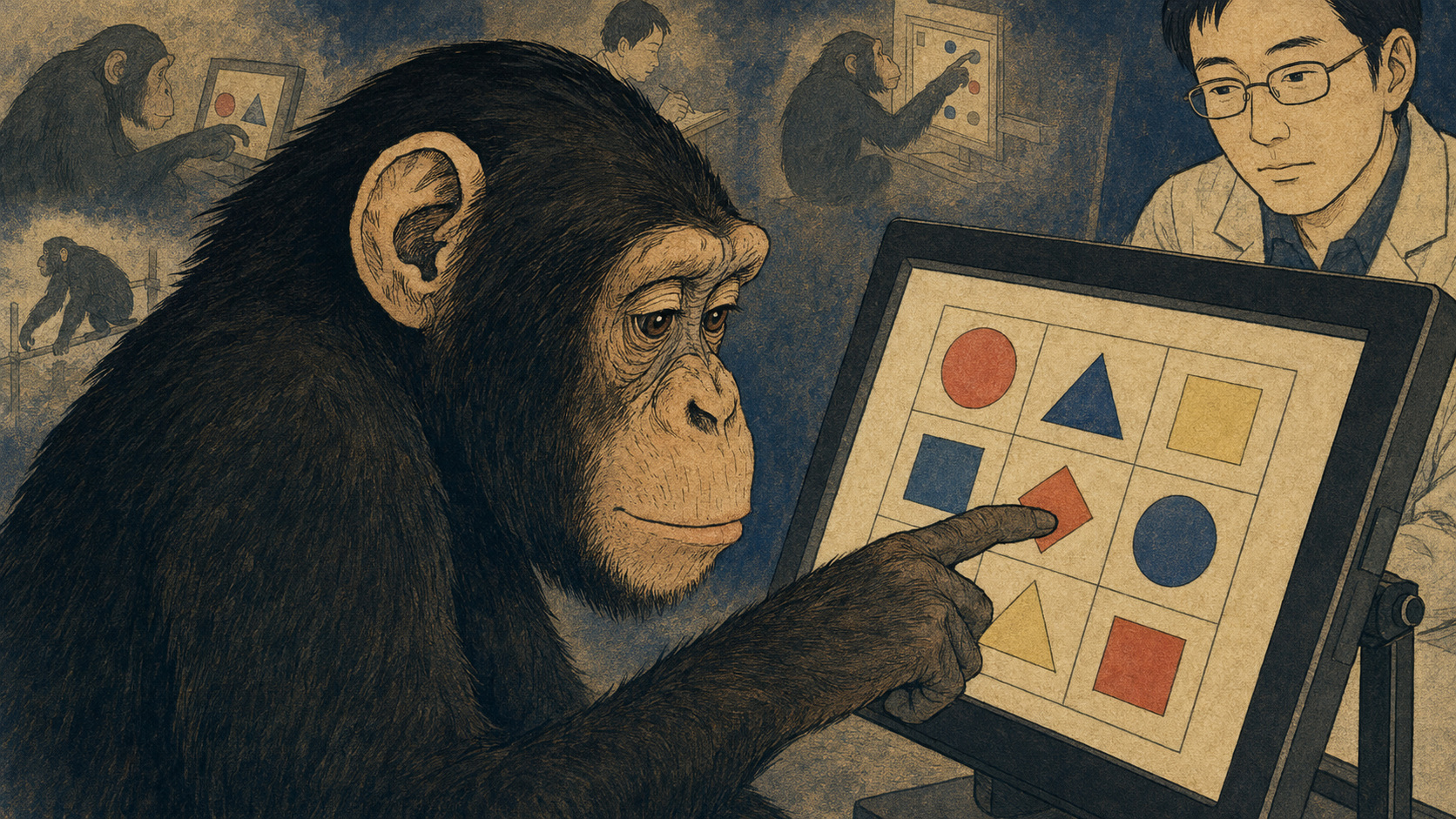
On April 15, 1978, Ai first touched a computer-linked keyboard. The program initiated by Professor Yasuko Murofushi came to be named the Ai Project after its first research partner. Its original question was audacious but testable: could a chimpanzee without spoken language learn visual symbols for objects, colors and quantities, then apply them beyond the specific examples used during training?
The keyboard was not a translator; it was a questioning machine
The apparatus was not a typewriter on which Ai composed ordinary sentences. Its keys carried geometric lexigrams, characters associated with colors, letters and Arabic numerals. A correct selection produced a small food reward. Researchers varied the sample, its attributes and the order of presentation to distinguish recognition of a shape from an understanding that a sign could stand for something else.
A later paper summarized her learned repertoire as 67 labels referring to objects, colors, numbers, individuals and personal pronouns. Other historical accounts speak more broadly of roughly 100 visual signs encountered across the project. Neither figure means that Ai read Japanese in the human sense or possessed an open-ended human language. Symbol-reference mapping is consequential; it is not by itself evidence of grammar, narrative, generative conversation or everything humans bundle into the word “language.”
The achievement of the project was methodological precision. Rather than settle a philosophical argument with one dramatic claim, it divided the problem: Can she match a sign to a sample? Transfer it to a new sample? Combine attributes? Preserve an order? Recognize a quantity when color and object change? The narrower the question became, the more clearly Ai could answer it.
In 1985, Tetsuro Matsuzawa published “Use of numbers by a chimpanzee” in Nature. Described in the paper as a five-year-old, Ai used Arabic numerals from one to six to label quantities. She could report the number, color and object represented by 300 kinds of samples. Although the researchers did not require a fixed response sequence, she favored two: color–object–number and object–color–number. The finding did not prove human grammar, but it showed that she spontaneously organized several attributes into preferred orders.
After one, two and three came zero
Simply touching a printed digit might be visual discrimination. The work therefore moved toward correspondence between signs and sets, comparisons of greater and smaller, ordering and eventually absence. Ai learned to label quantities from zero to nine and to select the numerals in ascending sequence. Zero was especially revealing because it asked her to attach a visible sign to a state in which there was nothing to count.
A second Nature paper, published by Nobuyuki Kawai and Matsuzawa in 2000, used a masking task. Several numerals selected from zero to nine appeared at random positions on a touchscreen. Once Ai touched the smallest, the remaining digits turned into identical white squares. To finish, she had to retain both identity and position, then touch the covered locations in numerical order. Her reliable span reached five items.
The experiment shifted the claim from number recognition to temporary representation and planned action. Ai was not merely reacting to whichever numeral remained visible. She had inspected a whole display, held an ordered map of it and used that map after the information disappeared.
Results like these weakened the image of intelligence as a single ladder with humans standing on the top rung. Cognition looks more like a mosaic. Humans excel in some combinations of language, abstraction and cumulative culture. Chimpanzees may be remarkably effective in particular forms of rapid visual processing, spatial memory, tool use and social attention. Evolution did not pour more or less of one substance called intelligence into different skulls; it preserved, traded and reorganized capacities under different pressures.
| Period | Ai’s life and research | Why it mattered |
|---|---|---|
| 1977–78 | Arrived at about age one; first used the computer keyboard on April 15, 1978 | Established a lifelong platform for testing visual symbols and cognition |
| 1985 | Combined labels for quantities one to six, objects and colors | Nature report demonstrated symbolic numerical representation |
| 1990s | Extended work to zero through nine, numerical order, vision and memory | Moved the question beyond memorizing digit shapes toward abstract relations |
| 2000 | Remembered the position and sequence of five masked numerals; gave birth to Ayumu on April 24 | Joined adult memory research to a new program on mother–infant development |
| 2000s–2020s | Participated in studies of faces, pictures, rhythm, social learning and aging | A single life connected changing techniques and generations of researchers |
| 2026 | Died January 9 at 49; memorial site launched February 9 | Expanded the scientific record to include biography, relationships and care |
An escape outside the experiment
In 1989, Ai drew national attention after apparently using a nearby key to open a padlock and leave her enclosure. It is often told as a light anecdote about an exceptionally smart chimpanzee. It also symbolizes something more serious: intelligence did not exist only when a human supplied a screen and a correct button. Finding a key, relating it to a lock and manipulating it toward an outcome involved practical understanding outside the prepared trial.
Nor should the story be inflated into a human political drama about escape and freedom. A chimpanzee’s intention cannot be translated perfectly into our preferred narrative. Comparative cognition lives in that difficult space: refuse to underestimate the animal, but resist the equally distorting urge to turn every attractive behavior into a human thought expressed without words. Ai repeatedly forced researchers to work at that boundary.
Motherhood changed the timescale of the project
On April 24, 2000, Ai gave birth by artificial insemination to a son, Ayumu. Two other mother–infant pairs—Chloe and Cleo, Pan and Pal—formed a cohort at Inuyama that year. Instead of separating infants for human rearing and training, researchers developed what they called participation observation. Young chimpanzees joined sessions with their biological mothers, whose long relationships with the human team allowed careful study without dissolving the mother–child bond.
In a honey-fishing experiment, infants watched adults choose and insert tools into narrow openings. Ayumu observed Ai at close range. She tolerated his attention and, at times, contact with the tool. The mothers rarely taught by breaking the action into lessons. The young watched, handled and tried. At roughly 20 to 22 months, they began succeeding, sometimes favoring the same tool types used by the adults. The pattern supported the researchers’ idea of “master–apprenticeship”: learning built from proximity, tolerance and prolonged observation rather than explicit instruction.
Ayumu later made the family famous again. In a 2007 Current Biology study, five numerals were displayed for as little as 210 milliseconds and then covered. His reported accuracy was about 79 percent; none of nine adult human participants approached it. The spectacle traveled around the world as proof of a chimpanzee with better memory than university students.
Good science did not end with the viral result. Critics pointed out that Ayumu had extensive practice while the human comparison group did not. Later work reported that adequately trained people could outperform him. Those critiques do not erase the original ability; they narrow the claim and expose the importance of matched experience. The willingness to revisit a captivating conclusion is part of Ai’s legacy. The animal is not honored by exaggeration. She is honored when methods are good enough to survive scrutiny.
More than numbers: faces, rhythm and drawing
Reducing Ai to “the chimpanzee who counted” discards most of her scientific life. Studies arising around her examined visual acuity, shapes, photographs, face recognition, cross-modal matching, motion perception, short-term memory and social behavior. Her unusually long history with visual signs also gave researchers a way to ask how early symbolic experience might affect later recognition of photographs and drawings.
One experiment asked whether movement could align spontaneously with an auditory beat. Ai tapped a keyboard in time with a 600-millisecond interval even though she had never been explicitly trained to attend to the sound. Reported in Scientific Reports in 2013, the behavior offered a comparative clue to the evolutionary background of synchronized movement, dance and music. It did not make Ai a musician in the ordinary human sense. It showed that sensitivity to temporal regularity does not begin at the boundary of our species.
Ai also drew. Her marks did not form human-style representational scenes, but she repeatedly handled paper and brushes and drew without food having to be the purpose of every stroke. For the fortieth anniversary of the Ai Project in 2017, one of her paintings was turned into a silk scarf. The first was presented to Jane Goodall, whose life’s work transformed the study and conservation of wild chimpanzees. A hand that selected numerical symbols had left lines that were at once data, artifact and a challenge to the border around the word “expression.”
The weight of calling an animal a “research partner”
Kyoto University consistently describes Ai as a principal research partner. The phrase expresses respect, but it cannot mean that animal and institution held equal power. Humans selected the facility, apparatus, reward and publication. Ai could refuse a session, yet she could not choose another life beyond human care. “Partner” should therefore be read not as a decorative honorific, but as a promise that enlarges the researchers’ duties.
At Inuyama, cognitive sessions developed around voluntary entry into testing spaces and small fruit rewards. Kyoto researchers have studied the welfare effects of the experiments themselves, comparing activity budgets of chimpanzees who participated, those who did not and wild chimpanzees at Bossou. Choice, social groups, enriched outdoor space, physical movement, relief from boredom and lifelong medical care became part of what makes the science credible.
Ethical tension remains. Voluntary participation in a task is not identical to informed human consent. A long-lived great ape requires skilled, expensive care long after a grant or researcher has ended. Buildings age. Social partners die. The memorial’s appeal for support to improve conditions for the ten surviving chimpanzees makes a necessary point: respect for past discoveries cannot be separated from responsibility for living individuals.
An institution changed names while the question endured
The Primate Research Institute where Ai lived was founded in 1967 and ended as an organization in March 2022. The Center for the Evolutionary Origins of Human Behavior inherited key facilities and research sections that April. In April 2026, three months after Ai’s death, it gained institute status and became the Institute for the Evolutionary Origins of Human Behavior.
This is more than a succession of signs on the gate. Experimental brain and behavior research now sits in the new institute, while Kyoto University established the Center for Primate Field Studies in April 2026 to consolidate field researchers dispersed after the old institute’s reorganization. A discipline once gathered under one institutional roof is specializing and reconnecting. The Ai Project’s habit of viewing a chimpanzee in a laboratory alongside chimpanzees living in West African forests remains essential to that work.
The project’s greatest technical resource was not a keyboard, a touchscreen or any one famous paper. It was time. Researchers knew one individual from childhood through old age. As devices changed from physical symbol keys to computer displays, eye tracking and other instruments, her accumulated history traveled with her. Development, experience, personality and aging could be interpreted on a life course rather than inferred from a brief encounter.
What a scientific memorial should preserve
- Life: Place arrival, social relationships, motherhood, aging and everyday preferences on the same timeline as publications.
- Method: Preserve apparatus, training history, reward, failed trials and individual variation so that claims are not enlarged beyond the evidence.
- Relationship: Record not only what researchers remember, but how Ai distinguished, watched and responded to different people.
- Welfare: Show how standards for voluntary participation, housing, medical care and social life changed over time.
- Future: Connect unpublished data and continuing papers to Ayumu and the other chimpanzees whose lives continue at Inuyama.
An archive of successful papers is not enough. Which tasks did Ai seek out? Which did she avoid? How did she react to an unfamiliar person or apparatus? Adachi remembers her as an acute observer who appeared to size up newcomers. Such observations can sound anecdotal, but when they guide the pace and design of a valid experiment, they are part of the method.
Memory alone is not enough either. Warm phrases—“genius,” “almost human”—can erase controls, sample size and uncertainty. The memorial’s best possibility is to hold affection and verification in the same place: photographs that make the individual unforgettable, papers that delimit the claim and care records that reveal the life on which the experiment depended.
The question Ai returned to us
Humans have repeatedly used number, language, memory, music and art as walls separating ourselves from other animals. Ai did not knock down every wall and cross to the human side. She helped examine the materials. Some capacities showed deep continuity; others remained profoundly different.
A chimpanzee can attach a numeral to quantity, remember five ordered locations briefly, align movement with a beat and learn by watching a tolerant mother. None of that needs to be inflated into human language or human art. Finding the similarity accurately—and preserving the difference accurately—is how two lineages divided from a common ancestor become intelligible.
The memorial site carries a simple message: what Ai taught will continue to live in those who learned from her. That is not only sentiment. Data outlast an animal. Methods become habits. A son enters a study made possible by his mother. A young researcher learns how closely a chimpanzee watches the watcher. The influence moves through science after the original session is over.
The grape juice on the altar will never appear as a result in a chart. Yet it records something a table cannot: the participant had tastes, grew older, changed her relationships and reached a final day. Perhaps Ai’s deepest contribution was to show that cognition is not simply the number of correct responses. It is a life of curiosity directed toward a world and toward others.
After the screen goes dark, the question remains. Who learned to understand number? Ai, certainly. But perhaps also the people who watched her finger for 49 years and were compelled to reconsider what they meant by understanding. Kyoto University’s monument is not stone. It is a page designed to be revised. That open form suits a scientific life that never allowed the human answer to be final.
Sources and references
This account relies primarily on Kyoto University records, original research papers and the Japan Science and Technology Agency’s July 23, 2026 report. Terms such as “language,” “genius,” “art” and “better memory than humans” are separated from the narrower findings of the experiments that prompted them.
- Kyoto University: Memorial website for Ai
- Kyoto University: Passing of Ai, January 9, 2026
- Kyoto University: Launching Ai’s memorial website, February 9, 2026
- Science Japan: Ai’s memorial and continuing research, July 23, 2026
- Matsuzawa, “Use of numbers by a chimpanzee,” Nature 315 (1985)
- Kawai & Matsuzawa, “Numerical memory span in a chimpanzee,” Nature 403 (2000)
- Scientific Reports: Ai’s symbol-learning history and face-image recognition (2020)
- Kyoto University: Thirty years of the Ai Project and comparative cognitive science
- Kyoto University: History of the Ai Project
- Hirata & Celli: Mother–infant acquisition of tool use
- Inoue & Matsuzawa: Working memory of numerals in chimpanzees (2007)
- Silberberg & Kearns: Reassessment of training and extraordinary working memory (2010)
- Kyoto University: Ai’s spontaneous synchronization to rhythm
- Matsuzawa: The Ai Project at forty and Ai’s painted silk scarf (2017)
- Yamanashi & Hayashi: Cognitive experiments and captive-chimpanzee welfare
- Kyoto University CICASP: From the Primate Research Institute to EHUB
- Kyoto University Center for Primate Field Studies: Establishment and mission