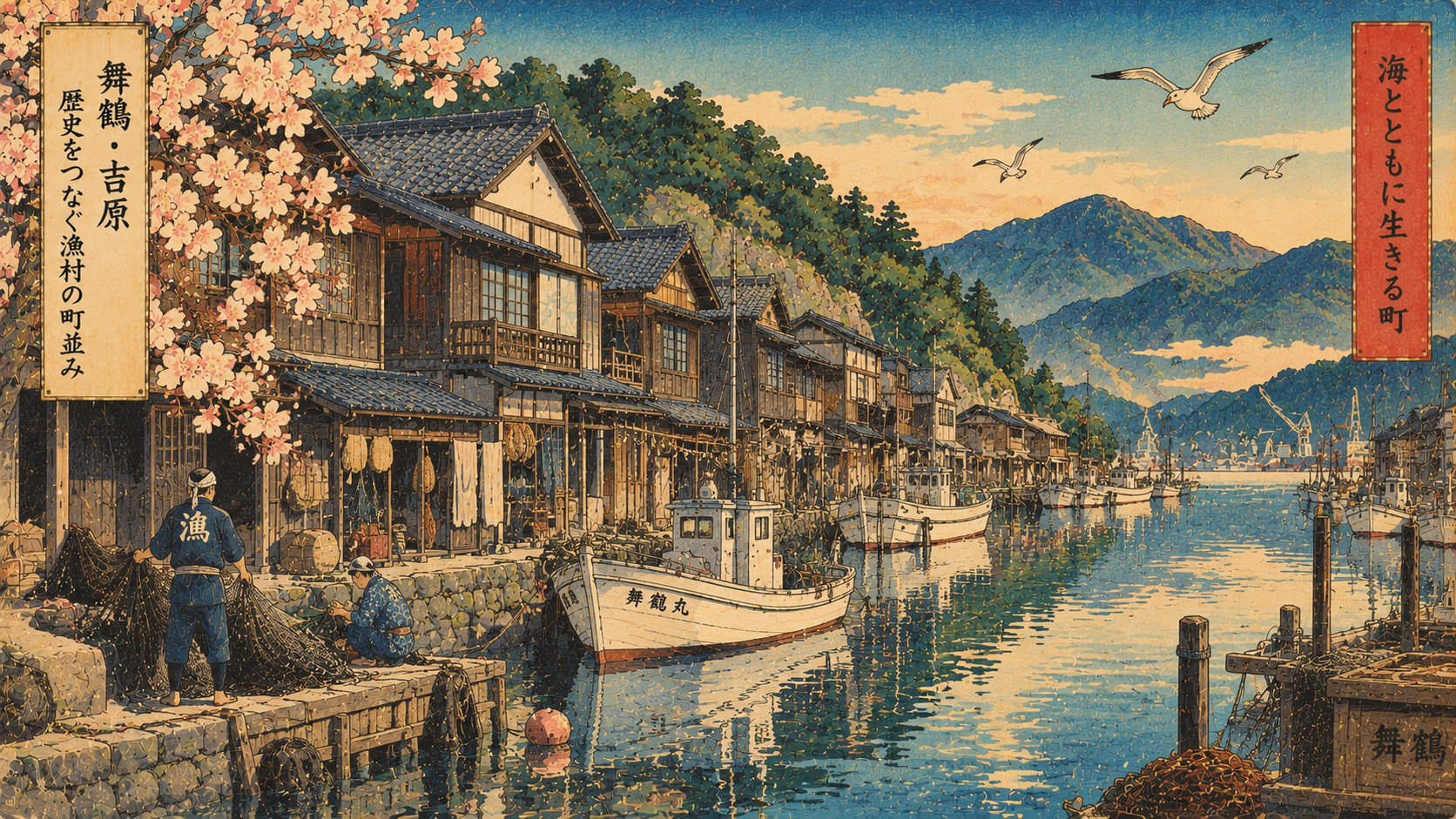
The heritage is not a single handsome building. It is the relationship between an inlet, boats, streets and the people who live there.
A fishing town the water helped build
A harbor need not have a monumental castle or a famous temple to deserve preservation. In Yoshihara, a small fishing neighborhood in Maizuru, Kyoto Prefecture, the extraordinary feature is the ordinary relationship between water, work and home. A slender inlet reaches into the settlement. Boathouses face it. Narrow passages run toward it. Modest gabled townhouses occupy long, slim plots. Taken separately, these details might seem unremarkable; together, they explain how a fishing town worked.
The October decision—and what it does not yet mean
On October 16, 2026, Japan’s Council for Cultural Affairs recommended that the Maizuru City Yoshihara Traditional Buildings Preservation District (舞鶴市吉原伝統的建造物群保存地区) receive national designation as an Important Preservation District for Groups of Traditional Buildings. The Agency for Cultural Affairs says the nationwide count would rise from 130 to 131 once the official gazette notice is issued. This is a recommendation, not proof that final notification has already occurred. Maizuru called it the city’s first such national selection prospect and held a celebratory gathering at the restored former Toriji residence.
The street plan is an archive
The agency dates the settlement’s formation to 1728 (Kyōhō 13), when a fishermen’s neighborhood was relocated from the Tanabe castle town and developed in stages. Yoshihara lies in western Maizuru, once an intermediate port in Sea of Japan trade. Buildings are not the only historical evidence. A narrow frontage preserves a way of dividing land; lanes show how residents approached the inlet; a boathouse explains how a working vessel belonged in daily life. These spatial relationships are what heritage officials mean when they describe the district’s distinctive historic character.
Not another Kyoto of temples
For overseas readers, Kyoto often evokes the former capital’s temples and gardens. Maizuru lies on the prefecture’s Sea of Japan coast, where shipbuilding, fisheries and maritime trade shaped a different architectural inheritance. The name Yoshihara also belongs to a living neighborhood—not an outdoor museum staged for visitors. Its significance does not depend on every house being a pristine eighteenth-century survivor. The persistence of an interconnected streetscape matters more than a claim that nothing has changed.
How a boathouse changes the architecture
A funaya, or boathouse, is not simply a picturesque façade. Its historic utility came from proximity to water, where boats could be sheltered and equipment handled. The agency describes Yoshihara’s small, relatively consistent gable-roofed, eave-facing townhouses, waterside boathouses and paths leading to the inlet as a single ensemble. That ensemble matters architecturally because rebuilding any one piece without regard to the others can erase the logic of the place. The description does not establish that all surviving buildings are the same age or retain their original uses.
The protection began at city level
National recognition is the newest chapter in a longer process. Maizuru enacted its preservation ordinance in July 2025, with provisions taking effect in April 2026. The city separately announced its urban-planning designation for the Yoshihara preservation area effective April 1, 2026. Municipal preservation and national selection are distinct legal steps: the municipality plans and regulates a defined district, while the national government can recognize areas of particular importance and support conservation.
A historic house and a modern building code
This is where the story becomes more complex than a beautiful view. Some traditional buildings do not meet every contemporary building-standard requirement. Maizuru adopted narrowly framed exemptions under Article 85-3 of the Building Standards Act for qualifying existing structures, addressing matters such as daylight, access to roads, building coverage and height. That is not a blanket exemption from building safety, nor permission to alter any building without review. It acknowledges a real problem: applying every modern design constraint mechanically can make historic streets impossible to maintain.
Whose costs, whose benefits?
Preservation requires roofs repaired, timber maintained, water edges cared for and buildings made usable. These are expenses borne in the first instance by real owners and residents. National programs can provide support for repairs, streetscape improvements and disaster prevention, but the size of Yoshihara-specific grants and the eventual private cost burden should not be presumed. Municipal discussion records show concern over distinguishing specially identified heritage properties from other buildings and over difficulty contacting some owners. An attractive heritage designation is not itself a financing plan.
The waterfront also has to be safe
Historic coastal and riverfront settlements face hazards that a carefully framed photograph cannot show. Fire prevention, evacuation access, flooding and structural resilience deserve attention alongside visual conservation. Yoshihara’s narrow lanes and inherited building forms create a particular need to reconcile practical safety with architectural character. The published municipal framework provides tools for review; it does not demonstrate that every building has already been retrofitted or that a complete hazard solution is in place.
The former Toriji residence as a test
Maizuru has already invested attention in public use. The former Toriji residence (旧鳥路邸), described by the city as a restored public-use heritage facility, hosted a completion-related lecture in February and served as the site of the October 16 celebration. A public building can become a place to explain restoration methods, welcome visitors and hold community discussions. But the more demanding test is whether surrounding private houses and working waterfront spaces remain affordable and useful to residents.
Tourism is an opportunity, not the only purpose
A national heritage label could attract visitors to a less familiar side of Kyoto Prefecture. That may help cafés, small businesses and guides; it can also increase pressure on narrow streets and private space. The city has published walking materials and hosted local ideas meetings. Those activities show civic interest, not verified future visitor totals or income gains. Responsible travel reporting should tell readers that Yoshihara is a residential community and encourage respect for access restrictions and ordinary daily life.
What the designation cannot save on its own
The underlying question is whether preservation protects a community’s ability to continue, not merely a view of its past. A house without an occupant deteriorates; a waterside town without water-related livelihoods risks becoming scenery. Neither the national recommendation nor the present public documents establishes long-term population retention, a recovery in fishing employment or a completed budget for every repair. Those are future measures by which policy should be judged.
A different kind of Japanese monument
A great monument points to one building. Yoshihara points to the relationships between many: the inlet and the boat, the small plot and the townhouse, the alley and the shore. The Council for Cultural Affairs has put that everyday architecture forward for national protection. If the recognition helps sustain a living neighborhood rather than freeze an attractive image, Maizuru’s fishing village may offer a broader lesson in how Japan conserves the places where people worked, not only the places where rulers lived.
Sources and documentation
Based on Agency for Cultural Affairs and Maizuru City documents available as of October 21, 2026. No site visit or original interviews were conducted. Formal national selection is subject to publication in the official gazette.
- Agency for Cultural Affairs: October 16 recommendation
- Maizuru City: recommendation and local ceremony
- Maizuru City: local planning designation
- Maizuru City: building-code exemptions
- Maizuru City: preservation ordinance
- Maizuru City: public comment results
- Maizuru City: heritage initiatives
- Agency for Cultural Affairs: preservation framework
- Maizuru City: former Toriji residence
- Maizuru City: district planning map