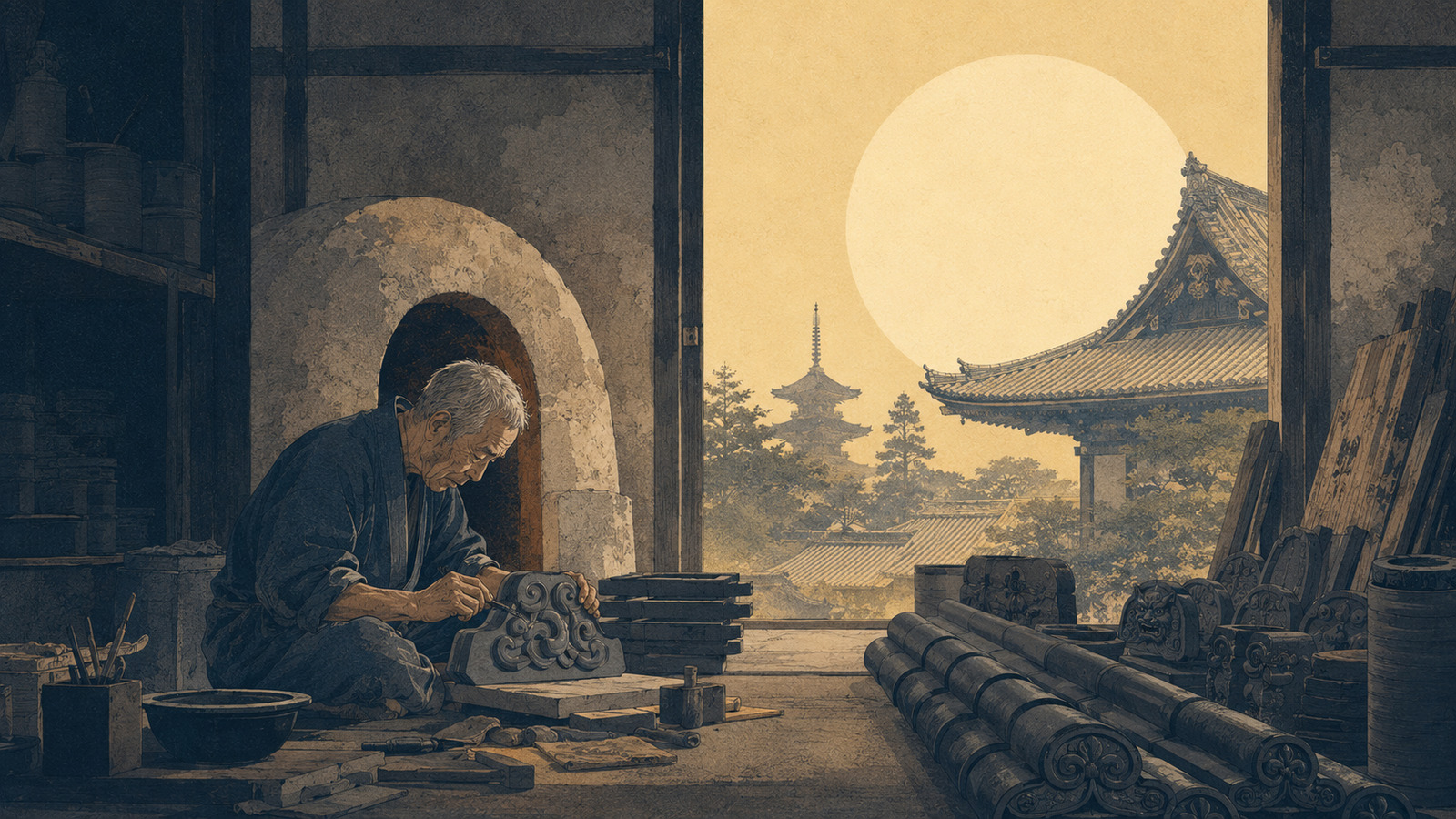
In a quiet workshop in Fushimi, clay waits for a hand that knows when it is ready. Too wet, and an ornamental ridge tile will slump. Too dry, and a line meant to look effortless will crack. A wooden form determines one side; the visible face is coaxed, pressed and cut by the maker. Then comes the act that gives Kyoto tile its particular authority: polishing, again and again, before fire and smoke turn the surface into a restrained silver-black sheen.
On July 22, Asada Seikawara Workshop opened a crowdfunding project with a declaration that sounds grander than the objects being offered: preserve Kyo-kawara for another hundred years. The objects are intentionally domestic—octagonal rice bowls, slab plates and chopstick rests made with the firing knowledge and material presence of roof tile. The proposition is that a craft once seen from a street or temple courtyard must now be touched at breakfast if it is to remain alive above Kyoto.
The campaign is also an admission. Asada, founded in 1911 and now operated by Kyoto Shoji, describes itself as Kyoto’s last Kyo-kawara workshop. Housing styles have changed, roof-tile demand has contracted and craftspeople are scarce. A gallery opened beside the factory in September 2025; new owners, a young entrepreneur and a potter joined the effort after a 2024 acquisition. In 2026, the workshop is not presenting survival as a matter of sentiment. It is trying to build a market.
What “Last” Means
Japan still has important tilemaking regions, especially Sanshu in Aichi, Awaji in Hyogo and Sekishu in Shimane. Kyoto still has roofers, restoration specialists and people who work with tile. “Last” therefore needs a careful definition. Kyoto City’s craft-tourism program identifies Asada as the city’s last existing Kyo-kawara factory. The workshop says third-generation master Masahisa Asada is the only active Kyo-kawara onishi—a maker of sculptural demon and decorative tiles—still producing.
That is a narrower and more consequential claim than “Japan’s last tilemaker.” It means the remaining place in Kyoto that can carry a special piece through the full handmade chain: read an old roof, translate its geometry into clay, shape and polish the form, judge drying, control the kiln, smoke the surface and anticipate how the fired object will settle among neighboring tiles.
A roof tile is never truly a solitary product. Asada explained in a 2016 interview that a piece must meet the tiles below, behind and above it, while the roof itself may not be perfectly flat. Thickness, lift, overlap and curvature are adjusted so an assembly sheds water and reads as one plane. A copied ornament that does not fit the roof is sculpture. Conservation requires sculpture, materials science and construction knowledge at once.
A Technology That Arrived With Buddhism
Japan’s tile history begins with international exchange. The Nihon Shoki records that in 588, as Asuka-dera was being established, Baekje sent monks and specialists that included four kawara hakase—tile masters. Excavated roof tiles at the site show deep technical and stylistic connections with the Korean peninsula. The tiled temple roof was not merely weather protection. It announced a new religion, a new monumental architecture and the state’s ability to mobilize specialized labor.
Tiles spread from temples to palaces and provincial institutions. When the capital moved to Heian-kyo in 794, Kyoto inherited an architectural language already two centuries old. Local kilns and clay sources served a city of palaces, monasteries and elite residences. The Higashiyama and Inari districts later supplied high-quality clay, while Kyoto’s concentration of patrons supported makers capable of unusual commissions.
The lineage now called Kyo-kawara crystallized around power and spectacle. Kyoto’s traditional-industry accounts trace a decisive concentration of skill to the late 16th-century construction of Hōkōji’s Great Buddha Hall, when excellent tilemakers were brought from across the country to Higashiyama. Their techniques did not remain fixed. They became a Kyoto vocabulary of proportion, finish and ornament, renewed every time a roof was repaired.
From Sacred Monument to Urban Skyline
For centuries, heavy and costly tile roofs belonged principally to temples, palaces, storehouses and the wealthy. The technological pivot came in 1674, when the Otsu tilemaker Nishimura Hanbei is traditionally credited with developing the sangawara. It combined functions previously divided between a broad concave flat tile and a half-round cover tile. The result used less material, reduced weight and cost, and made tiled roofs more practical for ordinary buildings.
Repeated urban fires gave the shift urgency. Noncombustible tile could not make a wooden city fireproof—embers enter through openings, and structures stand close together—but it offered far better roof protection than bark, shingles or thatch. Across the Edo period, authorities encouraged tiled and plastered construction. Roofs became part of the city’s defense as well as its identity.
Kyoto developed its own precise street rhythm. The eaves of a Kyo-machiya often use ichimonji-gawara, their lower edges cut into a straight horizontal line. Kyoto City’s heritage program notes how that continuous line gives unity to a streetscape. Look down a preserved lane and the roof is not background. Its pitch, silver surface, deep eave and terminal ornaments organize the public face of private buildings.
How Silver Is Made From Earth and Smoke
Kyo-kawara belongs to the family of ibushi-gawara, unglazed clay tiles finished through a smoking stage. The workshop’s process begins by blending clay and water, conditioning moisture and kneading. Clay is made into slabs and partially dried. A wooden form sets dimensions and the underside; the exposed face is shaped, cut and smoothed by hand. Ornament is modeled, and the surface is polished with a spatula before the piece dries completely.
During firing, the clay body is sintered. Near the end, oxygen is restricted and fuel is introduced so incomplete combustion deposits a carbon-rich film. On a carefully polished face, that film appears dense and ordered, producing the lustrous gray associated with Kyoto roofs. Asada has described polishing as improving not only appearance but water shedding and surface strength. The glow is not paint or metallic glaze. It is the visual record of pressure, timing, heat and atmosphere.
| Tile or role | Work it performs |
|---|---|
| Hiragawara and marugawara | Flat and round elements used together in traditional hongawara-buki, the monumental roof system seen on major temples. |
| Sangawara | A single interlocking profile combining flat and cover functions; lighter and cheaper, it helped tile spread to houses. |
| Nokigawara / kerabagawara | Special pieces that finish the eave and gable edge, where water, wind and the roof’s public line meet. |
| Onigawara, ridge and figurative tiles | Large sculptural terminals, crests, demons, Shōki guardians and custom pieces that protect joints and carry symbolic meaning. |
Kyoto craft organizations describe more than 700 forms and types. The number matters because a historic roof is an ecosystem of nonstandard parts. Field tiles cover most of the area, but survival of the building may depend on a corner, crest, ridge end or eave piece that a machine configured for volume cannot economically reproduce.
The Workshop That Began With Medicine
Asada’s recorded history starts in Meiji 44, or 1911. A surviving license shows that founder Tokusaburo Asada originally made sodium sulfate used in Yuzen textile work; the business operated pharmaceutical and tile divisions. The tile factory was formally established in 1913. It was a modern Kyoto enterprise born into a city already dense with ancient roofs.
The second generation became a leading figure in the trade. The workshop’s hooked pantile won a Ministry of International Trade and Industry award in 1955, and the factory moved to its present Fushimi site in 1959. A traditional daruma-gama kiln survived long enough to become educational material, while a gas kiln introduced in 1983 allowed more controlled firing. Tradition here never meant refusing technology; it meant deciding which technology preserved the result.
Masahisa Asada, the third generation, brought architectural training to the work. The workshop has produced or restored tiles for major temples including Nanzen-ji, Tō-ji and Ōbaku-san Manpuku-ji; company materials also cite Tōfuku-ji. In 1995 it recreated a roof-end shibi for the 1,200th anniversary of the capital’s founding. Asada was recognized by Kyoto City as a Distinguished Traditional Industry Technician, a “Master of Kyoto,” in 2018.
The sequence is not a quaint family chronology. It shows how a small shop accumulates an archive that is partly physical—wooden molds, stamped pieces, old drawings—and partly embodied. A repair request may arrive decades after the last similar commission. The ability to infer shrinkage, flame behavior and roof fit from incomplete evidence is the workshop’s real inventory.
When Local Clay Disappears Under the City
Kyo-kawara appears to be an archetype of local material, but the modern truth is more revealing. In the 2016 interview, Asada said accessible Kyoto clay had been overtaken by urban development. At that time, his blend was about 90 percent Aichi clay and 10 percent Vietnamese clay, and the fuel was butane gas. He concluded that what made the tile “Kyoto” was now the technique transmitted in Kyoto—above all, hand polishing.
That statement does not diminish authenticity. It explains it. Traditions survive by distinguishing essential knowledge from historical circumstance. A kiln may change fuel. Clay may need a new source and a new recipe. A digital scan may preserve the geometry of a damaged crest, and a 3-D-printed model may help make a plaster mold. The question is whether the maker still understands what the old roof requires and can judge the transformation from wet clay to fired component.
This is why documentation is urgent but insufficient. Temperature logs can externalize part of a firing judgment. Scans can preserve a form. Video can record a sequence. None alone tells a novice how clay should resist the thumb on a humid Kyoto afternoon. A living workshop turns records back into competent action.
The Market Fell Away
The national numbers explain the emptying of Kyoto’s craft. Data compiled by the national clay-tile industry federation from government manufacturing statistics show total shipments falling from about 1.60 billion pieces in 1995 to 170.8 million in 2023—roughly an 89 percent decline. The comparison covers all Japanese clay tile, not just handmade Kyoto work, but it reveals the scale of the market that vanished beneath every kiln.
The causes overlap. Postwar mechanization concentrated volume in large producing regions and made consistent field tile cheap. Urban lots grew smaller; prefabricated and Western-style houses adopted metal, slate and other roofs. Builders sought lighter assemblies, shorter schedules and lower up-front cost. Earthquake anxiety damaged the image of tile, even though roof safety depends on the weight of the whole design, structure and fastening system—not the material name alone—and modern tile roofs can be engineered and secured to current standards.
Historic work is the opposite of a stable volume market. A temple commission may require exquisite one-off pieces and then not recur for years. Each form demands consultation, mockups, drying time and firing risk. It is culturally indispensable but commercially irregular. Ordinary new homes once supported the kilns, labor and apprentices that made exceptional restoration possible. As that base disappeared, heritage work was left standing on a thinner supply chain.
The Apprentice Paradox
A craft may require ten years before peers regard someone as fully competent, yet a tiny workshop cannot hire an apprentice merely to practice for a decade. A young person needs wages, predictable work and a believable future. The master needs enough commissions to teach the whole cycle, including failures. If only one ornate tile arrives every few months, the learner sees fragments rather than a profession.
The loss compounds itself. When one workshop closes, old molds may scatter, kiln settings are forgotten and roofers lose a collaborator who understands their language. Fewer makers make custom repair slower and more expensive; higher cost encourages substitution; substitution further reduces work available to the craft. By the time a famous roof needs an exact replacement, the missing capacity cannot be recreated through emergency procurement.
Japan’s Agency for Cultural Affairs recognizes this broader principle through its Selected Conservation Techniques system: buildings survive only when the supporting crafts needed to repair them survive. A temple can be designated. A hand movement cannot be stored in a vault.
Bowls Are Not a Retreat From the Roof
Asada has been experimenting beyond roofing for years: screen-printed tiles developed with techniques associated with Yuzen dyeing, absorbent coasters created by changing firing conditions, interior wall and floor pieces, planters, lighting, figurines and chips made from broken or rejected tiles. A patented screen-printing method uses clay slip as ink. A kimono-patterned hexagonal tile appeared in the Kansai Pavilion at Expo 2025 Osaka.
The 2026 tableware campaign extends that logic. A rice bowl will not replace a temple-roof commission, and food-contact products have design and safety demands distinct from construction tile. But daily objects offer shorter production cycles, direct customer feedback and prices that can include the value of skilled labor. They put the kiln to work between restorations. They also turn an abstract appeal to “save tradition” into a physical relationship.
There is a risk. Heritage businesses can become souvenir companies whose original skill survives only as branding. The measure of success is therefore not how many objects bear the word kawara. It is whether new revenue pays for apprentices, molds, material tests, firing knowledge and the continuing ability to make a roof piece no catalog carries.
A New Ownership Test
In 2024, the workshop passed through an acquisition and entered a new operating structure. Kyoto Shoji, led by entrepreneur Tatsuomi Nakajima, now presents the project, while collaboration with potter Yoshihiro Wakayama has widened the product vocabulary. The adjoining Gallery Kyo Kawara opened in September 2025, combining exhibition, sales and views of production.
This is both rescue and experiment. A family succession chain has become a partnership among a master, management, designers, visitors and customers. That structure can provide marketing, digital sales and capital that a lone artisan cannot. It also creates a responsibility to keep technical authority with the craft. The true asset acquired was not a logo or an old building. It was a living body of judgment.
The July campaign’s phrase “100 years from now” is useful because it changes the time scale. Quarterly sales matter; so does whether an apprentice in 2036 will have enough work to master a ridge in 2046, and whether that person’s records can guide a restoration in 2126.
What Survival Would Require
| Need | A durable response |
|---|---|
| A restoration pipeline | Public and religious owners should coordinate long-range surveys and repair calendars so specialist workshops can see demand years ahead. |
| Paid transmission | Apprenticeship support must fund wages and repeated practice, not only demonstrations after a master has retired. |
| A technical archive | Catalog molds, clay recipes, shrinkage, kiln curves, commissions and roof measurements; keep the archive active inside production. |
| Everyday markets | Develop interiors, tableware and architectural surfaces that use genuine forming, finishing and firing skills while keeping roof capability central. |
| Design collaboration | Pair craftspeople with architects, engineers, potters and digital fabricators so new tools enlarge the tradition’s range. |
| Honest provenance | Explain which products are handmade, where materials originate and how sales support conservation skills. Precision builds trust. |
Kyoto’s landscape rules and preservation programs can protect the appearance of a tile roof. They cannot by themselves guarantee that the next replacement tile will be made in Kyoto. Regulation protects demand at the building end; industrial and cultural policy must protect capability at the workshop end. The two are parts of the same roof.
The View From the Street
From below, a Kyoto roof can seem permanent. Its dark ridge and straight silver eave give the street a line older than any passerby. Yet permanence is an illusion produced by maintenance. Clay cracks. Buildings move. Storms lift edges. Timber is repaired, tiles are sorted and reusable pieces return to the roof beside new ones shaped to match.
The last workshop is therefore not the final survivor of a dead art. It is a weak link in a living maintenance system. Its fight is about who will interpret a broken crest, who will know what a mold cannot tell, and whether the city’s future restorers will have a maker to call.
In Fushimi, the new bowls and plates wait for customers on a table while old roof forms wait on shelves. The distance between them is the workshop’s wager. If people bring the silver-black surface into daily life, the hand that finishes a chopstick rest today may still be able to finish a temple ridge tomorrow. The roof over Kyoto survives one fired piece at a time.
Sources and references
This article distinguishes company claims from independently documented history. Current project details come from Kyoto Shoji’s releases; ancient history, craft technique, industry data and streetscape context were checked against institutional and public sources.
- Kyoto Shoji: July 2026 Makuake project announcement
- Kyoto Shoji: Gallery Kyo Kawara and the post-acquisition project
- Asada / Kyogawara: tradition, production process and innovation
- Asada / Kyogawara: company history
- Kyoto City: Kyo-kawara and Asada Workshop
- Kyoto traditional-crafts council: Kyo-kawara forms and techniques
- Nara National Research Institute: Asuka-dera and Baekje tile masters
- Otsu City Museum of History: the sangawara and its spread
- Kyoto University of the Arts: 2016 interview with Masahisa Asada
- Kyoto Prefecture archaeology institute: Kyo-kawara techniques and tools
- National clay-tile federation: shipment history and housing starts
- Kyoto City cultural heritage: Kyo-machiya roof details
- Agency for Cultural Affairs: Selected Conservation Techniques